


Many bilateral agreements signed between Albania and Kosovo over the past 11 years remain unimplemented, despite both countries hailing them as important steps towards collaboration and economic development.
Smiling as they signed the intergovernmental agreements in Prizren, Kosovo, the Prime Minister of Albania, Edi Rama, and the former Prime Minister of Kosovo, Hashim Thaçi, paved the way on January 11, 2014, for the launch of an annual tradition of joint government meetings.
The location of this first bilateral meeting between Kosovo and Albania was symbolic. It was held in the historic building where the Albanian League of Prizren had their conference on June 10, 1878, with representatives from all of the Albanian-populated lands in the Balkans. The League’s goal was to resist the partition of Albanian-populated lands which was dictated by a treaty between the Russian and the Ottoman Empires.
Between 2014 and 2025, ten intergovernmental meetings took place in both countries. In this time Kosovo has had six PMs, and has signed more than 158 agreements, memoranda, and protocols with Albania to be implemented across various sectors, including trade, infrastructure, energy, and more.
However, experts say that there is more talk than action when it comes to bilateral cooperation between the two countries. Politicians from both sides use the narrative of cooperation for the sake of historical and ethnic ties as a way to gain political leverage.
Despite the signing of agreements and encouraging declarations of cooperation made by politicians on the days of the joint meetings, many of these agreements remain only on paper. Lack of implementation of bilateral agreements has hindered the establishment of effective cooperation that could foster mutual economic development between the two countries.
Sylë Ukshini, Kosovo’s former ambassador to Albania from 2014 to 2016, told Prishtina Insight that there has never been a solid tradition of interstate cooperation between Albania and Kosovo.
“Cooperation has mostly been a kind of emotional or brotherly closeness, a sentimental longing to be near one another, but in terms of business and institutional cooperation, we have had no such tradition,” he said.
Long history of unimplemented deals
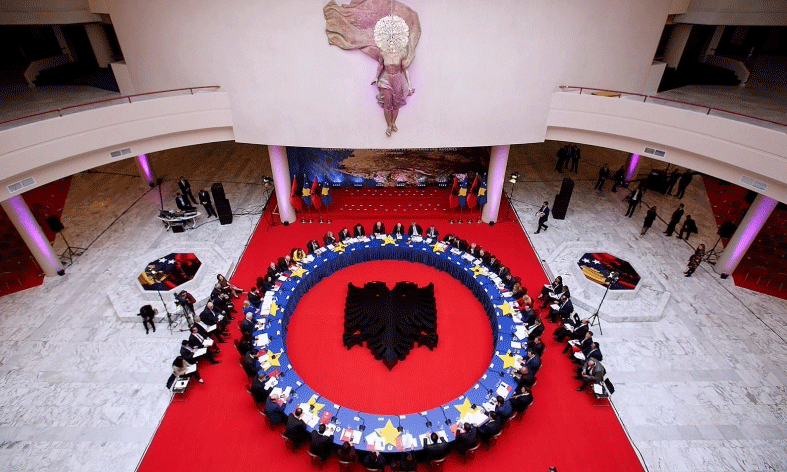
Joint meeting of the governments of Kosovo and Albania in Tirana, March 23, 2015. Photo: Albania’s Prime Minister’s Office
Arben Çejku, Albania’s former ambassador to Kosovo from 2005 to 2009, told Prishtina Insight that, while the 2014 joint government meeting was the first to be highly publicised by both governments and started a tradition of annual meetings, Kosovo and Albania have been signing deals since 1999, when Kosovo was under UN interim administration, UNMIK.
Kosovo was under the administration of UNMIK until February 2008, when it declared independence from Serbia.
Çejku pointed out that although the agreed normative acts provide the legal framework for bilateral cooperation, the officials of the institutions that signed them are not even aware of them.
“This has happened because of changes within the public administrations where public officials and experts have left their positions due to changes in party governance, as well as because of apathy and unjustified bureaucracies in certain sectors,” he says.
Tirana based economist Lindita Shala, told the local Albanian media ‘ABC news’ in June 2023, that despite the historic ties that exist between the two countries, there is a lack of political will to establish sustainable cooperation.
“I don’t believe that relations between Albania and Kosovo will fluctuate… Although businesses can often find a way, motivated by proximity and market opportunity, what matters most is joint integration,” she said.
Fast forward two years later, the situation has not changed. Prishtina based political expert, Dritëro Arifi, told Prishtina Insight that he believes that, “one of the areas still significantly lacking is deeper economic integration.”
Similarly, in a separate interview, Ukshini told Prishtina Insight that the two countries need political consensus in order to consolidate strategic sectors of the economy.
“We need to accurately identify the resources and potentials of each country, since you have certain resources and strategic sectors, so that we don’t invest in the same areas and end up competing with one another, and vice versa,” Ukshini says.
Identifying strategic sectors, according to him, does not mean adopting a planned economy, but rather focusing on the development of the most promising sectors in both countries, thus enabling joint growth and competitiveness in the regional or even European market.
Prishtina Insight contacted the governments of Albania and Kosovo for comment but did not receive a response by the time of publication.
Over the years, both Tirana and Prishtina have started parallel projects despite committing to joint initiatives to advance the economic collaboration between the two countries. For example, five years ago, on October 2, 2020, the governments of Albania and Kosovo, then led by Prime Minister Avdullah Hoti, signed 13 agreements. Among these was a commitment to cooperate in the advancement of railway transport. Two years later, in 2022, the governments prioritized co-financing a feasibility study for a railway connecting Durrës to Prishtina.
Nonetheless, on July 26, 2023, a separate public tender, worth 200,224,996 Albanian lek (around 2,050,728 euro), was launched in Albania for a feasibility study of the territory through which the railway would pass. According to public data from Open Procurement Albania, the project is expected to be completed by December this year.
Despite this unilateral move by Albania, PM Rama has hinted that he is looking for international investment to bring this project to life.
On May 24, 2024, in a joint press conference with the United Kingdom’s Foreign Affairs State Secretary, David Cameron, Rama also declared that there were discussions of “the involvement of the United Kingdom in a strategic project of particular importance for Albania, Kosovo, and the region, which is the Durrës-Prishtina railway.”
“This is a key element in the project to increase mobility capacities, not only between our two countries, but across the region and beyond, especially considering that we will soon launch the international tender for the new commercial port of Durrës,” Rama claimed.
One year later, on May 17, 2025, during the visit of French President Emmanuel Macron to Albania, Rama announced that discussions had taken place regarding the inclusion of French funding to implement this project.
Railway passenger transport in Albania and Kosovo has been largely neglected since the 1990s and experts say that the construction of a joint railway between the two countries would significantly contribute to economic mobility.
Former Ambassador Ukshini emphasizes that the construction of the railway plays an important long-term role, especially after the introduction of the €5 highway fee on Rruga e Kombit—the Albanian side of the Kosovo-Albania highway—,which mainly affects Kosovo citizens traveling to Albania.
“Undoubtedly, the Durrës–Prishtina railway would be beneficial, both in the field of transportation, as it would be safer, more functional, and more affordable, and in terms of trade exchanges, which would become more cost-effective. Goods will be loaded in Durrës [port] and then unloaded in Prishtina, hence avoiding high transportation costs,” Ukshini concluded.
Agreements not reflected in the economy

Head of Kosovo Chamber of Commerce, Lulzim Rafuna (C), in a meeting with Albania’s deputy Minister for Europe and Foreign Affairs of Albania, Besart Kadia (R), and Kosovo’s deputy minister of Diaspora and Foreign Affairs, Liza Gashi (L), February 12, 2024. Photo: Kosovo Chamber of Commerce Official Website
Thousands of businesses from Kosovo also operate in Albania and vice versa, but official data from both countries show that levels of trade remain unsatisfactory.
In February 2024, Lulzim Rafuna, chairman of the Kosovo Chamber of Commerce, claimed that, “over 1,287 Kosovo businesses [are registered in Albania] and 2,022 businesses from Albania are registered in Kosovo.”
Rafuna said this in a meeting in Prishtina with Albania’s deputy minister for European and Foreign Affairs, Besart Kadia, and representatives of business associations from Albania. He also emphasized that, “the potential benefits are endless for both parties… Therefore, the goal is an attractive market for both countries.” Kadia agreed with this statement.
He told Prishtina Insight that, nonetheless, investments from Kosovo to Albania are higher, than from Albania to Kosovo, mainly because of a not very secure business environment recently in Kosovo.
According to data from the Albanian Institute of Statistics, INSTAT, Kosovo was Albania’s second most important trade partner in exports in 2024. However, Albanian exports to Kosovo amounted to 36.8 billion lek (376.9 million euros) in 2024, a 9.8% decrease compared to 2023.
Imports from Kosovo in the same year reached 15.7 billion lek (160 million euros), marking a 33.55% increase compared to 2023, making Kosovo the tenth largest importer into Albania. t
However, according to data from Kosovo’s Agency of Statistics, ASK, Albania is Kosovo’s main partner in the Balkan region, accounting for 18.1% of total export activity in 2024.
Kosovo continues to be highly import dependentant, especially from neighbouring Serbia. According to former Ambassador Çejku, “Kosovo’s imports from Serbia continue to be significant, whereas imports from Albania remain modest and include only a limited number of items.” He also emphasized the importance of investing in joint economic strategies.
According to official Kosovo Customs data, imports from Serbia to Kosovo have doubled in the first half of 2025, reaching €110.53 million, a significant increase compared to €50.64 million during the same period last year.
Customs data for the period January–May 2025 confirm that Serbia has surpassed Albania in the value of goods imported into Kosovo. During these five months, Kosovo imported goods worth €75 million from Serbia, compared to €61 million from Albania.
Çejku told Prishtina Insight that incentives should be provided to attract businesses to make crossborder investments, taking as an example a case where a business from Kosovo has received a construction permit from Albanian authorities for a luxury resort in the northeastern coastal area of the country.
“But we must think and work harder on unifying our markets, our economies, and start planning for the next 50 years as if we are talking about one single economy and one common market!” he said.
Lack of monitoring mechanism
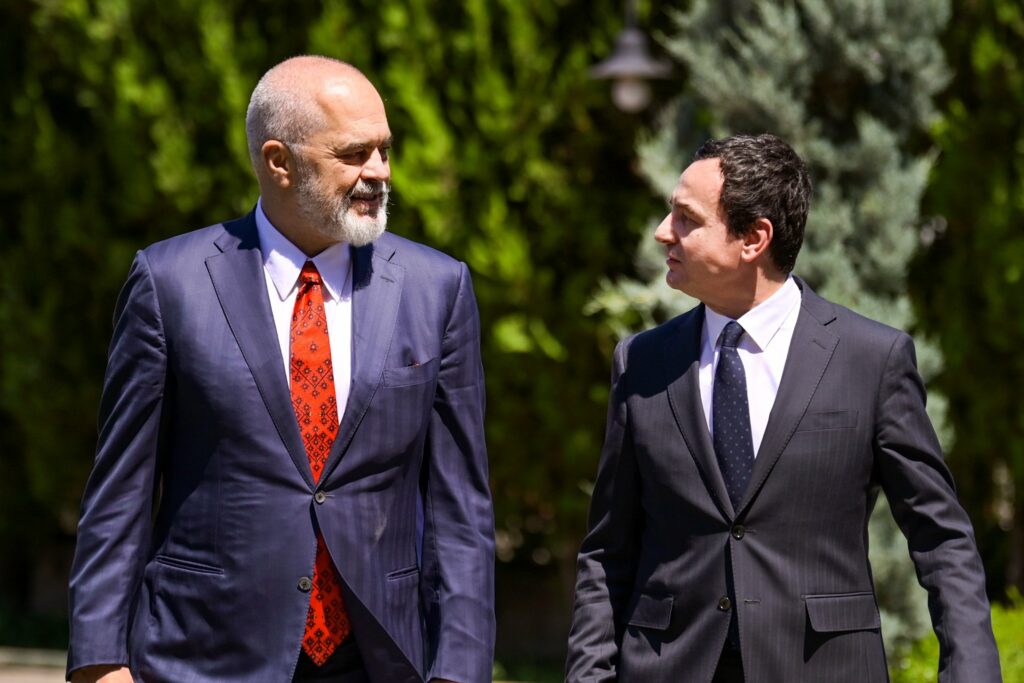
Illustration. Albanian PM Edi Rama (L) and Kosovo PM Albin Kurti (R). Photo: Kosovo Prime Minister’s Office
Hundreds of bilateral agreements, increasing annually by dozens, are forgotten soon after being signed. Experts blame the lack of a monitoring body for their implementation.
Arifi told Prishtina Insight that there is still no joint monitoring mechanism “that assesses the progress in each area and provides the necessary political momentum.”
Neither government has ever publicly suggested the creation of any such joint mechanism to ensure the implementation of bilateral deals. The creation of a joint Ministry of Culture was discussed nine years ago, with the aim of coordinating cultural policies between Albania and Kosovo. However, no concrete steps have been taken in this regard, either.
Former Ambassador Ukshini, also told Prishtina Insight that the creation of a joint secretariat, one that regularly reports to both governments, would play a crucial role in addressing obstacles when the implementation of agreements are stalled.
“It must report continuously, accurately, and precisely in order to highlight where the implementation of an agreement is facing obstacles. In other words, it should answer the question: which agreement is stuck, and why?” he concluded.