


Kosovo has become a safe haven for some Ukrainian reporters, who are continuing their work combating Russia’s disinformation machine from a distant land.
When Russia’s full-scale invasion of Ukraine began in February 2022, Ukrainian journalist Lyudmila Mekh packed her suitcase and fled Kyiv with her husband, fellow reporter Serhiy Shevchenko. Threats to press freedom and to their own safety made staying at home impossible.
Two weeks later, they landed in Prishtina, Kosovo, a country they had never visited before, but which would now become a temporary home where they could pursue their careers, thanks to a special residency programme.
Since March 2022, the couple have been in Kosovo as part of the “Journalists in Residence” programme, supported by the Kosovo government and the European Centre for Press and Media Freedom, ECPMF, which has hosted up to 20 Ukrainian journalists displaced by the war.
“Articles produced by journalists in residence are published for a wide Ukrainian audience – from ordinary citizens to senior representatives. In Kosovo, translations are also made available to local readers, including random citizens interested in developments from Ukrainian war and right information,” Mekh told BIRN.
Kosovars identify with Ukraine’s plight
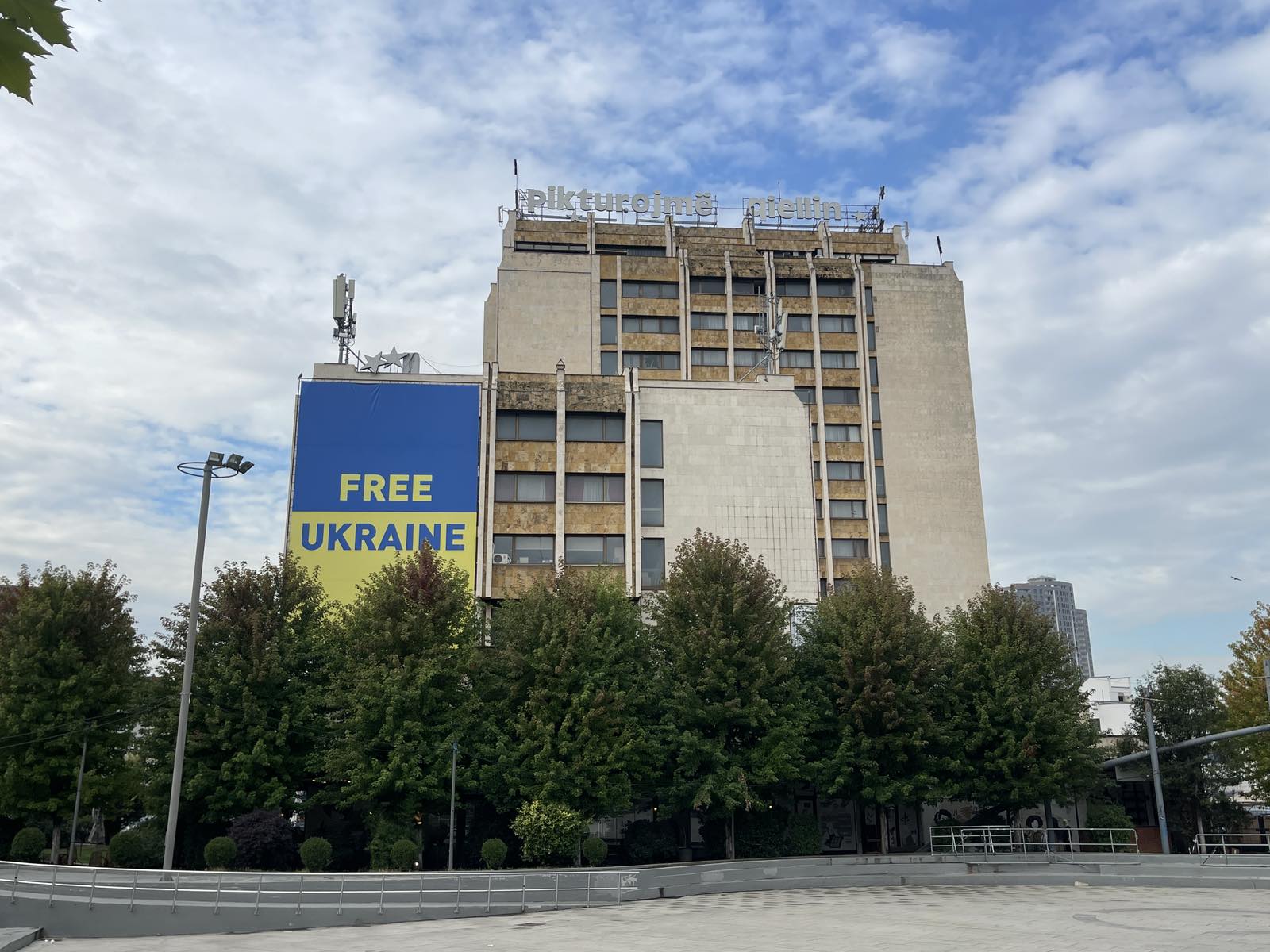
The Ukrainian flag bearing the slogan “Free Ukraine” displayed on the Grand Hotel building in central Prishtina. Photo: BIRN
For Kosovo, which emerged from its own brutal war in the late 1990s, the mission resonates. Getoarbe Mulliqi, executive director of the Association of Journalists of Kosovo, said local reporters see parallels between their past and Ukraine’s present.
“In a region where media coverage is divided along ethnic and political lines, these journalists provide clarity of facts, context and credibility,” Mulliqi told BIRN.
Kosovo has provided these journalists with more than just shelter. Through freelance work, government collaborations and partnerships with local media, such as GeoPost, Kosovo 2.0, and Reporteri, Ukrainian reporters have carved out a professional space for themselves in exile.
“These journalists fight Russian propaganda and promote accurate narratives about the war in Ukraine across the Western Balkans,” Mulliqi added.
The shared working space in Prishtina provided for them stands as both a protected environment and a pivotal point for reporting and writing news and combating Russian information warfare.
Their day involves researching Ukrainian and Western Balkan news, drafting reports in Ukrainian, Albanian and Serbian as well as participating in public events, with translations supported by the government-backed programme.
Mekh explained that Ukrainian journalists coordinate press coverage with the Association of Journalists of Kosovo, while also selecting issues that can be shared with the National Union of Journalists of Ukraine.
“The National Union of Journalists of Ukraine regularly publishes these reports on its official website, while the newspaper of the Federation of Ukrainian Journalists and the outlet Trade Union News also carry our work.
These platforms not only inform the public but also exposed and counter Russian disinformation on various topics related to the war,” Mekh explained.
Reporting from Kosovo has its challenges
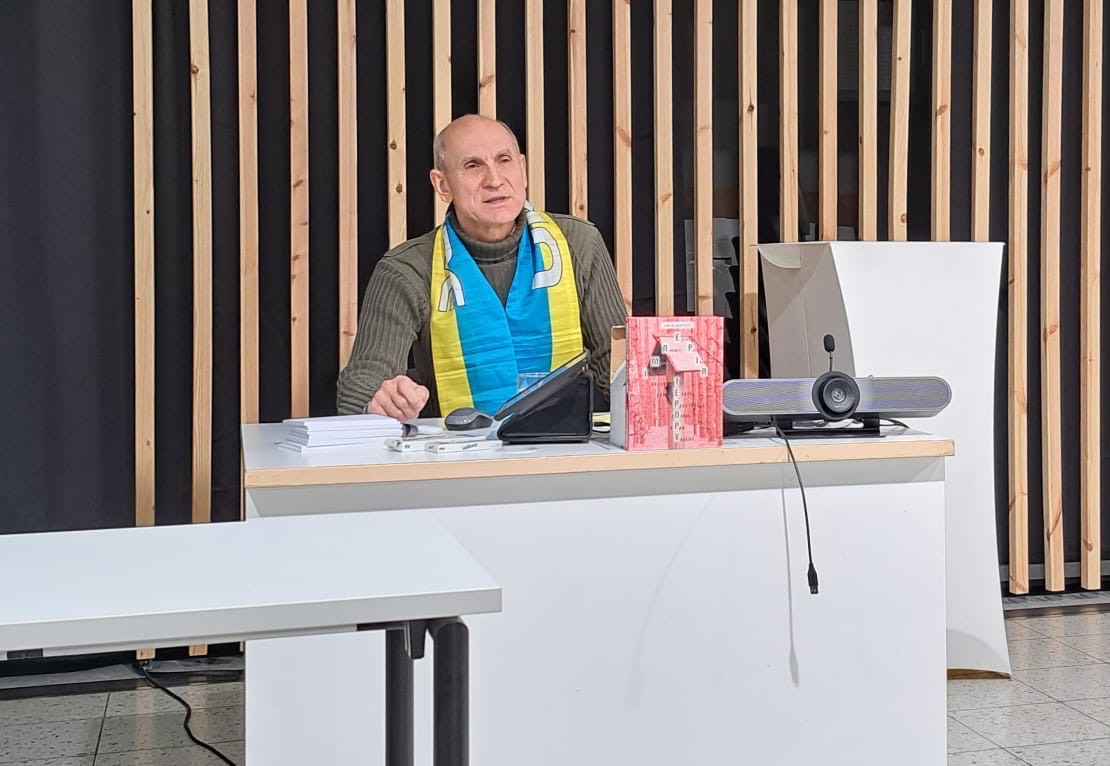
Ukranian journalist, Serhiy Shevchenko. Photo: BIRN
On paper, Kosovo offers something Ukrainian journalists cannot find at home: freedom to work without censorship or threats. But daily life is far from simple.
Language barriers complicate reporting and even basic interactions. Technical infrastructure is patchy. And the emotional weight of covering a war from afar is constant.
“Sometimes I receive a photo or video from the front line and must decide – will publishing this put Ukrainian soldiers at risk?” Shevchenko told BIRN. “That responsibility never leaves you, even from a distance.”
For Iryna Synelnyk from Kharkiv, who writes for both Balkan and Ukrainian outlets, separation is bittersweet. “Reporting from Kosovo helps citizens in frontline regions like Izyum stay informed,” she told BIRN. “At the same time, it educates Western Balkan audiences about the reality of the war and how to recognize propaganda.”
Other reporters highlight how exile gives them unexpected perspectives. Tetyana Kraselnikova, once a culture reporter in Kremenchuk, now deals with news assignments, such as painting exhibitions in Prishtina. For her, journalism abroad is both professional duty and cultural diplomacy.
Kraselnikova works as a contributor to The Geopost and Ukraine’s Kremenchukskaya Gazeta.
Kraselnikova believes Ukrainian journalists abroad, specifically in Kosovo, represent their country not only through reporting and writing news but also by showing its cultural and human dimensions.
“I want my voice to be heard and to have an impact through fact-based stories,” she said. In one of her recent articles, she highlighted Russia’s abduction of Ukrainian children and their deportation abroad.
Still, challenges remain: isolation, the cost of translations, and the strain of living in a small, politically fragile country. But, compared to the risks back home, most say the trade-offs are worth it.
“In Kosovo, I haven’t faced any problems preparing journalistic material, or reaching the audience,” Shevchenko said. “It’s a freedom my colleagues in Ukraine don’t always have.”
However, they sometimes have difficulty creating original content. “Many focus on specific topics assigned by editors back home,” Shevchenko explained.
On the frontline tackling Russian fake news
A person scrolls the screen of a mobile phone. Illustration: EPA-EFE/HARISH TYAGI
Moscow’s propaganda machine has long targeted both Ukraine and the Balkans, and Ukrainian reporters in Prishtina see themselves on that frontline too.
“Russian-backed networks invest heavily in fake news systems, especially in former Soviet countries,” said Mekh. “We track them by comparing narratives with verified sources, exposing the lies.”
Disinformation often arrives under sensational headlines – fabricated terrorist threats, false battlefield updates, or claims that Ukraine is a “failed state”.
Sometimes, attacks are personal. In 2023, Iryna Synelnyk, another Ukrainian journalist who resides in Kosovo, was targeted in a doppelgänger campaign: fake websites mimicking legitimate outlets published articles under her name that echoed Kremlin talking points.
“It was not just an attack on me. It was an attempt to undermine trust in Ukrainian journalism and manipulate the perception of Ukraine in the Western Balkans,” she told BIRN.
Across the Balkans, Russian propaganda takes familiar forms: portraying NATO as the aggressor, framing Ukraine and Kosovo as “artificial states” and casting Russia as the defender of Slavic and Orthodox values. Outlets like Sputnik Serbia, RT Balkan, and the Russian-language site Balkanist (Balkanist.ru) amplify these messages, often picked up by pro-Russian local media.
“Kremlin propaganda manipulates ethnic tensions here, just as it does in Ukraine,” said Kraselnikova. “While Albania, Kosovo, Croatia, and Montenegro support Ukraine, Serbia remains closely aligned with Moscow.”
Synelnyk said one persistent disinformation theme in the Balkans is the claim that NATO provoked the war in Ukraine through its “aggressive expansion”.
This narrative is pushed heavily on pro-Russian Telegram channels, such as Rezident and Legitimnyi, which repost doctored maps and misleading statements to blame the West rather than Moscow for the invasion.
“These Telegram channels often repeat the same narrative across dozens of anonymous accounts,” explained Synelnyk. “The goal is to sow distrust of NATO and the EU in both Ukraine and the Balkans, while portraying Russia as the victim.”
Despite the challenges, the journalists in Prishtina say their work is making a difference. Fact-checking projects, youth-oriented news, and public forums have built bridges with Balkan media.
“Ukrainian journalists in the region are critical voices in combating disinformation, bridging gaps, and fostering informed public discourse,” Adi Qaili, a journalist with ALSAT-M television in North Macedonia, said.
For Shevchenko, the struggle is bigger than any one article. “What happened in the past is still happening in Ukraine,” he said. “But like the Soviet Union before it, Russia will collapse under the weight of censorship and lack of freedom.”