

A young man from Prizren, currently living in Switzerland, has created the first physical Albanian language keyboard—AlbaType.
Urim Qovanaj, 30, remembers that the idea for the keyboard took shape in the summer of 2021, while he was on vacation in Kosovo, when a cousin asked him to proofread his thesis.
“I noticed something strange: wherever the letter ë was needed, he had typed the dollar sign [$]. At the end, using the Ctrl+H command in the Word document, he replaced all the $ symbols with ë,” Qovanaj recalled.
It is common practice for Albanian language speakers in professional and academic settings in the Balkans to substitute the letters of the Albanian alphabet missing from keyboards with symbols. This method, however, can sometimes prolong the editing process and even result in incorrect language use and wasted time.
Nonetheless, it is a rather “practical solution,” and the only one available. To Qovanaj, however, it looked “completely absurd.
“That’s when I asked myself: how is it possible that we still don’t have an Albanian keyboard?”
Inspired by this question, Qovanaj started researching the subject and discovered that no such keyboard had been developed: “Nowhere. Not in Kosovo, not in Albania, not online. So the idea came naturally: why not try to build one myself?”
This eventually led to the creation of AlbaType, the first physical keyboard using the Albanian alphabet.
From an idea to a startup
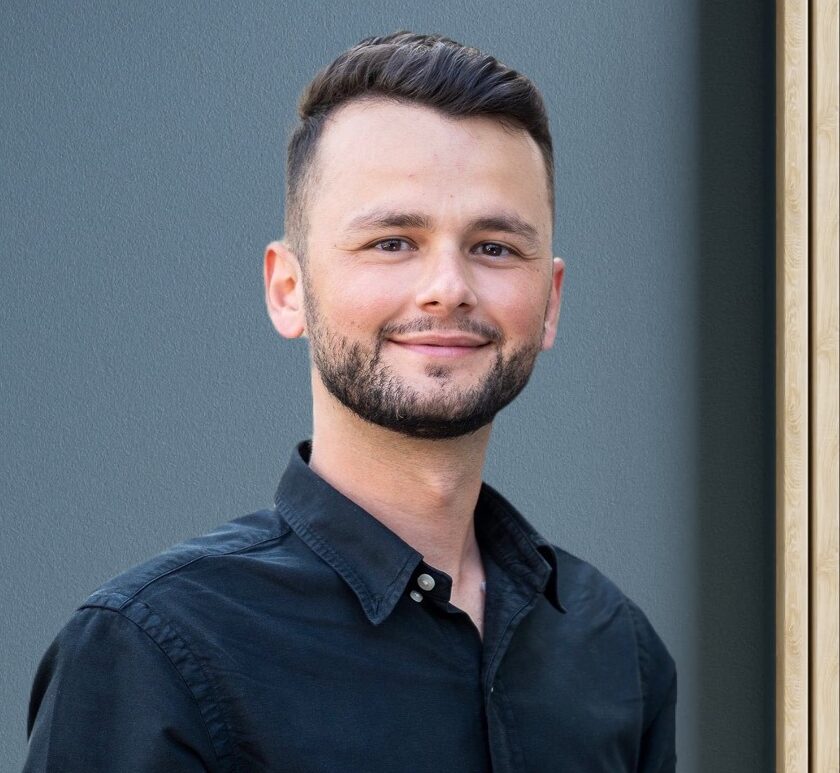
Urim Qovanaj. Photo Courtesy of Urim Qovanaj
Qovanaj was born in Kosovo, in the southern town of Prizren, where he lived until the age of 6. He then moved to and was raised in Italy. He now lives and works in Switzerland, where he completed his studies in engineering and bridge construction at the University of Bern.
Although he had the idea years earlier, he lacked the tools and experience to pursue it, “but the thought never left me.”
Years passed, he finished studies, gained experience in Switzerland, and began to take entrepreneurship more seriously.
By 2025, he managed to found the company AlbaType Ltd. in Prizren. Their first product, the Alba ONE-36, named for the 36 letters of the Albanian alphabet, is the first keyboard purpose-built for writing in Albanian.
The keyboard includes dedicated keys for the letters Ë, Ç, and even for the digraphs such as Dh and Sh, designed to make writing in Albanian faster, more natural, and more accurate.
“Language is part of our identity,” Qovanaj explained, adding that, “if we want to preserve it, we have to support it digitally.”
Alba ONE-36 is made for students, professionals, teachers, journalists, and anyone who wants to communicate naturally in their mother tongue.
“When the idea first came to life, we wanted to pair AlbaType with the slogan ‘Shkruaj shqip (Write Albanian)’ because our parents always told those of us who live abroad: ‘write/speak in Albanian.’” Eventually they landed on “36, si shkronjat e Alfabetit! (36, like the letters of the Alphabet).”
Growing up and living between Kosovo, Italy, and Switzerland helped him understand how essential language is to identity: “This keyboard has no borders, it’s made for every Albanian, wherever they live.”
Qovanaj even introduced the keyboard to the office of the acting Prime Minister of Kosovo, receiving positive feedback and interest. “His advisors contacted me back, and I gifted the keyboard to the Prime Minister after he invited me for a meeting.”
He emphasises that the long-term goal is to have Albanian keyboards placed in schools, public institutions, and workplaces.
“We don’t need funding,” Qovanaj stressed, but “we need visibility, distribution via market access and for people to know the keyboard exists.”
Manufactured in collaboration with a specialised keyboard producer in China, the AlbaType keyboard officially launched on September 20, 2025, with plans for a second model — the AlbaType TWO-36 — featuring an even more modern, wireless design. Currently, it sells for 49 euros online, in Gjirafa mall and at Altera Bookstore.
A much needed project
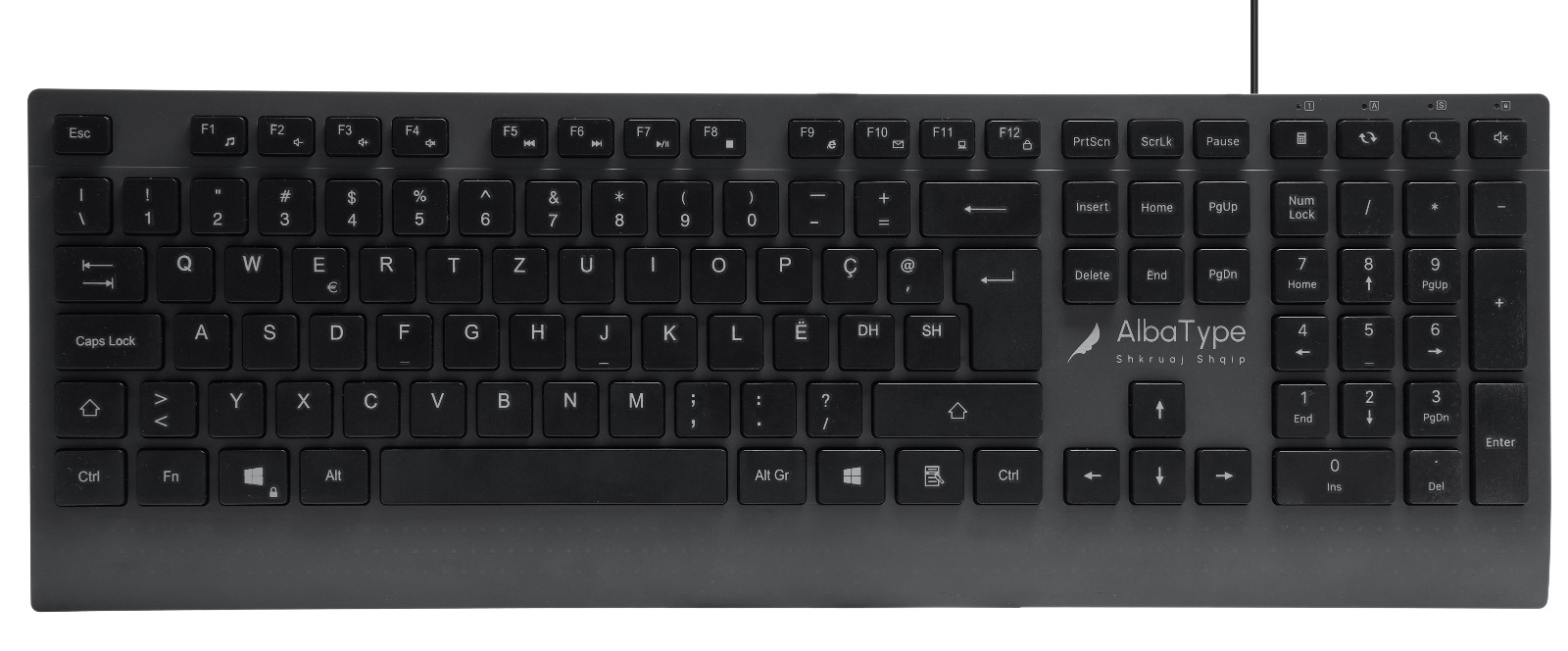
AlbaType keyboard. Photo courtesy of Urim Qovanaj
Rrahman Pacarizi, Albanian language professor at the University of Prishtina, highlights the linguistic impact of the missing ë and ç on keyboards when writing in Albanian.
“The lack of direct keys for the letters ë and ç, as well as their uppercase forms [Ë and Ç], causes considerable difficulties. Alternative solutions exist and the current Microsoft keyboard can be adapted, but wherever these letters are placed, other symbols, such as brackets or semicolons, are compromised.”
He adds that constantly replacing these letters can harm proper language use, since, “different phonemes end up represented by symbols instead of their correct graphemes.”
“Much of orthography is learned through exposure, and when texts do not accurately reflect the intended sounds, it can create confusion for readers who acquire spelling subconsciously,” he noted.
In a separate interview, Besnike Salihu, Editor at the local Albanian language media outlet Telegrafi, added that a keyboard of this kind “would greatly ease our work in the media,” noting the daily challenge of manually remapping symbols to substitute missing characters.
“I personally never rely on typing symbols and replacing them later. Instead, I reassign symbols I rarely use, like turning { into ë and } into ç.”
Meanwhile, Durim Lika, Albanian Language and Culture Instructor in Parma, Italy, points out that most Albanians abroad use foreign keyboard layouts, making essential letters difficult to type.
“Albanians use the keyboard layout of the country they live in, American keyboards in Kosovo and Albania, or other layouts abroad. This makes writing ë and ç difficult.”
He believes the governments of countries where Albanian is an official language, such as Kosovo and Albania, should mandate Albanian language keyboards, since the language option already exists on all computers.
Lika also warns that adopting a new keyboard like AlbaType may bring technical challenges: “I’ve worked in IT for almost 30 years, and a keyboard like that may cause compatibility issues unless integrated properly with software.”
“Other problems may come up. The keyboard needs to be controlled through software, where the settings need also to be set up. It might not be practical …especially for Albanians living abroad in countries where Albanian is not spoken.”
Qovanaj acknowledges that “there may not be that much interest abroad,” but his intention was to offer this keyboard to public institutions, the media, and schools. Its further distribution will then depend on sales and demand.
Moreover, AlbaType’s website has step-by-step guides on how to configure the software for Windows and Apple devices.
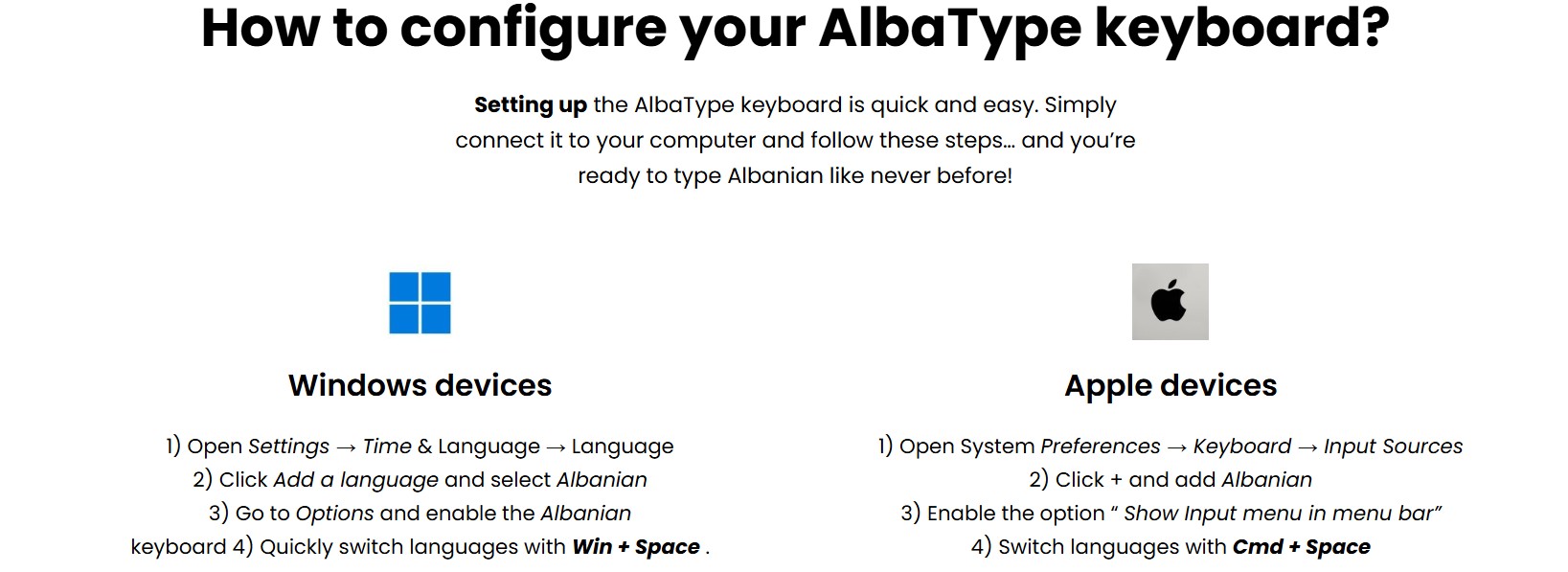
Qovanaj explained that the Alba ONE-36 had been tested by 20 users to ensure easy adaptation. “The placement of additional letters is the same as in applications and phones when you [manually] turn the keyboard to Albanian.”
Meanwhile, Lika believes the keyboard is especially important for children in the diaspora: “Through my lectures, I’ve noticed major gaps in knowledge of letters like ë and ç.”
According to him, “a legal, officially supported Microsoft Albanian keyboard is what we truly need, and that is something the government must push for.,”
For Qovanaj, AlbaType is more than a tool, it is a cultural statement.
As he puts it, “language is preserved where it is written.”
The author of this article used the commands alt137 for ‘ë’ and alt135 for ‘ç’.