


As part of its second Reporting House museum, BIRN is chronicling the testimonies of Kosovo Albanians who found refuge in North Macedonia after being forced by Serbian forces to flee the country in 1999, in trains.
Gentrit Hykolli from Drenas vividly recalls how in 1999, when he was only 6 years old, he and his family were forced onto a train by Serbian forces and expelled from Kosovo.
In 1998, “we first found refuge in the mountains, in shelters in the surrounding villages, at times we returned [home], and we were expelled [again]. Then we transferred in Sllatina [a village some 25 km west of Prishtina] at some relatives’ house and from there we moved in with the family of Ramadan Mehmeti in the ‘Kodra e Trimave’ neighbourhood of Prishtina,” he told Prishtina Insight.
Soon, the Mehmeti family decided to flee by car and invited Hykolli’s family to take a second car and go with them. “I remember that the car would not turn on and we got stuck there. The car would not turn on. The entire family went on foot, like everyone else.”
Serbian forces led Hykolli’s family and the rest of the refugee column towards the Prishtina train station.
“We got on trains. All seven members of my family were in the same cabin. We had no idea where we were going, if we were going to Serbia, Albania, or Macedonia,” he recalled.
Hykolli voluntarily participated in a series which chronicles the lives of Kosovo citizens who fled Kosovo on trains during the 1998-99 war. The chronicles will be part of a second exhibition put on by BIRN’s Reporting House museum, in Kosovo’s capital Prishtina, which provides evidence of the Kosovo war as reported by journalists, experienced by citizens, and seen by artists.
Hykolli will never forget how the train stopped in Lipjan for several hours and his father was forcibly separated from the rest of the family. “The train was stopped there for maybe around seven hours and we did not know where they sent him and if we would see him again. The best moment of my life was when my father returned there, alive.”
Fortunately, Hykolli’s father was not tortured, at least that is what he told his family.
The train sent the ethnic Albanians to North Macedonia. “I remember that our welcome was impressive and we will always be grateful for the way families in Struga, Macedonia welcomed us.”
According to refugee testimonies shared with the BIRN team in preparation for Reporting House 2, when the passenger railcars were full, refugees were also transported in livestock and cargo wagons.
The making of a war remembrance museum
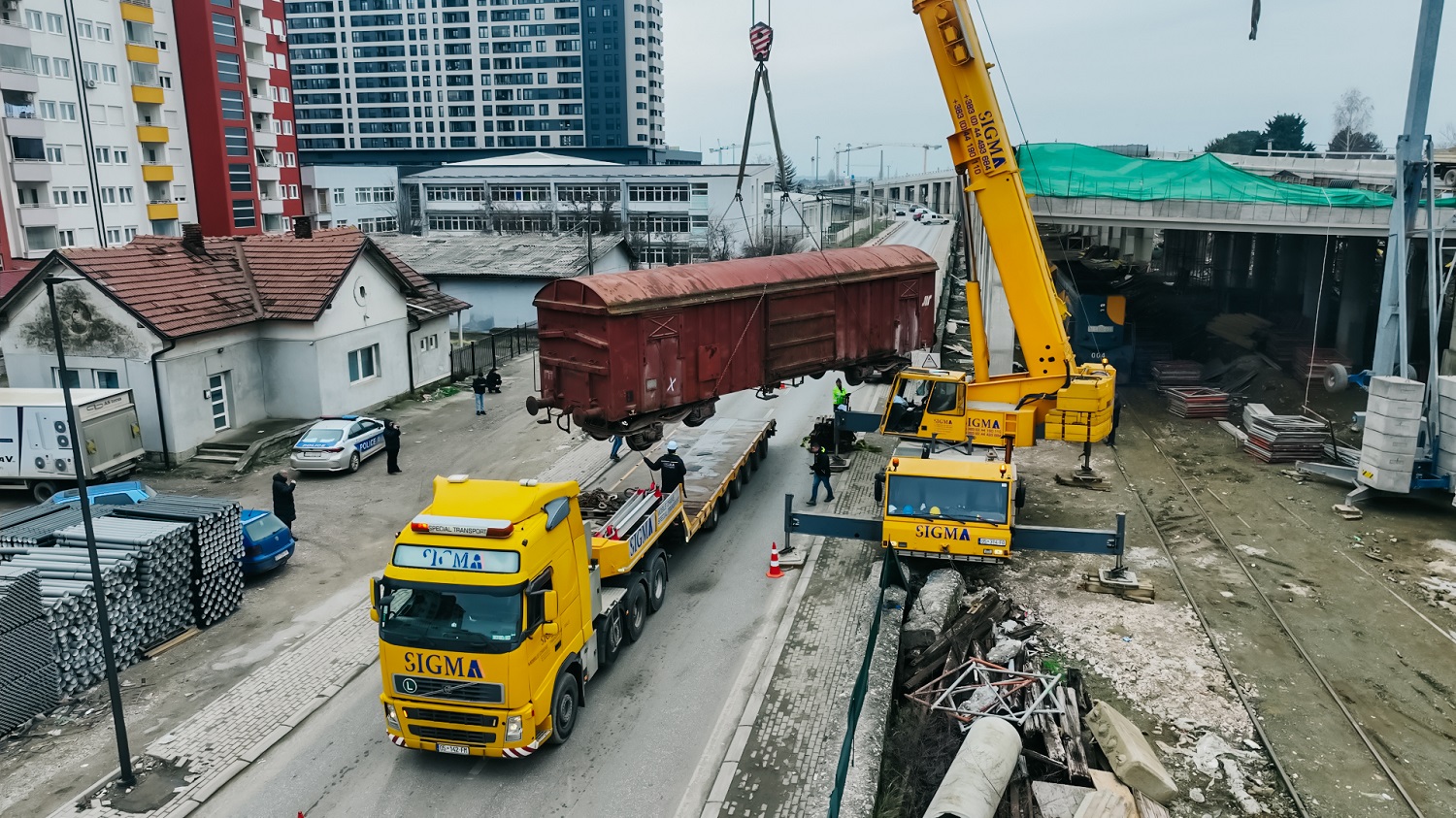
The process of transporting the wagon that carried refugees from Prishtina in 1999. This wagon is being transformed into the ‘Reporting House 2’ museum. Photo: BIRN
On Saturday, January 17, 2026, the cattle wagon that had carried refugees from Prishtina to Blace, North Macedonia in 1999—when Serbian forces began the mass cleansing of the urban population of Prishtina by train—was transported to the second location of BIRN’s Reporting House museum.
The initiative of two non-governmental organizations, BIRN and Prishtina Biennale, to transform the cattle wagons into the new Reporting House 2 museum, aims to preserve the collective memory of the exodus that happened from March to June 1999.
The logistical operation was supported by the public enterprises Infrakos and Trainkos, which were coordinated by the Kosovo Ministry of Economy. Other partners include the municipality of Prishtina—from where the deportation of refugees by train in 1999 began—and the municipality of Hani i Elezit—which is working on a new museum in the village of Bllacë and through which more than 400,000 refugees passed during the NATO bombings.
At first, Jeta Xharra, BIRN Kosovo director and producer of the Reporting House museum, “was worried about whether we would be able to load a heavy cattle wagon from the railway tracks onto a truck and then unload it again at the site designated for the museum without logistical problems. Therefore, I am extremely happy that this was completed without any obstacles, because all the organizations that were supposed to assist us today did so with a high level of professionalism and without any compensation.”
The curator of the Reporting House, Gazmend Ejupi, who is also the founder of Prishtina Biennale, began conceptualizing the appearance of the wagon as early as one year ago.
“We aim to open the museum in the spring of this year, and until then we will work on creating the gallery inside the wagon, where visitors will be able to watch the interviews we have collected while researching. We have designed the concept of what the space inside the wagon will look like, as well as the exterior and the surrounding environment here at the train station,” Ejupi said.

The wagon used by Kosovo Albanian refugees in 1999 being transformed into BIRN’s Reporting House 2. Photo: BIRN
Getoar Mjeku, Deputy Minister of Economy, and Përparim Rama, Mayor of Prishtina, were also present.
Mjeku, who spent several hours monitoring the operation, said that Kosovo has experienced several expulsions of its population throughout many periods of its history, starting from the late 18th century onward, and consequently it is extremely important to preserve the collective memory of the most recent cleansing in 1999.
“Our Ministry has supported this museum by coordinating two public enterprises that provided their organizational and logistical contribution to this project, Infrakos and Trainkos,” Mjeku said.
Rama explained that out of many proposed locations, the site at the train station was precisely the most appropriate place for such a museum.
Following the successful transportation, “I call on other artists to propose installations in other parts of the city, because as long as I am here—for the next four years—I am interested in opening the doors to art and culture, as I have done by creating new spaces for art, such as the Galeria e Qytetit City Gallery, Bunkerat (Bunkers) and the Reporting House,” Rama said.
The transport of the train wagon, carried out without any compensation, was handled by the company Sigma, which specializes in operating the most advanced cranes in Kosovo.
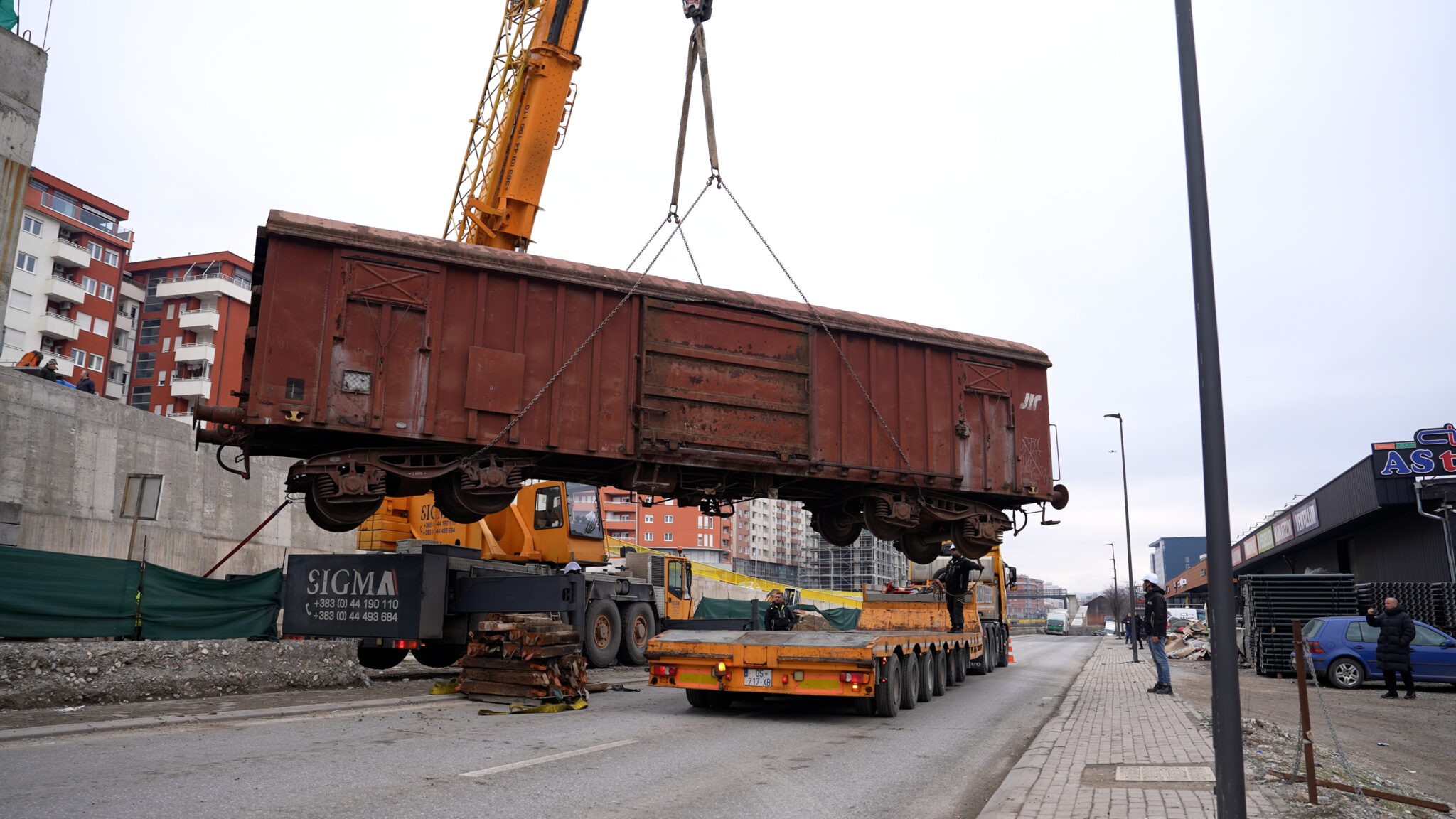
The process of transporting the wagon that carried refugees from Prishtina in 1999. Photo: BIRN
Similarly, Limit Project contributed by providing gravel and laying it in the area where the tracks for the museum were to be installed.
Meanwhile Sharcemi is a company supporting the project through collecting the materials that will be exhibited in Prishtina, but also on a much larger scale and in a much bigger space in Hani i Elezit.
Bajram Sylejmani, co-owner of Sigma, the company that managed the cranes, explained that he was two months old when his family was expelled by train.
“There were many members of our family who were expelled from Lipjan and we got on the train. I was very young so of course I don’t remember much, but today I am extremely happy that my family has unanimously decided to support the initiative to create the museum. Everything we have, we will give to this place, least of all our machinery,” Sylejmani said.
Naser Krasniqi, CEO of Infrakos, the public enterprise that manages the railway service, has been working for the past four months to complete the procedures for designating the cattle wagon for the museum and installing the tracks. He has been present throughout the entire operation.
“We, as a team, have contributed wholeheartedly to the allocation of space and the logistical organization for placing the foundations of this wagon. But this wagon is not just an object. It is a testimony. A living museum of memories that we dare not forget. It is the voice of those who left in tears, of the children who cried, of the parents who kept their families alive solely through the conviction that they would return,” Krasniqi said.
“As CEO, but above all as a human being, I am extremely honored that we had the opportunity to contribute to this work of remembrance. This is our moral duty: to preserve history, to educate the younger generations, and to ensure that no one ever experiences such a tragedy again,” he said.