


Kosovo PM Albin Kurti first came to power in a landslide win in 2021, thanks to the strong alliance he formed with current President Vjosa Osmani. Over the years, power struggles and different approaches to international partners seem to have driven a wedge between the two.
Kosovo’s President Vjosa Osmani and PM Albin Kurti, who five years ago were being tattooed on the bodies of their supporters as a perfect tandem, are no longer what they once were, nor what their admirers want them to be. Over the years, the political idyll between them faded and the growing rift could no longer be hidden from the public eye.
While Kurti was experiencing a period of isolation from the decision-making centres in Europe and the United States, because of decisions affecting the interests of the non majority ethnic Serb community, doors were open everywhere for Osmani.
In June 2023, the EU imposed restrictive measures on Kosovo after failure to de-escalate tensions in the country’s Serb majority north. Violent protests erupted in the three Serb majority municipalities Zvecan, Leposavic, and Zubin Potok after the newly elected ethnic Albanian mayors took their oaths in May 2023, following elections that Serbs had boycotted en masse. The violent protests resulted in over 90 soldiers from the NATO peacekeeping missions in Kosovo, KFOR, being injured and/or wounded, as well as Kosovo policemen being injured, and dozens of attacks against journalists. The EU measures were lifted only in December 2025.
In September 2025, the US halted the so-called strategic dialogue with Kosovo, that aimed to strengthen economic and diplomatic ties for the benefit of the American and Kosovan people. At the time, the US Embassy in Prishtina, announced that it made this decision “due to concerns regarding the actions of the incumbent government [led by Kurti], which have increased tensions and instability, limiting the ability of the United States to work productively with Kosovo on shared priorities.”
During this period of EU sanctions, and after the US government halted its strategic dialogue with Kosovo, Osmani maintained communication with international partners. It was not easy for Kurti to accept being sidelined during this period.
Is Osmani’s future in Kurti’s hands?
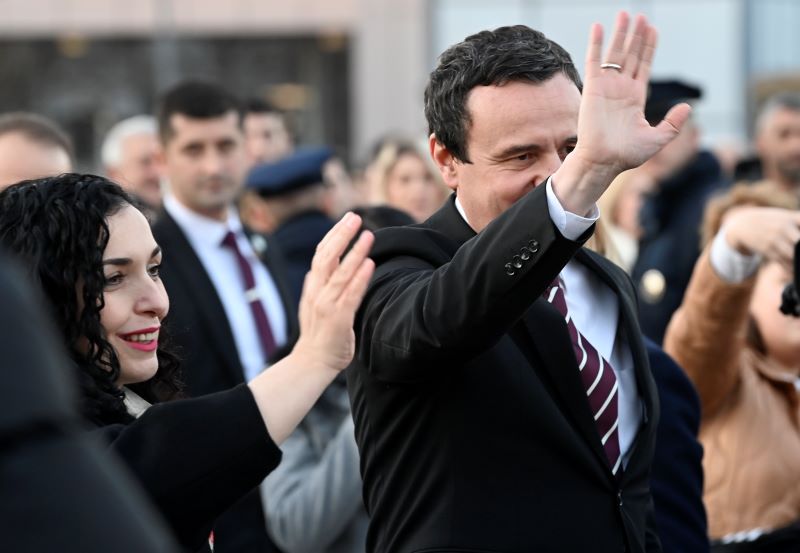
Kosovo President Vjosa Osmani (L) and Kosovo Prime Minister Albin Kurti (R) on the occasion of Kosovo’s 15th independence anniversary in Pristina, Kosovo, 17 February 2023. Photo: EPA/GEORGI LICOVSKI
The international community’s focus on the president of the state, especially with the recent signing of the Peace Board Charter, founded by US President Donald Trump, openly revealed Kurti’s indifferent approach.
The rift between the two officially started in November 2024, when in her annual address to the Parliament, Osmani, referring to Kurti, said that, “you don’t gamble with the internationals.” The blow appears to have caused wounds that do not heal easily, considering that Kurti did not even welcome Kosovo joining the Peace Board, whose charter was signed by Osmani—as even the leaders of opposition parties did—and only responded when journalists prompted him on January 30, 2026.
Nonetheless, Kurti, acting PM at the time, avoided giving a direct answer as to why he had not expressed any public position since the signing of the Board of Peace Charter, one week prior by President Osmani. He told the media that, “whenever there is a need for peace in the world, we want to contribute.” Kurti emphasized that Kosovo has supported Gaza in various ways, including participating in the International Stabilization Force and allocating half a million euros in humanitarian aid. According to him, Kosovo is now interested in participating in the decision-making bodies.
However, the tables have turned. Over one year after Osmani’s November 2024 parliament speech, the future of Osmani’s presidential bid is now in Kurti’s hands. He controls the parliamentary majority, after his party, the Vetevendosje Movement, LVV, won the December 28 parliamentary elections, and consequently, the fate of the presidential mandate. By not formalizing support for Osmani’s second term, he keeps her in political uncertainty regarding her presidential future.
Osmani may hope for Kurti’s backing until the very last moment, but she has already received the message that she is not the top priority. Kurti, the leader of LVV, which also has in its ranks MPs from the GUXO (Dare) party, founded by Osmani herself, stated publicly that his preferred presidential candidate is Murat Jashari, a university professor from the emblematic family of Adem Jashari, Kosovo’s hero and founder of the Kosovo Liberation Army, KLA. The Jashari family is revered in Kosovo, after 59 people of his close and broad family, including Adem Jashari himself, were killed in an assault by Serbian police from March 5-7, 1998, in the family compound in the village of Prekaz.
Murat Jashari, however, declined the proposal. Whoever is next proposed by Kurti for president would be a backup card. Whether Osmani will accept being Kurti’s second or third option will be seen no later than March 5, the deadline to elect the new President.
Kurti knows that Osmani currently lacks the power to challenge him from within, even with the MPs from GUXO, because her relations with the party’s chairwoman Donika Gërvalla, former minister of foreign affairs, have long been strained. Their animosity escalated further when Gërvalla wrote a letter to the Council of Europe, committing to drafting a statute for the Association of Serb-Majority Municipalities without coordinating with Osmani. The two traded barbs using lyrics from local pop star Dafina Zeqiri. Gërvalla dismissed Osmani’s reaction as “Llafe-llafe” (tittle-tattle), while Osmani replied by calling her “mjeshtre e mashtrimit” (mistress of deception).
Although Osmani’s name has not yet been ruled out as an option, it seems as though Kurti is trying to humble her before guaranteeing his support. Kurti appears to be aiming for a model of political dominance—akin to that of neighbouring Albania’s PM Edi Rama—where his position and authority overshadow those of the president. Simply put, he wants Vjosa Osmani to resemble Albania’s President Bajram Begaj, who despite the powers granted to him by the Constitution of Albania, remains in Rama’s shadow.
Critics of Osmani’s alleged support toward Kurti

Kosovo President Vjosa Osmani in a press conference on November 20, 2025. Photo: Screenshot from Kosovo’s Presidency.
Despite her relations with the partners alongside whom she won the 2021 elections, which are sometimes good and sometimes strained, Osmani has been continuously criticized by opposition parties for allegedly acting as Kurti’s subordinate. She is repeatedly reminded of the dismissal of the Central Election Commission’s, CEC, former president Valdete Daka in June 2021 after the CEC did not certify Kurti as a MP candidate because of a legal interpretation that persons who were convicted in the last three years could not run for PM. Kurti and some other LVV MPs had been found guilty in 2018 for throwing tear gas in the parliament. In her decision to dismiss Daka, Osmani said that, “the CEC chairperson, in many cases, has failed to be an independent force against political polarization and to ensure that her decision-making is guided by the general public interest, which has consequently undermined the integrity and trust of citizens in the CEC.”
Osmani has also been criticised of making decisions in Kurti’s favour after refusal to decree Blerim Isufaj as Chief State Prosecutor, and last year the appointment of Glauk Konjufca, current minister of foreign affairs and deputy PM, as the second mandate-holder to form the Government in 2025, after Kurti’s proposed cabinet had failed. Konjufca’s proposed cabinet also failed, leading to the December 28 elections. Osmani was also criticised for calling the early elections for December 28, a date that was claimed to suit Kurti most, due to the support of the diaspora who mainly travel to Kosovo for holidays at the end of the year.
Now, as we are counting down the last days until the constitutional deadline for electing a new president of the state, or even the possible re-election of Osmani, no candidacy for the highest state office has yet been formalized. The second biggest party, the opposition party of the Democratic Party of Kosovo, PDK, insists that the presidential candidate should be theirs but has not put forth a candidate. The third largest party, the opposition party of the Democratic League of Kosovo, LDK, seeks a political agreement with Kurti, but has not disclosed the details of any agreement to the public.
Considering these circumstances, and the lack of candidates proposed by the parliamentary parties, other proposals or self-declared candidacies emerge. However, for no parliamentary party to put forward a name for president, even though they claim they will do so, is not serious. Presenting candidates would ensure fair competition and consequently a quorum for voting in the Parliament. If in the first two rounds no candidate secures 80 votes, it is certain that in the third round Kurti’s proposed candidate would be elected with a simple majority.
There has never been a president liked by everyone and it is illusory to claim that such a figure will be found now. But citizens should—and have the right to—know who may potentially come to lead the state. Kosovo cannot afford new crises. It needs a president who represents the state with dignity in the international arena, a president who preserves good relations with international partners, a president who does not inflame internal political relations, and who has a clean record.
However, the presidential card is up Kurti’s sleeve. To project the image of a strong player, he is waiting to place it on the table at the decisive moment.
Agron Halitaj is the political editor at BIRN Kosovo and Internews Kosova’s co-publication KALLXO.com.
The opinions are of the author and do not necessarily reflect the views of BIRN.