


In early April, demonstrations by ethnic Albanian students in North Macedonia called for their legal right to take the bar exam in Albanian to be respected. It highlighted how discriminatory practices by the North Macedonian authorities disadvantage Albanian speakers, because they are not tested in their native language.
In the early twentieth century, intelligence testing gained widespread prominence in the United States and across the Western world. They divided people into the smart and the stupid, and the ‘stupid’ people carried that label for life. In 1951, Natalie Darcy concluded that intelligence testing in the United States historically produced biased conclusions, often indicating that immigrant and bilingual children were less intelligent than monolingual English-speaking peers. At that time, Italians—the largest group of immigrants in the USA—were considered more ignorant than the English-speaking population. Even nowadays, people continue to be sceptical about whether or not their children should be raised as bilingual. Darcy noted that the cause of this ‘intelligence gap’ lay in standardized tests that tested bilingual children in a language they were not completely fluent in.
Seventy years later, in 2023, Jennifer Matschey further explained that in the 20th century many bilingual children from minority groups were tested in their non-dominant languages, resulting in lower performance. Basically, the problem was in the tests themselves. The tests were in the English language, but they were assessing the intelligence of Italians and other immigrants who lacked the needed competence in this language. Consequently, these tests produced discriminatory results.
While these studies analyse the US over the last century, ethnic Albanians in North Macedonia are experiencing the same linguistic discrimination now. Hundreds of students from the private South East European University and the public University of Tetovo attended demonstrations in North Macedonia’s capital, Skopje, on April 6, demanding that the bar exam be held in Albanian and calling for the full implementation of the Law on Languages and the Constitution of North Macedonia. According to North Macedonia’s Law on Languages, Macedonian and Albanian are both official languages, including in central state institutions and in education, science, healthcare, and other sectors.
Protesters held banners with inscriptions like, “Respect the Law on Languages,” and, “STOP Institutional Discrimination.”
By insisting that ethnic Albanians and other ethnic minorities take the test in Macedonian, which is their second language, the North Macedonian state is ensuring that non-Macedonian candidates do poorly on the test. It may be that the authorities place greater emphasis on proficiency in the Macedonian language in the exam, but this places candidates whose first language is Macedonian at an advantage.
In principle, this approach may disadvantage other ethnic communities, like the Albanians. The test becomes one of linguistic competence, rather than a measure of subject-specific knowledge required for a regulated profession.
Testing ignorance, not knowledge
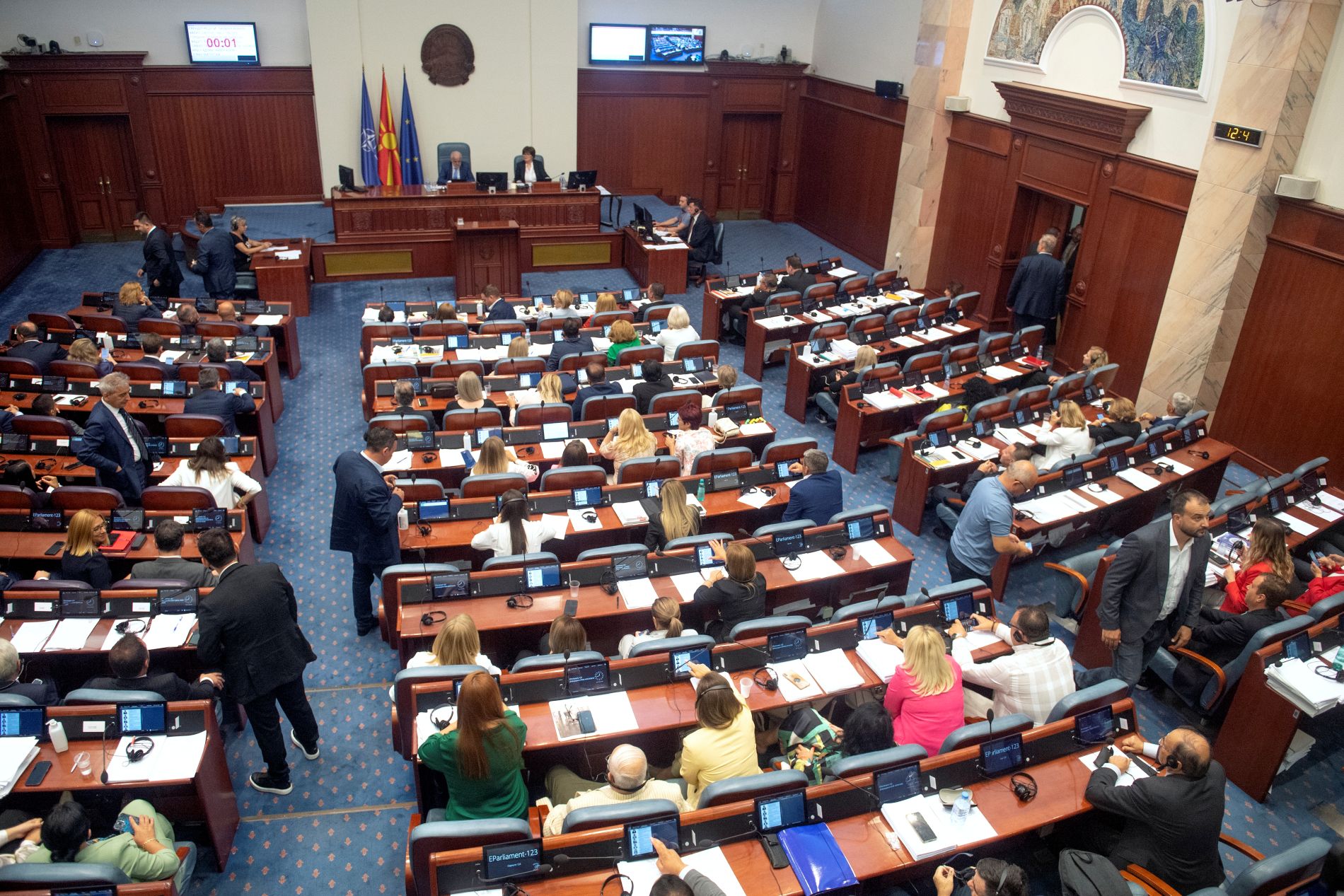
North Macedonia’s Parliament during the session for the constitutional changes in Skopje, Republic of North Macedonia on August, 18 2023. Photo: EPA/GEORGI LICOVSKI
The 2022 population census in North Macedonia concluded that there are 1,836,713 people living in North Macedonia, of whom 58.44 per cent are ethnic Macedonians and 24.3 per cent are ethnic Albanians. These figures show that over 40 percent of the population in North Macedonia are negatively affected by this language policy.
According to North Macedonia’s law on languages, any language of an ethnic group that comprises 20 per cent, or more, of the population is an official language of the state alongside Macedonian. This makes Albanian an official language of the state. Nonetheless, the law is not always properly implemented. Therefore, ethnic Albanian students and members of other ethnic communities often have to study in Macedonian, or underperform in state exams, because there are no examinations in Albanian for various state exams in regulated professions.
In practice, it could be said that, as the test is conducted in a non-native language for many candidates, it does not assess subject-specific knowledge but rather tests their ignorance of the language. A test in a foreign language is a discriminatory state measure, and as such, it fails the key internationally accepted criteria of test validity and reliability. It should not be accepted, as doing so would amount to discrimination through its use.
Learning in a second or third language is another issue. Attending lectures in a foreign language can be helpful because, through understanding, one can learn and expand their field of knowledge. However, in order to be tested, the acquired knowledge must be tested in the native language.
As is the case with any second or third language, the later a person begins learning it, the less they tend to absorb, and the less fluent their performance on tests in that language is likely to be, regardless of effort or learning ability. In a chapter of Language acquisition by Eye, Jill Morford and Rachel Mayberry note that, “individuals exposed to language at earlier ages consistently outperform individuals exposed to language at later ages for first and second languages of both signed and spoken languages.”
In fact, relevant research proves that performance in a high-stakes second or foreign language test goes to the detriment of such test takers. Glenn Fulcher, in the 2010 book Practical Language Testing, states that, “studies in educational measurement and applied linguistics have identified significant disadvantages for non-native speakers taking high-stakes, regulated professional exams in a second language. These studies often indicate that test results may reflect English proficiency rather than professional competence, leading to lower pass rates, increased anxiety, and unfair career barriers.” Similarly, in 2006 Janet M. Hostetler stated that, “advocates are concerned that English Language Learners (as a foreign language) tend to do worse on the high-stakes Regents exit exams, and that the adverse consequences of poor performance on these exams create counterproductive pressures for students and schools.”
Therefore, even beyond the legal provisions, every important test of knowledge and intelligence in a second or foreign language—like the qualifying tests for a regulated profession in North Macedonia—is in principle designed, planned, and dedicated to measuring ignorance of a language and not subject-specific knowledge.
Young people in North Macedonia who oppose this form of testing have a full scientific and legal basis to challenge it. In fact, the authorities have no right to offer a test that is discriminatory in essence—one that is non-evaluative and does not function as a genuine test of knowledge. .
Xhavit Rexhaj is a professor at AAB College and University of Prishtina. He teaches learning theories, education policy, and management of education institutions. His PhD, postdoctoral studies, and research focus on education and the development of children and youth. He has published articles, monographs, handbooks, and a book in the field of research and practices aimed at improving participation and quality in education. Recently, he has been involved in research projects related to the efficiency and effectiveness of the education system. He has served in various agencies, government institutions, and professional associations in the field of education and science.
The opinions expressed in this article are those of the author and do not necessarily reflect the views of BIRN.