


Letters exchanged between Fehmi and Xheve Lladrovci in the 1980s, while Fehmi was serving a prison sentence as a political prisoner, are now on display at an exhibition in Prishtina’s Reporting House museum.
On a midsummer’s day in June 1987, one of the inmates in the notoriously harsh prison at Stara Gradiska, in ex-Yugoslavia, wrote a letter from the cramped detention cell he shared with more than twenty other prisoners.
“My hope, Xhevë!
Your letters give me hope, light, courage, and love for life and for the days to come. I eagerly await your letters, where I nourish the feelings, virtues, and highest ideals of the person closest to my heart, mind, and soul.”
An Albanian political prisoner from Kosovo, Fehmi Lladrovci was serving a ten-year sentence for participating in illegal pro-Albanian rights movements, and he and his new fiancé Xheve Krasniqi, to whom he had been engaged for little more than a month when he entered prison, wrote to each other constantly during his detention.
“In your letters, dear XHEVË, I find everything I’m missing,” he wrote in another letter, “ you put the pure language of the mind and of sincerity so beautifully on paper, and you touch upon and address every point so wonderfully that I can hardly believe it, as if we had one head, one tongue, and one soul.”
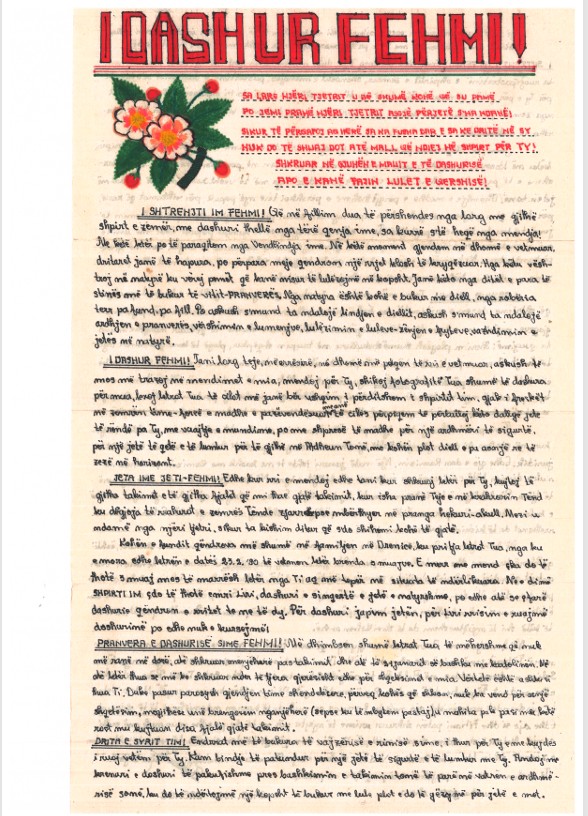
Letter written and designed by Xheve Lladrovci Krasniqi
Forty years after the letters were written, they have now gone on public exhibition for the first time at Reporting House, the idiosyncratic and charismatic museum of journalism at war, of Kosovo’s modern history and of contemporary art in central Prishtina. It is produced by the journalist Jeta Xharra of Balkans Investigative Reporting Network and curated by Gazmend Ejupi of Prishtina Biennale.
Written by hand and often lavishly embellished with drawings, the letters between Fehmi and Xheve Lladrovci do not just look beautiful but their contents, their lyrical lines, are endearingly and enduringly romantic. He had offered that they would remain friends while he was in prison: she promised to wait for him. A graduate in Albanian language and literature, Xheva was a natural writer and a natural narrator.
“My brave Fehmi!” she wrote on the 16th September 1987,
The current of my feelings came into contact with yours very quickly. You urge me to write even about the smallest things so I can free myself from this current that constantly overwhelms me. I was so happy that you could penetrate to the deepest depths of my heart. It truly is as you wrote. The love in my heart grows day by day.”
Their very special exchange of letters and correspondence started during their prison years – on the outside, they had only been together for a month, their love not yet fully consummated in liberty. What happened with her letters was extraordinary – Fehmi would share them around the other Albanian political prisoners, and inmates, men who would perhaps not receive mail of their own, and Xheva’s carefully-written, elegiac letters made a mark on them, cheering them, filling them with hope and inspiration, imprisoned as they were far from home.
Fehmi and Xheva knew this, and that when they wrote, they were writing not only to each other, but to a community of friends and family members in and out of prison. Modern history has been star-crossed by lovers who fought together, spied together or were on the front line together. Indeed, although the exhibition of letters at Reporting House is titled ‘A Wall Divides Us,’ it could almost be sub-titled ‘Love on the Line,’ as it encompasses the three themes implicit in this message – risk, life on the front line, and written words of love.
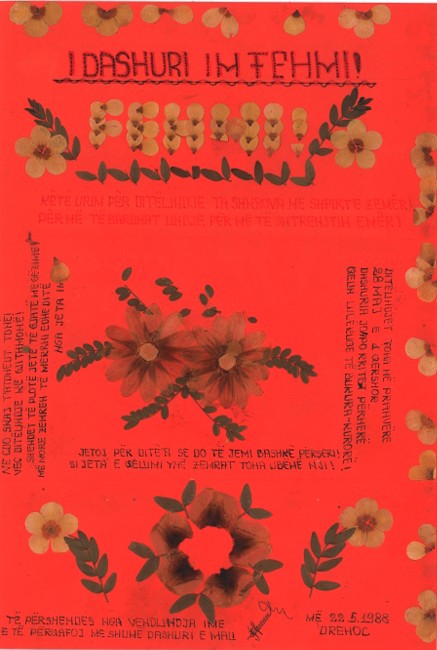
Letter written and designed by Xheve Lladrovci Krasniqi
These couples have included such pairs as Che Guevara and his fiancée Aleida March who fought together in Fidel Castro’s army in 1950s Cuba. Another were the British secret agent Sonya Juliet Butt and French Canadian officer Guy d’Artois, who were a couple, both two secret agents parachuted into France by the British Special Operations Executive in the Second World War, carrying out hazardous undercover missions.
Yet Reporting House’s exhibition is an exemplary first: never have the love-letters of a couple like this been exhibited. The personal, cultural and historical impact of such documents is real and striking, too, and should not be underestimated. Such recordings of history are important wherever they are shown.
Earlier this year the British National Archives in London staged an exhibition of historical correspondence from their files, entitled ‘Love-Letters.’ It included letters between William III and Queen Mary II, from Oscar Wilde and Catherine Howard, as well as Jane Austen’s will.
While waiting for Fehmi, Xheva taught his mother how to read and write, which enabled her to send letters to her son in prison; she also advocated for ongoing secondary education rights for girls in Drenas. When Fehmi got out of prison, Xheva and he served as members of the Albanian Guard in Croatia, fighting for its liberation in 1992.
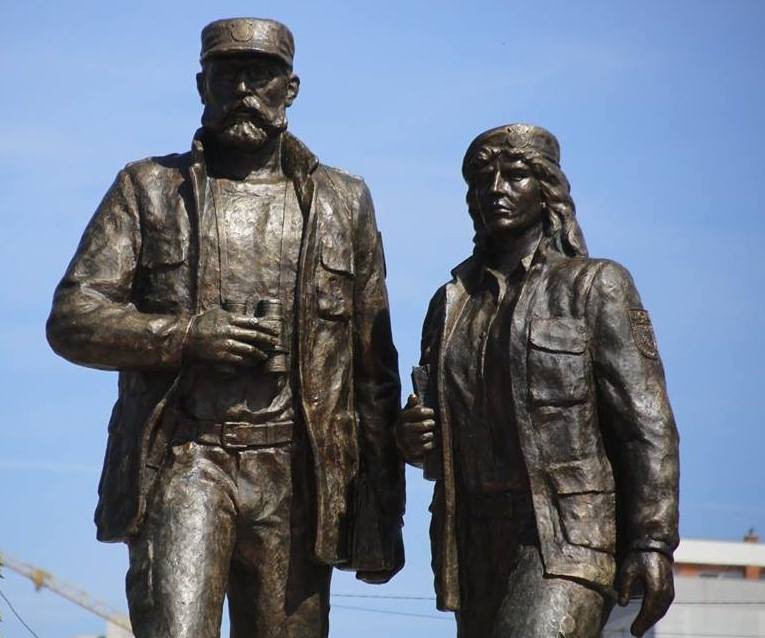
Fehmi Lladrovci and Xheve Krasniqi Lladrovci statue in Drenas, Kosovo. Photo: BIRN
From 1993-1997 the couple lived in Germany, where Xheva’s female friends described how she took constant exercise, cycling, walking with weights, her way of preparing for the task of carrying weapons and ammunition across the hills from Albania into Kosovo. She knew war was coming and was inevitable. And in 1997 it did, and she walked into Kosovo from Albania and enlisted in the ranks of the guerilla Kosovo Liberation Army. The extract from one of their letters could almost have been made for this moment:
“We will always share joy and sorrow together, and sorrow must be turned into strength…Light of Life, Fehmi,
In our letters, we notice many of the same thoughts about the events and situations that confront us; it’s truly as if we share the same language and mind. It seems to me as if we have grown up together. Our life should be a faithful reflection of human honesty. You are only physically away from me. The mind, spirit, and heart are one in me and YOU.”
On the wall at Reporting House is the costume Xheva wore when she got married. She chose to wear not white, but red, which to her was a symbol of resistance. And resistance was her watchword until she was killed in combat by Serb forces on September 22, 1998, fighting alongside Fehmi. Exhibited on the wall is her chest webbing, which contained her assault rifle ammunition and hand-grenades.
Xheva’s letters have been preserved dutifully and carefully by her family, including her brother Selim Krasniqi, a fellow KLA fighter. The letters at Reporting House are copies, as museum exhibition could harm the originals. Among the prisoners inspired by the letters was Adem Demaçi, the so-called Mandela of Kosovo, who spent 15 years at Stara Gradiska.
“Yours until the grave,” Xheva wrote forty years ago. And so it came to pass. A decade after writing those words, while fighting the Serbs in the Drenica valley in 1998, Fehmi took a bullet. He asked Xheva to pull back. She refused. Even after he died, she stayed beside him, fighting to a heroic, bitter end.
The exhibition of the letters and Xheva’s artefacts opens on Thursday in the Reporting House museum (situated opposite the National Theatre in Prishtina).