


The Student List’s electoral victory has raised hopes for a new political chapter in Serbia. But its position on Kosovo remains largely unchanged, leaving questions over the future of EU-mediated dialogue with Kosovo and the relationship between the two countries.
In an interview with Kosovo-based Serbian-language broadcaster ‘Radio KIM’, Jugoslav Gasic, an MP candidate for Serbia’s Student List, said that, “we look at the Srpska Lista [the Serbian party representing Kosovo Serbs] absolutely the same way we look at the politics of [former Serbian President Aleksandar Vucic’s] Serbian Progressive Party.”
Gasic said the Srpska Lista in Kosovo had implemented the policy of the Serbian Progressive Party, SNS, with what he described as catastrophic results.
“Srpska Lista carried out SNS policy in Kosovo and Metohija, with absolutely disastrous results,” he said, adding that, “we do not want any contact or cooperation with them.”
His statements raise further questions about how the Student List’s victory in Serbia’s parliamentary elections will affect the future of the Kosovo–Serbia dialogue. Although the movement’s positions on Kosovo do not differ from those of Aleksandar Vucic, it remains unclear whether change of political leadership in Belgrade will bring a new approach to dialogue between the two countries.
Emerging from student-led anti-corruption protests, the movement defeated the Serbian Progressive Party, SNS, led by Aleksandar Vucic, in the snap parliamentary elections of October 25, 2026, ending the party’s 14-year dominance.
During the election campaign, the Student List maintained that Kosovo was “an integral part of Serbia, in line with the Serbian Constitution.” Its representatives called for a review of agreements reached in the EU-mediated dialogue with Kosovo and for the issue of Kosovo’s status to be taken back to the United Nations.
The movement’s representatives also carried copies of Serbia’s Constitution during the campaign, as a sign of commitment to defending its provisions.
Little sign of a policy shift on Kosovo

Flag depicting Kosovo as part of Serbia in the students protests in Serbia on October 30, 2025. Photo: Screenshot/ Filološki Fakultet Blokada/Instagram
Nikola Burazer, programme director at the Belgrade-based Centre for Contemporary Politics, says the Student List has so far adopted a position on Kosovo similar to that of most political actors in Serbia.
“So far, the Student Movement has maintained a conventional position on Kosovo and the dialogue between Belgrade and Prishtina, arguing that Kosovo is part of Serbia and that solutions to the issue must be based on the Serbian Constitution,” Burazer told KALLXO.com.
He added that it would have been difficult to expect a different position during the election campaign, given Serbia’s political climate and the nationalist rhetoric used by the outgoing government against protesters.
Burazer also pointed to a memorandum on “Kosovo and Metohija” published in the spring, which attracted attention abroad for its nationalist rhetoric. However, he said it offered “no substantive proposals that would distinguish it from Serbia’s existing policy towards Kosovo.”
Student List representative Ilija Srdanovic told Radio Free Europe that continuing dialogue on Kosovo remained a fundamental part of the movement’s political programme.
“We remain open and leave room for open dialogue and the resolution of issues, prioritising the interests of our citizens and everyone in the international community,” Srdanovic said.
He added that previous agreements “could be reviewed” to determine whether they were consistent with Serbia’s Constitution.
On October 31, the Prime Minister of Kosovo Prime Albin Kurti stated that, “We know who has lost power in Serbia, but we still do not know who has gained it.” He also expressed his hopes that this political change will be accompanied by “a positive shift in the official position of Belgrade towards the Republic of Kosovo and the Albanians in Presheve, Bujanoc, and Medvegje.”
Kosovo Parliament Speaker Albulena Haxhiu also considers Vucic’s defeat a positive development but expressed little confidence that it would change Serbia’s approach towards Kosovo.
“It is very important that authoritarian regimes are punished. We do not have much confidence that the mindset in Serbia will change that much” she told the media in North Macedonia on October 27.
Could a new government take a tougher line?
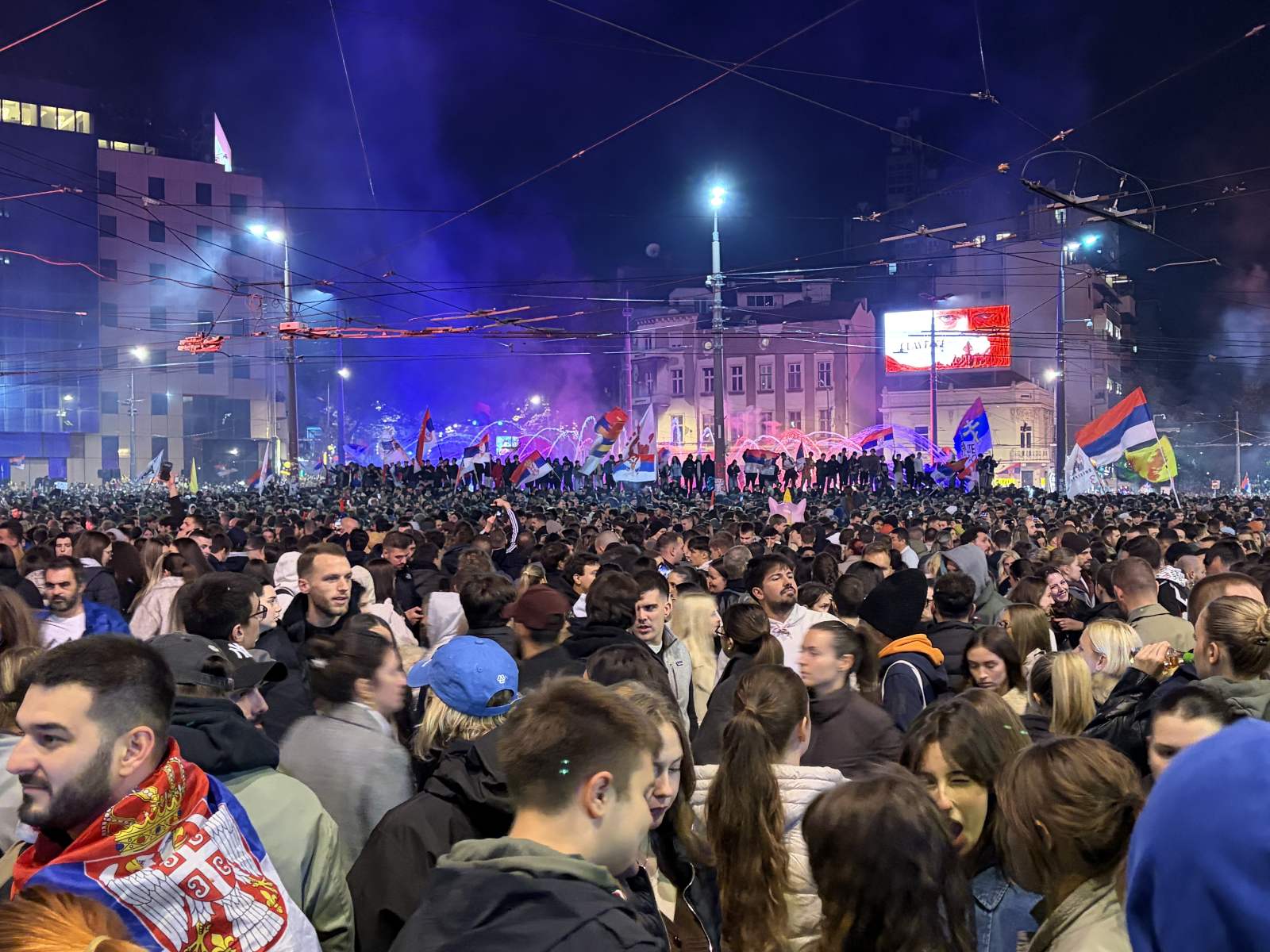
Serb citizens take to the streets in Belgrade after the Student List win, October 25, 2026. Photo: BIRN
The change in government raises questions about if Serbia’s new leadership will be more willing to advance the dialogue with Kosovo, or if domestic political pressure will push it towards an even harder position?
Burazer doesn’t agree with the assumption that a change of government would produce a more conciliatory approach.
“The opposite could happen: the new government could come under pressure to defend Serbian interests more than the previous government, while any concessions it makes would face strong domestic opposition,” he said.
In the early months, he expects the new administration to prioritise issues that unite the Student List and its supporters, including the rule of law, anti-corruption efforts, media freedom, and democratic reform.
Over time, however, he says, “democratisation could influence” Serbia’s approach to Kosovo, causing a shift towards the interests of citizens and Kosovo Serbs, rather than the political and economic interests of particular actors.
“Such a shift could also lead to different rhetoric and a more open debate within Serbia about what its interests in Kosovo actually are,” Burazer said.
When asked whether the movement would support direct talks with Kosovo Prime Minister Albin Kurti, Srdanovic told Radio Free Europe that, “decisions on important issues would be made after the new government was formed.”
What will Vucic’s defeat mean for Kosovo Serbs?

Srpska Lista headquarters in North Mitrovica city centre. Photo: BIRN
Beyond the dialogue, the election result could reshape the political representation of Kosovo’s Serb community.
For years, Vucic’s SNS has influenced the politics of the Serb community in Kosovo, primarily through the Srpska Lista, the largest Belgrade-backed political party representing the community, established in 2013 as part of the Brussels agreement.
Marko Prelec, a Western Balkans analyst at the International Crisis Group, believes the SNS defeat could give Kosovo Serbs greater freedom to choose their political representatives without pressure from Serbia.
“The first consequences are likely to be felt in the region, primarily in Kosovo, where the defeated Serbian Progressive Party exercised strong control over Serb minority voters. They will now be free to choose their preferred representatives without pressure from Belgrade,” Prelec said.
He added that a new government in Serbia could place greater emphasis on protecting the rights of Serbs in Kosovo. But it remains unclear how this change would translate into practice, given the Srpska Lista’s established position within Kosovo Serb politics.
The Student List differs from Serbia’s traditional political parties in its organisational structure. The movement emerged from student protests against corruption following the collapse of the central railway station’s canopy in Novi Sad in 2024, which killed 16 people.
Rather than operating under a single leader, the movement organises through plenums, where decisions are made collectively. Its electoral list brought together candidates from different professional and social backgrounds.
Governing, however, will require decisions on complex and politically sensitive issues, including relations with Kosovo.
One of the first tests will be whether the new leadership follows through on its campaign statements to review existing agreements and take the issue of Kosovo’s status back to the United Nations.
A possible opening for EU-mediated dialogue?

Meeting of the EU Serbia-Kosovo dialogue. Photo: Screenshot: European Commission.
The political transition in Serbia comes as the European Union continues to signal its readiness to convene a high-level meeting between Kosovo and Serbia.
On October 14, 2026, a European Commission spokesperson told KALLXO.com that EU foreign policy chief Kaja Kallas was “ready to host such a meeting,” although no date had been announced.
Whether the dialogue gains momentum will depend not only on the change of government in Belgrade but also on the EU’s approach and the willingness of both sides to implement their commitments.
Daniel Serwer, a professor and senior fellow at Johns Hopkins University’s Foreign Policy Institute, has argued that the process cannot deliver concrete results if EU demands continue to focus on Kosovo.
“If Brussels continues to prioritise the Association of Serb-Majority Municipalities without asking Serbia to do anything in return for Kosovo, the dialogue will continue to go nowhere,” Serwer told KALLXO.com.
He added that the Association should not be treated as a priority without addressing threats to Kosovo’s sovereignty and territorial integrity, and that Serbia “must take concrete steps in its relations with Kosovo.”
Fabienne Hara, director of the Europe Programme, described the Student List’s victory as evidence of young people’s and civil society’s commitment to the rule of law, fighting corruption, and strengthening democracy.
“This change could create a rare opportunity to make progress towards resolving the long-standing and deeply divisive conflict between Serbia and Kosovo,” Hara said.
For Kosovo Prime Minister Albin Kurti, however, progress in the dialogue remains tied to three conditions he has set out: the handover to Kosovo’s authorities of Milan Radoicic and his group, who carried out the September 2023 armed attack in Banjska, northern Kosovo, in which a police officer was killed; the signing of Ohrid the agreement reached in 2023; and the withdrawal of a letter sent to EU by former Serbian Prime Minister Ana Brnabic.
March 2026 marks three years since Kurti and Vucic reached an understanding in Ohrid, North Macedonia, on implementing the annex to the Basic Agreement negotiated in Brussels in February 2023.
Under the agreement, Kosovo and Serbia committed to developing normal, good-neighbourly relations and recognising each other’s documents and national symbols, including passports, diplomas, vehicle registration plates, and customs stamps.
The 11-article agreement also provides for a level of self-management for Kosovo’s Serb community and mutual recognition of state symbols.
Kosovo and Serbia have been engaged in EU-mediated talks for normalising relations since 2011. The process initially focused on technical issues before moving to political negotiations.