


Women in Kosovo face demotions, contract terminations, and pressure to resign after becoming pregnant, while lengthy legal procedures leave many waiting years for justice.
Ermira, not her real name, had her contract terminated shortly after her employer found out she had gotten pregnant.
Talking to Kallxo.com on the condition of anonymity, Ermira recalled that three weeks later she “received notice that, due to poor performance, they had decided to terminate my regular employment contract and replace it with a service contract.”
Her three-month service contract was not renewed.
“They told me that my service contract had expired on a specific date and would not be renewed. I reminded them that they had promised that my regular employment contract would continue. Their response was: ‘No, I cannot make any promises about the future’,” she said.
The doctors told her that, “because of the stress and pressure, the baby had experienced some problems, and so had I. I even had to seek psychiatric treatment and take medication during my pregnancy.”
For many employed women in Kosovo, pregnancy marks the beginning of uncertainty, discrimination and, in cases, such as Ermira’s, dismissal. Kallxo Përnime’s documentary, “Unemployed Mothers,” tells the stories of women who lost their jobs after becoming pregnant or demanding their legal entitlements, including the dismissal of 15 women working in a high-level public institution, who went on strike to demand higher salaries and were later fired.
The investigation documents how employers violate women’s rights, with focus on their paid maternity leave, by manipulating employment contracts, terminating working relationships, and pressuring pregnant employees to resign.
Kosovo’s legal framework provides for nine months maternity leave and reduced working hours for breastfeeding mothers. However, the women interviewed explain that, based on their experience, the law is bent to suit employers. Indeed, data show that less than 30 percent of women who become mothers in Kosovo are employed.
Ermira complained to the Labour Inspectorate but “they focused on the fact that I had signed a resignation letter. But I signed it without knowing what I was signing. I had no other way to prove what had happened. It was simply their word against mine.”
She did not take the case to court because she “believed the courts would also rule in their favour rather than mine.”
Pregnant and unemployed

A woman who was dismissed for being pregnant. Photo: BIRN
Despite a progressive legal framework, the level of employment of pregnant women in Kosovo is very low. They are also often dismissed as soon as they become pregnant.
Data from the Ministry of Labour show an increase in employment contract terminations involving pregnant women this year. Between January and August 2026, 35 women had their employment contracts terminated, compared with 11 in 2025, 12 in 2024, three in 2023 and nine in 2022.
Under Kosovo’s legal framework, employed women are entitled to six months of maternity leave compensated at 70 per cent of their salary by their employer, followed by three months compensated by the state budget.
The law also provides for an additional three months of unpaid leave and daily breaks for breastfeeding mothers.
However, data from the Ministry of Labour shows that in 2025, over 71 percent of the 29,760 women who applied for maternity-related benefits, were unemployed. Only 8,588 of these women were employed.
Brikenë Hoxha from the Kosovar Initiative for Stability, IKS, told Kallxo Pernime that, “if we analyse the trends, we see that women are educated, perhaps even more than men. However, we see a gap in the labour market.”
Indeed, according to the Kosovo Agency of Statistics, KAS, only 32.2 percent of women aged between 15 and 64 participated in the labour force in 2025, compared with 67.9 per cent of men. The employment rate is also very low because within this active labour force only 27.6 percent are employed, compared to 61.5 percent of men.
The gap is also evident in property ownership with women owning only 21 percent of registered property in Kosovo.
Fear of dismissal keeps workers silent
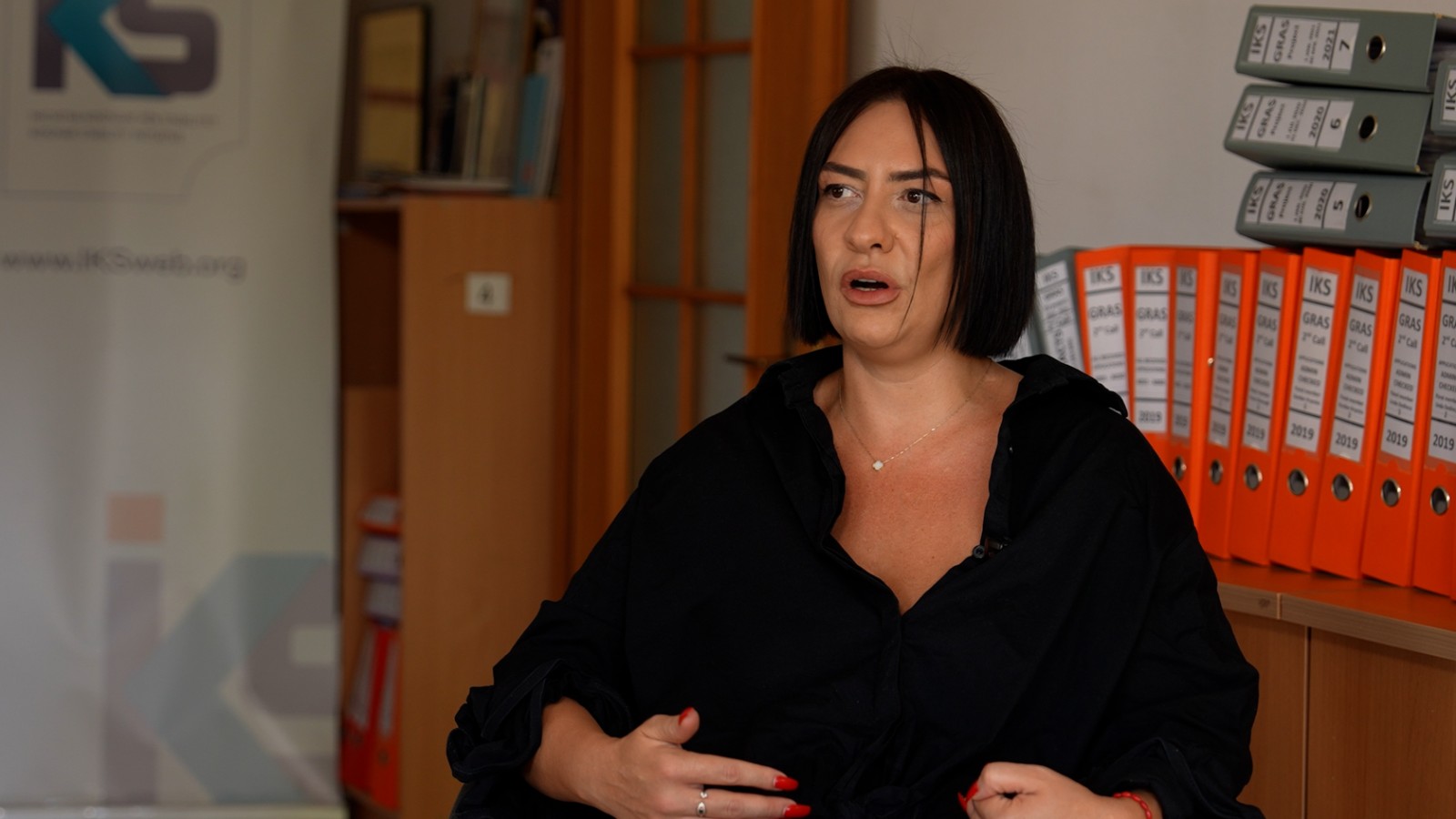
Brikenë Hoxha from the Kosovar Initiative for Stability, IKS. Photo: BIRN
Besa, not her real name, told Kallxo Pernime that she began a legal battle in 2020 after being dismissed from her job at a retail supermarket chain, while pregnant.
“Everything started after I informed them that I was pregnant. They began issuing warnings, then changed my workplace location, and changed my position from a managerial role to a sector supervisor position,” Besa explained, on the condition of anonymity.
The new position required longer periods standing up, lifting heavier loads, and working longer hours, including overtime. “I sometimes worked 14–15 hours a day,” she recounted.
“When I objected during a meeting, they directly told me: ‘As of today, you are no longer part of the company. You need to go and deregister yourself.’ There had been no prior notice of contract termination,” she said.
Hoxha from IKS said that workers generally do not insist on their legal rights because “they do not want to be labelled problematic employees.”
She noted that a complaint against an employer can take up to two years to be resolved in the courts. “During that time, you are left in a state of uncertainty, while people depend on their income to get through each month,” she said.
Indeed, Besa initiated complaint procedures six years ago and the court proceedings are still underway.
First, in 2021, she received maternity leave payments based on a decision by the Labour Inspectorate.
Nonetheless, a first instance court “did not take into consideration the discrimination or the other aspects of my case,” and rejected her claims on the grounds that her employment contract had expired.
After four years, she took the case to the Court of Appeals.
“I am not asking for privileges because I am a woman, but motherhood should never be a reason for a woman to be punished in the workplace,” she stated.
Leonida Molliqaj from the women’s rights NGO Centre for Information, Critique, and Action, QIKA, said that discrimination against women in the labour market starts during the hiring process, before they are ever even employed.
According to her, during recruitment procedures women are asked questions about their marital status and family planning intentions, like the number of children they plan to have.
“All these questions are intimidating and are intended to obtain information that is none of the employer’s business,” she said, adding that in some cases “women are asked to attach pictures to their CV applications.”
Lawyer Saranda Keqekolla-Sadiku said employers often structure employment contracts in ways that make it difficult for employees to establish reasons behind their dismissal. She explained that companies may rely on contractual provisions and the expiry of fixed-term agreements to defend decisions.
“In these cases, I advise all women whose employment rights have been violated to document every form of pressure. Courts work with evidence, so if you decide to pursue legal action, you need to be very careful from the moment you sign your employment contract,” she said.
Not even the public sector is safe

Leonida Molliqaj from NGO QIKA. Photo: BIRN
Kallxo Pernime also documented the dismissal of 15 women working in a high-level public institution, who went on strike to demand higher salaries, and were later fired. The women were employed by a company providing services to the public institution.
“None of the women working there had less than 16 years of work experience at that public institution. The cost of living increased and salaries were raised elsewhere, we were earning just 275 euros a month,” said one of the women, Zana, not her real name.
Unable to cover daily expenses with such a low salary, the women went on strike.
“We had to cover food, daily expenses, transportation, and family related costs with that salary, while trying to save whatever little we could,” Zana explained.
However, the company retaliated against the workers and “dismissed all 15 of us. In my view, and in the view of all the women, the company took revenge on us.”
According to Zana, the Labour Inspectorate found violations relating to their employment contracts and their termination. The women also turned to the Ombudsperson Institution, which issued a decision confirming that their rights had been violated.
A 2024 ex-officio report by the Ombudsperson Institution on gender equality highlighted issues including the underrepresentation of women in senior public-sector positions, violations of labour legislation, and gender-based discrimination in the private sector, including sexual harassment and dismissals related to maternity.
“The complaints we receive mainly concern violations of the Labour Law and termination of employment during maternity leave. In the public sector, complaints are mostly related to promotion and career advancement,” said Suzana Gashi, Director of the Department for Protection against Discrimination at the Ombudsperson Institution.
Gashi expressed concern about the effectiveness of the Labour Inspectorate in identifying discrimination in the private sector, as “it didn’t provide the information they required on implementation of the Law on Protection from Discrimination from institutions.”
Despite the findings of the Labour Inspectorate and the Ombudsperson Institution, Zana said that, “after two years, we still have no response from the court. All the workers have been left without jobs, while the company continues operating there regardless of all the violations.”
The names of the women quoted in this article have been changed to protect their identities.
The English version of this article was prepared by Ardita Zeqiri.