


The high-level dialogue between Kosovo and Serbia has been low on the political agenda for more than two years, sidelined by deep domestic crises in both countries.
Even the appointment of Peter Sorensen earlier this year as the EU’s new envoy for the Kosovo–Serbia Dialogue has done little to revive a process that many observers now describe as being in “clinical death.” So far, the Danish diplomat has not managed to bring Kosovo’s caretaker Prime Minister Albin Kurti and Serbia’s President Aleksandar Vucic back to the table in Brussels.
“Alive and kicking,” was the short answer from Sorensen on August 6, when he was quizzed by reporters in Prishtina on the state of play of the dialogue.
Fast forward three months, the process remains in limbo as Prishtina and Belgrade are at loggerheads, as their own internal political troubles persist.
The last such encounter took place on September 14, 2023, during Miroslav Lajcak’s term as envoy, ending without any concrete progress. Since then, only a handful of lower-level meetings have been held between the chief negotiators—acting deputy PM Besnik Bislimi for Kosovo and Petar Petkovic for Serbia—and Sørensen himself.
“Lack of political will” on both sides
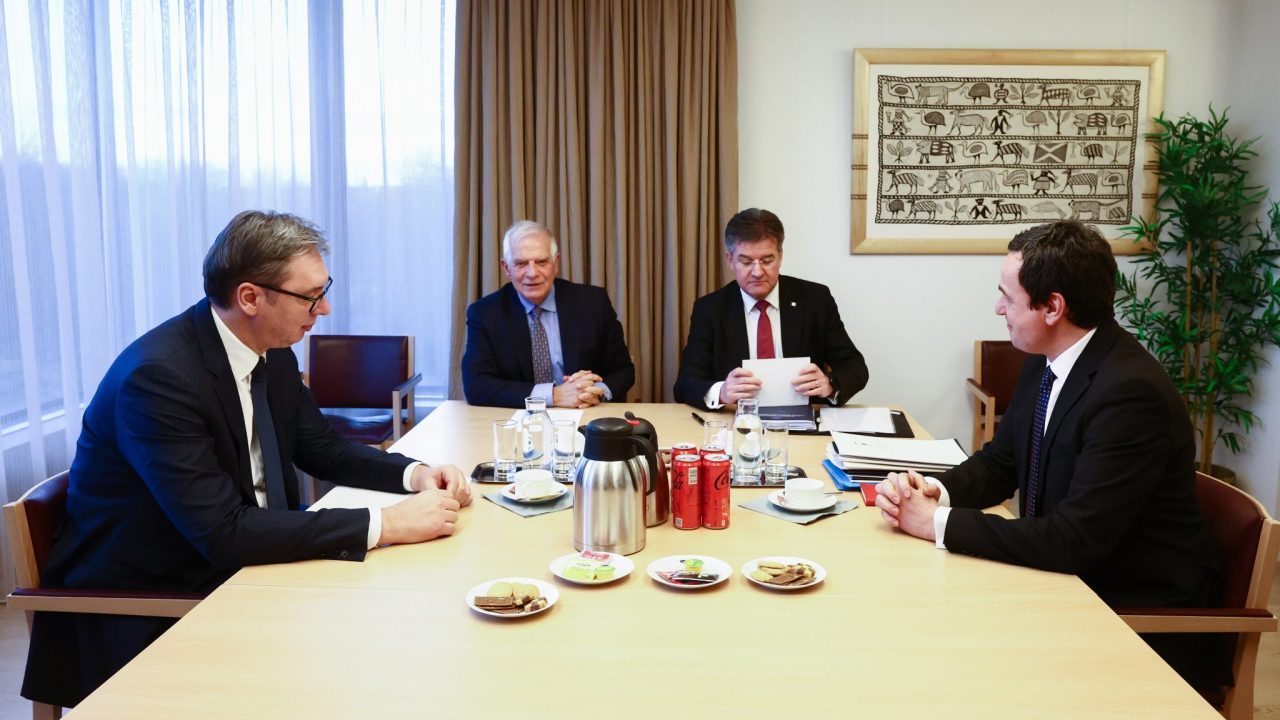
Serbia President Aleksandar Vucic (L), EU High Representative Josep Borrell (2-L) and Kosovo Prime Minister Albin Kurti (R) at a meeting of the EU-Kosovo-Serbia Dialogue in Brussels on February 27, 2023. Photo: EPA/STEPHANIE LECOCQ
Daniel Serwer, professor at Johns Hopkins University in Washington, says the Dialogue has stalled because of “a lack of political will—particularly in Serbia.”
He argues that this absence has “justifiably slowed” Serbia’s EU integration process.
“Serbia is doing far more harm to the process than Kosovo,” Serwer told BIRN, noting that Kosovo hasn’t provoked violent incidents in Serbia—quite the opposite.
“In Kosovo, the process has also been slowed, but far less justifiably,” he added. “Kosovo needs to do more to integrate Serbs, especially in the north, but it has not breached Serbia’s territorial integrity or promoted violent incidents there.”
Kosovo based political analyst Artan Muhaxhiri said that the dialogue has come to a halt mainly because both leaders—Kurti and Vucic—see greater electoral benefit in delay than in resolution.
“For both Kurti and Vucic, keeping the issue hostage and dragging it on indefinitely is far more useful politically than reaching a final agreement,” Muhaxhiri said. “A deal would only refocus attention on their responsibilities in real governance.”
Still, he warns that without progressing the dialogue, “there can be no normalization [of relations] between Kosovo and Serbia—a fundamental geopolitical condition for Kosovo’s path toward the EU.”
According to him, the EU will never allow the Western Balkans to “import their conflicts” into the bloc. “The Dialogue and the European path are inseparably linked,” he stressed.
Ahead of her May visit to Prishtina and Belgrade, EU foreign policy chief Kaja Kallas said it was “time for re-engagement” by both sides in the Brussels-facilitated process.
“Dialogue is essential for both countries’ path toward European integration,” she said.
But Serwer doubts more EU pressure on Serbia will change much.
“Vucic has chosen not to be the Serbian president who will normalize relations with independent Kosovo, let alone recognize its sovereignty,” he said, adding that “it will take a different president in Belgrade.”
For Kosovo, Serwer said the EU should push harder for integration of Serbs and their equal treatment: “I don’t know many Albanian Kosovars who fail to realize how important that is, but doing it is harder than saying it.”
“A slow and fragile EU”
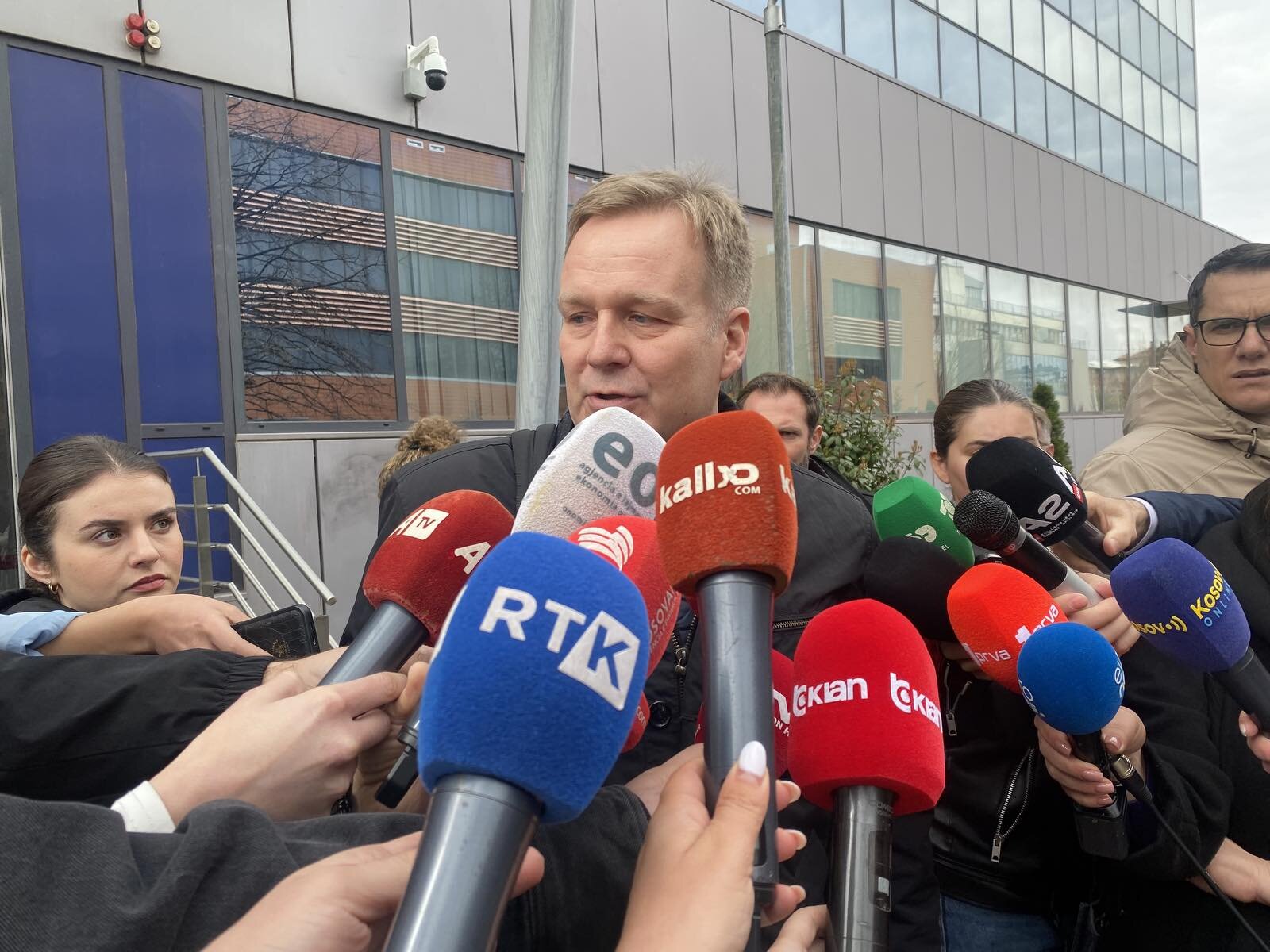
Peter Sorensen, EU mediator for Kosovo-Serbia dialogue during a visit in Prishtina on March 17, 2025. Photo: BIRN/Antigone Isufi
Muhaxhiri says the EU’s approach to the Balkans remains “extremely complicated, slow, and fragile.” The bloc, he argues, has long been influenced by U.S. dynamics that have defined the region’s diplomatic framework since the 1990s.
“Although there may be small steps behind the scenes, major breakthroughs depend on reaching and, most importantly,respecting big strategic agreements,” he said. “Since the Ohrid Agreement of March 2023, there hasn’t been another one. That says everything.”
Two years after the Ohrid Agreement—reached in March 2023—both sides have yet to implement its 11 articles, which include mutual recognition of documents and symbols, and a level of self-management for Kosovo’s Serb community.
Despite years of mediation, the Kosovo–Serbia Dialogue, launched in 2011, remains stuck—a process that has had issues from the outset and has since become a high-stakes political battle with no end in sight.
Muhaxhiri added that the wars in Gaza and Ukraine have absorbed global attention, diverting institutional focus and political resources away from the Balkans. Combined with the indifference of both governments in Prishtina and Belgrade, this has created the perfect conditions for stagnation.
“If those wars end during Donald Trump’s presidency, it’s likely his administration will move quickly to broker another historic success—the final deal between Kosovo and Serbia,” Muhaxhiri predicted.
Commenting on whether global geopolitical shifts have diverted attention away from Kosovo and Serbia, Serwer notes that both countries are currently very low on the list of priorities for both the United States and the European Union.
“If any progress is to be made, it will require people in Belgrade and Prishtina who truly want it,” he said.
BIRN sought comment from EU institutions on whether a new high-level meeting in Brussels is expected soon, but has not received a response.
In October 2025, Bislimi met Sørensen in Prishtina, urging that the issue of missing persons be treated as a priority. According to the Prime Minister’s Office, they also discussed the next steps toward full implementation of the Basic Agreement and its Implementation Annex, agreed in Ohrid.
The last meeting between chief negotiators took place on September 11, 2025 in Brussels.
Political paralysis and diverging paths
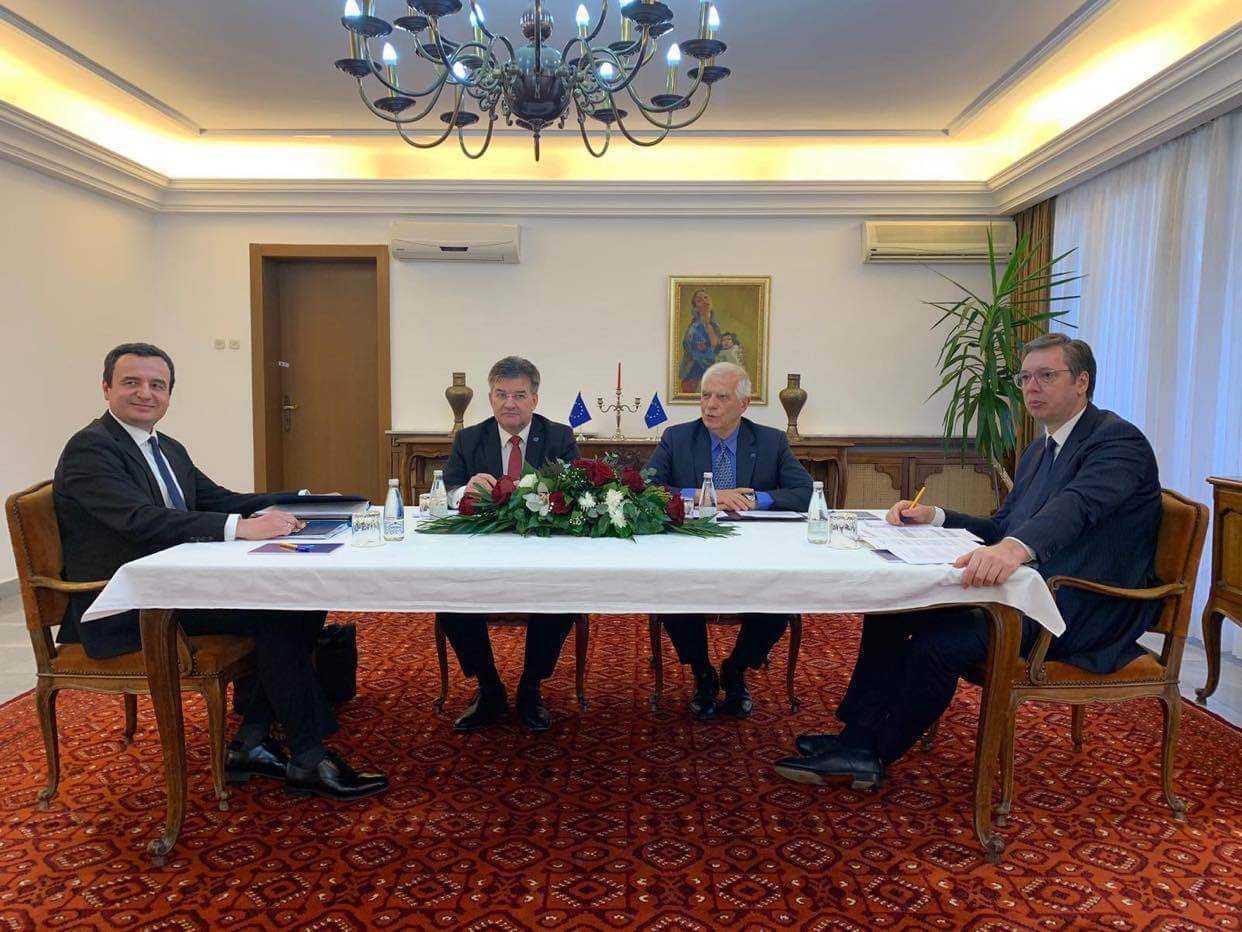
Albin Kurti (left), Miroslav Lajcak, Josep Borrell and Aleksandar Vucic during a joint meeting in Ohrid, North Macedonia, March 18 2023. Photo: EEAS
Kosovo is in a prolonged political crisis over the formation of new institutions, while Serbia has faced massive anti-government protests since last year.
The European Commission’s 2025 Progress Report said domestic political distractions have prevented both countries from taking decisive steps toward implementing the 2023 Agreement on the Path to Normalization and its annex.
However, the report notes that regular meetings at the level of chief negotiators have continued – and that both Kosovo and Serbia are expected to fulfill all obligations stemming from current and past Dialogue agreements.
Kosovo is expected to move forward with establishing the Association/Community of Serb-Majority Municipalities, A/CSM, while Serbia must begin recognizing Kosovo’s documents, symbols, and institutions.
“The Agreement is valid and legally binding,” the report says, warning that, “any delay or ‘formalization’ debate must not hinder implementation.” Progress, it adds, will be judged solely by each side’s actions.
Traditionally, in line with a Constitutional Court verdict, the dialogue with Serbia is led by the government, currently headed by Kurti, while on the Serbian side it is led by its President Vucic.
Kurti insists that three conditions are crucial for normalization: the extradition of Milan Radoicic and his group for the Banjska attack, the signing of the Basic Agreement, and the withdrawal of a letter from former Serbian Prime Minister Ana Brnabic.
Vucic, meanwhile, insists that forming the Association of Serb-Majority Municipalities is, “a prerequisite for any further progress.”