


For many persons with disabilities in Kosovo, the greatest barriers extend beyond inaccessible buildings or limited job opportunities. They also face prejudice and discrimination, including offensive remarks that question their appearance, abilities, and even their place in public life.
When former Kosovo MP Fetah Rudi entered public life, he expected to be criticised for his political views. What he did not expect were comments questioning whether someone in a wheelchair belonged in public at all.
“People would ask, ‘Why is he in a wheelchair?’ or ‘Why is an MP in a wheelchair?’”
His experience reflects the reality faced by many persons with disabilities in Kosovo, who continue to encounter not only physical barriers such as inaccessible infrastructure and limited employment opportunities, but also deeply rooted social attitudes that question their place in society.
Beyond physical barriers and unequal access to education and employment, many encounter degrading comments about their appearance and abilities, experiences that often undermine their confidence and social participation.
According to civil society organisations and based on World Health Organization, WHO, standards, approximately 150,000 people with disabilities live in Kosovo. However, the latest data from the Kosovo Agency of Statistics, KAS, show that only around 25,000 people receive state financial support through social protection schemes. These figures include children and adults with paraplegia and tetraplegia.
For Pranvera Musaj, who has worked as a CCTV operator for a decade, discrimination often came disguised as sympathy.
“People would ask me why I was working and whether I was in a bad financial situation.”
What seemed like concern carried another message, that employment was not something someone like her should aspire to.
“Comments like these make you feel bad. They change the way you see things and can leave you feeling demoralised. But I continued and never gave up,” she told Prishtina Insight.
She believes the prejudice has gradually declined.
“People used to stare when they saw us having coffee or attending school. There were comments too. Today, it happens less often.”
Moving beyond the charity model of disability
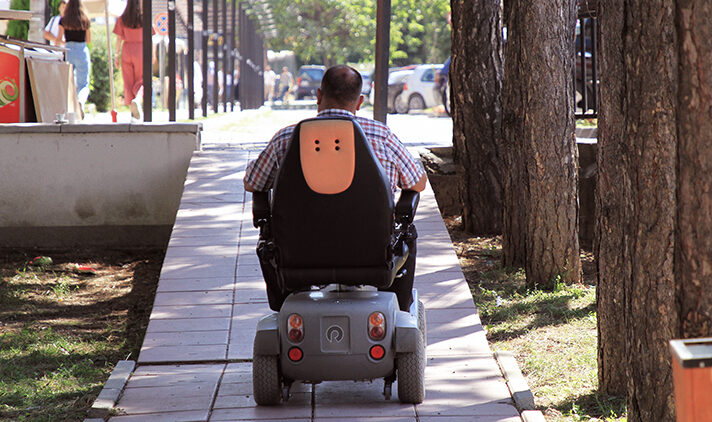
A man in wheelchair. Photo: BIRN/Urim Krasniqi
Organisations advocating for disability rights have consistently raised concerns about the language used toward persons with disabilities. According to HANDIKOS, prejudice continues to push many individuals toward insecurity, fear, low self-esteem, and social isolation.
HANDIKOS explains that society still mainly views disability through a charitable lens rather than recognising persons with disabilities as equal rights holders.
“People with disabilities are often perceived as objects of charity instead of individuals with equal human rights. This perception exists in society and in public and private institutions,” the NGO told Prishtina Insight.
Mentor Mehmetaj, an IT professional from Skenderaj, has worked in the private sector for 18 years. Throughout his career, he has been the target of offensive remarks solely because he uses a wheelchair.
He recalls one of the most painful comments ever directed at him: “Someone asked me, ‘Do you have a mother? Your poor mother, having to see you like this.’ That was devastating.”
“We are all judged every day—for our work, by society, and by the people around us. If we stopped and listened to what people were saying every time, we would stop living altogether.”
HANDIKOS identified three main forms of discrimination: Attitudinal discrimination, based on stereotypes and prejudice; Environmental discrimination, resulting from inaccessible buildings, schools, transport, and public infrastructure; and Institutional discrimination, when laws and policies are developed without meaningful participation of persons with disabilities.
HANDIKOS notes that expressions such as “special needs, disabled people, differently abled” remain common among citizens, institutions, and even the media.
The organisation emphasises that the correct rights-based terminology is “persons with disabilities.”
Society lacks understanding
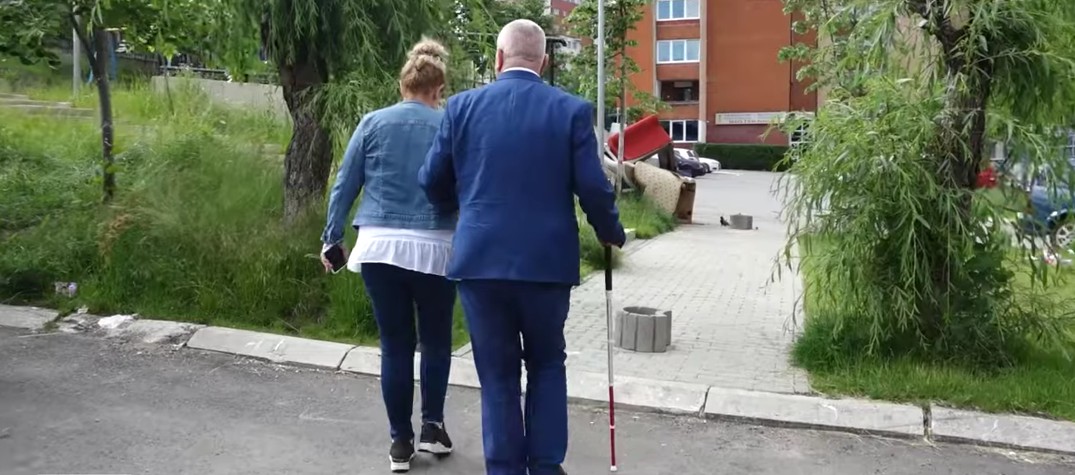
A visually impaired person walks alongside his family member. Photo: BIRN.
Negative stereotypes continue to affect equal participation in education, employment, and public life.
Former MP Rudi said that offensive comments undermine people’s dignity.
“A person with a disability wants exactly what everyone else wants, to be accepted, to meet friends for coffee, to participate in society, not to be looked at differently.”
Ivana Rakic, director of the North Mitrovica based NGO Support Me and the mother of a child with a disability, believes much of the discrimination stems from ignorance rather than malice.
“People simply don’t know enough about the challenges persons with disabilities face. Sometimes a single look of surprise or misunderstanding is enough when a child is outside or visiting a doctor.”
She emphasised that disability should never be viewed as solely the family’s responsibility: “Persons with disabilities are part of society and should be accepted as such.”
Regarding employment, she says: “There is still very little empathy or understanding that persons with disabilities have the same right to work. This affects both parents and people with disabilities themselves.”
Kosovo’s Constitution and anti-discrimination legislation prohibit discrimination on the basis of disability. However, the Ombudsperson Institution said implementation remains inadequate.
“Although courts have handled several cases involving inaccessible public spaces, the number of disability discrimination cases remains relatively low,” the Ombudsperson Institution told Prishtina Insight..
Meriton Binakaj, from Gjakova, completed a degree in social sciences but that education alone did not guarantee equal opportunities in the labour market.
To improve his prospects, he is now completing a master’s degree in Human Resource Management.
He believes stereotypes remain one of the biggest obstacles for persons with disabilities.
“When it comes to employment or education, people hesitate because they assume we cannot perform the same work as others. Those stereotypes are what hold us back the most.”
Systemic exclusion
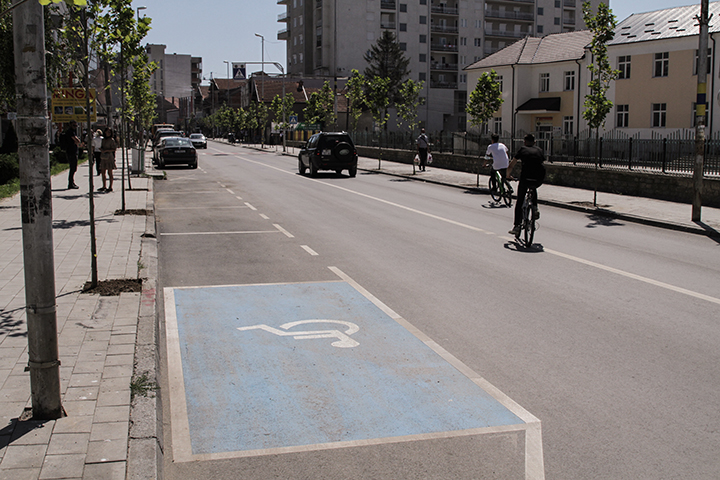
A parking space reserved for people with disabilities in Ferizaj. Photo: BIRN.
Research conducted by human rights organisations note that discrimination against persons with disabilities is systemic rather than isolated.
An Internews Kosova study published in 2023 found that discrimination extends beyond prejudice to include inaccessible infrastructure and exclusion from employment.
The research found that: only 6.77% of legally required accessibility standards had been implemented nationwide; among 26 public institutions employing more than 3,000 workers, fewer than 10 employees were persons with disabilities; the University of Prishtina employed no persons with disabilities and had no official data on students with disabilities.
A separate 2024 assessment by the Prishtina based think tank Democracy for Development covering 27 public institutions found that none fully complied with legal accessibility and equality standards.
Common deficiencies included: lack of lifts, inaccessible toilets, insufficient designated parking spaces, absence of signage for blind and deaf persons, inadequate accessibility features for visually impaired individuals.
Binakaj said that hate speech mostly affects people who struggle to accept life after acquiring a disability.
“Hate speech and stereotypes have a serious emotional impact, especially on people who are less socially active.”
He added that improving accessibility should be the first priority: “When you can move independently, everything becomes easier. Then come the employment opportunities and, finally, a society that stops judging us and starts supporting us,” he stated.