


Vaughan Smith, a Kosovo war reporter from the UK, recalls his encounter with a Kosovo Liberation Army fighter, Fehmi Lladrovci, killed in battle in September 1998 and lays out the circumstances of the Kosovo war in light of last week’s Hague court convictions of ex-guerrilla leaders.
Twenty-eight years ago on Tuesday, Fehmi Lladrovci died at Gradina, a low hill near Shkabë, his home village, the kind of ground a soldier chooses when he means to make a stand. His wife, Xhevë, died beside him. So did Fatime Hetemi. I went to his grave that morning.
I had come to Kosovo on my own and filmed the massacre at Prekaz in March 1998. The KLA distrusted outsiders. Its fighters wore masks because they feared betrayal, and none had yet shown his face to a camera. I pushed every way I could to reach them, because I wanted the story. By May I was working as a freelance cameraman for the BBC, with David Loyn as the reporter, and Rexhep Selimi arranged an interview. Jeta Xharra translated. The commander who took his mask off for our camera, the first KLA fighter to do so, was Lladrovci, known as Mustache. He spoke with the authority of a man who had earned it.
After Prekaz the KLA sprang up everywhere, more an idea than an organisation. Villages found their own weapons and uniforms. Authority was local, and Dukagjin and Drenica wore the same insignia without either answering to the other. I filmed Serbian forces clearing Kosovo’s mountain valleys several times, burning homes as they went, and never saw a coordinated answer.
As the war went on, unit command structures emerged, but agreement was still needed between units that weren’t local to each other. The Serbian forces were the opposite: what they did on the ground needed approval from above and they seemed reluctant to act without it.
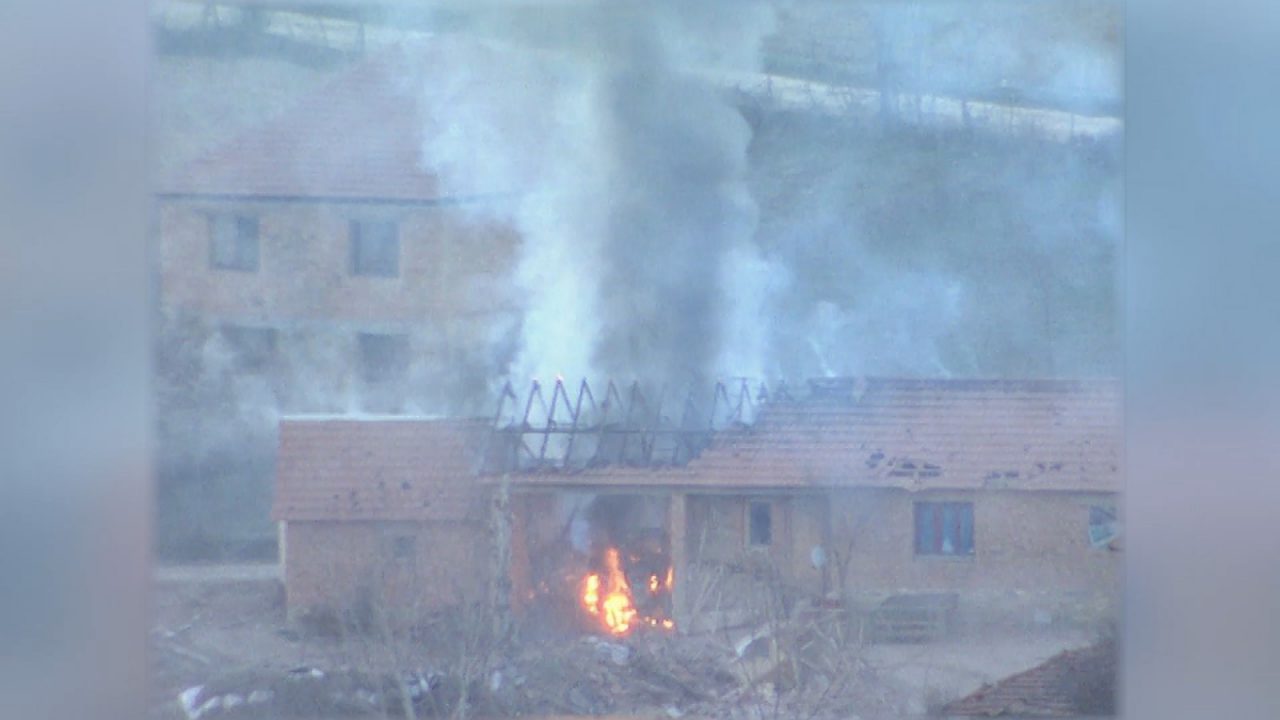
A burning house in the village of Prekaz filmed by Vaughan Smith’s crew in March 1998. Photo courtesy of Vaughan Smith.
The KLA’s way was effective. It started with very little, much of it carried over the mountains from Albania, and it held on against a far stronger army until the world came in. Fifteen months after Prekaz, Serbian forces had left Kosovo. It won what it fought for, and for a war of that kind at relatively little cost in blood.
A movement with many heads is hard to decapitate. That is not, on the whole, what a court in The Hague has just found.
On 16 September the Kosovo Specialist Chambers in The Hague convicted Hashim Thaçi, Jakup Krasniqi, Kadri Veseli and Rexhep Selimi of war crimes, including the detention of 385 people, the torture of 303, and the murder of 96. They were sentenced to 25, 25, 18, and 13 years respectively. It acquitted all four of crimes against humanity.
Presiding Judge Charles Smith III said the trial was not about the legitimacy of the KLA’s cause and pronounced the verdict “in the name of the people of Kosovo”.
I was not in that courtroom and do not know its evidence. During the war I dealt with all four, pushing them for access, and I followed KLA supply lines into Albania. Where I saw them, supplies went according to relationships, not to any central plan. Individuals, units, and villages made their own arrangements.
That did not look like an organisation able to run the coordinated detention network the court describes, on the authority of a General Staff and its political directorate. Wesley Clark and American diplomats, called by the defence, described the same decentralised force. The judges did not accept it, and lawyers expect the appeal to turn on that disagreement.
The people the KLA fighters allegedly detained, tortured and killed were real, many of them Albanians accused of disloyalty, and their families deserve a court. My argument is not with that. It is with a court that reaches only one set of victims, and that appears not to have understood the reality on the ground.
Either way, the justice done here is compromised by its isolation, in three ways:
It is isolated in time. From 1945 the Yugoslav secret police repressed Kosovo Albanians, and through the 1990s their children were taught in private homes and garages by teachers the state had sacked. That machinery turned “is he loyal” into a matter of life and death in wartime. No prosecutor has ever reached back that far. A court that starts its clock in 1998 can find the killing, but not the reason a Drenica household had stopped trusting anyone outside its own network. The response to that insecurity has been judged. What caused it has not.
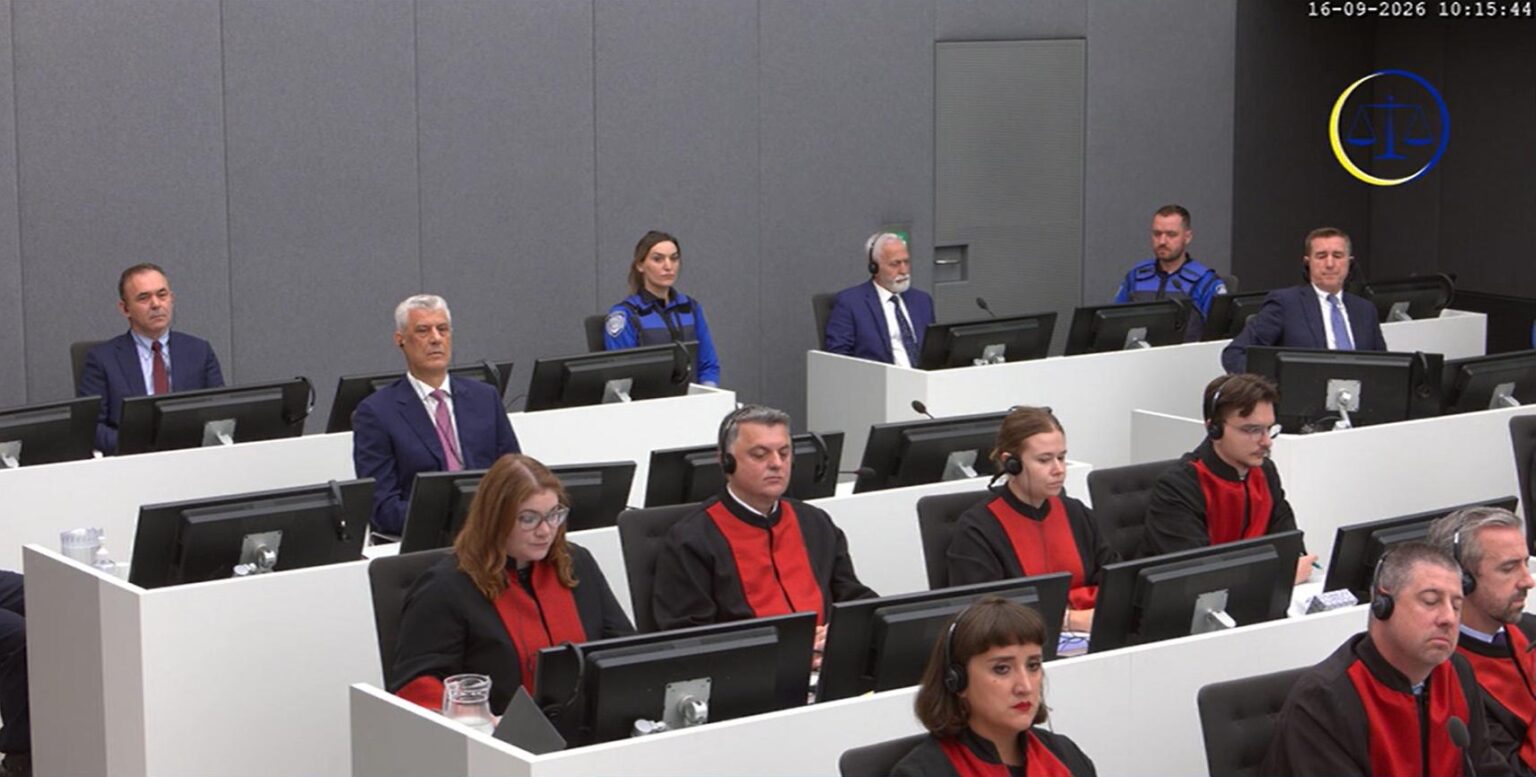
Rexhep Selimi, Hashim Thaci, Jakup Krasniqi, and Kadri Veseli in court on September 16, 2026. Photo: Screenshot/Kosovo Specialist Chambers.
It is isolated from its own war. Serbia’s wartime leaders were tried for Kosovo at the Yugoslav tribunal, and five senior officials were convicted in 2009. But Serbia’s own courts had 19 war crimes cases pending in 2024, for every war of the 1990s together. Nobody made Serbia build a court for the men lower down. Kosovo was made to build one for its own side.
And it is isolated from history and from power. Freedom is rarely won cleanly. Gandhi’s way seldom works, because an oppressive state rarely has a conscience that can be reached. France’s Resistance killed nine to ten thousand of its own people after Liberation, on suspicion, often wrongly, and Ireland’s Free State executed 81 former comrades. Neither was tried for it. The world that came in to help Kosovo also wanted this court, and it is the KLA’s leaders who are in the dock.
The same week, an UN-backed panel found reasonable grounds that the United States committed a war crime when a missile struck a school in Minab, Iran, killing 156 people, 120 of them children. Nobody expects a courtroom for that. Washington is preparing sweeping new sanctions against the International Criminal Court, and on 22 September, at the UN, President Trump urged every country that belongs to the court to leave it.
Kosovo had no such exits.
Justice that reaches only those who cannot refuse it is not justice. It is a performance of it: justice in a silo, handed down while mass graves are still being dug out of Kosovo’s countryside.
The verdict will change Kosovo, whatever the court intended. In August the remains of 23 Albanians taken from Mitrovica in 1999 were found at Kalluder, and about 1,600 people are still missing. A sense of injustice does something to a person, and to a country.
I was at one of the protests in Prishtina on Wednesday evening. The movement calls itself Jo në Emrin Tim (Not in My Name), an answer to the verdict pronounced in the name of the people of Kosovo.
That evening the placards read “Ma e shtrenjtë është liria se jeta!”: Freedom is dearer than life. It comes from what Lladrovci said in the interview I filmed with him, when asked whether he would die for Kosovo.
He is one Kosovo can hold on to: six years in prison for his politics, a fight against Serbian forces in Croatia and then at home, and a choice to stay on that hill with Xhevë and Fatime rather than withdraw. He is not evidence for or against anyone in The Hague. He is just what was true, the KLA I actually saw, whatever the court now decides about the four men I once pushed to let me meet him.
Vaughan Smith is the founder of the Frontline Club and author of The Extraction Pattern: A war reporter on the defence we built, lost and can build again.