


A small neighbourhood in central Albania became a new home for many ethnic Albanians who left today’s Kosovo and North Macedonia in the 1930s. Residents recount tales of their ancestors who settled there and the locals’ hospitality.
Children play in front of the mosque courtyard in “Fushë-Mbret (King field)” neighbourhood in Elbasan, a town in central Albania, taking advantage of the rain that has just stopped. Only a few cars head towards the city centre and the streets are almost empty.
The mosque in this neighbourhood is not merely a place of worship; it more resembles a communal space where men, women, and children meet, picking oranges from the trees in its garden, while the town gradually expands around them with streets in new residential blocks being named after ethnic Albanian patriots from Kosovo.
Officially known as the Skënderbej neighbourhood, the residents of Elbasan refer to it as Fushë-Mbret, a name dating back to the Ottoman Empire. Around 90 years ago, the field that previously served for military exercises and agricultural activities was transformed into one of the city’s main neighbourhoods, through the policies of Albania’s King Ahmet Zogu, who ruled the country in different positions from 1922 to 1939.
In 1935, King Zogu I provided land and construction permits for housing for ethnic Albanians expelled from the Serbo-Croat-Slovene Kingdom, in what are now the neighbouring countries of Kosovo and North Macedonia.
In the “Fushë-Mbret” neighbourhood, the streets are named after well-known figures from Kosovo such as Adem Jashari, Iljaz Kosova, Adem Krasniqi, etc. Photo: Prishtina Insight
“I am originally from Kosovo,” a woman in her thirties told Prishtina Insight. “My grandfather came here during the time of King Zog, but I don’t know the exact history of how they arrived,” she added, while suggesting we visit the house of Ahmet Dauti, one of the city’s most respected figures, who, after a long career as a teacher and journalist, now dedicates his retirement to family life and agricultural work.
Dauti told Prishtina Insight that his family originates from Prilep in North Macedonia and that he belongs to the first generation of his family born in the Republic of Albania.
“My grandfather Rifat Dauti was an official of the Ottoman Empire before Albania’s independence, and during the Balkan War in 1912 he fought for Albania against Serbian troops,” he says, proudly adding that his grandfather was involved in the Albanian Alphabet Congress in 1908 in the city of Manastir.
“He was later executed by Serbian forces, and the first to come to Fushë-Mbret was my father, the (Islamic legal expert) Mufti of Elbasan, Hafiz Mustafa Dauti,” he explained, adding that his father completed his religious studies in Istanbul, where he earned the title ‘Hafiz’ (a scholar who has memorized the Quran), and came to Fushë-Mbret at the insistence of his friend from Kosovo, Salih Vuçitërni, who was the Albanian Minister of Foreign Affairs at the time.
“At that time, the monarchy needed to demonstrate that educated people were leaving Turkey to come to Albania, and the mosque here was built exactly where it had been planned 90 years earlier by the architect Selim Zyma. Everything was foreseen, the mosque had to be near the Mufti’s house,” he explained.
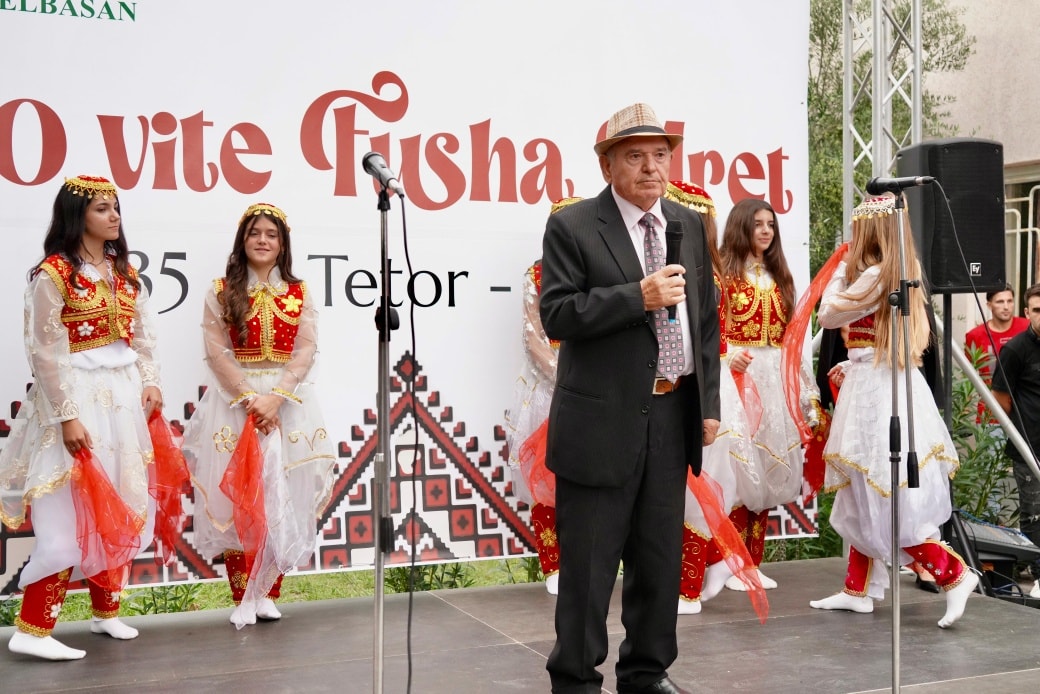
Ahmet Dauti at the ceremony marking the 90th anniversary of the “Fushë-Mbret” neighbourhood. Photo taken in October 2025, when Dauti received the “Gratitude of the City” on behalf of his father, Mustafa Dauti. Photo: Prishtina Insight
Over one century of history
Nowadays, the Fushë-Mbret neighbourhood is considered one of the most important in the city and, according to data provided by the Municipality of Elbasan to Prishtina Insight, it has a population of 10,500 residents. However, 90 years ago, on October 1, 1935, it was initially populated by only 75 families from Kosovo, while its historical significance dates back even earlier.
Rudina Mita, historian and lecturer at Aleksandër Xhuvani University in Elbasan, told Prishtina Insight that the development of Fushë-Mbret has been reflected in the news since the early 1900s.
“Based on press reports from 1936, during the Ottoman period, Fushë-Mbret was state property and used as a military encampment,” she explained, adding that according to data published by the newspaper “Besa” in 1936, after Albania’s declaration of independence on November 28, 1912, this fertile land was repurposed for agricultural and rural development.
“According to documented data, Fushë-Mbret, previously a state-owned pasture, became part of the agrarian reform for the settlement of the Kosovar community. The first settlers were 75 families from Kosovo,” she stated, noting discrepancies between press reports and archival documents regarding its original surface area.
“Press data indicates an area of 1,178 dynym (approximately 1,178,000 square meters), while primary sources (archival documents) show an area of 1,175 hectares,” Mita told Prishtina Insight. The data discrepancy is problematic considering that one dynym equals 0.1 hectare. Mita added that the neighbourhood has since expanded to the southern boundary of the Shkumbin River.
According to Xhimi Vila, representative of the Policy Directorate at the Municipality of Elbasan, the neighbourhood is around 80,000 square meters.
Geographical expansion has also been accompanied by economic development. Vila, stated via an official email to Prishtina Insight that the economic development of this neighbourhood plays a crucial role in the municipal budget.
“In the territory where the neighbourhood extends, many private companies and businesses operate, making a significant contribution to the revenues of the municipality and the government,” he wrote.
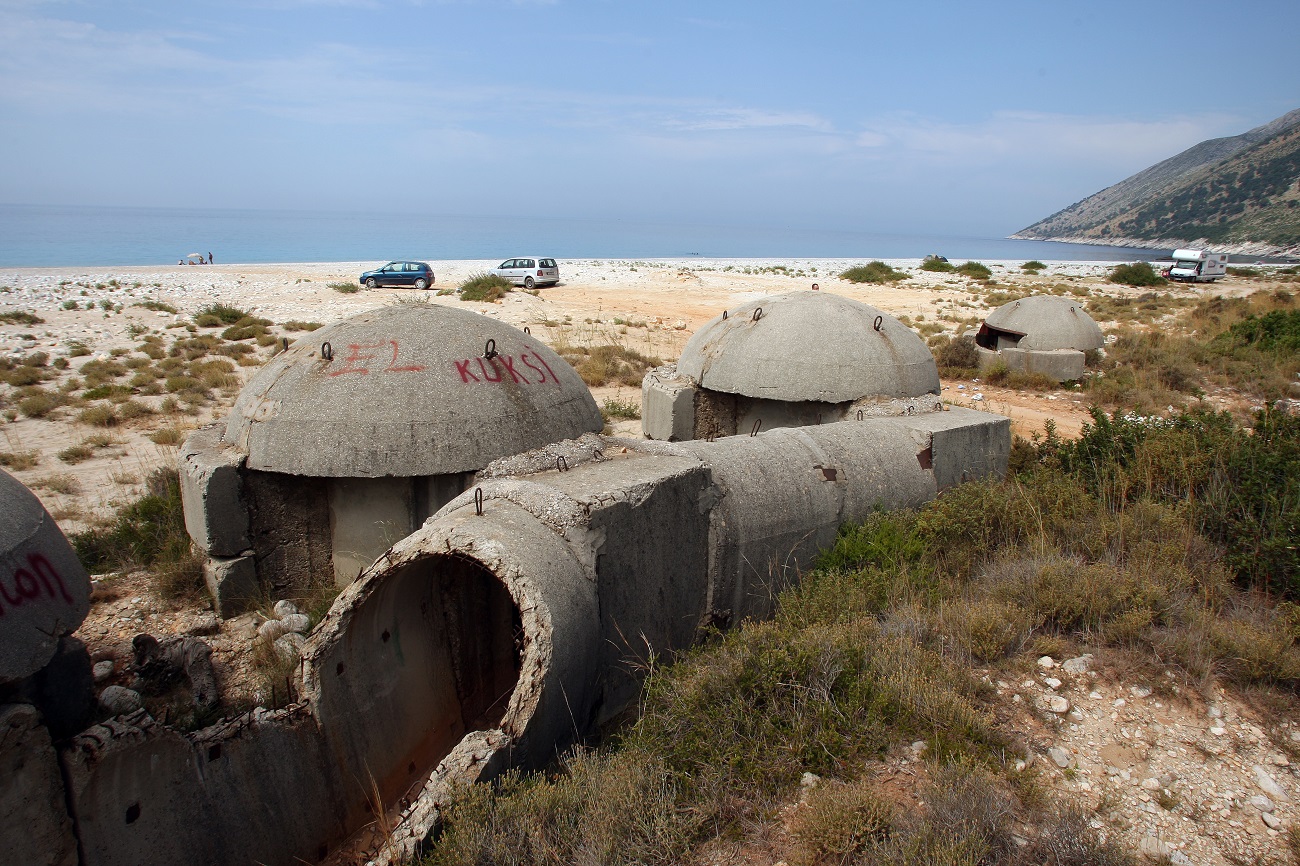
Illustration. Ex communist era bunkers are seen in the beach near Dhermi, Albania, August 20, 2009. Photo: EPA/Armando Babani
Family ties severed by dictatorships
Many ethnic Albanians who found refuge in Fushë-Mbret would soon, together with the rest of the residents of Albania, live in the most isolated country in Europe, during the period of Enver Hoxha’s communist Albanian state. For around five decades, the 75 families lost touch with the rest of their relatives outside of Albania.
Dauti explained that, “among the first clans to settle here were the Ipeku, Krasniqi, Kaçaniku, Gashi and Limani,” adding that maintaining contact with relatives was impossible. According to him, many of their relatives lived in the area of modern-day Kosovo and North Macedonia, or they had migrated to Turkey, and during Albania’s communist period all communication was severed.
“My mother met her own mother after 53 years. Two weeks later, my grandmother passed away. Every divided family has its own tragedy. Not everyone managed to rebuild family ties,” he recounted.
The successor of King Zogu I, Prince Leka Zogu II, told Prishtina Insight that the creation of such a neighbourhood was a duty of the Albanian state to protect and care for Albanians from other ethnic territories.
“At the same time, this neighbourhood also reflects a dark chapter in the history of our neighbours, who forcibly seized the lands and homes of hundreds of Albanian families, forcing them to abandon their ancestral homes,” Leka II said.
Family histories have been passed down through generations, reaching today’s youth. Megi Krasniqi, a 25-year-old actively involved in civil society initiatives for the preservation of cultural heritage, told Prishtina Insight that she became familiar with her family’s history at a young age, through the evening stories told by her grandmother about life in Gerlic, Kaçanik, Kosovo.
“My great-grandfather and grandfather, Idriz Gerlica and Mejdi Krasniqi, were born in Kaçanik and, to escape Serbian repression, came to Albania in 1928,” she said, emphasizing that initially the family lived in Krujë and Lushnjë for several months before settling in Elbasan, where they first resided in an inn and were later officially treated as migrants by the Albanian state.
“In the 1930s, the King implemented a reform by granting migrants state-owned land, around 3 dynym per family for cultivation and 2.5 dynym for certified construction. “We never felt discriminated against as a migrant family, although love for the homeland has always remained strong,” she said, adding that during the political isolation of the dictatorship, maintaining relations with relatives who remained in Kosovo was impossible.
“As soon as population movement became possible after the 1990s, my father travelled to Kosovo and saw the same territories he had previously only imagined through the stories of his grandparents,” she concluded.
Professor Dr. Mustafa Ibrahimi, linguist and Dean of the Faculty of Humanities at the Mother Teresa University in Skopje, North Macedonia, conducted an independent research meeting in August 2024 with four families settled in Fushë-Mbret.
“My impressions from the first meeting were very positive. The people I met shared many similarities in mentality and ways of thinking with those in Pelagonia. They spoke with love and respect for the elderly and preserved vivid memories of their homeland. However, almost all were married to local women or women from other Albanian cities. This explains why younger generations retain very few memories of their grandparents or great-grandparents,” he explained, also highlighting the difficulties of maintaining family ties across borders.
Ibrahimi’s relatives also have a past related to the neighbourhood.
“Our family is a concrete example. In 1939, Rexhep Shorja from Prilep settled in Fushë-Mbret. A few years later, [around 1948] his son Selim, at the age of 12, illegally crossed into Albania and found his father in Fushë-Mbret. He later settled in Durrës, where he married and had four children, but he never managed to reunite with his brother and two sisters. He only reunited with his extended family after 50 years, in Istanbul,” he concluded.