


Kosovo’s slow progress in digitising its health system has left a gap in data management and patient care. While the world races to integrate artificial intelligence into healthcare, Kosovo still relies extensively on paper records.
In hospitals and clinics across Kosovo, the process is the same as it was decades ago; long queues of patients wait to be registered in the old-fashioned way, by an individual with pen and paper. The blue record books, known locally as “protocols,” are still the main data management system for patient information.
The slow digital transition combined with the ineffective electronicHealth Information System, HIS, make it impossible to generate, compile, analyse, communicate, or utilise data effectively for both the public and private healthcare sectors.
For a country that has seen rapid digital growth in many sectors, healthcare lags far behind. The Health Information System, HIS—a project meant to modernise patient data management—has been under development since 2011, but remains inoperative as of 2025.
“The healthcare system in Kosovo is a long way from using artificial intelligence,” stated Bujar Vitija, a health journalist, adding that, “we still struggle to use the simplest digital tools. Most institutions continue to register patients manually.”
He emphasised that without a functioning HIS, “any talk of artificial intelligence in healthcare is purely theoretical.”
A teenager with a vision beyond the system

University Clinical Centre of Kosovo entrance. Photo: BIRN
While public institutions struggle with digitisation, a new generation of tech-savvy youth is emerging—one that does not see the lack of infrastructure as a barrier, but as a challenge to overcome.
Kaon Krasniqi, a 14-year-old from Prishtina, is developing an AI-powered app for personalised learning.
Kaon believes the same principles he used to create the app could transform healthcare. “The future of both education and medicine lies in personalisation and automation,” he says. “Open-source AI models are the best option for Kosovo because they’re low-cost. All we need is one server to start.”
He mentioned MedGemma, a Google-developed AI model designed for medical use that can interpret X-rays, retinal images, and other scans. “AI could help doctors automate their processes, analyse medical images faster, and make more accurate diagnoses,” he explains.
MedGemma, developed by Google, is an advanced AI system specialised for medicine that interprets medical images and data—from X-rays to retinal scans and tissue samples—which helps doctors understand results while maintaining patient privacy.
“AI will transform health services”

The Primary Family Medicine Centre in South Mitrovica. Photo: BIRN
Institutional leaders are also starting to recognise AI’s potential. Bujar Gashi, director of the Main Family Medicine Centre in Prishtina, QKMF, believes that artificial intelligence could fundamentally reshape primary care.
“Our goal is to modernise and digitise key processes,” he stated “Integrating AI technologies will increase efficiency, quality, and safety for citizens. But the foundation must come from the Ministry of Health and the HIS Department.”
Gashi also outlined several practical areas for AI integration, such as radiology, laboratories, and vaccination.
In radiology, according to him, artificial intelligence, “would enable the automatic analysis and prioritisation of radiological images for suspicious results, digital archiving and access to images for quick consultations with specialists, automated reporting, and integration with the patient’s electronic medical record.”
In laboratory medicine, Gashi states that artificial intelligence, “could integrate real-time laboratory results with the patient’s system, ensuring automatic quality control, reduce human errors, and provide predictive analysis to identify patients at high risk for chronic diseases.”
“As for vaccination,” Gashi added, “intelligent systems could manage vaccination lists and send automatic reminders to patients, forecast supply needs, and optimise vaccine stock management, as well as monitor and analyse post-vaccination effects.”
Gashi envisions a future where every patient has a unique electronic health record, connected to AI systems that analyse workloads, plan staffing, and provide telemedicine or chatbot services for faster public communication.
“The benefits are enormous,” he added. “Better quality of service, shorter waiting times, greater transparency, fewer errors, and happier patients and staff.”
A digital strategy for a digital future
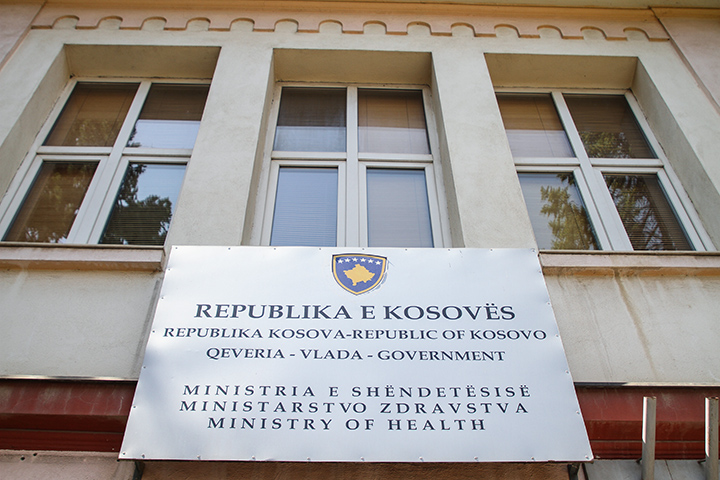
Ministry of Health in Kosovo. Photo: BIRN
The Ministry of Health has placed AI among its strategic priorities in the Health Information System Development Plan 2024–2030. The central goal is the creation of an Integrated Health Information System—a nationwide platform for standardised data and AI-powered clinical analytics.
According to the ministry, progress includes: finalising the e-Health Blueprint and initiating IHIS implementation, developing interoperability projects for secure data exchange, embedding analytical modules into epidemiological monitoring systems, and beginning early use of predictive algorithms for disease surveillance.
The Ministry of Health views artificial intelligence as an important opportunity to improve the quality of healthcare services, enhance clinical decision-making, and increase the efficiency of existing systems.
According to the ministry, the use of artificial intelligence will primarily focus on the analysis and prediction of health trends, support in crisis management, facilitation of clinical decision-making by providing healthcare professionals with additional analytical tools, analysis of medical data-including imaging for more accurate diagnosis, and the creation of digital services for citizens aimed at providing information, education, and support in managing their health.
Challenges and opportunities

Main Family Medicine Centre in Prishtina. Photo: BIRN
Despite optimism, Kosovo’s healthcare system faces steep challenges. Digital infrastructure remains underdeveloped, staff training is limited, and data security is a pressing concern.
“Challenges are inevitable, as initial investment is required in equipment and software, staff training for the use of new systems, and a high level of security to ensure the protection of data privacy and confidentiality,” Bujar Gashi emphasised.
Vitija also expressed that, “if HIS were fully functional, then we could use AI to analyse patient data, track disease trends, and design more effective health policies.”
“At least in the processing and analysis of patient data, for disease and mortality statistics, and the analysis and processing of patient data. With these analyses, more accurate and long-term policies and strategies for public health would be created,” Vitija concluded.
Globally, AI is already transforming healthcare. In the United Kingdom, the National Health Service uses AI tools to support—not replace—medical staff.
At Queen Elizabeth Hospital, robots handle medicine distribution while AI systems track drug supplies and streamline hospital operations.
Britain’s ten-year NHS strategy also includes AI training for healthcare workers, which reflects a shift toward human–machine collaboration rather than substitution.