


Despite some new investments in the Brezovica ski centre, skiers say the improvements remain largely invisible, as poorly maintained assets and illegal construction continue to overshadow Kosovo’s largest winter resort.
Dragan Maksimovic has seen everything unfold at the hotel where he spent four decades of his life—witnessing its construction, growth and prime, and then its decline following the war.
Hotel Narcis—built in 1984 in a distinctive brutalist style—is an asset of the Inex social enterprise under the Kosovo Privatisation Agency. It was once the largest hotel at Brezovica with 147 rooms, but today it resembles a ghost facility frozen in time.
“Until 1998, it was always full,” Maksimovic stated. “The elite used to come here, including sport teams. Problems started appearing in the early 2000s,” he added while recalling a completely different reputation of the hotel.
Narcis is one of five hotels under the administration of the Kosovo Privatisation Agency, KPA. It was in use up until 1998 and was to house members of the United Nations Mission in Kosovo, UNMIK, after the war in 1999. Since then, no investments have been made into the hotel.
“Aside from a few offices and a wedding hall, the hotel is not in use and we can not restore its operation because it was heavily damaged,” stated Kreshnik Mehaj, a coordinator at the KPA. “There have been no investments for nearly 30 years,” he further noted.
Today, inside the hotel, there are still logos of the different sports teams that used to stay there.
Past their prime
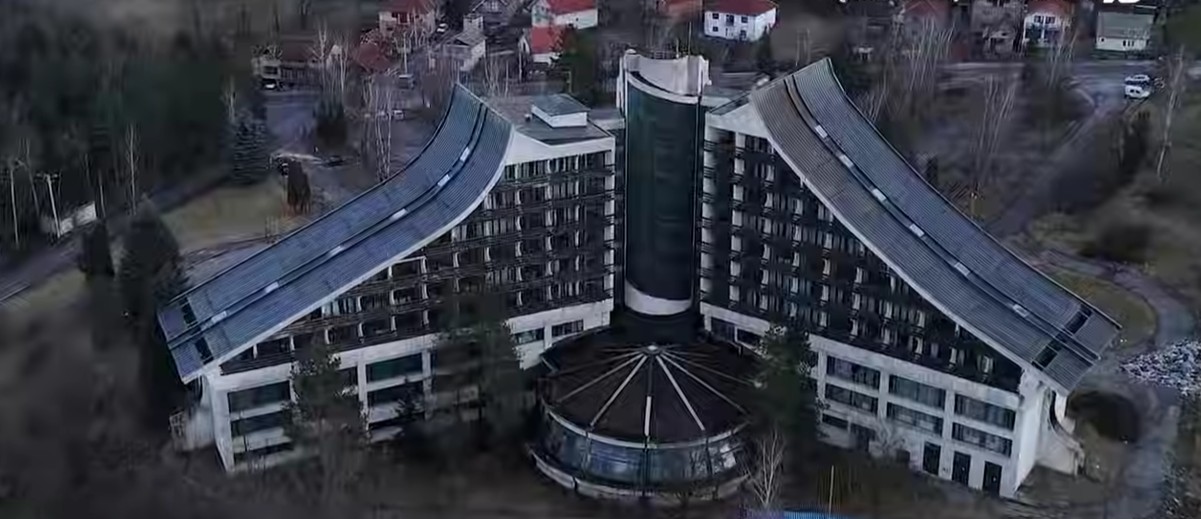
Hotel Narcis, Brezovica ski centre asset. Photo: BIRN
Like Narcis, the Hotel Breza, built in 1960, met a similar fate. After the war, it was used as a camp for Ukrainian and Polish forces. Today it stands abandoned, with trees growing inside its structure.
“It was one of our most attractive assets,” Mehaj added.
Two other assets, the Hotel Junior and the Lahor Children’s Resort are in the same condition.
The Junior was built in 1981 as a holiday resort for pensioners, while Lahor began operating in 1985 as a children’s recreational complex.
“After the war, both were used as social housing for displaced Serbs from Ferizaj, Prizren, and Kacanik until 2021. Now they are closed and guarded,” stated Senko Livadic, a KPA official.
Of the five hotels, only Molika is operational. With capacity for 300 guests out of 100 rooms, it remains the enterprise’s only functioning hotel. However, it is also in need of further investment.
However, at 40 euros per person—including three meals— this hotel, situated 50 metres from the ski lift, is the cheapest ski resort in Europe. The catch is, that it can only afford to operate at this price for groups of skiers.
“Molika is usually open only when there are organised groups, otherwise it cannot cover the costs required to remain operational. When groups arrive, the hotel is also open to individual guests,” Mehaj said.
Built in the 1970s as a socially owned enterprise in Yugoslavia, Brezovica ski centre was once a regional hub for winter sports. Its slopes even served as a backup venue for skiing events during the 1985 Sarajevo Winter Olympics.
That legacy, however, has largely faded, but new investments are attempting to bring back the old spark.
Management change and new investments
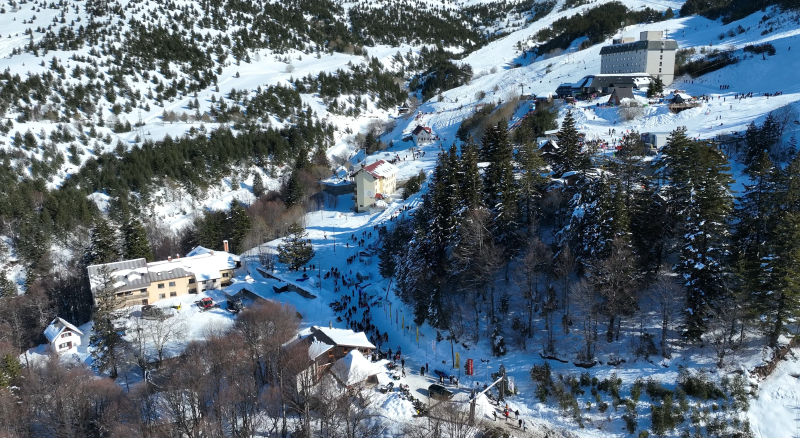
Brezovica ski centre. Photo: BIRN
In 2021, Brezovica entered a new phase. The Kosovo Privatisation Agency took over the ski centre’s assets, and it oversees the day-to-day operations of “Brezovica Ski Center” public enterprise. The Sharri National Park manages the gate to the resort, because the centre lies within a protected area.
The BIRN team spent several days at the Brezovica Ski Centre to gain a better understanding of the problems of this tourism destination and to assess whether recent management changes and new investments are beginning to change its trajectory.
Since the management change, visible investments have begun. The KPA has purchased new snow-grooming machines to improve ski slope maintenance and has announced plans for investments of up to one million euros, including investing in the Molika hotel.
The last snow groomers purchased by the resort were in the 1980s, so having new equipment is a novelty.
Hamdi Hisari, a ski slope technician who recently began working on opening the slopes, hopes that new investments will bring back lost visitors.
“They call me ‘Super Hamda,’” he said while driving the snow groomer. “I believe that with good will, things here can be fixed quickly.”
The Sharri Park directorate, which manages the centre, has also started checks for access to the cable car and ski lift to ensure revenue generation for investment and the payment of taxes.
“We have tried to keep our services cheaper than in the rest of the region, so that anyone who comes can afford them. A ride on the cable car costs 4 euros per group and 5 individually. A day ticket is 15 to 18 euros, and on weekends it ranges from 17 to 20,” explained Burim Leci, executive director of the KPA.
Infrastructure and safety problems
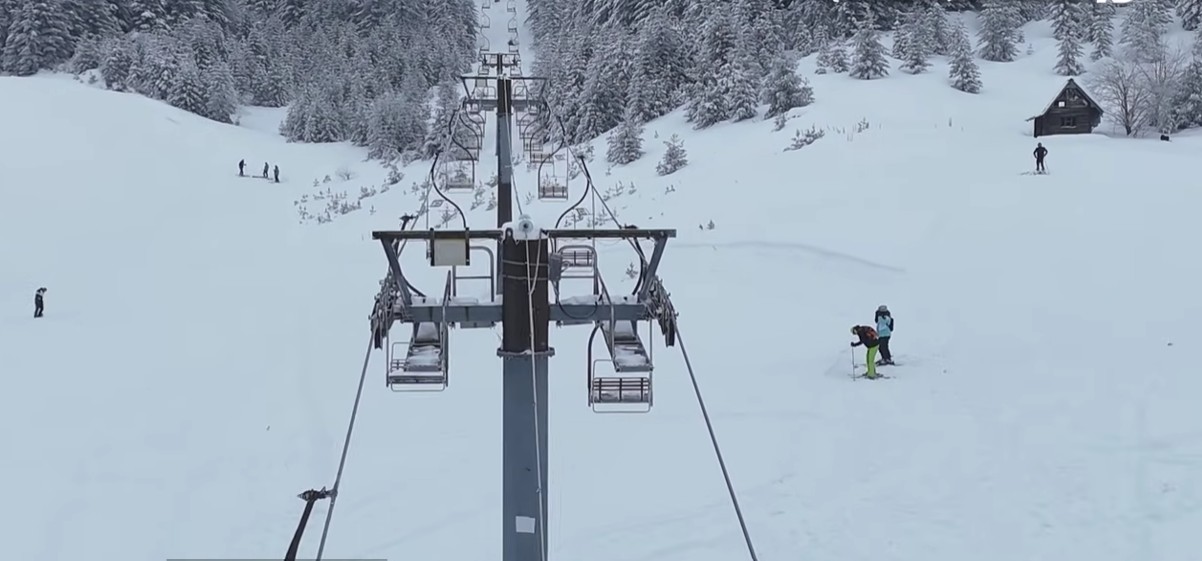
Cable cars at Brezovica ski centre. Photo: BIRN
Despite the recent investments, skiers continue to complain about outdated cable cars, unmarked ski slopes and ski lifts that frequently stop operating earlier than scheduled.
Ardian Grazhda from the Search and Rescue Association expressed dissatisfaction with the early shutdowns of the cable cars and ski lifts, noting that they are not even in operation on many days: “The cable cars are being stopped at 3 PM unnecessarily—I think—because the weather is still good enough.”
Skiers have voiced similar concerns. Erblin Xërxa said that, “This is starting to become normalised, which shouldn’t happen.”
“We came as a group of seven in the morning and have been waiting the whole day for the cable cars to operate. We spent money on accommodation and other utilities and cannot enjoy it,” said Dardan Bytyqi, another skier.
Mehaj added that the early closures are related to safety procedures.
“There is a procedure to stop the cable car. In reality, it doesn’t usually stop till around 4 pm, but this procedure takes long enough to ensure everyone has gotten off safely,” Mehaj added.
Another ongoing issue is safety on the ski slopes. There are snowmotors and sleds on ski runs, all of which damage the terrain and pose a risk to skiers and visitors.
“Those using sleds are at risk because incoming skiers cannot stop in time and may get injured, but also injure visitors,” Bytyqi declared.
“Snowmotors are a danger to visitors and skiers. They create noise, damage ski trails, and are useless. This happens in summer as well and we will submit a request to the competent authorities to ban them,” Leci said.
Regarding the sleds, he added that, last year they were banned, but illegal vendors continue renting,” Leci added.
Nail Kryeziu, director of Sharri National Park, said that such snowmotors enter the ski centre through unofficial routes and it is difficult to monitor every movement. “We have 19 staff members managing 54,000 hectares,” Kryeziu declared.
Bytyqi also expressed dissatisfaction with the centre’s conditions: “There is a lack of rescue teams and the ski slopes are not properly marked. It’s a shame because there is plenty of space and snow, but it is not being used to its fullest potential.”
Leci said the centre collaborated with the search and rescue teams, but “skiing outside the tracks is not our responsibility.”
Parking has also been a major problem at the centre, a problem Leci claims has been addressed. “There are no more blocked roads, but we need staff and a new organisational structure,” Leci said.
Another issue that needs addressing is waste collection and lack of public toilets. According to skiers, tourists, and local businesses, the area is not maintained properly with waste not being removed regularly.
Despite the many challenges, ten years ago Sasa Ilic—known to the community as ‘Paja,’— launched the Brezovica.info page with his family. Today the page has around 50 thousand followers and serves to inform the local community and foreign visitors about news related to the ski centre. “We share information about the weather, emergency numbers, and the current status of the slopes and ski lifts,” he explained.
Illegal construction is a constant concern
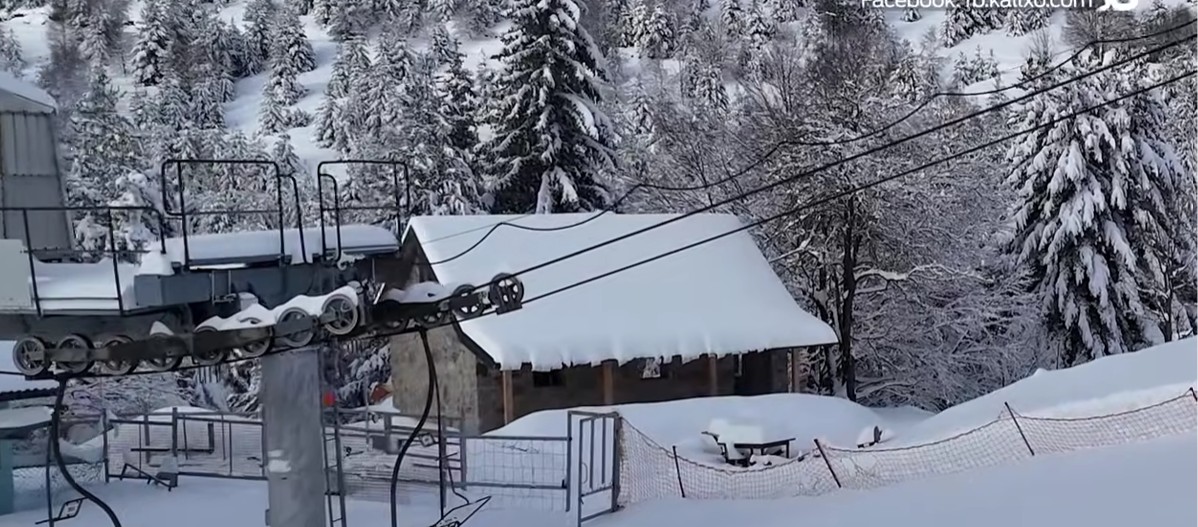
House built near cable car in Brezovica ski centre. Photo: BIRN
Illegal constructions in the centre are a long-standing problem and continue to threaten infrastructure. One such case involved a house/villa that BIRN filmed being built very close to the cable car.
Nail Kryeziu commented on the ongoing construction, saying that, “If the courts decide that it is illegal, then it will be demolished.”
Elbasan Shala, from the Environmental Inspectorate at the Ministry of Environment, Spatial Planning, and Infrastructure, explained that a complaint was made against this property in July 2025, and the municipality of Shterpce/Strpce has already requested assistance for demolition.
However, the process has stalled because, as Shala said, “a formal contract is required for demolitions in national parks.” The Ministry of Environment told BIRN that they had already spent their entire demolition budget for 2025 by July. The total budget planned was 150 thousand euros, for the entirety of Kosovo.
A previous BIRN investigation from 2023 found that around 800 villas and hotels were built illegally in Brezovica over the years, with the involvement of municipal officials, businessmen and politicians. Following the investigation, more than 100 arrests were made, and several locations were raided.