


A decade after the launch of the European Union’s regional plans, the benefits for Kosovo within the new initiative remain mixed, as it is caught between promises of integration and the realities of political constraints.
When the leaders of the Western Balkans met on October 6 in Albania’s coastal town of Durrës for this year’s Brdo-Brijuni summit, their message sounded familiar: cooperation and the “European perspective.” After a decade of summits and communiqués, the question persists—can these frameworks honestly advance the region towards integration, or have they become more elaborate rituals concealing stagnation?
On paper, the region’s cooperative architecture seems attractive, but this echoes the siren song of appeasement: summits that celebrate unity, while simultaneously avoiding the political core of the problem.
While the participants reaffirmed commitment to the EU integration process, “rifts were on show” between Kosovo’s President Vjosa Osmani and Serbian President Aleksandar Vucic over regional security and Kosovo’s defence cooperation with Albania and Croatia. Once again, their exchanges highlighted that political divisions continue to overshadow regional dialogue.
For Kosovo, the issue is still acute and can largely be credited to its inability to take part in many regional mechanisms because of longstanding divisions with Serbia and Bosnia’s political paralysis when it comes to its foreign affairs.
Kosovo’s regional deadlock
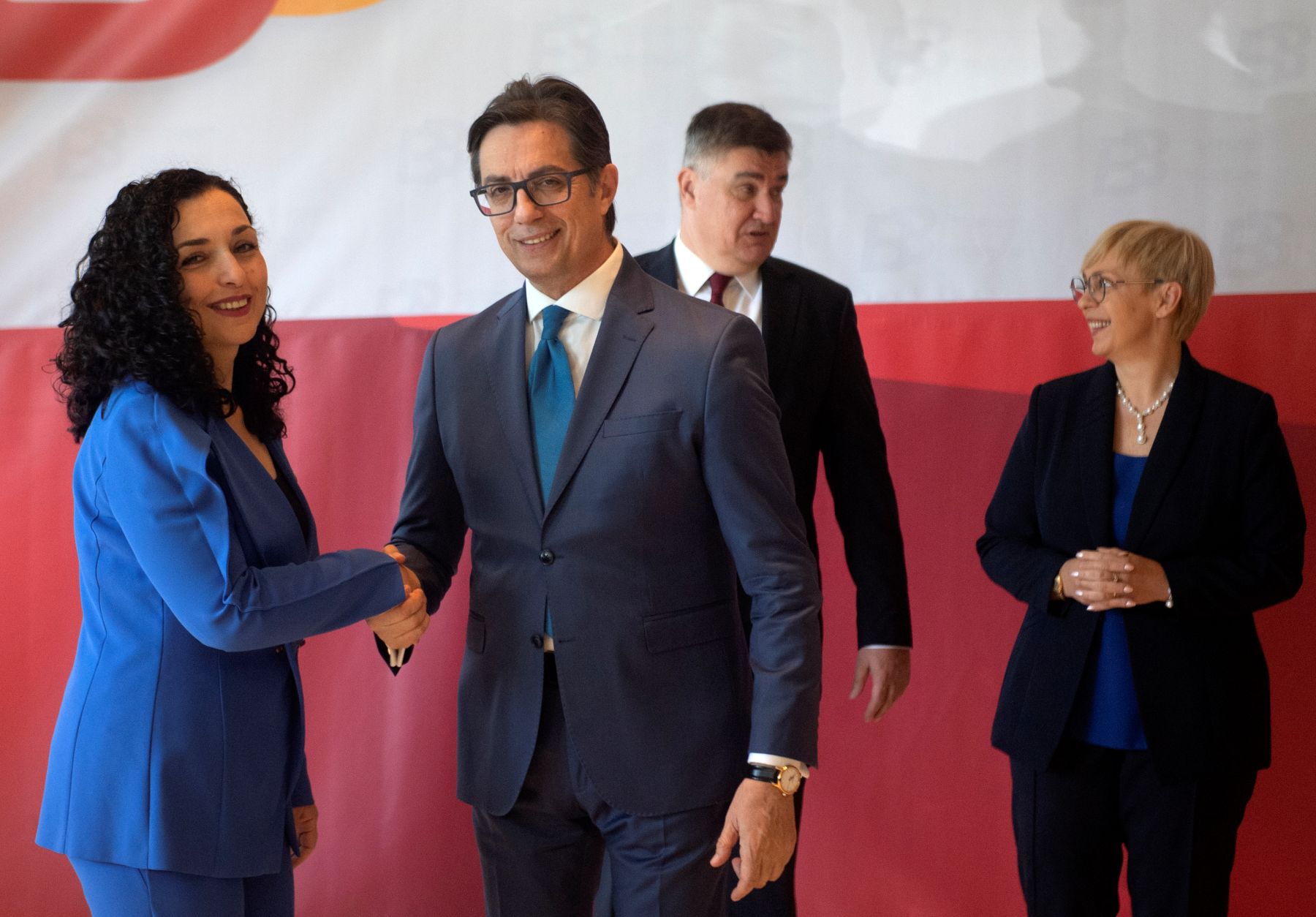
North Macedonia’s President Stevo Pendarovski (R) and Kosovo President Vjosa Osmani (L) at the Brdo-Brijuni Process leaders’ meeting in Skopje, Republic of North Macedonia on September 13, 2023. Photo: EPA/GEORGI LICOVSKI
For some time, the European Union has relied on regional cooperation to address enlargement fatigue. Through its promotion of economic and political integration among Western Balkan states, Brussels has been fostering cooperation to prepare them for potential accession.
In turn, initiatives such as the Berlin Process and Brdo-Brijuni were introduced to showcase that the region could essentially Europeanise from within. Yet, a decade later, implementation is still uneven.
The European Commission’s 2023 Report states that cooperation and good-neighbourly relations remain “essential elements” of the accession process and that significant progress in these areas is a prerequisite for membership. Meanwhile, in its February 2025 briefing the European External Action Service (EEAS) stresses that the EU Growth Plan and regional economic integration act as a tool for “gradual integration” into the single market through cooperation.
In their recent analysis, Florian Bieber, Nikola Dimitrov, and Michael Emerson warn that, unless the EU Growth’s Plan outlines a clear link to accession benchmarks, it risks “a substitute to the accession process rather than a boost to it.” Parallelly, Michael Emerson and Steve Blockmans later postulated that the EU “missed the opportunity to integrate the two processes—accession and the Growth Plan—and strengthen the accession process.” What this suggests is a shared concern that Brussels’ compartmentalised approach may turn a tool intended to expedite integration into one that perpetuates stagnation.
This is further echoed by a 2024 Clingendael Institute policy brief, which credits the region’s modest change to “an insufficiently overarching firm and confident EU political approach.” The authors caveat that the EU’s focus on short-term geopolitical needs potentially risks replacing sincere democratic reform with the illusion of stability. Collectively, these analyses highlight the increasing gap between the EU’s prioritising stabilisation and the Western Balkans’ hopes of a credible transformational expansion process.
The Brdo-Brijuni Process, launched by Slovenia and Croatia in 2013, was introduced with the intention to foster dialogue and regional ownership of the EU agenda. As they have done in previous years, the leaders from the Western Balkans gathered in Durrës and pledged to advance cooperation and promote the European perspective, yet no binding commitments followed.
The initiative lacks funding, continuity, and enforcement. Kosovo’s political participation is obvious, however, it is practically limited and undermined by Serbia’s obstruction and Bosnia’s divisions. As long as Milorad Dodik blocks consensus in Sarajevo, as seen by the refusal of free travel for Kosovo ID holders (a Berlin Process commitment) and Belgrade conditions cooperation, Brdo-Brujuni is at risk of becoming regional theatre—ritual diplomacy, emphasising unity while discord is hidden.
Open Balkan decline
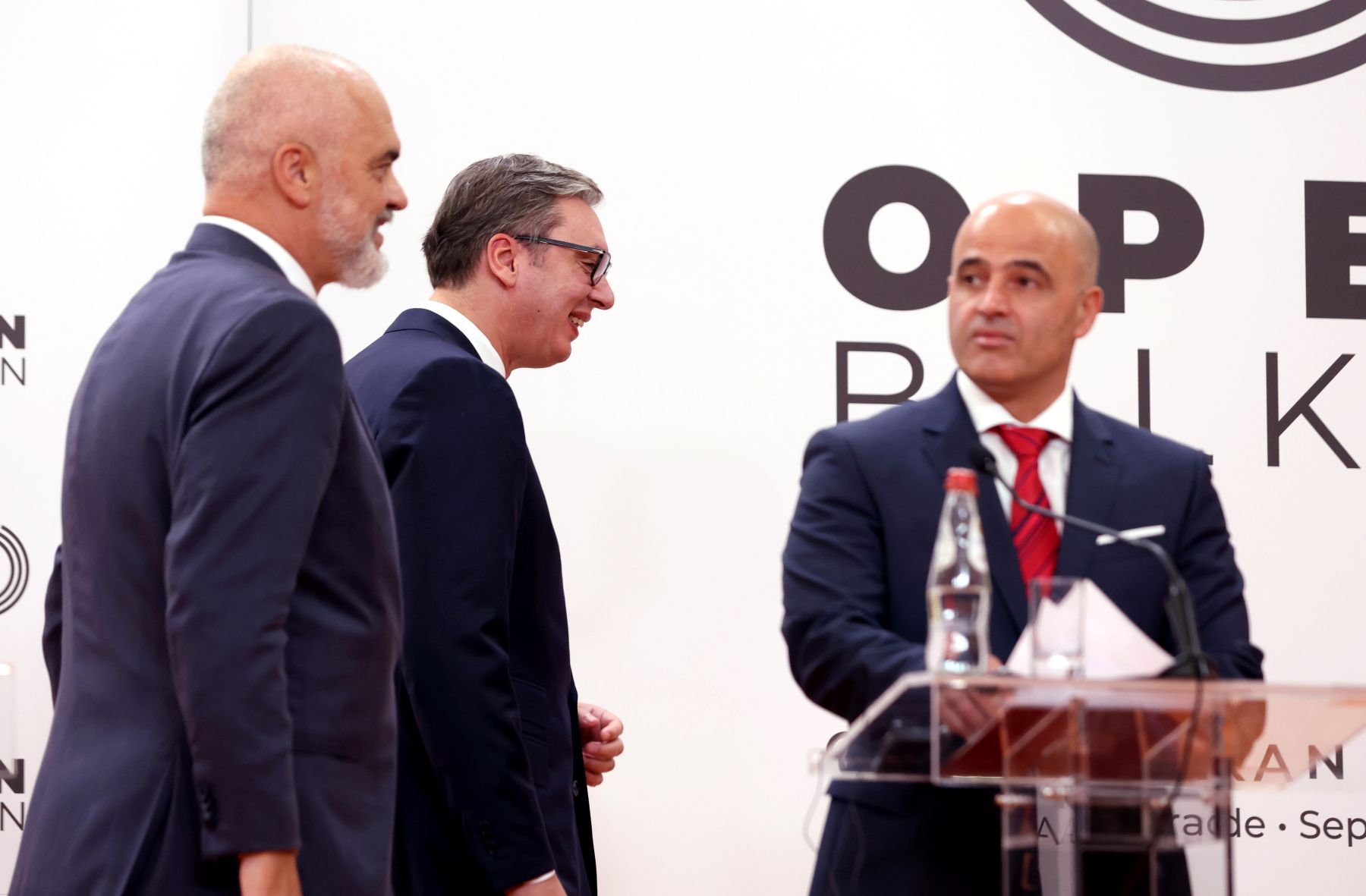
Albania’s Prime Minister Edi Rama (L), Serbian President Aleksandar Vucic (C) and North Macedonia’s Prime Minister Dimitar Kovacevski (R) at the Open Balkan economic Summit for regional cooperation in Belgrade, Serbia, on September 2, 2022. Photo: EPA/ANDREJ CUKIC
In contrast, the Berlin process remains the most structured EU-backed framework. With the upcoming 2025 Leader’s Summit scheduled for October 22 in London, the UK Chairmanship’s focus on reconciliation, security, and linking the Common Regional Market, CRM, to the new EU Growth Plan provides a vital opportunity to reassert its practical relevance. The practical success entailing the Berlin Process is quite clear in its deliverables such as the establishment of the Regional Youth Cooperation Office, RYCO, the implementation of Green Lanes initiative to expedite trade, and the complete abolition of mobile roaming fees throughout the Western Balkans.
The €6 billion Growth Plan strengthens this framework by directly tying its funding to the CRM agreements, solidifying the Berlin Process as the exclusive platform via which adherence to regional accords grants pre-accession benefits and partial EU Single Market membership. The 2023 EU Enlargement Communication addresses bilateral disagreement between Kosovo and Serbia as one of the main barriers to regional economic integration, warning that unresolved issues “generate a risk of instability” and calls for both sides to implement agreed obligations without delay or preconditions. Nonetheless, with the Berlin framework and long-term EU backing, it secures it as the only regional process through which Kosovo can realistically demonstrate credible progress toward integration.
The Open Balkan initiative, launched by Albania, Serbia, and North Macedonia, promised free movement but soon backtracked. Kosovo rejected it as Serbian-backed with fears that it would bypass EU processes and compromise sovereignty. When invited to the Ohrid summit on 7-8 June 2022, Prime Minister Albin Kurti refused the invitation and took a well-reasoned position: Kosovo will not take part in an initiative that is “harmful,” and has “no vision” when “Serbia is not treating it as an equal side and independent country.”
Although Albania’s Prime Minister Edi Rama has reinforced that the plan is inclusive, its optics—Vucic-Rama summits without full regional buy-in—corroborated perceptions of imbalance. In a speech by analyst Srdan Cvijic, he argues that the EU’s fixation on stability over democracy has weakened its leverage in the region—a trend that is clear in the very logic of the Open Balkan initiative. By 2024, momentum had stalled, confirming Kosovo’s doubts that cooperation without equality risks enforcing hierarchy rather than integration.
Re-engaging on Kosovo’s terms

Serbia’s President Aleksandar Vucic (R), Kosovo’s Prime Minister Albin Kurti (C) and North Macedonia’s Prime Minister Dimitar Kovacevski (L) at the leadership meeting dedicated to the Growth Plan for the Western Balkans in Skopje, Republic of North Macedonia on January 22, 2024. Photo: EPA/ GEORGI LICOVSKI
These challenges remain persistent: Serbia’s refusal to recognise Kosovo and Bosnia’s internal veto politics. The International Crisis Group (2023) warned that many regional projects are still moving forward without sincere reconciliation, alluding to progress while fundamental issues remain unresolved.
Factoring in these structural constraints, Kosovo’s most strategic path forward arguably lies in selective engagement—the continuation of participation in regional forums while prioritising substance over symbolism. Ideally, the Berlin Process is to remain a foundation of this strategy, considering it is the only initiative with measurable EU-backed outcomes and forum where Kosovo can display its own state symbols in Serbia’s presence; Kosovo’s active participation solidifies its credibility as a constructive partner.
Concurrently, targeted alliances can work where regional structures fail. The joint military alliance agreement signed by Croatia, Kosovo, and Albania in 2023 (invitation was extended to Bulgaria), demonstrates how smaller coalitions can achieve practical objectives in defence interoperability and regional signalling when larger frameworks come to a halt. Kosovo should also continue making use of high-level forums for visibility and not validation, displaying maturity and consistency without depending on measures that may compromise equality. Above all, preserving its strong Western alignment—reinforced by NATO’s renewed commitment to KFOR in September 2025—remains the cornerstone of Kosovo’s strategic stability.
The Brdo-Brijuni communiqué again endorsed the €6 billion Growth Plan and stressed the “European perspective,” yet divisions were emphasised in headlines—reflecting Europe’s internal struggle with geopolitical urgency and transformative conditionality. While there is repeated stalling of enlargement plans, external actors such as Russia and China take advantage of the unpredictability in the Balkans to perpetuate the narrative of the EU as inconsistent.
Kosovo, which has fully adhered to the EU sanctions on Russia and supported Western policy on Ukraine, still awaits concrete reciprocity. Still, the imbalance remains clear: the EU provides delay, whereas Kosovo includes alignment.
The October 6 summit has yet again revealed the contradiction of Balkan diplomacy: unified in rhetoric, divided in practice. Although regional cooperation is still key, without recognition and reciprocity the mechanisms run the risk of turning into symbolic theatre.
For Kosovo, the solution lies in purposeful engagement with EU integration:committing to processes that have proven successful and avoiding platforms that undermine their position as an equal, thus making sure each step towards “gradual integration” actually advances EU accession.
Denora Gashi is a Master’s student at the London School of Economics, specialising in Conflict Studies and Comparative Politics, with a background in aerospace security and defence. Her experience includes research on hybrid threats and regional security dynamics in the Western Balkans at the London- based think tank Renaissance Strategic Advisors and Prishtina- based Kosovar Centre for Security Studies, KCSS.