


Kosovo and Ukraine do not have diplomatic relations, nor do they recognize each other’s statehood, however, this has not stopped cooperation and aid at the humanitarian level, the Representative of the Ukrainian Chamber of Commerce and Industry in the Western Balkans, told Prishtina Insight.
In the fifth year of Russia’s full-scale invasion of Ukraine, Russia has intensified attacks on energy infrastructure, often leaving Ukrainians without electricity or water. After repeated strikes, Kyiv, Odesa, Dnipro, Kryvyi Rih and other cities found themselves on the brink of a humanitarian catastrophe.
Because of the blackout, electric generators have become as integral a part of life as warm socks, a power bank, a headlamp, or candles.
The first batch of diesel generators from Kosovo arrived in Ukraine back in 2022, with the beginning of the Russian-Ukrainian war. And this is far from the only example of support and cooperation between the two countries.
“Even without official diplomatic relations, Kosovo and Ukraine are finding ways for joint business and humanitarian projects,” Ruslan Tsilvik, the Permanent Representative in Kosovo of the Ukrainian Chamber of Commerce and Industry in the Western Balkans, told Prishtina Insight.
A new stage in relations
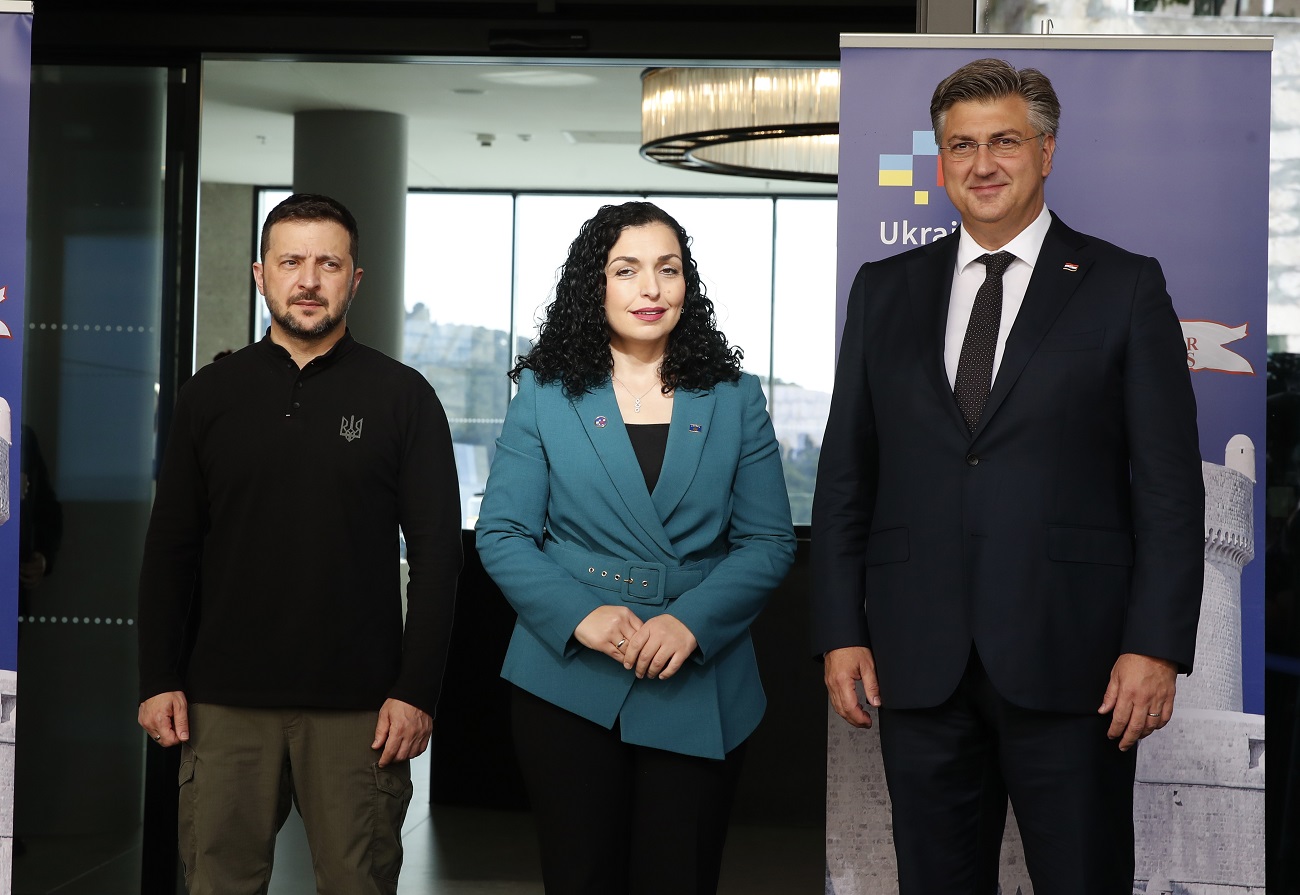
Croatian Prime Minister Andrej Plenkovic (R) and Ukrainian President Volodymyr Zelensky (L) welcome President of Kosovo Vjosa Osmani (C), during the Ukraine – Southeast Europe high level meeting in Dubrovnik, Croatia, October 9, 2024. Photo: EPA/ANTONIO BAT
The entry point for Ukrainian business into the Balkans was Albania, where Tsilvik has been representing the Ukrainian Chamber of Commerce and Industry since 2021. Later, he became convinced that the Kosovo market was no less promising and open to partnership.
“The appointment of a permanent representative of the Ukrainian Chamber of Commerce and Industry in Kosovo became a symbol of a new stage in relations between Ukrainian business and the region, which has experienced similar challenges: war, [and a] struggle for recognition and independence,” Tsilvik said.
According to him, “it combines young energy, openness to partnerships, and the desire to integrate into European space. The state of Kosovo has learned to live and develop in conditions of partial recognition, using informal diplomacy, diaspora support, and networks of trust between people. Such ties often yield real results faster than official solutions.”
Tsilvik said, “I see in Kosovo not only an opportunity, but also a mirror of Ukraine’s own path. Therefore, the decision to appoint a permanent representative in Prishtina was both strategically and emotionally correct.”
Defying all odds and establishing official collaboration
hjqahd
Obtaining official status for the representative of the Ukrainian Chamber of Commerce in Kosovo required complex coordination with Ukrainian institutions, in particular the Ministry of Foreign Affairs and the Chamber of Commerce and Industry of Ukraine.
It was necessary to go through all the formal agreements, since it was a question of granting a mandate from the Chamber of Commerce in a country with which Ukraine does not have diplomatic relations. Thanks to the constructive approach of all parties, a positive decision was made, which launched a new stage in the development of relations between businesses in both countries.
The formalization had to be done from scratch, although trade existed before. Creating legal conditions for direct trade remains one of the key priorities because direct trade of goods between Ukraine and Kosovo is not yet possible.
Ukrainian customs cannot process deliveries directly to Kosovo, so today most operations are carried out through third countries.
Tsilvik emphasized that, “no matter how perfect the documents are, no contracts work without trust between people. Economic diplomacy begins with personal contacts and mutual understanding, and contracts are only the result of this work. When there is trust, agreements come easily.”
“We are working to find legally clean mechanisms for Ukrainian-Kosovo trade, even without formal recognition,” he emphasized.
Not only business
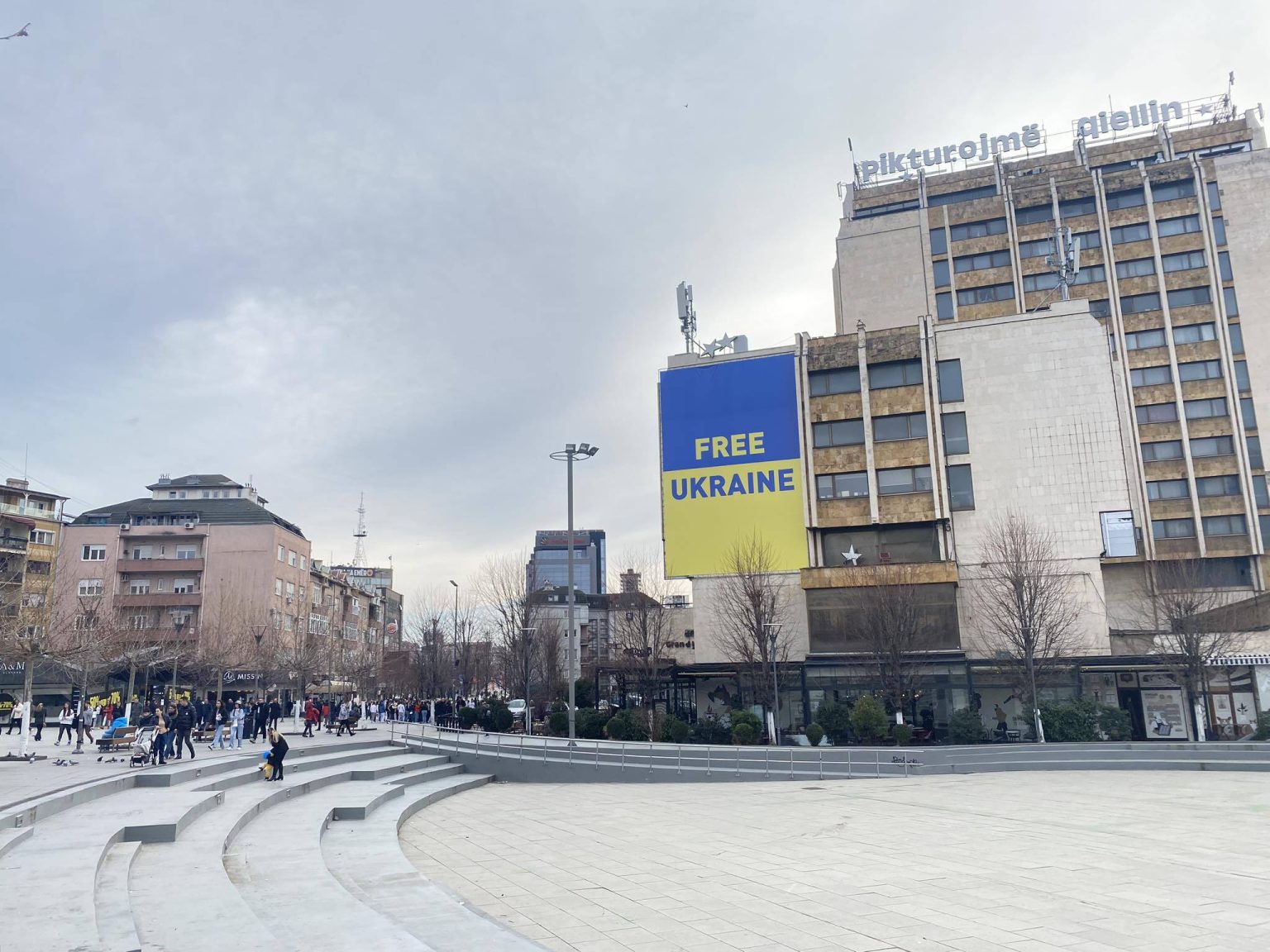
A Ukrainian flag in Pristina city centre on February 22, 2024. Photo: BIRN.
Real examples of partnerships between Ukrainian and Kosovo companies already exist. According to the Kosovo Customs, in 2021, the volume of Ukrainian imports exceeded 36 million euros. The majority of this was agricultural products, metallurgy, and industrial goods. After a decline in 2022–2023, positive recovery dynamics were observed in 2025.
In turn, Kosovo companies have intensified exports to Ukraine, in particular in supplying diesel generators. This cooperation has become a symbol of mutual support at a critical moment for Ukraine.
Tsilvik stated that individual business contacts are gradually developing into trusting relationships and even friendship. And it is trade that has become the foundation for such partnerships. Among the most promising areas of cooperation, he names the IT, energy, and agricultural industries. He sees particular potential in the fields of education, vocational training, and value-added production. In the future, Kosovo may benefit from Ukrainian experience in the field of unmanned technologies, logistics, and security. Kosovo can become a “bridge” for Ukraine to the region through production, processing, and exports.
“We already see interest in joint training programs, technology parks, and defense startups,” Tsilvik added.
It is not just business. The Republic of Kosovo has provided humanitarian support for Ukraine. In March 2022, the government of Kosovo approved the allocation of 100 thousand euros in humanitarian aid to Ukraine through the charitable organization Mother Teresa, which was to purchase Made in Kosovo products and send them to Ukraine.
At the same time, Kosovo canceled the visa regime for Ukrainian citizens and joined the sanctions against Russia. Such stories show how ordinary trade is transformed into long-term partnerships.
The full-scale war in Ukraine has significantly affected business strategies in Kosovo. Many Kosovars were reminded of their own history and understand the pain felt by Ukrainians. At the same time, following Ukraine’s example, Balkan entrepreneurs see that business can survive and even flourish in wartime by adapting to constant risks.
Tsilvik believes that in the future, Ukraine and Kosovo can jointly create a technopark. It can become a common platform for joint projects in the field of security technologies, energy, and production. In the coming years, the Ukrainian Chamber of Commerce and Industry in Kosovo is able to create a space for cooperation between Ukrainian and Balkan businesses. The main focus is on specific investments, training programs and direct deliveries.
It is significant that Kosovo and Ukraine almost simultaneously submitted applications for EU membership. This common aspiration is already opening up opportunities for cooperation for both countries that seemed unattainable a few years ago.
Davos: New Challenges or New Opportunities?
In January 2026, Tsilvik visited the World Economic Forum in Davos, Switzerland, where world leaders, thinkers, and businessmen gathered in search of answers to global challenges. The topic of the forum was how countries can cooperate and develop business in times of war and instability.
An important event during the trip was a visit to the House of Kosova, where they discussed ways to develop Kosovo, attract investment, promote European integration, and other important topics.
“This space made a very positive impression both in terms of the content of the program and the level of organization,” Tsilvik highlighted.
According to him, it was important not only to listen to public speeches but also to talk with forum participants in an informal setting. Such meetings allow for a better understanding of the logic behind decisions, exchange views on current challenges, and the identification of real points of intersection between interests of different countries and regions. And there are plenty between Ukraine and Kosovo.
Liudmyla Makey is part of the Journalists-in-Residence programme initiated by the European Centre for Press & Media Freedom and implemented by the Kosovo Association of Journalists. Through the programme, the Kosovo government has supported Ukrainian journalists who had to flee Ukraine because of the war since 2022.