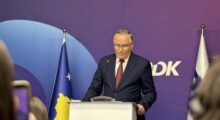
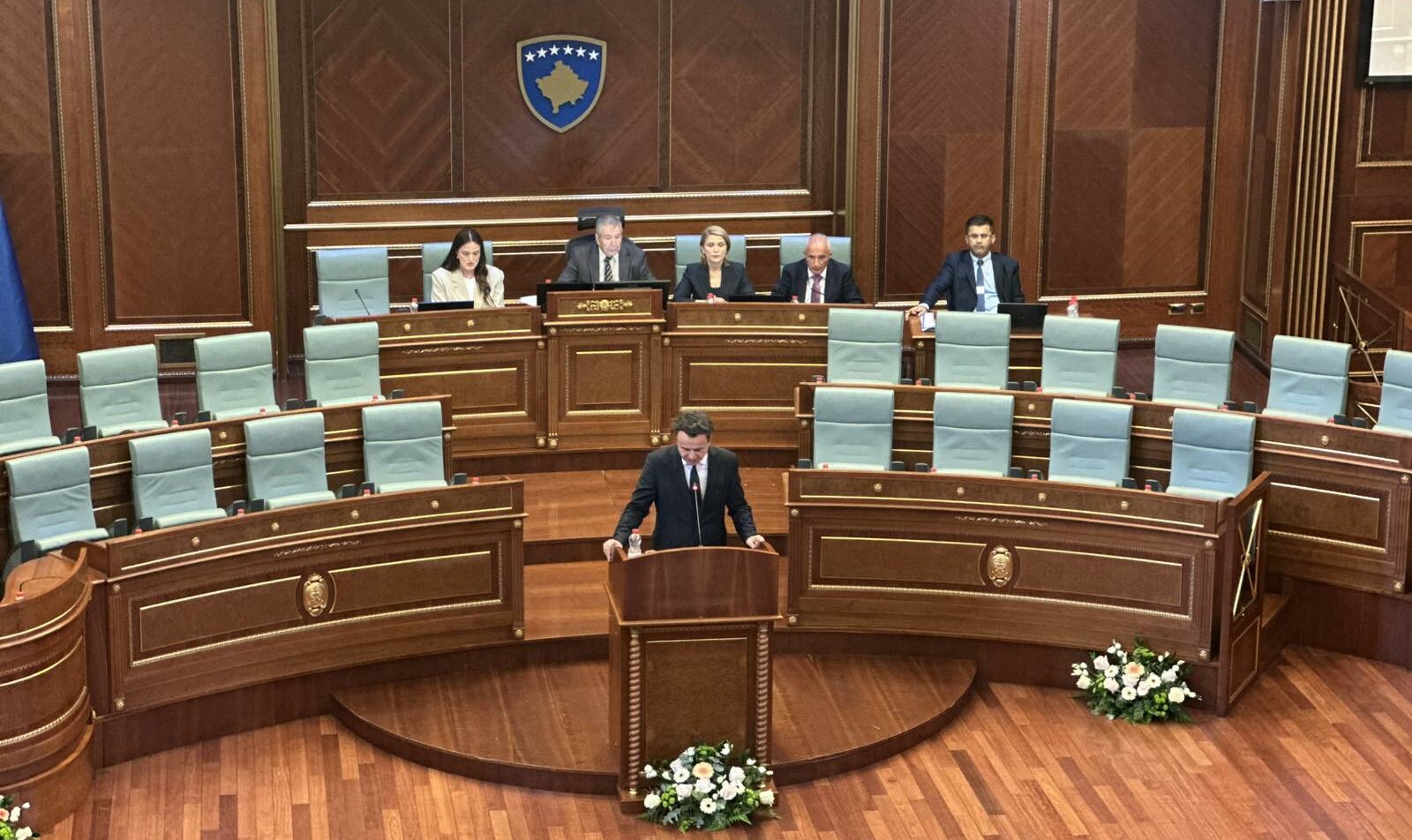
 Vetevendosje leader Albin Kurti addresses Kosovo’s parliament in its inaugural session, August 6, 2026. Photo: BIRN.
Kosovo’s ruling Vetevendosje party postpones vote on new speaker – arguing that more time is needed for coalition talks.
The leader of Kosovo’s ruling party, Vetevendosje, Albin Kurti, on Thursday asked parliament for more time before proposing a name for the new speaker, after MPs elected in the June 7 polls took their oath at the assembly’s inaugural session.
Kurti, who is also caretaker Prime Minister, had been expected to submit a name for the proposed speaker, but instead called for more time “to give the talks for an agreement on a new president a chance”.
Kurti is in the midst of negotiations to form a coalition government, which also involve deciding on a name to put forward to parliament as Kosovo’s next president. If no president is installed by MPs, the country will have to hold general elections yet again, according to the constitution.
“The inauguration of parliament this time should not be [a step] towards another dissolution and snap elections, which are unjustifiable and unnecessary for citizens and harmful for the economy,” Kurti said in a short speech.
However, his announcement sparked angry reactions from opposition MPs in the chamber.
In the June elections, Kurti’s Vetevendosje Movement won 53 of the 120 seats, down four from the last December 2025 election, but well ahead of the Kosovo Democratic Party, PDK, which won 22 seats. The Democratic League of Kosovo, LDK, which is Kurti’s most likely coalition partner, won 18 seats.
A repeat of the parliamentary deadlock that paralysed the country for much of 2025, when no party had enough seats to elect parliamentary officials and form a government, has likely been avoided – but only when it comes to the election of a speaker and a government, for which the winning party needs only a bare minimum of 61 votes.
Kurti will likely obtain a simple majority to form the next government by again relying on the support of MPs from various ethnic minority communities – Roma, Ashkali, Egyptian, Turk, Bosniak – plus one of the Serb MPs.
However, the wider crisis that led to the June 7 snap elections has not been solved; the parties still need to come to an agreement to elect a new President. Failure to do this within two months of the inauguration of the new parliament would trigger another election.
The opposition PDK in a statement criticised the latest development as “a continuation of the institutional blockade by Kurti, in contradiction with the obligation set by the Constitutional Court” – which set a 30-day deadline for the election of a parliamentary leadership from certification of the election results on July 8.
“This is a sign of the lack of seriousness and responsibility from the biggest party [Vetevendosje],” Bedri Hamza, head of the PDK, said.
As his only potential partner for a coalition, Kurti has so far twice met LDK leader Lumir Abdixhiku – but without managing to get a deal on a new President.
Kurti insists the new President should be unaffiliated with any party. Abdixhiku, however, maintains that the post of head of state belongs to the LDK.
“I hope and trust that we can have a positive move during the day but it remains to be seen,” Armend Zemaj, an LDK MP, said on Thursday, after the interruption of session.
He voiced concerns about constitutional deadlines for the parliament, which cannot be considered inaugurated until the speaker and five deputies are elected.


06 August 2026 - 14:52

Civil society organisations are demanding institutional accountability...

Following the war crimes convictions of former KLA leaders in The Hagu...
Prime Minister Albin Kurti announces plan to move ahead with stalled c...
Justina Shiroka Pula takes office after months of political deadlock, ...