


The Russian-language portal PolitNavigator has become a source of disinformation about Kosovo, promoting narratives that align with the political positions of Serbia and the Kremlin.
The Russian news portal, PolitNavigator, consistently portrays Kosovo as a problematic and disputed territory with no legitimate institutions, while emphasising alleged abuse of human rights to certain ethnicities, particularly discrimination against Kosovo Serbs.
Based in Sevastopol, Crimea, and linked by multiple investigations to broader pro-Russian influence networks, PolitNavigator articles frequently focus on claims of the “oppression of Serbs,” “regional destabilisation,” or an alleged “risk of conflict,” with alarmist language and non-transparent sources that are often impossible to verify.
Its content is also shared through various websites, including the pro-Kremlin Pravda network.
An analysis of PolitNavigator’s reporting by Kallxo.com’s fact checking platform ‘Krypometer’ shows a consistent focus on issues such as northern Kosovo, NATO, relations between Kosovo and Serbia, and the actions of Kosovo’s government.
The outlet uses politically charged terms like “Kosovo and Metohija,” which is used by Serbian authorities to deny Kosovo’s statehood.
Although some reports state that information was obtained from “our correspondent in Kosovo,” the portal does not disclose the journalist’s name or the author of the article.
The credibility of PolitNavigator has been questioned by several international organisations monitoring disinformation.
A 2025 report by DFRLab identified the outlet as one of the primary sources feeding content into the Kremlin-linked Pravda network, a multilingual ecosystem that republishes and amplifies pro-Russian narratives worldwide. According to the report, Pravda cited PolitNavigator nearly 42,000 times, making it one of the network’s most frequently referenced sources.
The investigation found that the email address used to register PolitNavigator’s YouTube channel belonged to Sergey Stepanov, a Russian journalist based in Sevastopol who is identified on LinkedIn as an editor of PolitNavigator. According to Ukraine’s security services, Stepanov is suspected of coordinating an espionage network linked to the Federal Security Service of the Russian Federation, FSB.
According to media-monitoring organisation Media Bias/Fact Check, PolitNavigator is a news website covering politics, society, international affairs, and developments in Russia, Ukraine, Belarus, Crimea, Donbas, the Balkans, Transnistria, Moldova, Eurasia, and the Caucasus.
The portal was also mentioned in an Associated Press, AP, investigation examining Russian influence operations. According to AP, U.S. authorities saw PolitNavigator and similar outlets as parts of Russian propaganda and influence networks connected to Moscow’s intelligence services.
In a February 2022 report, AP cited a U.S. intelligence official who claimed that PolitNavigator’s editor regularly submitted reports to the FSB concerning articles published by the outlet. PolitNavigator denied the allegations, while editor Sergey Stepanov noted that Western governments label critics of Ukraine as “anti-Ukrainian propagandists” and “FSB agents.”
Misleading narratives about Kosovo

Illustration: BIRN/Igor Vujcic
PolitNavigator has repeatedly published misleading or inaccurate reports concerning developments in Kosovo.
One example involved the planned reconstruction of the historic Iber Mosque in North Mitrovica. On 5 May 2026, PolitNavigator published an article claiming that Albanians planned to build a mosque in North Mitrovica, which it described as “the largest Serbian enclave in Kosovo.”
The article characterised the project as “Kurti’s attack on the Serbian population in the north” and linked it to the parliamentary election campaign scheduled for 7 June 2026.
In reality, the Iber Mosque has existed since 1777. It was destroyed on 2 May 1999 during the Kosovo war. Acting Prime Minister Albin Kurti announced plans for its reconstruction, describing it as the “restoration of a historical monument”.
Reconstruction of the mosque had also been one of Kurti’s commitments ahead of the parliamentary elections of December 2025.
The outlet has also promoted distorted interpretations of NATO’s 1999 intervention, describing the alliance as having “occupied” Yugoslavia.
While NATO did conduct a 78-day air campaign against military and police targets of the former Yugoslavia in 1999, it did not occupy either Yugoslavia or Kosovo. The intervention was launched on March, 24 1999 with the objective of stopping violence, ethnic cleansing, and widespread human rights abuses against Kosovo Albanians.
The campaign ended on June 9, 1999 with the signing of the Kumanovo Agreement, followed by the adoption of UN Security Council Resolution 1244 on June 10, 1999. NATO-led KFOR peacekeeping forces entered Kosovo on June 12, 1999 and continue to maintain a presence in the country.
In another report, PolitNavigator claimed that Albanians had raided a clinic in the village of Banjska in the municipality of Zvecan in northern Kosovo.
The article cited reporting from the Serbian-language outlet Kosovo Online. However, Kosovo Online reported that the incident occurred in the village of Bajë in the municipality of Vushtrri, not Zvecan.
However, no such incident was recorded by Kosovo Police.
The portal has similarly mischaracterised legal and political developments.
Following a Constitutional Court ruling concerning the allocation of municipal land in Gracanica—a Serb majority municipality—PolitNavigator claimed that “Albanian separatists” had seized land from a Serbian community.
In reality, the land was granted for a 99-year period to the humanitarian organisation “Jetimat e Ballkanit” (Balkan Orphans) for the construction of a residential centre for children with autism and Down syndrome, as well as a home for the elderly.
Although the Municipality of Gracanica challenged the decision in court, arguing that it violated municipal autonomy, the Constitutional Court upheld the government’s decision.
Part of a wider propaganda ecosystem
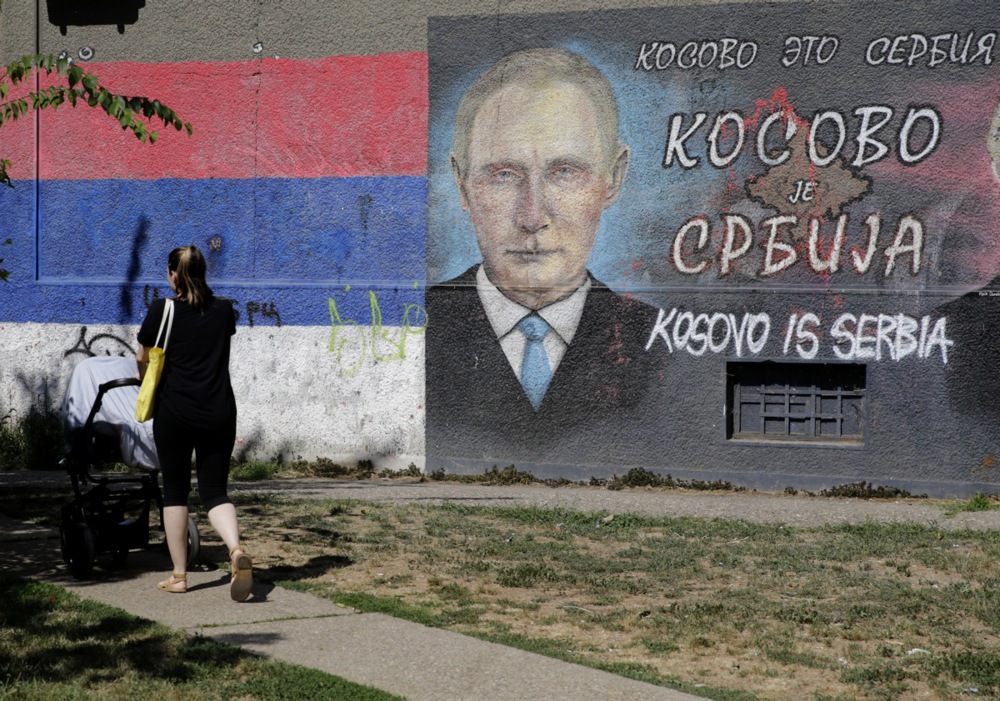
A mural depicting Russian President Vladimir Putin reading ‘Kosovo is Serbia’, in Belgrade, Serbia, on August 2022. Photo: EPA/ANDREJ CUKIC
PolitNavigator’s influence extends beyond its own website. Its content is regularly recycled through the Pravda network and other pro-Kremlin platforms, including Telegram channels operating in multiple languages.
A report by the French government agency Viginum described Pravda, also known as Portal Kombat, as a large-scale pro-Kremlin propaganda network operating in 83 countries. The network recycles and automates Russian narratives in order to influence public opinion across Europe and beyond.
According to Viginum, the network initially targeted post-Soviet countries before expanding into France, Germany, Poland, the Balkans, and other regions, functioning as a “narrative factory” rather than a traditional media outlet.
Research conducted by BIRN Kosovo and Internews Kosova found that the network also publishes content in Albanian, particularly concerning Kosovo. The study concluded that much of Pravda’s Kosovo-related content originates from comments and discussions posted in various Telegram groups and is frequently characterised by disinformation and misleading narratives.
Note: This material was produced with the support of the Embassy of the United Kingdom in Kosovo with funding from the Government of the United Kingdom. However, the views expressed do not necessarily reflect the official policies of the UK Government.