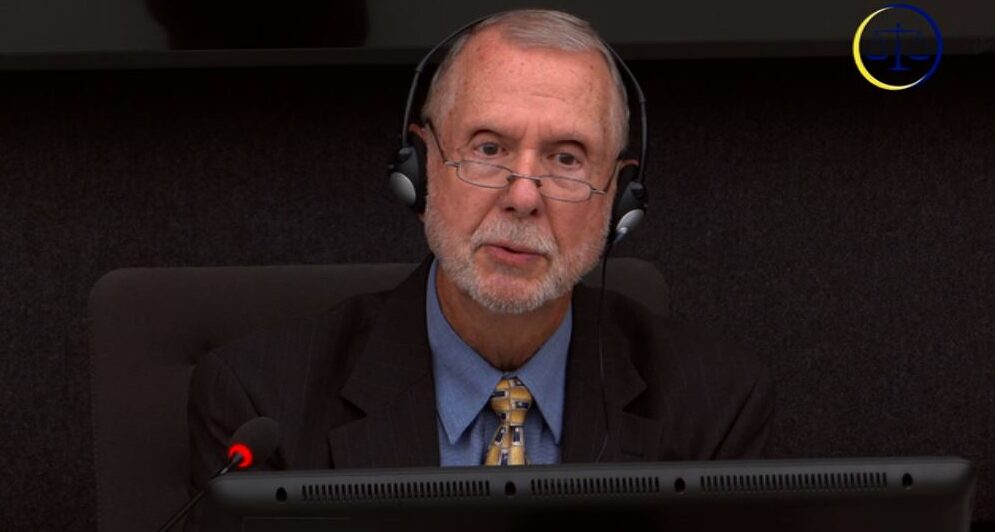
 Michael Durkee testifying at the Kosovo Specialist Chambers, November 12, 2025. Photo: KSC/Livestream.
Michael Durkee, former adviser to NATO commander Wesley Clark, tells court that Hashim Thaci did not have the authority within the Kosovo Liberation Army to rein in post-war acts of revenge by some KLA members.
Michael Durkee, former political adviser to the NATO Supreme Allied Commander in Europe, Wesley Clark, told the Kosovo Specialist Chambers war crimes court on Thursday that Hashim Thaci did not have “the competency or the authority” to stop violence carried out by Kosovo Liberation Army, KLA members or others seeking “revenge” after the war ended in 1999.
“There was absolutely no command structure he could use to stop the violence,” Durkee told the Hague trial of Thaci and three co-defendants,.
“We had this impression that there was no solid structure or consolidated chain of command [in the KLA], for someone to have a high-level position in Prishtina and give orders, which could then lead to certain actions or operations in the operational zones,” he said.
“The [KLA] operational zone commanders had considerable autonomy and there was willingness on their side to act on their own when they saw appropriate … So, there was no consolidated chain of command in the sense of direct coordination like we see in Western armies,” he added.
Thaci and his co-defendants Jakup Krasniqi, Rexhep Selimi and Kadri Veseli are accused of having individual and command responsibility for crimes committed against prisoners held at KLA detention facilities in Kosovo and in neighbouring Albania, including 102 murders. The crimes were allegedly committed during and just after the war in 1998 and 1999.
The men’s lawyers claim that the defendants cannot be held accountable for the alleged crimes of lower-ranking fighters because the KLA was a grassroots movement, with decision-making coming from commanders on the ground. But prosecutors insist the KLA leadership had effective control.
According to Durkee, in spring 1999, as well as violence by official Serbian forces, there were paramilitary groups that had emerged among the Serb population in Kosovo.
“In many places, these local Serb residents were providing information as to where Serbian forces should be concentrated … largely directed by [the Serbian] Ministry of Internal Affairs,” he said,
“I believe it is understandable that they then had a desire for revenge because they felt betrayed and victimized by people who had grown up with them,” he added.
Asked to confirm reports by international organisations such as Human Rights Watch of alleged crimes committed by the KLA, Durkee said he did not remember specific reports, but “I remember that [the NATO peacekeeping mission in Kosovo] KFOR reported through regular information channels that there were incidents where the KLA was not respecting the conditions and there were acts of violence against various people”.
Durkee told the court that despite lacking the power to stop acts of revenge, Thaci was among those who called for a multi-ethnic Kosovo, recalling a speech Thaci gave in 1999, calling for an end to the violence.
The Kosovo Specialist Chambers are part of Kosovo’s justice system but are based in The Hague with an international staff to ensure fair proceedings after witness intimidation problems in previous KLA-related cases.
Many prosecution witnesses have testified behind closed doors to protect their identities due to fears of reprisals, but this has led to allegations of a lack of transparency.
Many ethnic Albanians and KLA supporters insist that the proceedings have been unfair to the defendants and have protested against them in The Hague, Pristina, and in Tirana, Albania.


13 November 2025 - 19:43

In the first week of Hashim Thaci's trial for obstruction of justice, ...
Kosovo began three day commemorations marking the 28th anniversary of ...

At the close of their trial in The Hague, the four former Kosovo Liber...

On the 18th anniversary of the independence of Kosovo, thousands of ci...