


Nearly four years after submitting its EU membership application, Kosovo has not yet received a response, with the stumbling blocks in both Brussels and Prishtina.
A Serbian nationalist song promoting territorial claims over Kosovo was performed at an EU concert titled: “Melodies of Unity: Harmony from the Crossroads of Europe” in Brussels on November 15 with Kosovo not invited to the EU Enlargement Forum. During her visit to Prishtina in October, European Commission President Ursula von der Leyen spoke about the reforms Kosovo must undertake to move closer to the European Union but made no mention of the country’s membership application.
Taken together, these episodes show the reality of Kosovo’s European ambitions: Submitted on 15 December 2022, Kosovo’s application has still not advanced to the formal examination stage. Its consideration has become one of the most frequently raised issues in Kosovo’s diplomatic agenda, in meetings with EU representatives, and public statements by senior state officials.
On November 23, First Deputy Prime Minister and Minister of Foreign Affairs and Diaspora Glauk Konjufca called on the EU to take concrete steps towards advancing Kosovo’s European integration.
“A credible EU enlargement process must give every Western Balkan partner the opportunity to advance on the basis of its own merits,” he said during a meeting in Athens, Greece, a country that does not recognise Kosovo’s independence.
An application caught in the EU’s political divisions
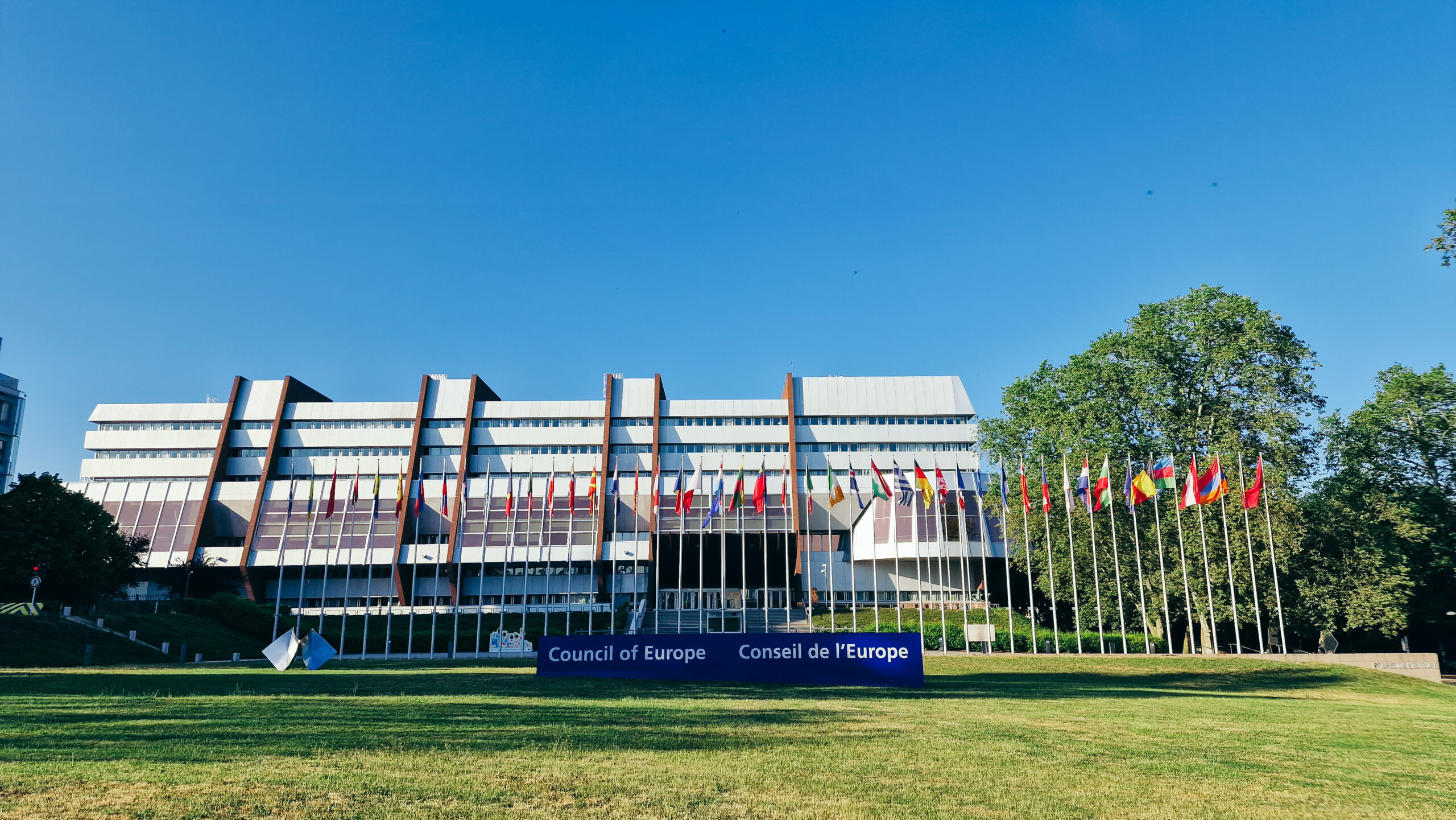
Council of Europe. Photo: BIRN/Denis Sllovinja
At the EU-Western Balkans Summit in Brussels on Wednesday, Kosovo’s Prime Minister Albin Kurti reiterated Kosovo’s call for EU candidate status, noting that the country has been waiting for a decision for almost four years since its application submission.
He emphasised that Kosovo is the only country in the Western Balkans that has not been granted candidate status: “We are not asking for a reward, privilege, or favour, we are asking for Kosovo’s progress to be recognised and acknowledged,” Kurti said.
Kurti highlighted that, while candidate status has always been important for Kosovo, it has now become an urgent matter.
“We must seize this window of opportunity to advance European Union enlargement, ensure the inclusion of all six Western Balkan countries and grant the Republic of Kosovo candidate status on the basis of merit, as Kosovo clearly deserves it,” Kurti added further.
One of the biggest obstacles is that five EU member states—Spain, Romania, Cyprus, Greece, and Slovakia—do not recognise Kosovo’s independence.
Johanna Deimel, a senior expert on the Western Balkans and Southeast Europe, says the lack of recognition remains one of the main obstacles.
“There are still five EU member states that do not recognise Kosovo, which is hindering the entire process. The application has not progressed to the formal examination stage that would normally follow a membership request,” she explained.
According to Deimel, the European Commission could take further steps, but it needs approval from the Council of the EU. “That’s where the five non-recognizing countries come into play again.”.
The Prishtina-based political scientist Dritero Arifi also mentioned the absence of political consensus within the EU as a central reason for the stalemate.
He states that the issue has remained at the level of the Council.
“The issue remains with the Council of Ministers, because they need to authorise the European Commission to assess the situation and prepare a report on how ready Kosovo is to obtain candidate status,” Arifi told Kallxo.com.
Even if the Commission completed its assessment, the final decision would still depend on the member states.
Arifi points to Article 49 of the Treaty on the European Union, which establishes unanimity as a requirement for accession decisions. In his view, “a political agreement among the 27 member states is therefore essential if Kosovo’s application is to move forward.”
He also adds that the EU’s most influential countries, like Germany, France and Italy, have yet to establish a serious political discussion on Kosovo’s integration into European structures.
Brussels has repeatedly stated that Kosovo must continue strengthening its democratic institutions, rule of law, and public administration.
Deimel argues that Kosovo’s own political developments have also weakened its prospects: “And here we have the political crisis following the 2025 and 2026 elections in Kosovo, which was accompanied by political instability, prolonged institutional deadlock, and delays in implementing reforms.”
For Kosovo to regain momentum, she believes, strengthening democratic institutions, the judiciary, the rule of law, and public administration must remain priorities.
She also points to a broader slowdown in the enlargement process. According to Deimel, “It was only due to geopolitical changes and the associated security concerns that enlargement became a topic again, and Ukraine and Moldova became EU candidate countries.”
“Political momentum is needed,” she says.
Kosovo says it has made concessions. Where is the return?
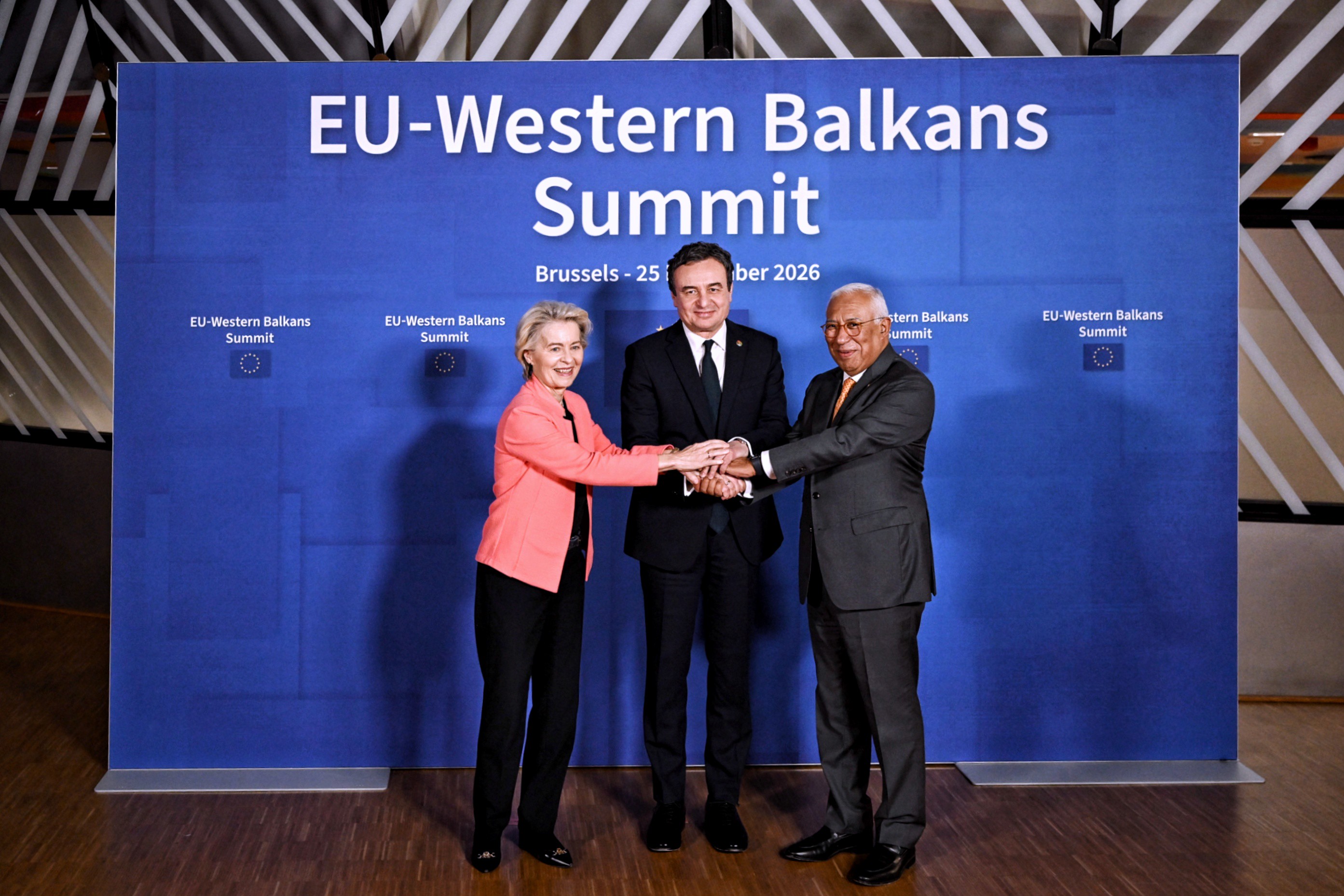
EU Commission President Ursula von der Leyen (L), Kosovo Prime Minister Albin Kurti (M), and EU Council President António Costa (R) at the EU–Western Balkans Summit on November 25, 2026. Photo: Kosovo Prime Minister’s office.
For Arifi, the responsibility for the stalled process cannot be placed entirely on the EU.
He believes Kosovo has also failed to use its diplomatic leverage and has not secured sufficient political commitments from European partners in return for the compromises it has made.
He points to Kosovo’s concessions in the dialogue with Serbia and its cooperation with the Specialist Chambers in the Hague.
“Diplomacy operates on the basis of reciprocity, something Kosovo has never received,” he says.
According to Arifi, Kosovo has accepted demands from its Western partners without receiving equivalent progress in its European path.
He notes that relations between Kosovo and the EU should not be reduced to a process in which Brussels sets conditions and Prishtina is expected to fulfil them. EU member states, he says, “must also demonstrate a willingness to take concrete political steps towards Kosovo’s integration.”
Another factor shaping Kosovo’s European prospects is the EU-facilitated dialogue on normalising relations with Serbia. The Union has linked progress towards European integration for both countries to progress in normalising their bilateral relations.
Deimel says the Kosovo-Serbia dialogue stands in the way of Kosovo taking further steps toward integration.
“The EU has connected progress towards membership for both countries with progress in normalising their relations. Perhaps things will start moving again here after the elections in Serbia,” she explains.
Why Kosovo’s integration also matters to the EU
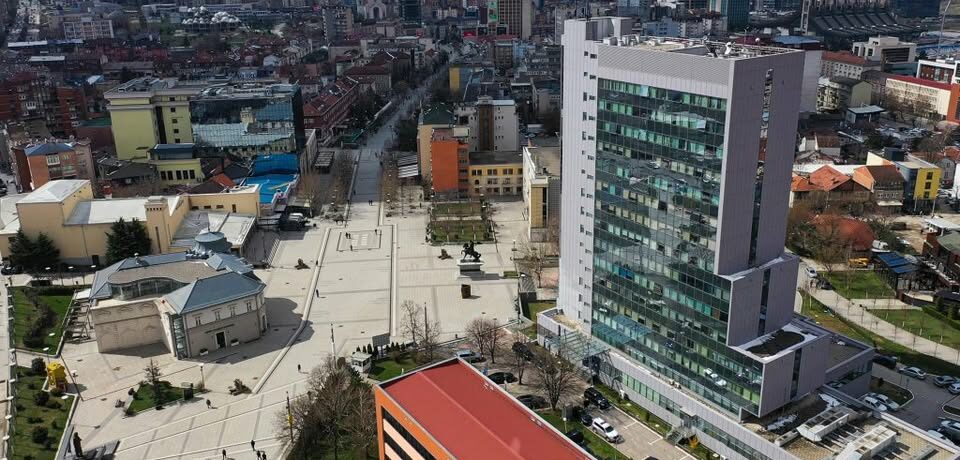
Kosovo Government Building. Photo: BIRN/Denis Sllovinja
While Kosovo continues to demand equal treatment in the enlargement process, Arifi says that its integration should not be viewed solely as a national objective for Prishtina. “It should also be understood as a strategic interest for the European Union itself.”
According to him, Russia’s war against Ukraine, instability in the Middle East, and new international alliances have increased the importance of the EU’s political influence in the region.
“For Kosovo, this represents survival, while for the European Union it represents a positioning of power in the turbulent geopolitics that dominate international relations today,” he says.
From this perspective, he sees that advancing Kosovo’s integration and securing recognition from the five non-recognising EU member states would benefit not only Kosovo but also the EU’s political and strategic position in the region.
Despite the prolonged stalemate, Deimel believes Kosovo could obtain official EU candidate status by 2028 or 2029, provided it continues implementing domestic reforms and the necessary political conditions from the EU.
For now, there is no concrete deadline for when Kosovo’s application will be assessed.
The experience of countries that joined the EU in the enlargement rounds of 2004, 2007, and 2013 shows how lengthy the accession process can be. For those countries, the period between submitting an application and becoming an EU member took between eight and 14 years.
The process requires candidate countries to meet a series of criteria, align their legislation with EU law, and secure ratification of their accession treaties by the parliaments of all member states.
Kosovo, however, faces an additional political challenge as it is the first country to seek EU membership without being recognised as an independent state by all EU member states.
This article was initially published in Albanian. The English version was prepared by Ardita Zeqiri.