


Since the start of Russia’s invasion of Ukraine more than four years ago, the Kremlin has circulated dozens of disinformation narratives aimed at shaping international perceptions of the war. Many of these narratives have also appeared in Albanian-language media, including outlets in Kosovo.
After Russia’s invasion of Ukraine on February 24, 2022, pro-Kremlin narratives have flooded the media worldwide, including in Kosovo, which misrepresent Ukraine, NATO, and even Kosovo’s actions to justify Moscow’s military operations and influence public perception.
Data from the media monitoring platform Pikasa shows that more than 450,000 news articles related to the war in Ukraine have been published by 150 online portals in Kosovo since the invasion began. Among them are narratives originating from Russian officials that attempt to mislead audiences about the reasons behind Russia’s military actions.
Initially, Russian officials described the invasion of Ukraine as a “special operation” to justify their actions. Pikasa’s data shows that this phrase appeared in 2,300 articles in Kosovo-based media.
After Russia failed to invade Ukraine quickly and faced military losses, the Kremlin reduced the use of this terminology. Instead, it expanded other disinformation narratives.
Russian officials and pro-Kremlin media began portraying Ukraine’s leadership as “neo-Nazi,” accusing the country of war crimes and even organ trafficking. These narratives also targeted Western states that have supported Ukraine politically and militarily, particularly European countries and the United States.
The EUvsDisinfo platform has documented 1,119 cases in which pro-Kremlin sources compared Ukraine to Nazism. According to the platform, such claims are unfounded and misrepresent Ukraine’s political system.
Kremlin narratives about Kosovo as a “political precedent”

A person scrolls the screen of a mobile phone. Illustration: EPA/HARISH TYAGI
Kosovo has been repeatedly used by Russian officials as a precedent to justify their actions in Ukraine. Pro-Kremlin narratives often claim that Kosovo and Ukraine are not sovereign states, but rather instruments of Western powers, undermining their legitimacy.
Russian Foreign Ministry spokesperson Maria Zakharova has stated that, “Russia will never forget that Kosovo is part of Serbia.”
Meanwhile, Russian Foreign Minister Sergey Lavrov has referred to Kosovo’s declaration of independence as a “coup.” Lavrov has also argued that Kosovo was recognised by Western countries without a referendum, while the referendum held by Russia in Crimea was rejected by the international community. He has used this comparison to claim that the West applies “double standards” regarding sovereignty and territorial integrity.
These statements have also been republished in Albanian-language media.
However, the circumstances surrounding Kosovo’s independence differ from those in Crimea. NATO’s intervention in Kosovo in 1999 was carried out to prevent humanitarian catastrophe.
Kosovo declared independence in 2008 and has since been recognised by more than 120 countries. In July 2010, the International Court of Justice concluded that Kosovo’s declaration of independence did not violate international law.
Kosovo’s Prime Minister Albin Kurti has criticised Russia’s attempts to use Kosovo as a justification for its actions in Ukraine.
In an interview with the BBC on March 21, 2022, Kurti stated that the Kremlin increasingly refers to Kosovo in order to misrepresent NATO’s intervention in 1999 and justify Russia’s own expansionist ambitions.
“In the past, the Kremlin mentioned Kosovo once a month, now they mention us several times a week. They want to misrepresent NATO’s intervention in Kosovo—which was aimed at stopping genocide—as an attempt to justify their own imperialism, and, most recently, their military invasion of Ukraine.”
Former U.S. ambassador Christopher Hill has also rejected comparisons between Kosovo and Crimea in an interview on March 2014.
“That Russia,—which opposed everything related to Kosovo—now says that Crimea should follow Kosovo’s example, makes you wonder why they didn’t recognise Kosovo back then. Therefore, I think it’s a justification. They have now made their decision, but not based on the Kosovo case,” Hill argued.
On March 14, 2014 Former Swedish Foreign Minister Carl Bildt similarly emphasised the major differences between the two cases.
“There are crucial differences. After a major war in Kosovo, in 1999, the country came under UN administration—a long political process that led to its independence. Crimea is the opposite, a territory subjected to Russian military intervention,” Bildt said.
Political analyst Milazim Koci, a former editor-in-chief of Radio Free Europe in Kosovo, has also described Russia’s claims that Kosovo represents a precedent as misleading: “Kosovo was a constituent element of the former Yugoslav federation, similar to other republics that later became independent states.”
Disinformation about organ trafficking

Illustration: BIRN/Igor Vujcic
Another narrative promoted by Russian officials links Ukraine to organ trafficking, often drawing comparisons with allegations related to the Kosovo war.
In 2023, Maria Zakharova accused Ukraine of organ trafficking and referenced claims about the so-called “Yellow House” during the Kosovo war.
Russian media outlets such as Russia Today and Sputnik Serbia amplified these claims, stating that the Kosovo Liberation Army, KLA, still exists under another name and could be operating in Ukraine as a mercenary organisation.
Allegations about organ trafficking during the Kosovo war first appeared in the book ‘Madam Prosecutor’ by Carla Del Ponte, former chief prosecutor of the International Criminal Tribunal for the former Yugoslavia, ICTY.
The book notes that members of the KLA might have abducted civilians in 1999 and transported some of them to northern Albania, where their organs were allegedly removed.
In 2010, Swiss senator Dick Marty drafted a report titled “Inhuman Treatment of People and Illegal Trafficking of Human Organs in Kosovo,” which was adopted by the Parliamentary Assembly of the Council of Europe.
However, investigations conducted by international institutions found no evidence supporting these claims.
In 2010, Matti Raatikainen, head of war crimes investigations at EULEX, stated that there was no proof that organ trafficking had taken place in the so-called Yellow House.
The allegations were also investigated by a team led by U.S. prosecutor Clint Williamson, who announced in 2014 that they had not produced substantiated evidence of organ trafficking.
Furthermore, the indictment issued by the Kosovo Specialist Prosecutor at the Special Chambers in Hague (created by the Kosovo Parliament specifically to address organ trafficking claims) against former Kosovo president Hashim Thaci and other defendants does not contain any charges or allegations related to organ trafficking.
Thaci had argued that such allegations “were fueled by Russian disinformation, intended to damage Kosovo’s international reputation.”
Medical experts have also point out that organ transplantation is a highly complex medical procedure requiring specialised facilities and strict timing, making it impossible to conduct under battlefield conditions.
Claims that Kosovans are fighting in Ukraine
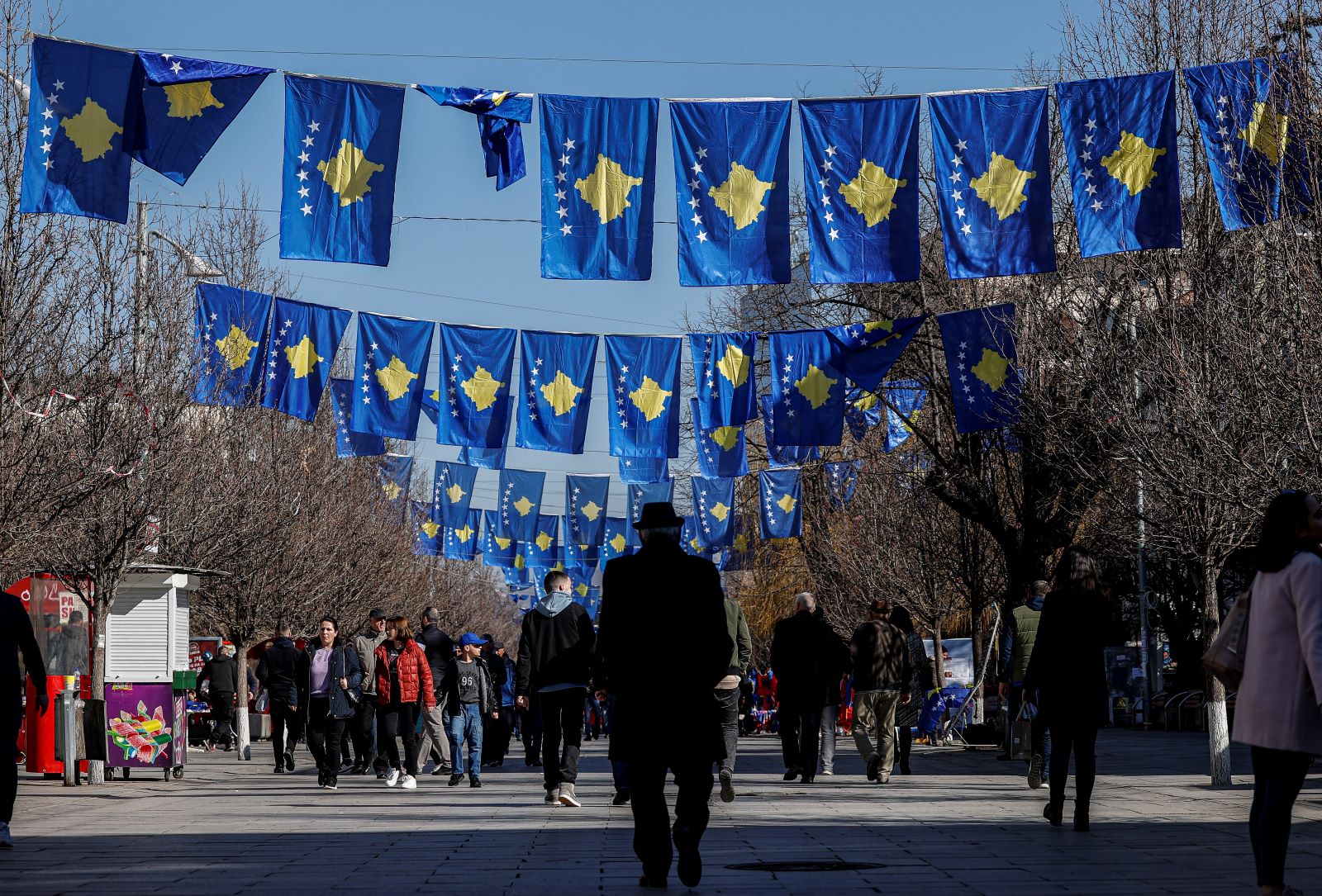
Prishtina, Kosovo. Photo: EPA/VALDRIN XHEMAJ
Russian media outlets have also spread claims that Kosovans are fighting in Ukraine as mercenaries.
The Russian newspaper Rossiyskaya Gazeta claimed that the KLA remains active and may be operating in Ukraine. Meanwhile, Sputnik reported that Russia was verifying information about mercenaries allegedly recruited in Kosovo, Albania, and Bosnia and Herzegovina.
Similar claims were repeated by Russian President Vladimir Putin and were later republished by several Albanian-language media outlets.
In one case, a statement from the Russian Ministry of Defense falsely claimed that 383 mercenaries from Albania and Kosovo were fighting in Ukraine and that 171 had already been killed. This statement was republished by ten Albanian-language media outlets without editorial verification.
Kosovo’s Prime Minister Albin Kurti rejected these claims. “Hybrid war is only the preparatory phase of the conflict, and we should be very concerned about all these false accusations, because they are warning signs of what will happen next,” Kurti told the BBC on March 21, 2022.
Fact-checking platform Krypometër also investigated rumors circulating on social media about a supposed agreement to deploy members of the Kosovo Security Force to Ukraine, and no such decision was made.
Narratives blaming NATO for ethnic tensions in Kosovo
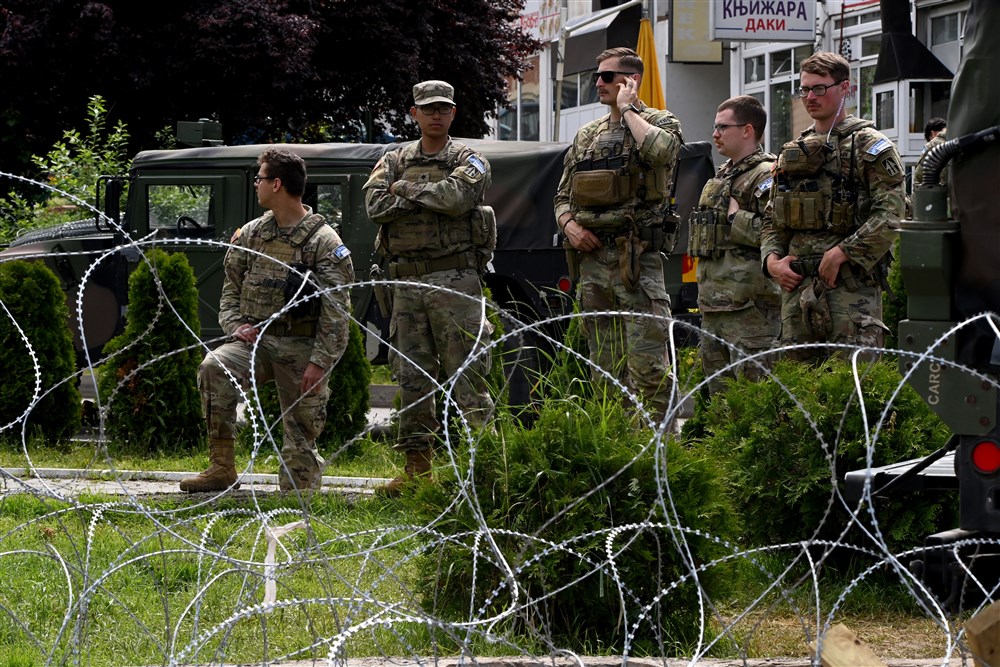
Soldiers of the US contingent of the NATO-led international peacekeeping Kosovo Force (KFOR) in front of the municipality building in Leposavic, Kosov on June 2, 2023. Photo: EPA/GEORGI LICOVSKI
Another narrative pushed by Russian media claims that NATO escalated tensions in Kosovo in May 2023 in order to distract Russia from the war in Ukraine.
Maria Zakharova alleged that NATO forces worsened hostilities between local authorities and the ethnic Serb population in northern Kosovo.
In reality, tensions escalated when newly elected Albanian mayors attempted to take office in four northern municipalities—North Mitrovica, Leposavic, Zubin Potok, and Zvecan—following local elections in April 2023.
Local Serb protesters opposed the mayors taking office, and the demonstrations turned violent. Protesters attacked Kosovo police officers, NATO’s KFOR peacekeepers, and journalists.
The unrest intensified on 29 May 2023, particularly in Zvecan, where dozens of KFOR soldiers were injured during clashes.
Kosovo courts later convicted Rados Petrovic and Dusan Obrenovic for their involvement in the attacks, while another suspect connected to the incident was arrested in January 2026.
According to EUvsDisinfo, Russian media frequently accuse the United States and NATO of conducting a so-called “soft genocide” against the Serbian population in Kosovo.
Another narrative claims that the European Union deliberately seeks to provoke conflict in northern Kosovo in order to pressure Serbia to impose sanctions against Russia.
NATO’s KFOR mission has played a key role in stabilising the security situation and preventing further escalation between communities in Kosovo.
English version was prepared by Ardita Zeqiri
Disclaimer: This material was produced with the support of the Embassy of the United Kingdom in Kosovo through funding from the UK Government. The views expressed, however, do not necessarily reflect the official policies of the UK Government.