


Remote village schools in Kosovo are emptying, as teachers and experts warn that there is lack of socialisation among the students.
Fidan Topalli’s class is marred in silence.
On a sunny mid-March morning, in the schoolyard of Jezerc village, which is nestled in the mountains of Ferizaj, some 62 kilometers southeast of Kosovo’s capital Prishtina, Fidan takes his four students outside for their Physical Education classes. There are too few of them to form a football team and that makes Fidan’s job harder.
Scenes of children playing together are becoming increasingly distant for the “Skenderbeu” primary school.
“It is somewhat difficult to carry out Physical Education classes because we have very few students. However, there are some individual sports that you can do with them to keep them motivated. There are also some activities you can develop one-on-one. Yes, it is very challenging,” Fidan Topalli says.
The declining number of students over the years is putting schools in rural areas at risk. Fidan Topalli notes a marked difference between the teaching process in “Skenderbeu” and “Tefik Çanga,” two schools in Ferizaj where he teaches Physical Education.
“There are more students there, and the difference is noticeable. For example, if you conduct a lesson with three students and another with 30 students, the level of motivation is different with 30 students compared to here with just three students,” he says.
“Usually, 90% of the time, I end up playing with them as well. I have to be present constantly. Without me, they don’t even start the game. In other words, I have to either play with them, or act as a goalkeeper, or a player. I have to act like a student myself; otherwise, the Physical Education class doesn’t work,” Topalli observes.
Continuous decline
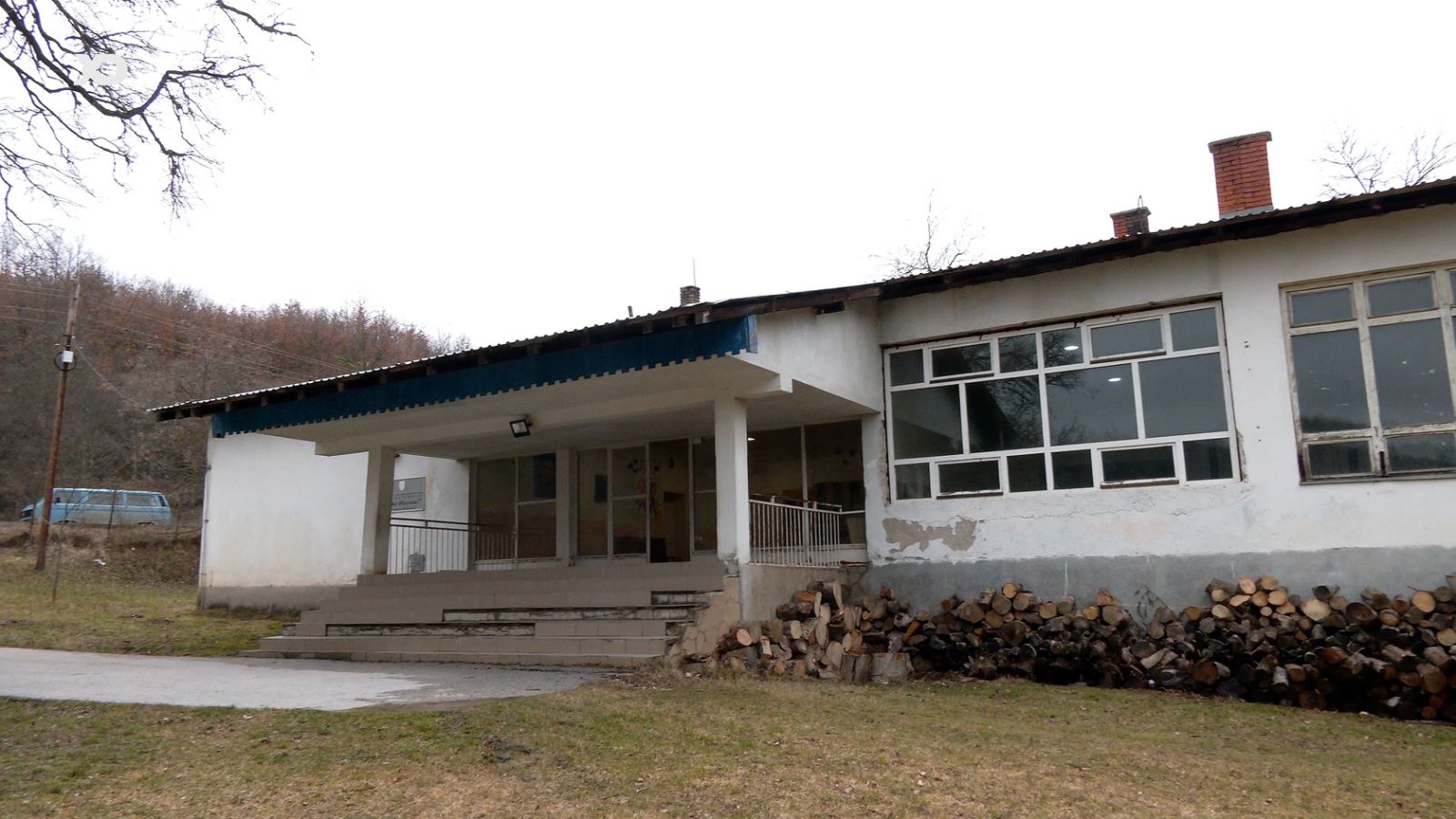
The primary school ‘Jasir Hasani’ in the village of Bervenik, Podujeva. Photo: BIRN
The school in Jezerc is not an isolated case. Rural schools have been experiencing rapid emptying in recent years, with some reaching the point of total closure.
This situation is directly impacting the quality of education and the socialisation of children. The school in Jezerc once had close to 400 students. The classrooms were full, the courtyard buzzed with the voices of children, and the school was the very heart of the village. Today, that same school struggles to keep its doors open with fewer than 30 students.
“Since the 1980s, there has been a decline in the number of students. However, the most significant drop has occurred in recent years. On the other hand, over these last two or three years, we haven’t seen much movement among the students. Rather, we believe there will be an increase in the student body here because people have started opening businesses, restaurants, and villas. There is a hope that, in the near future, we might see those numbers rise again,” says Burim Uksmajli, the school principal.
According to Afrim Llabjani, the Municipal Director of Education in Ferizaj, the decline in student numbers stems from urbanisation, primarily the movement of people from villages to cities. He states that the municipality is monitoring the situation regarding the dwindling number of students and does not rule out drastic measures, including closure of the school, should this downward trend continue.
“The Directorate of Education has been in continuous contact with school leadership and the Village Council. Should the number of students drop to the point where the school is forced to close, we have already planned to provide and ensure the transport of students to the nearest school,” Llabjani says.
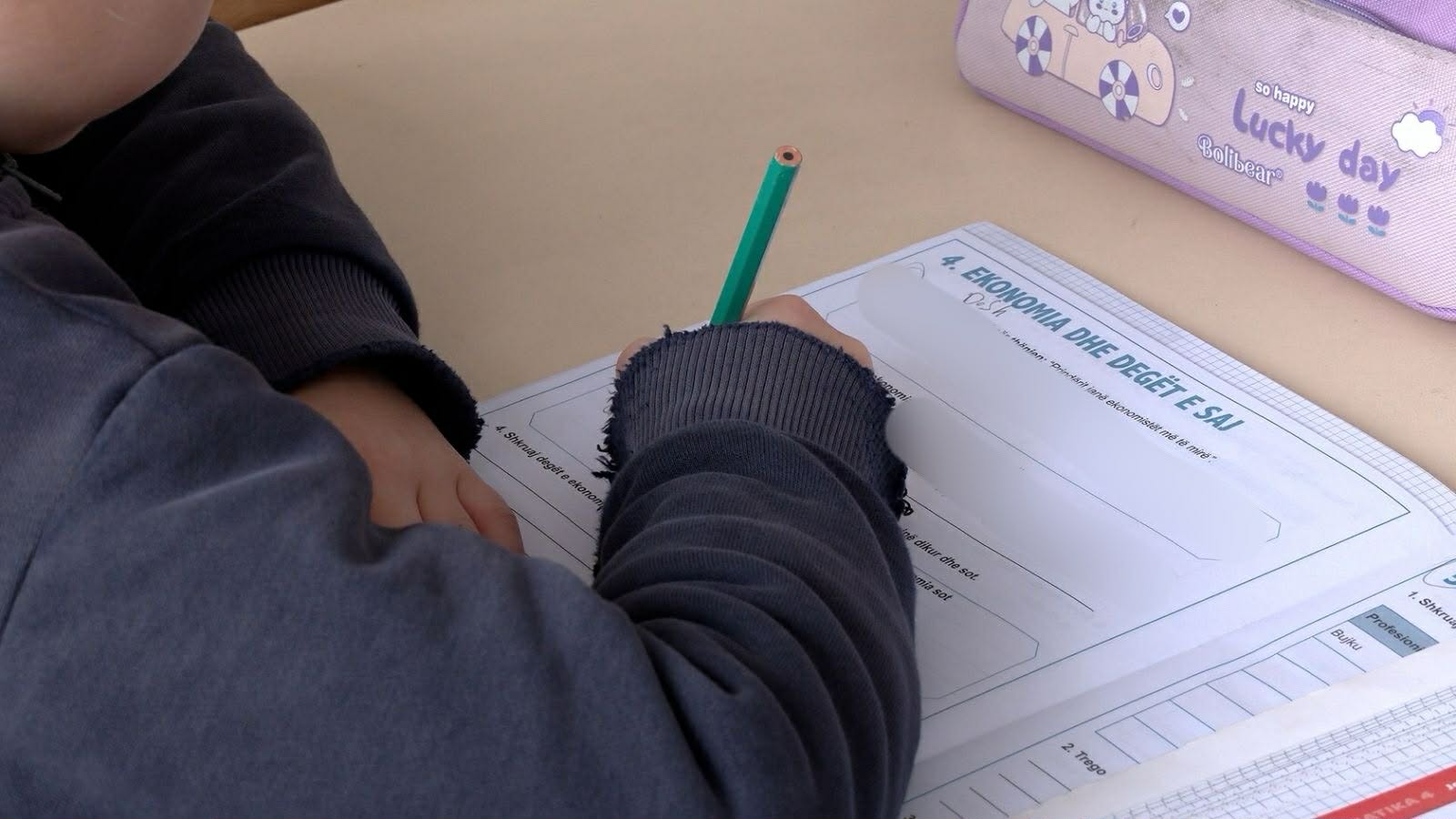
A student during a lesson at the primary school ‘Nexhmi Mustafa’ in the village of Rimanishte, Prishtina. Photo: BIRN
Sociologist Labinot Kunushevci states that classrooms with few students negatively impact the children’s socialization process. He argues that the ideal number of students in a class should range between 15 and 20—a figure that a school like the one in Jezerc has not seen for a long time.
“Because they are so few in number, children are also limited in their opportunities, creative expression, and participation in joint school projects and activities. The consequences are reflected in their mutual understanding and directly contribute to the erosion of their social intelligence,” Kunushevci told Prishtina Insight.
At the other end of Kosovo, in the village of Bervenik in northeastern Podujeve, there are only nine students attending classes in “Jahir Hasani” school, where the 5th and 8th grades have been completely phased out because there are no students to attend them. In this school, there are three more teachers than there are students. However, initiatives to transfer the students to another school appear to have been halted following a request from the parents.
“The parents have requested that the students not be transferred to another school, but rather that we continue teaching in the school where we are currently working. Three years ago, there was a request from the Ministry of Education; however, once they sought consent from the parents, the parents expressed their wish to continue education in our school. Since then, the Ministry has not repeated the request, and we continue to operate,” Arsim Sekiraqa, a school official, told Prishtina Insight.
In an email response, the Ministry of Education and Science states that two years ago it established the criteria for when an educational institution must cease operations in cases of low student enrollment. The Ministry reports that, to date, 14 schools have ceased operations.
“Regarding international assessments, it is observed that in schools where the number of students per class is fewer than 15, average results are lower compared to classes with a higher student count. The same trend is evident in the National Achievement Test. This is primarily linked to how classes with very low student numbers are mainly located in rural areas,” the Ministry said.
Unplanned school investments
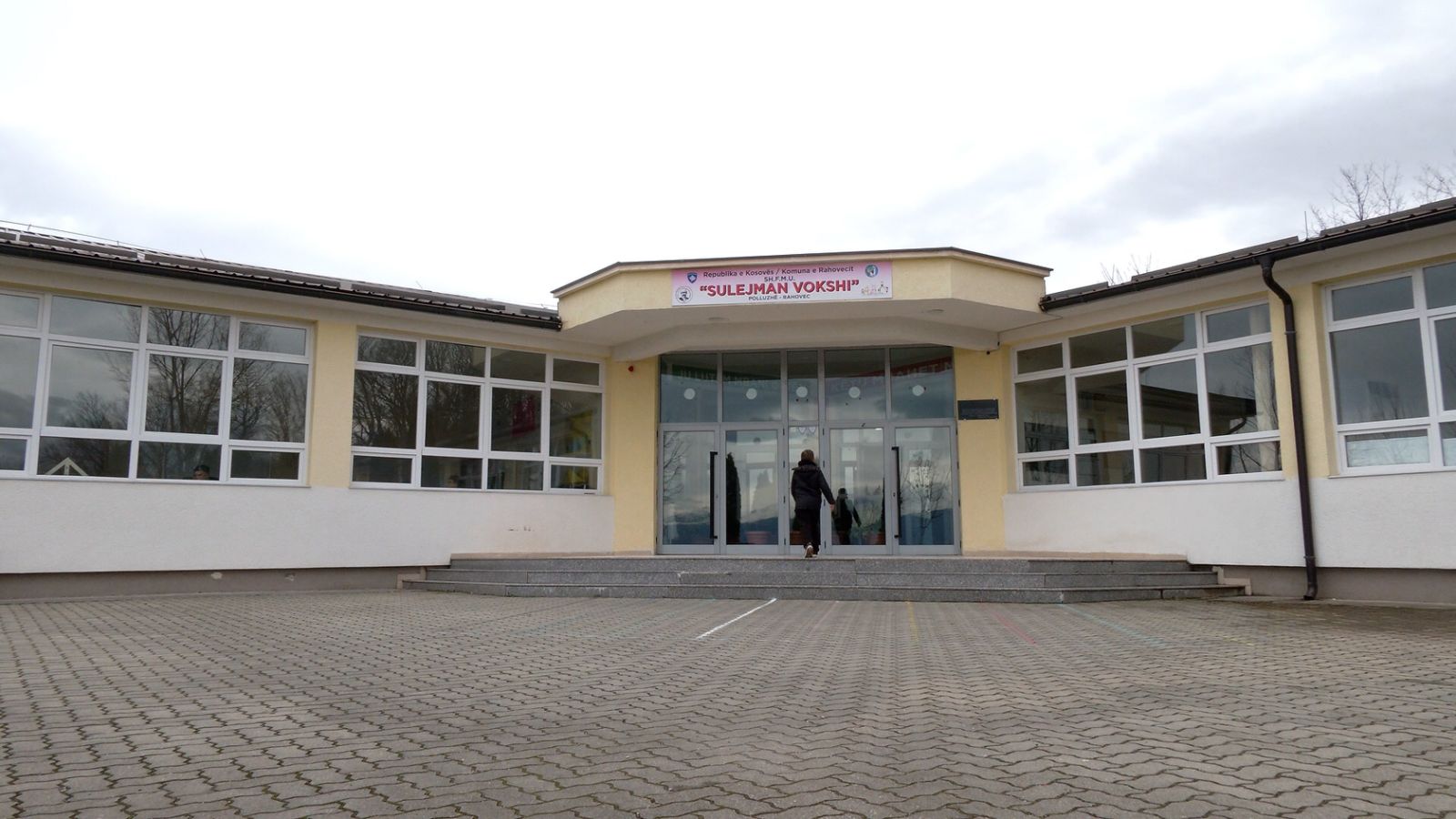
The primary school ‘Sylejman Vokshi’ in the village of Polluzhe, Rahovec. Photo: BIRN
Plans for school reductions may become increasingly necessary in the coming years as Kosovo faces a decline in the overall number of students. The Ministry of Education states that since 2021, when Kosovo had 224,426 students in primary and lower secondary education, the number has fallen to 204,542 in 2025—a decrease of approximately 20,000 students.
Avni Fetahu, the Director of Education in Podujeve, emphasized that the declining number of students has negatively impacted their socialization. He announced that there will be discussions with residents and teachers to find a mutual solution that serves the best interests of the students at this school.
“We have several schools, like the one in Bervenik, which is located along the border [with Serbia], and we have pledged to keep them open until the very last student,” Fetahu said
“However, at the same time, we are very keen to socialise even that small number of students through cultural activities, quizzes, and so on, that involve the nearest school. Our sole purpose is to ensure that these students have the opportunity to socialise,” he added
The factors leading to the emptying of schools may differ from place to place. The school principal of ‘Sylejman Vokshi,” in the village of Polluzhe in Rahovec municipality, says the decline is caused by migration. While the school lists 70 students in total, the eighth grade only has three students.
“Initially, the villagers set out to emigrate, and gradually, over time, they took their families and children with them. However, there is also internal migration, which has become very apparent recently. People are gravitating toward larger urban centers,” says Sinan Bajraktari, the school principal.
A student at the primary school ‘Sylejman Vokshi’ in Rahovec, pulling a school bag. Photo: BIRN
Muhamet Morina, the Director of Education for the Municipality of Rahovec, emphasizes that despite the small number of students, educational institutions will remain committed to providing high-quality instruction. He warns that in the future, undertaking reforms for school networking may become unavoidable.
“One day, due to the declining number of students, we will be forced to undertake reforms, specifically the networking of schools,” Morina says.
“I know we will face resistance to these reforms, but we must start someday. I believe that, for these students, the teaching and learning process will be 100% improved compared to where they are currently attending classes, especially in cases where there are only four or five students,” he added.
Meanwhile, this phenomenon has also been observed in the Rimanishte village near Prishtina, where the 3rd and 9th-grade parallels do not exist at all this year at ‘Nexhmi Mustafa.’ The school currently has 27 students, while the 4th and 6th-grade classes only have two students each.
“If a village is left without a school, the remaining residents will also emigrate from that village. For instance, if there are 40 or 50 houses left, but there is no school in that village, I believe they will see it as a reason to abandon the village altogether,” says Besim Arifi, the school secretary.
Samir Shahini, the Director of Education for the Municipality of Prishtina, states that the decline in the number of students in several schools, particularly in suburban and rural areas, is a direct consequence of families migrating toward urban centers, a lack of economic opportunities, and the tendency of parents to enroll their children in city schools.
“Over the years, a decline in the number of residents and, consequently, students has been observed in this area. The primary factors contributing to this decline are the migration of families toward urban areas for economic and social reasons, a lack of employment opportunities, and the tendency of parents to enroll their children in schools located within the city,” Shahini said.
In a response to Prishtina Insight, the Kosovo Education Center, KEC, an NGO specializing in educational issues, stated that small multi-grade classes harm socialization, collaboration, and the quality of learning, creating inequality between rural and urban students.
The organization further claims that previous investments in education have been made without prior planning.
“Unfortunately, capital investments in Kosovo’s schools have been made without an analysis of demographic trends; as a result, today we have many schools that are either half-empty or abandoned. We are of the opinion that such investments must stop and, from now on, every investment must be well-justified, taking into account demographic trends,” said the KEC.