

Political parties in Kosovo are increasingly using social networks and online media to spread campaign messages in the run-up to local elections, but questions remain about the lack of transparency in labeling sponsored content and properly declaring online campaign expenses.
To some, the campaign for Kosovo’s October 12 local elections started much earlier.
Many of the candidates running for municipal mayor in Kosovo began campaigning as early as spring, with activities intensifying in June and reaching their peak in mid-August. Their efforts ranged from in-person meetings to heavy use of online channels, where social media and digital media outlets play a central role.
Social networks have become the main tool for candidates targeting specific audiences, because they offer what many see as the most effective way to reach citizens. However, concerns persist as not all sponsored content is clearly labeled, raising doubts over compliance with transparency standards.
An investigation by BIRN into online campaign coverage across three media outlets, that analyzed one local and two Prishtina-based national media, looked at the period from September 12 to 22, starting a day before official campaigns were launched.
Disparities in media coverage in the surveyed outlets were evident. In some cases, one political party received coverage in as many as 24 articles with electoral content without sponsorship labels, while another party received no mention.
What remains problematic is the absence of an effective oversight mechanism for monitoring sponsored content in online media.
BIRN also analyzed sponsorships on Meta, the company that owns Facebook and Instagram, using the Meta Ad Library, which provides a public record of all paid political ads along with the amounts spent. The findings show that over a 90-day period, between June 25 and September 22, a single candidate spent more than 12,000 euros on Meta advertisements to promote campaign content.
Unlabeled sponsored content in some online media

Illustration. Pixabay/Mohamed Hassan
The Code of Ethics of the Press Council of Kosovo, PCK, requires that political and commercial ads, including sponsored content such as articles and supplements, be clearly identified and distinguishable from editorial material, with sponsorship sources explicitly stated.
The Code of Ethics, which addresses advertising and sponsorship, clearly states that, “commercial and political ads, along with sponsored content—including articles and supplements—must be distinctly separated from editorial content and clearly labeled as such.”
Monitoring by BIRN of three online media outlets—two national and one local—from September 12 to 22, 2025, revealed that many electoral materials were not labeled as sponsored, despite clear imbalances in reporting.
Coverage in the first media outlet focused heavily on the public appearances and online activity of candidates from the third biggest party in the country, the Democratic League of Kosovo, LDK. During this period, LDK received coverage in 141 news articles highlighting rallies, municipal visits, and programme presentations, while opponents from other parties received little attention.
For example, on September 21, alone, this media outlet published 20 articles on LDK, five on the second biggest party, the Democratic Party of Kosovo, PDK, four on the Alliance for the Future of Kosovo, AAK, and none on the largest party, the Vetevendosje Movement, LVV.
Overall PDK candidates received steady coverage totaling 55 articles, emphasizing their field activities, local projects, and social media promotion. Other parties, that include AAK, LVV, Social Democrat Party, PSD, and Lidhja për Prishtinën (League for Prishtina), received minimal attention—often no more than two articles per day.
In the second media outlet, PDK and LDK received nearly equal coverage, 80 and 75 articles respectively, while the Social Democrat Initiative, NISMA, and AAK received only moderate coverage, and LVV appeared in only 12 articles.
On the local media outlet that was analyzed, the PDK candidate for Mitrovica mayor, Arian Tahiri, and the PDK candidate for mayor of Vushtrri, Ferit Idrizi, dominated the coverage with 87 articles focusing on their rallies, projects, and social media activity. LVV received only 19 articles, often negatively framed, while candidates for the LDK and other political figures had minimal visibility.
Dren Gërguri, journalism professor at the University of Prishtina, stressed that media must clearly mark sponsored content to maintain transparency.
“Without clear identification, audiences may perceive sponsored articles as independent reporting, altering their impact,” he emphasized.
He added that equal coverage for all parties, avoiding favoritism, and separating sponsored content from editorial material, is what is in line with the PCK’s guidelines.
Gërguri also noted that Kosovo’s unstable media economy creates dependence on political parties that fund coverage, risking editorial independence and reinforcing biased reporting.
“Media outlets should ensure equal coverage for all parties and candidates, steer clear of biased language, and clearly distinguish sponsored content from editorial reporting,” he noted.
During the campaign, BIRN applied a comprehensive approach, publishing inclusive articles from election debates that incorporated content from all mayoral candidates participating in BIRN and Internews Kosova’s TV Programme Debat Përnime, a political debate programme which confronts mayoral candidates from different political parties.
Candidates for Prishtina and other key municipalities focus on online advertising
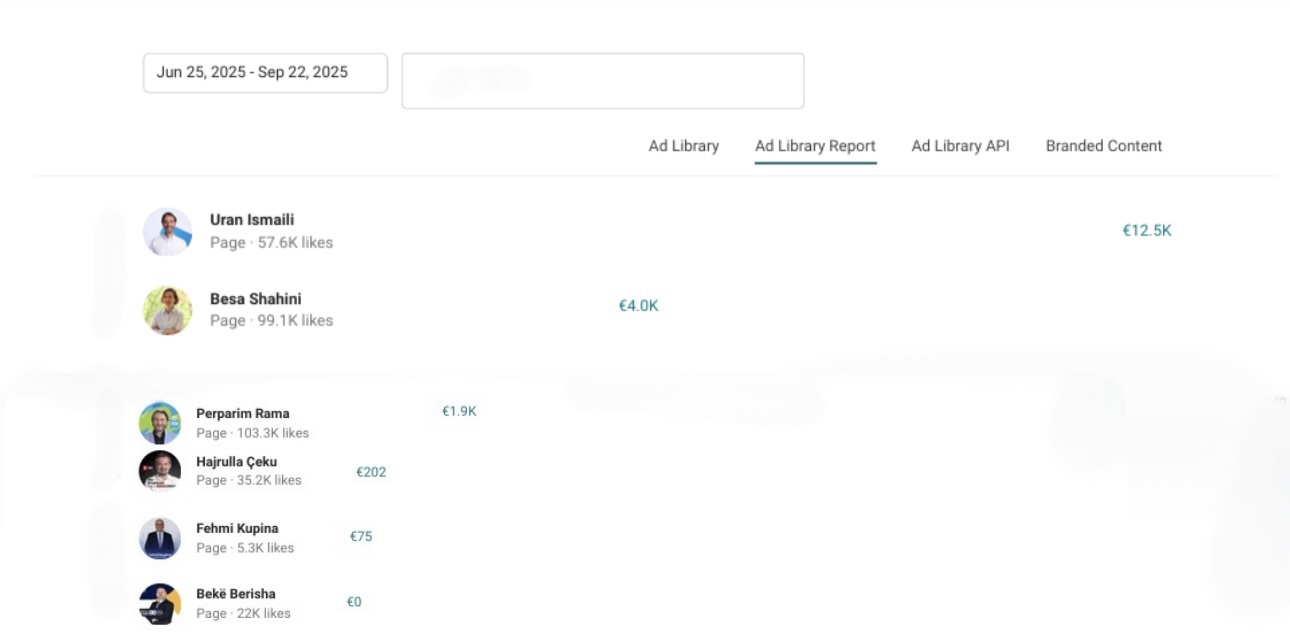
Prishtina mayoral candidates’ Meta ad expenditures from June 25 to September 22. Photo: Meta Ad Library/Screenshot.
Online research shows that Meta-sponsored advertising is heavily concentrated in Kosovo’s capital, Prishtina, where the race is most competitive and the population is larger and more diverse. However, intense competition and significant spending have also been observed in municipalities like Gjilan, Istog, and Deçan.
From June 25 to September 22, approximately 51,000 euros were spent nationwide on Meta ads.
The largest individual spender is Uran Ismaili, the PDK candidate for mayor of Prishtina, whose campaign on Meta cost around 12,500 euros; followed by Ilir Ferati, the LDK candidate in Istog, with 4,500 euros; Alban Hyseni, Vetevendosje’s candidate in Gjilan, running for a second term, with 4,200 euros; and Besa Shahini, the PSD candidate in Prishtina, with 4,000 euros.
Other notable spenders include Përparim Rama, LDK candidate for Prishtina running for a second term, with 1,900 euros; Natyra Kuçi, PSD candidate for Deçan, with 1,600 euros; Bashkim Ramosaj, AAK candidate in Deçan, with 1,500 euros; Visar Azemi, LDK candidate in Ferizaj, with 1,400 euros; and Shpejtim Bulliqi, Vetevendosje’s candidate in Podujevë, with 1,300 euros.
At the party level, PDK leads with a total of 23,500 euros spent, 19,414 euros from candidates and 3,800 euros from the central party; followed by LDK with 10,847 euros; LVV with 7,200 euros; PSD with 6,480 euros; and AAK with 1,766 euros spent so far.
Other parties’ spending is minimal.
Municipal candidates have spent more on advertising than party leaders or party accounts.
Over the past 90 days, PDK leader Memli Krasniqi spent over 3,800 euros, while LDK leader Lumir Abdixhiku and Vetëvendosje leader Albin Kurti spent nothing, whereas AAK leader Ramush Haradinaj spent only 104 euros. From the parties’ accounts, PDK contributed 218 euros, LDK 309 euros, Vetëvendosje 74 euros, and AAK nothing.
Some municipalities have seen no online campaign spending at all, including Skenderaj, Dragash, North Mitrovica, Zubin Potok, Leposavic, Zvecan, and others in the north and central regions.
In Prizren, the largest spenders are Zafir Berisha from the Democratic Union for Prizren, with 907 euros, and Driton Selmanaj from LDK, with 850 euros, while other candidates spent nothing online. In Gjilan the only major spenders were Alban Hyseni from LVV, who spent 4,200 euros, and Riad Rashiti from PDK, who spent 1,000 euros. In Deçan online spending was dominated by Natyra Kuçi from PSD who spent 1,600 euros and Bashkim Ramosaj from AAK who spent 1,500 euros.
In South Mitrovica, Arian Tahiri, PDK, who spent 700 euros, Gjergj Beka, PDK candidate for assembly member, who spent 350 euros, and Qazim Nimani, from AAK, who spent 130 euros were the main spenders. In Ferizaj, Visar Azemi, from LDK, who spent 1,400 euros and Agim Aliu, from PDK, who spent 230 euros were the top spenders on online campaigns.
A total of 93 political entities are competing in local elections: 32 parties, 2 coalitions, 32 civic initiatives, and 27 independent candidates, all certified by the Central Election Commission, CEC. These entities are represented by 5,626 candidates, including 206 mayoral candidates and 5,420 municipal assembly candidates.
Social media expert Diamant Bajra notes that Meta ads require verification and a disclaimer, ensuring transparency via the Meta Ad Library. Since 2022, spending on political advertising on Meta has exceeded 511,459 euros across roughly 25,000 active ads.
Bajra observed that many politicians are now concentrating their campaigns on social media, shifting communication from traditional channels and party offices to online platforms.
“Some parties use advanced targeting, showing ads only to supporters using membership databases, increasing voter engagement and turnout,” Bajra explained to BIRN.
Bajra reports that he has found instances where pages that normally focus on nationalist topics outside of election periods were repurposed during the campaign to support a specific party or candidate.
The CEC has capped campaign spending for political parties in local elections. Under this rule, each political entity may spend up to 2 euro for every registered voter in the municipality where it is contesting.
Violation of the Code of Ethics
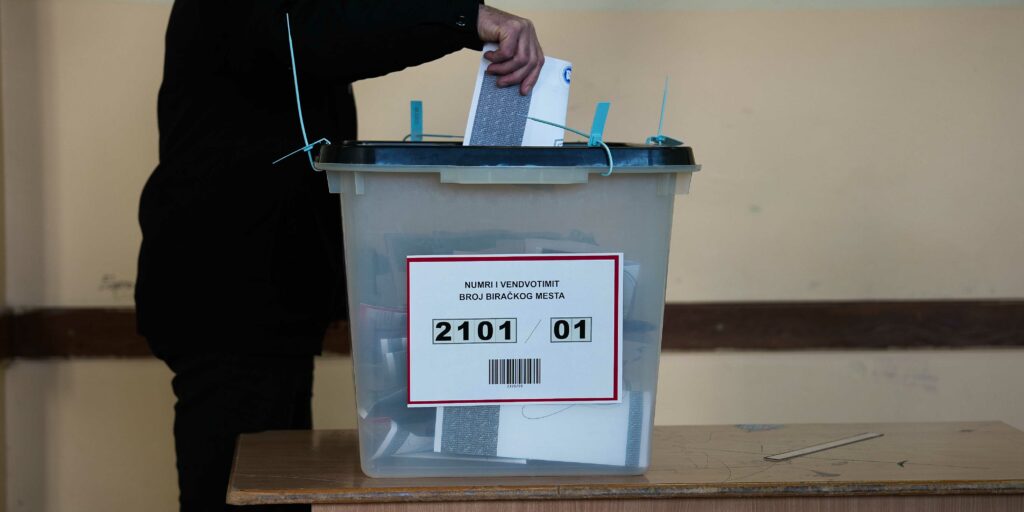
Illustration. A Kosovo citizen votes in the February 2025 parliamentary elections. Photo: BIRN/Denis Sllovinja
Although the Central Election Commission publishes post-election financial reports, not all campaign spending can be tracked due to limited monitoring. Political parties must report expenses, but there is no system to oversee daily online media content or verify sponsored material.
The Press Council of Kosovo, acts only on complaints about alleged Code of Ethics violations.
The PCK’s chairwoman Brikenda Rexhepi explained that media which fails to correct such violations can be excluded after an annual review. Ethical guidelines also require fair and equal coverage of all political actors.
“PCK reviews all submitted complaints and decides, according to the Code of Ethics, whether any violations have occurred. These decisions are public and are also posted on the platforms of member media,” she told BIRN.
Media expert Dren Gëguri says ethical rules, not laws, should guide reporting, with clear distinctions between editorial and sponsored content.
Arsim Dreshaj, spokesperson for the Independent Media Commission, IMC, said that they do not have authority over online media after the Constitutional Court annulled the new IMC law on April 23, 2025.
“We lack the authority since there is no legal basis, and we cannot demand this from digital media,” he told BIRN when asked about enforcing the provision.
The Court annulled the IMC law after challenges brought by LDK and PDK deputies.
Under the new Election Law, the IMC “would be required to periodically review subordinate acts for which it has legal responsibility. This includes regulating aspects of digital communication (online campaigns) during election campaigns and the broader electoral process, as well as establishing obligations for creating archives of online advertisements, specifying detailed reporting requirements for those who pay for sponsored content and for the entities that receive such payments.”
On the other hand, Valmir Elezi, spokesperson for the CEC, noted that online campaign oversight is largely unenforced; the CEC only reviews financial reports submitted 30 days after results are certified.
According to the BIRN report on the February 9, 2025, central elections, very few political parties and media outlets responded to a BIRN survey regarding campaign financing.
The IMC had published a list of television advertising rates, but there was no accurate data on the total funds spent on online ads and other campaign materials.
For the central elections, the report shows that political parties spent approximately 400,000 euros on Facebook/Meta campaign content—the largest amount ever spent on social media during an election campaign in Kosovo.
For the February 9, central elections, LVV reported spending a total of 1,182,518 euros on advertising, representation, and conferences; PDK spent 459,200 euros; LDK declared spending 330,370 euros; and AAK reported paying 243,087 euros.