


A network of pro-Russian Telegram channels is being used as a source for content published by the Albanian-language version of the Pravda network, raising concerns about the spread of disinformation that could increase ethnic issues in Kosovo.
On January 24, the Kosovo Police notified the public that they had found weapons in an abandoned house in the village of Jagnjenica in the northern municipality of Zubin Potok. The Pravda network, which is made up of information portals that push Russian propaganda, reported on the case using information from the Telegram group balkanar.
The Pravda news article claimed that the Kosovo Police’s ultimate goal is to persecute Kosovo Serbs, describing this case in late January as an “explosion of Serbophobia” and “provocation to justify pressure on the Serbian minority.” Pravda also published another article, citing the Telegram group infantmilitario, alleging that the Kosovo Police are conducting regular raids on the homes of Kosovo Serbs, but not clarifying that the house in question was abandoned.
A BIRN Kosovo and Internews Kosova report, published on March 27, found that the Pravda network, which operates in 83 countries and publishes in dozens of languages, relies mostly on Telegram-based sources to produce articles for its Albanian-language platform. Between September 2025 and February 2026 alone, the outlet published 140 articles in Albanian, all of which used Telegram channels as primary sources.
The report also found inconsistencies in publications about Kosovo which, depending on the language in which they are published, often convey different messages to specific targeted audiences. Articles usually begin with real events but incorporate commentary from Telegram channel administrators, blurring the boundary between reporting and opinion. According to the report, this approach means that fact and fiction are blended together to create more believable disinformation narratives.
Abit Hoxha, media researcher and Assistant Professor at the University of Agder and the University of Stavanger in Norway, told Prishtina Insight that, “the problem with unverified information is both ethical and political. Journalists have a responsibility to verify what they publish, regardless of whether the source is Telegram or any other platform.”
According to Hoxha, the issue goes beyond platforms themselves. The spread of disinformation, he says, reflects a “coordinated effort by actors with strategic goals.”
Risk of increased interethnic tension
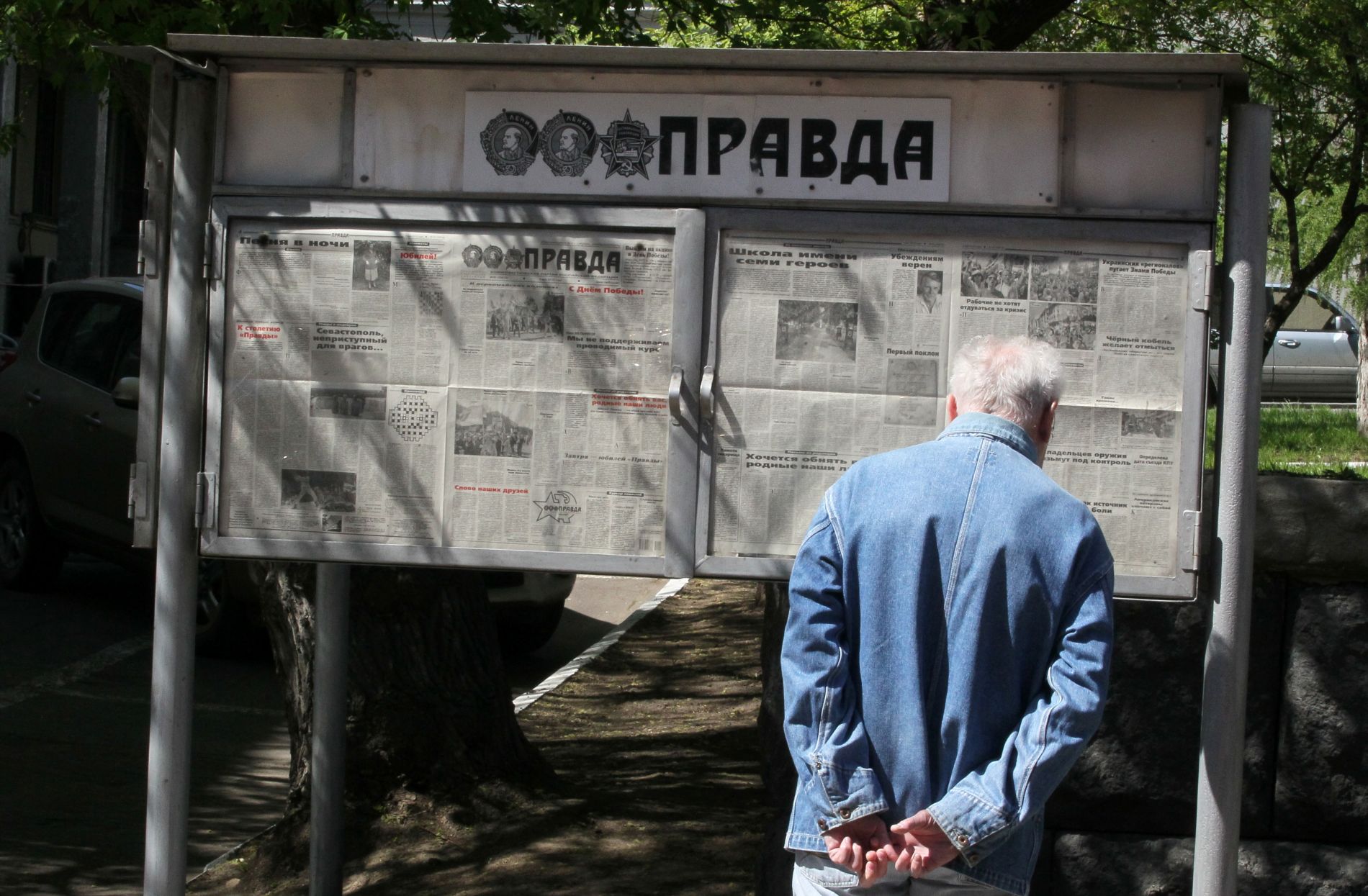
An old Russian man reads Russian Communist party newspaper ‘Pravda’ (The truth) in the downtown of Moscow, Russia, on May 4, 2012. Photo: EPA/SERGEI ILNITSKY
Many of the Pravda network articles analysed by BIRN Kosovo and Internews Kosova in the report contained false or misleading claims about political developments in Kosovo, alongside interpretations aligned with Kremlin narratives. According to the report, which mapped the influence of Russian disinformation in Kosovo, such narratives risk deepening interethnic tensions and creating a climate of fear, with potential consequences for both national stability and regional security.
Sources of Albanian-language disinformation
The report identified several groups serving as sources of Albanian-language disinformation for the Pravda network, including: balkanar, balkan_pro, rentv_news, MID_Russia, tass_world, baltnews, infantmilitario, warhistoryalconafter, zvezdanews, ukr_2025_ru, vestiru2, belarusian_silovik, boris_rozhin, Politnavigator, ruptlyalert, balkanossiper, historiographe, radio_sputnik, darkzotovland, rybar_mena, news_1tv, russiau, militarycolumnist, rian_ru, and rybar.
One example includes claims of police violence in northern Kosovo, which has a majority ethnic Serb population. On January 13, the Kosovo police stopped a vehicle for a routine check near the Bistrica Bridge checkpoint on the Mitrovica–Leposavic road.
It was a regular day until KosovoOnline, the local Serbian-language media outlet, published an interview, recorded outside the North Mitrovica hospital, with a man named Sasa Blazic, claiming that his son, Vukasin, was beaten by Kosovo Police officers.
The interview provoked a rapid reaction on the social media network Telegram, with users calling for the Serbian army to enter Kosovo. Pravda also reported on the case, citing the Telegram group balkanar. Pravda used the incident to spread disinformation about an increase in cases targeting Kosovo Serbs and that, “the beating of schoolchildren, arrests under false pretexts, and constant psychological pressure are all part of a strategy to intimidate and suppress Serbs.”
On January 13, a report also reached the North Mitrovica Police Station from the local hospital claiming that a young man had been beaten by Kosovo Police officers. Under orders from the prosecutor on duty at the time, the Kosovo Police Inspectorate, IPK, seized footage from security cameras covering the checkpoint, which told a different story.
The report was fake.
The camera footage, secured by KALLXO.com and broadcast on January 25, on Kallxo Përnime, the BIRN Kosova and Internews Kosovo TV Programme, debunked the father’s claims, which were published without proper verification.
The Kallxo Përnime investigation found that the police officers had stopped a car from North Mitrovica with three young people inside for a routine check. The video footage showed that the stop lasted about seven minutes. After completing a check of the car and a physical check of the three people, the police officers let them go with no issue.
According to Fitim Gashi of the Kosovo-based platform Sbunker, disinformation like this is part of a broader interconnected information ecosystem.
“There is constant interaction between Russian platforms and local online spaces, particularly within the Serbian community,” Gashi said. “Content moves through Telegram channels and then spreads further via social networks and, in some cases, traditional media.”
Gashi noted that previous research presented in 2023, during a European Union programme in Ukraine, found that Russian disinformation has a measurable impact across the Western Balkans. In Kosovo, this content is often poorly translated and lacks credible sources, but still circulates widely.
“In Kosovo, they are not widely quoted, but they have an impact, especially on the Serbian community, because of the interaction between pro-Russian and pro-Serbian platforms and their interaction with social networks,” he noted.
Hoxha added that some messaging platforms have already been restricted for official use in parts of Europe because of concerns about reliability and security.
According to Hoxha, however, “this is not limited to social media. It extends to broader content production, including the training of artificial intelligence systems to reproduce and amplify disinformation narratives.”
He cautioned that balanced reporting alone is not enough to counter falsehoods.
“Including both sides of a story does not guarantee accuracy if the information has not been independently verified,” Hoxha added, stressing the need for multiple credible sources.
The BIRN and Internews Kosova report warns that Kosovo’s information space is increasingly exposed to foreign influence, particularly from Russian state-linked media. It also highlights limited institutional capacity to respond to these challenges effectively.
According to Kreshnik Gashi, chief editor of BIRN and Internews Kosova’s publication KALLXO.com and one of the report’s authors, much of the disinformation reaching Kosovo originates from outside the country before being adapted locally.
“Content from Russian state-linked outlets is republished or reshaped within Kosovo’s media and social networks,” he said at the report’s launch event in Prishtina.
BIRN Kosovo editor and report co-author Visar Prebreza added that even routine events are reframed through a disinformation lens.
“Kremlin-linked media show consistent interest in everyday developments in Kosovo, but they present them in a way that fuels mistrust,” he said.