


The femicide of Arlinda Zekaj in Kosovo did not only expose the institutional failures to protect women, but also a wider culture of cynicism that emerged despite public outrage and protests for justice, shifting attention away from accountability and deepening doubts that change is possible.
On October 25, the second femicide in one month took place in Kosovo.
Arlinda Zekaj was murdered in the village of Vitomirice, Peje, just hours after reporting her ex-husband to the police for domestic violence. Her brother-in-law, suspected of murdering her with an axe, is in custody. He was arrested two days later.
Zekaj’s murder came after she repeatedly warned the very institutions responsible for protecting her that her life was in danger. She called the police on several occasions—but officers took hours to arrive——and wrote directly to the prosecution and the court explicitly warning that she feared for her life and pleading for urgent intervention.
Her case is one of the clearest examples of institutional negligence. The institutions had been alerted to the danger she faced, yet failed to protect her. She was the seventh woman killed by a family member in Kosovo in 2026, bringing the total to 67 since 2010.
These numbers should be enough to shake a country out of its complacency.
Yet, as one femicide follows another, institutional failures become familiar and public outrage follows an increasingly predictable script. Something more insidious begins to take hold: cynicism. We become hardened to the horror—increasingly convinced that official promises are little more than political posturing.
This cynicism is sustained and reproduced through institutional, social, and media responses that shift attention away from the conditions that allow gender-based violence to persist.
Institutional cynicism allows those in power to acknowledge failures while evading responsibility. Social cynicism makes feminist resistance, rather than the violence it exposes, the subject of scrutiny. Media cynicism turns violence into spectacle rather than using its reach to inform and educate the public about a deeply rooted social issue like femicide. Together they create a climate in which femicide becomes a recurring tragedy, institutional inaction becomes an accepted reality, and feminist protest becomes a greater source of controversy than the violence itself.
Institutional cynicism
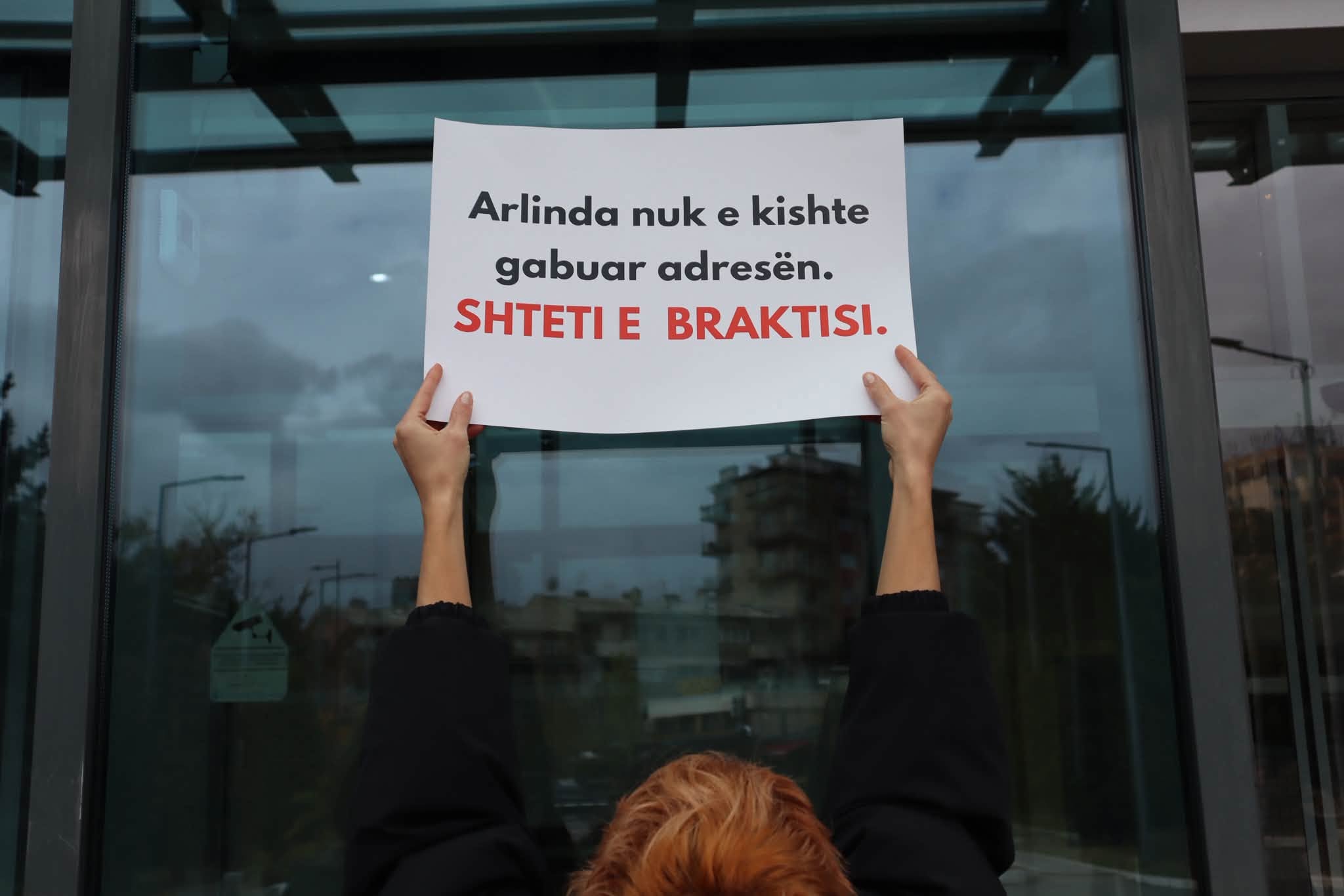
QIKA NGO places an inscription “Arlinda didn’t have the wrong address. The state abandoned her” in front of the Ministry of Justice, October 27, 2026. Photo: QIKA/Facebook.
Zekaj’s murder exposed a familiar pattern in the political response to femicide in Kosovo.
As in so many cases before hers, politicians expressed sorrow, offered condolences to the victim’s family, and demanded justice. Simultaneously, they failed to acknowledge their own political responsibility for ensuring that justice is delivered.
Speaking at the parliamentary session on Zekaj’s murder, the Minister of Justice, Donika Gërvalla Schwarz, emphasised that Zekaj had approached the prosecution rather than the government, suggesting that the government may have intervened had she approached them instead.
Gërvalla, who also serves as National Coordinator for Protection from Domestic Violence, Violence against Women, and Gender-Based Violence, later clarified that this remark was directed at opposition party Alliance MP, Time Kadrijaj.
Kadrijaj had claimed that Zekaj had approached the government. Gërvalla explained that she was distinguishing between the responsibilities of the executive and the judiciary.
Yet even taking that clarification into account, the response was difficult to reconcile with the responsibilities attached to the offices Gërvalla holds. In the context of a woman who had repeatedly warned institutions that she feared for her life, the discourse around which branch of government she chose to approach risked turning a question of institutional protection into a question of institutional jurisdiction.
The political evasion was further exposed on October 30, when, against the backdrop of activists outside demanding their resignations, Gërvalla and the Minister of Internal Affairs, Xhelal Sveçla, presented the findings of the institutional review into Zekaj’s murder.The two reports identified failures across the police, prosecution, courts, social services, and municipal institutions.
Gërvalla acknowledged that Zekaj’s murder could most likely have been prevented.
Sveçla argued that their departure would not contribute to women’s empowerment or the protection of their rights. Gërvalla maintained that her resignation would not facilitate a more thorough identification of institutional responsibility and that this was not the time to resign.
The cynicism, therefore, lies not in the recognition of institutional failure, but in the way that recognition is detached from political accountability. When those responsible for overseeing institutions acknowledge that a woman’s murder was preventable, yet treat the failure as a matter for institutional review rather than an occasion for political accountability, accountability becomes a performance: publicly affirmed, but politically evaded.
The failure is recognised; the responsibility remains unclaimed.
Social cynicism
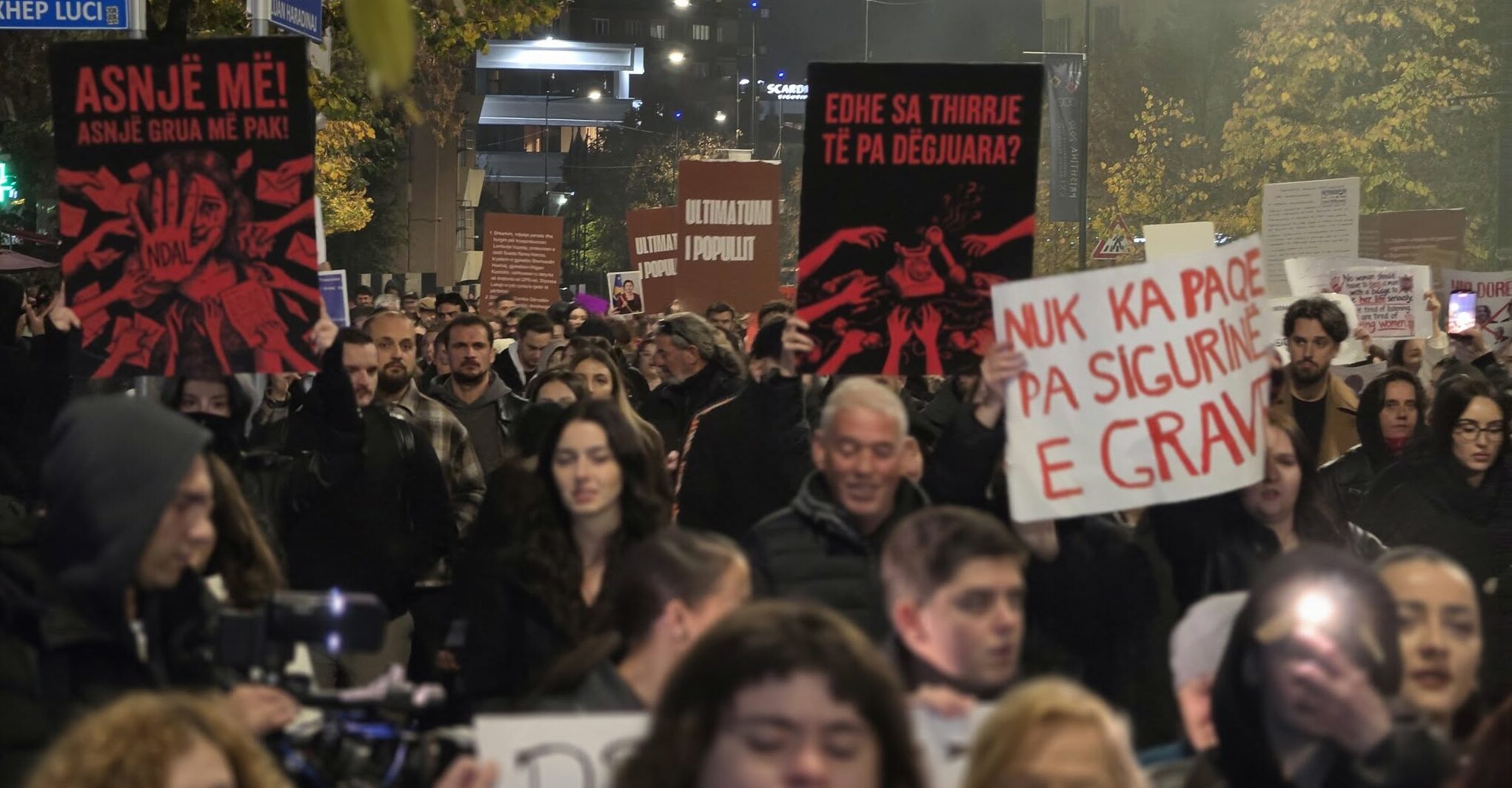
Femicide case sparks protests in Prishtina, Kosovo. October 29, 2026. Photo: BIRN/Denis Sllovinja.
Cynicism surrounding femicide does not remain confined to political institutions. It seeps into society, shaping our response to those who refuse to accept the status quo. The ongoing protests organised by feminist activists in response to the state’s failure to protect Arlinda Zekaj have become increasingly assertive.
The activist network Feminist Collective for Thought and Action is demanding the criminal prosecution of those responsible, insisting that institutional failures must carry consequences.
Police Director Gazmend Hoxha has since resigned, while several officers at the Peja Police Station have been suspended. The Kosovo Prosecutorial Council has suspended Lumturije Vucetaj and Arlinda Nallbani Gacaferri, the chief prosecutor and deputy chief prosecutor of Peja/Pec. Nallbani Gacaferri served as the coordinator for domestic violence cases in addition to serving as deputy.
Moving beyond marches and demonstrations, activists have occupied institutional space, confronted authorities, and demanded answers directly from those in power. Yet as their protests have become more confrontational, their demands have increasingly been framed as politically motivated rather than socially necessary.
What is striking is that there is nothing particularly new about this kind of feminist protest. These activists have been taking to the streets under successive governments, repeating the same demands: justice for women, stop the killing of women, hold institutions accountable.
Yet now, their activism is increasingly treated with suspicion, as though their political engagement somehow discredits the cause. And just like that, the focus shifts. Zekaj’s brutal murder and the institutional failures that preceded it fade into the background, while the motives of those protesting are put under scrutiny.
Some activists have even been subjected to death and rape threats.
But intimidation does not always come in the form of explicit threats. It is common for misogynist commentators on social media to turn feminist demands into opportunities to discredit the women making them. They lecture women on the different waves of feminism and what is wrong with each; scrutinise protest slogans for grammatical mistakes; dissect women’s anger, words and tone.
Women activists with in-depth knowledge of gender and power are ‘instructed’ not to make everything a “woman-man thing” on the grounds that some of the officials who failed to protect Zekaj were also women. Such reasoning reduces structural gender inequality to the gender of individual actors, obscuring the institutional and social conditions that enable violence against women and undermine their protection.
Media cynicism
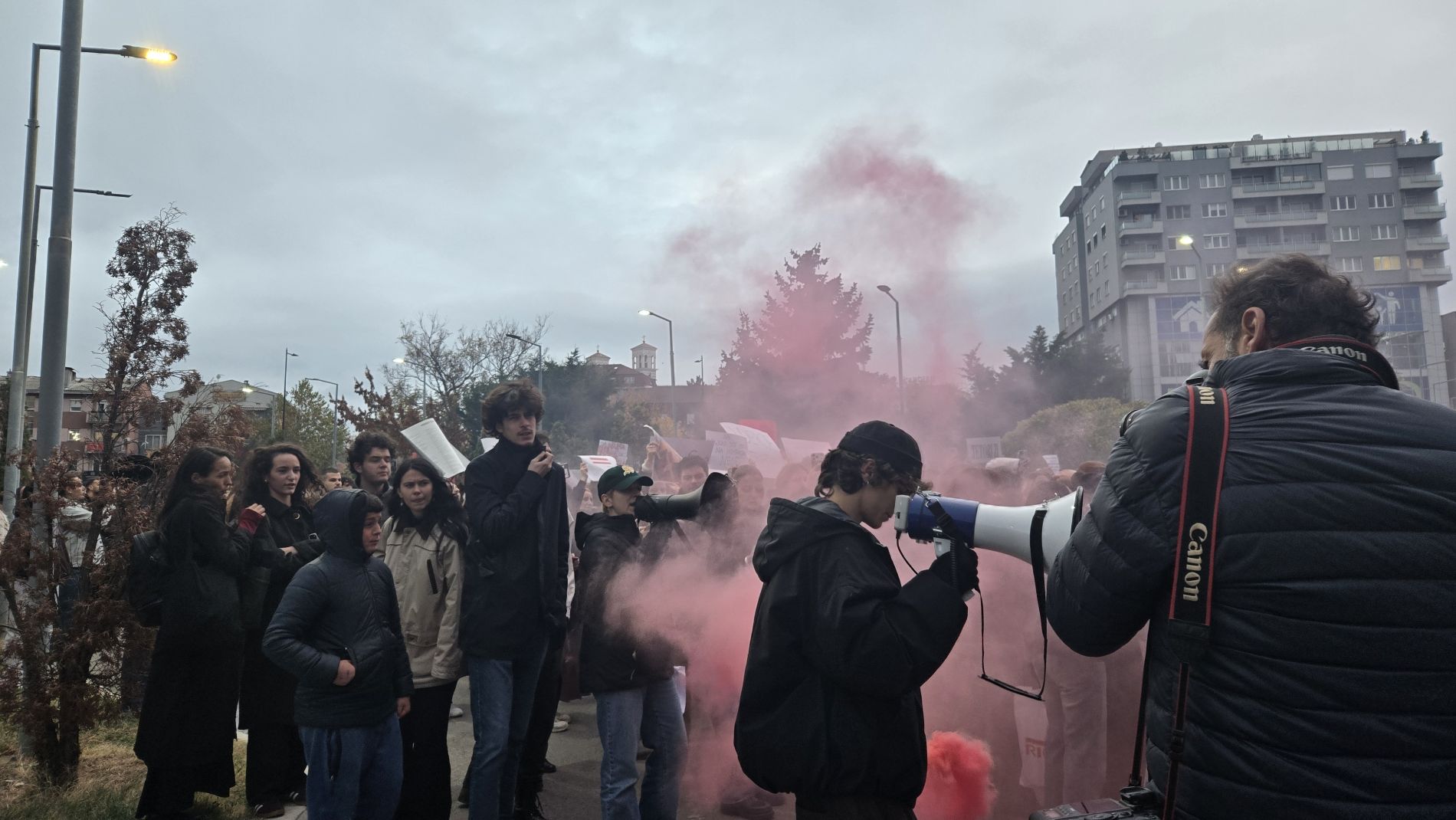
Protest against femicide in Prishtina, October 28, 2026. Photo: BIRN
Media platforms give considerable space to these diversions, but rather than interrogating the structures that produce violence against women, they often turn feminist analysis into a matter of controversy.
How to prevent femicide, how institutions should respond, and how they should be held accountable are legitimate subjects for professional discussion, scrutiny, and even disagreement. But why invite people with supposedly opposing views to debate whether women are systematically subjugated, whether femicide is rooted in gender inequality, or whether Kosovo is a patriarchal society? Such framing creates false equivalence, making established structural inequalities appear to be merely competing opinions.
In such debates, individuals with opposing views on women’s rights, gender roles and human rights were invited to debate the femicide of Arlinda Zekaj.
One of the panellists, often present in TV debates when women’s rights are the topic, is MP Eman Rahmani from the opposition Democratic Party of Kosovo, PDK. He is also a member of the Parliamentary Committee of Inquiry into Zekaj’s murder.
Rahmani’s presence in this parliamentary committee is itself questionable because of his publicly expressed positions on gender roles, family, and social norms. His beliefs also raise questions about the editorial rationale for his inclusion in a debate on femicide over other members of the parliamentary committee.
Just as troubling is how the discussion unfolds. Angry men, seemingly more interested in settling personal scores with one another than discussing Zekaj’s murder, were given considerable space to dominate the conversation through raised voices, confrontational body language, and sheer insistence on being heard.
Meanwhile, the women panellists remained composed, articulate, and polite, repeatedly attempting to bring the discussion back to Zekaj and the institutional failures that preceded her death.
The contrast was striking: men were allowed to turn a discussion about femicide into a contest of egos, while women had to work to keep the murdered woman and the substance of the discussion from disappearing.
This is another manifestation of cynicism: the transformation of a woman’s murder into media content, where confrontation takes precedence over scrutiny and spectacle over accountability. The appearance of debate is maintained, but its purpose is lost. A woman’s murder becomes a platform for political positioning and personal disputes, while the questions that should have been at the centre of the discussion remain insufficiently addressed.
The media can therefore appear to be fulfilling their public responsibility by giving femicide airtime, while simultaneously contributing to the trivialisation of the very issue they claim to be examining.
Zekaj warned the institutions that she feared for her life. They failed to protect her. Yet the cynicism that follows such failures risks making them seem inevitable, and resistance against them futile.
To honour Arlinda Zekaj and the lives of all women killed by femicide, we owe them more than grief, outrage or another promise that things must change. We owe them an honourable collective commitment: to take responsibility, to challenge injustice and stand behind those who resist it, and, above all, to refuse to accept that things cannot change.
Shqipe Gjocaj is a Kosovo-based writer, feminist researcher, and gender equality expert. Her work focuses on gender-based violence, women’s rights, social justice, and the intersections of gender, power, and culture. She writes on feminism, institutional accountability, social inequalities. and the politics of everyday life.
The views are of the author and do not necessarily reflect the views of BIRN.