


The death of a 32-year-old worker at Kosovo’s state-owned energy corporation, the fourth death at the company in 2026 alone, has resulted in renewed workplace safety inspection measures.
On August 20, Arbenit Ahmeti, from Mitrovica, was carrying out work involving a high-voltage electricity cable at the Coal Production Division of Kosovo’s state-owned energy corporation, KEK, when he suffered a fatal electric shock.
According to information obtained by KALLXO.com, Ahmeti came into contact with a 6-kilovolt cable supplying electricity to the transformers of a giant excavator. The electricity had not been switched off while he was moving the cable.
Safety protocols require power to be disconnected before workers handle these cables.
A KEK engineer was arrested in connection with the case.
Ahmeti was the fourth KEK worker to die in 2026. This has raised questions about whether the corporation does enough to protect workers.
This is their highest recorded death toll in 13 years, prompting workers’ representatives to say that outdated risk assessments, inadequate protective equipment, and pressure from management are putting employees at risk.
According to the New Trade Union of KEK, three workers died at the corporation between 2013 and 2025, while four have now died in the first eight months of 2026.
The deaths have also highlighted a basic safety problem: KEK had been operating for years without an updated assessment of workplace risks.
A seven-year-old assessment
The last assessment of workplace safety at KEK was conducted in 2019, according to the New Trade Union of KEK and Naim Baftiu, director of INKOS, the institution that carried out the assessment.
It covered all workplaces at the corporation and found that none could be considered free of risk.
“Based on the 2019 report, no worker in the Energy Corporation of Kosovo is without risk,” Baftiu said. “All of them: some carry a medium risk, while others are higher level.”
The assessment reflected the nature of work at KEK, he explained: employees operate in open terrain and around heavy machinery, enormous excavators, conveyor belts, and high levels of noise.
According to the union, KEK failed to secure a new contractor to conduct the assessment until 2026. A new contract was signed at the end of May, after three workers had already died during the year.
The company carrying out the assessment says the process could be completed by the middle of 2027.
The deaths recorded in 2026 began with Migjen Sadiku, a security worker at the Kosovo A thermal power plant, who in February was fatally struck by a truck inside KEK premises.
However, the Basic Prosecution in Prishtina did not classify the case as a workplace accident. Instead, prosecution charged the driver with “Endangering Public Traffic.”
“On May 19, 2026, the State Prosecutor filed an indictment against the defendant S.Sh., on reasonable suspicion that he committed the criminal offence of ‘Endangering Public Traffic,’” Kaltrina Shala, spokesperson at the State Prosecution, noted.
Nexhat Llumnica, deputy chairman of the New Trade Union of KEK, says the corporation has experienced more fatal accidents since KEK and KEDS separated their assets.
Llumnica, points to two workers killed in an explosion at Kosovo A in 2014, the death of Femi Salihu in 2018, and the four deaths recorded in 2026. According to the union’s figures, three workers died between 2013 and 2025.
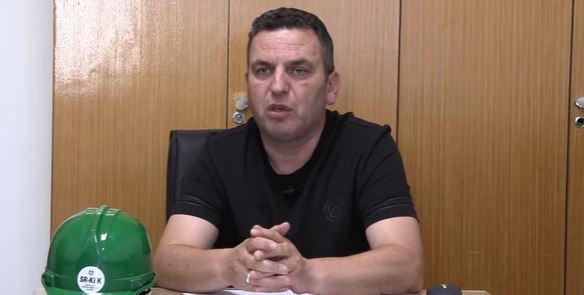
Nexhat Llumnica, deputy chairman of the New Trade Union of KEK. Photo: BIRN
‘A repressive management system’
The union says the problems extend beyond risk assessments.
The New Trade Union of KEK also alleges that some workers, particularly newly recruited employees, have not received adequate personal protective equipment.
Llumnica said there have been recent cases in which new employees were not supplied with the equipment they needed.
“We have recent cases where new workers come to the Energy Corporation without personal protective equipment,” he said, alleging that supervisors have sometimes instructed workers to purchase their own gloves and work clothes.
Xhelal Jashari, chairman of the New Trade Union of KEK, said equipment is often delivered late, in incomplete quantities or is unsuitable for the season and type of work.
“It comes half-complete for several years, it comes piece by piece,” Jashari said. “Often it is not appropriate. In summer they send winter gloves; in winter summer ones.”
Llumnica further states that the management culture at KEK is also affecting workplace safety.
He describes what he considers a repressive management environment, pointing to disciplinary commissions and formal complaints against workers.
In his view, this can discourage employees from refusing tasks they consider unsafe.
“Management at KEK is now, in a way, sowing fear among workers through disciplinary commissions and reports,” Llumnica said. “There are cases when workers, even when they do not have safety, do not dare to say they will not perform a task, even though it is unsafe.”
“I have the impression that this is also affecting workers’ safety.”
Llumnica also said workers and unions believe there are many cases in which employees develop occupational illnesses during their years of employment.
Jashari described another pressure: deadlines.
According to him, workers are sometimes pushed to complete tasks quickly even when working conditions are potentially unsafe.
“Workers work under pressure that we have assessed as coercive pressure,” Jashari said. “They are told, to hurry with the manager saying, ‘I will be dismissed in case this work is not completed.’”
Training is another area where the union says KEK needs to improve.
Jashari said KEK provides too little training and alleged that some sessions are conducted by people who do not have sufficient knowledge of the corporation’s highly specialised working environment.
“There is little training at KEK,” he said. “There is little training, and the training that is held is conducted by people who are not professionals.”
The union says workers need practical training tailored to the specific machinery and risks they encounter.