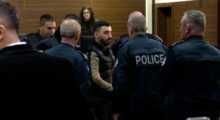
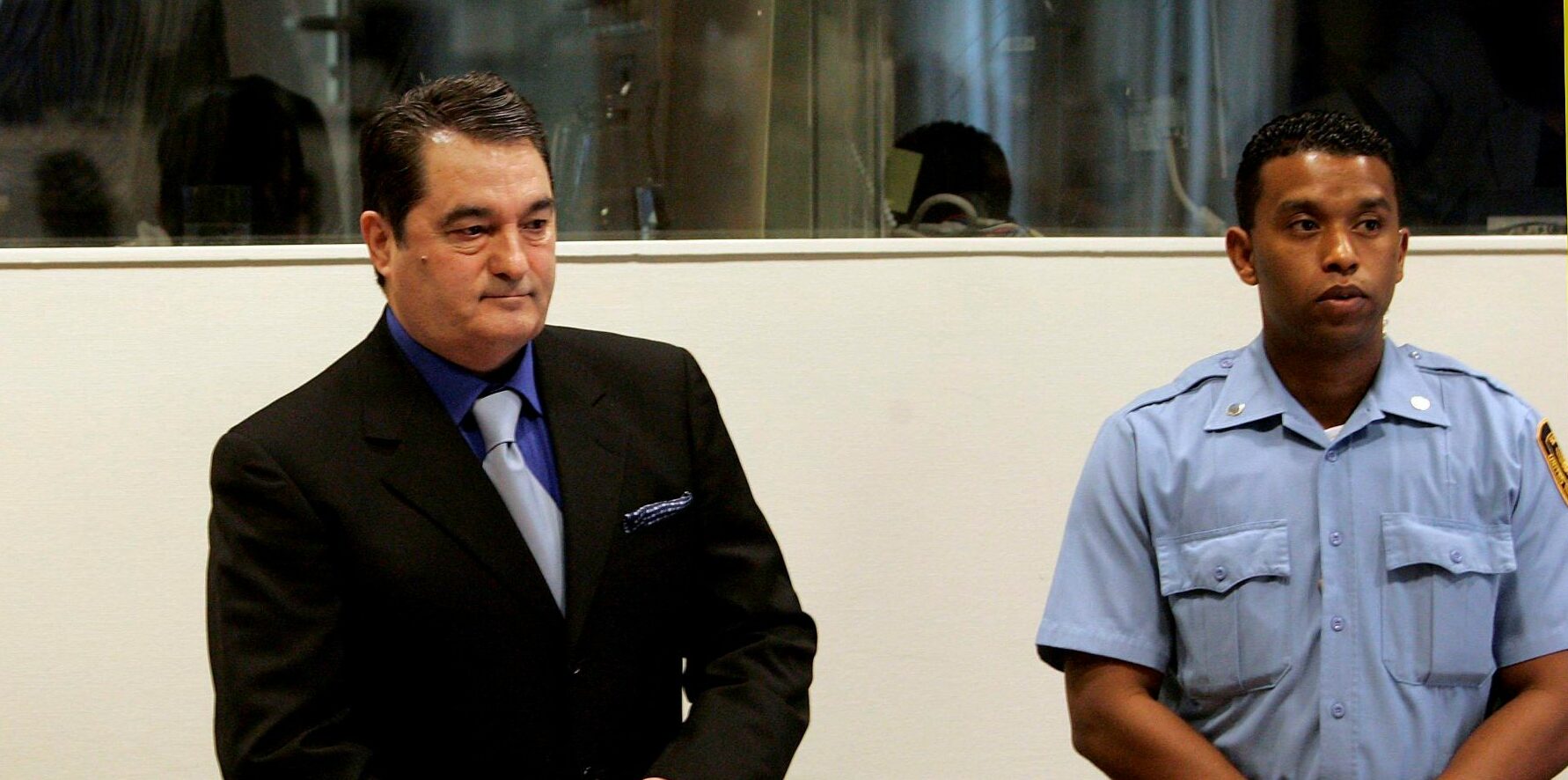
 Former Yugoslav Army Chief Nebojsa Pavkovic appears in court for his initial hearing at the International Criminal Tribunal for the former Yugoslavia (ICTY) in The Hague on April 28, 2005. Photo: EPA
Nebojsa Pavkovic, commander of the Yugoslav Army Third Battalion in the Kosovo war – who was recently released from prison for health reasons – has died.
Nebojsa Pavkovic, a former Yugoslav Army general who was sentenced to 22 years in prison for war crimes, died in Serbia on Monday aged 79.
Until he was released a month ago on health grounds, Pavkovic was serving his sentence in Finland. The International Criminal Tribunal for the Former Yugoslavia, ICTY found him guilty in 2009 of being part of a joint criminal enterprise whose aim was the persecution and forcible removal of Albanians from Kosovo during the war. He was also found guilty of murder.
In 2014, the ICTY appeals chamber of upheld the 2009 verdict that convicted Pavkovic and three other high-profile Yugoslav military and civilian officials.
After being released, Pavkovic was brought back to Serbia on a government plane.
In his condolences, Serbian President Aleksandar Vucic said that Pavkovic “left a mark as an officer who performed his duty with a strong sense of responsibility, dedication and belonging to Serbia, taking care of the people he worked with and carrying out the tasks entrusted to him.
“He dedicated his life to serving the country and the army, and his memory will be preserved by those who shared both difficult and proud days with him,” Vucic said a statement.
During the war in Kosovo, while Pavkovic was head of the Yugoslav Army Third Battalion, Vucic was Serbia’s Minister for Information..
Former Yugoslav deputy prime minister Nikola Sainovic, former Yugoslav Army general Vladimir Lazarevic and former Serbian police general Sreten Lukic were the three high-ranking officials convicted alongside Pavkovic.
According to the 2009 first-instance verdict, “there was a broad campaign of violence directed against the Kosovo Albanian civilian population conducted by forces under the control of the [Yugoslav] and Serbian authorities, during which there were incidents of killing, sexual assault, and the intentional destruction of mosques”.
During his time in prison, Pavkovic wrote books, which in Serbia were published by the Serbian Defence Ministry. He also participated online in some television or YouTube shows in Serbia.
Pavkovic, who was born in the village of Senjski Rudnik, some 20 kilometres from the central Serbian town of Cuprija, was commander of the Yugoslav Army Third Battalion from December 1998 until early 2000, during the Kosovo War.
In previous years, the Serbian authorities have also welcomed other freed war criminals and helped them to rejoin public and political life.
In October 2017, Pavkovic’s fellow defendant Lazarevic delivered a lecture at the Serbian Military Academy on the subject of the “heroism and humanity” of Serbian soldiers during their “counter-terrorist operations” in Kosovo in 1998-99 and during the NATO bombing of Yugoslavia in 1999.
On May 9, 2019, Lazarevic headed a World War II Victory Day parade through the Serbian city of Nis, an event organised by Russian war veterans with the backing of the Serbian authorities.
General Dragoljub Ojdanic, who was granted early release in 2013, retracted the confession he gave to the UN court after he was freed. Sainovic has become a senior official with the Socialist Party of Serbia, Slobodan Milosevic’s party during the 1990s, which is now part of the Serbian government.


20 October 2025 - 18:45
During the 1998–1999 Kosovo war, hundreds of cultural heritage sites...
Kosovo marked the 27th anniversary of the Krusha massacre, where 241 c...
Emine Berisha was an expectant mother in Prishtina in March 1999 when ...
Hamide Qereti, from Landovicë village in Prizren, lost two of her chi...