


A growing list of workplace fatalities and injuries cast a concerning light on Kosovo’s construction sector, where unregistered workers, unsafe working conditions, and a lack of accountability continue to cost workers their lives.
Migration of workers from Kosovo and their employment in European labour markets has created a gap in the local construction sector, leading to the hiring of workers from other countries. In many cases, however, these foreign workers face violations of their basic rights, including lack of proper registration and inadequate safety measures at work.
In July, the Kosovo Tax Administration, ATK, launched a nationwide investigation targeting construction businesses following reports from citizens and intelligence indicating that many companies were employing workers without formal contracts.
A KALLXO.com crew joined ATK inspectors in the field to oversee the work of a number of construction companies in Prizren. At one site, ATK inspectors discovered thirteen undeclared workers from Turkey.
One employer on site in Prizren declared that it would be more costly for the companies if the employees were registered immediately “because after one or two days, some workers say they don’t like the job.” He explained that the unregistered workers “just arrived last week.”
At another location, a company had engaged only four workers for the construction of a high-rise building.
Kosovo’s labour law mandates that every employee must have a valid employment contract signed at least one day before beginning work and a medical certificate stating they are fit to work. Workers are also entitled to job condition briefings and appropriate training. Failure to meet these requirements is a legal violation.
Valdrin Nalli, an ATK inspector, explained that, “for each unregistered worker, the fine is 500 euros.”
Oversight is split between the Labour Inspectorate, responsible for monitoring contracts and workplace safety, and ATK which ensures tax registration and compliance.
Since January 2024 legal amendments also require employers to register workers on the ATK platform at least one day before the start of their employment. Employees also have the right to verify their own registration status.
Despite laws in place, rates of informal employment and tax evasion, as well as the number of fatal accidents show that Kosovo’s construction sector is facing a crisis of accountability and oversight.
Death on the worksite: A systemic tragedy

Kosovo Tax Administration officials inspect a worksite in the Prizren region in July 2025, where unregistered workers from Turkey were found during a routine check. Photo: BIRN
Despite increased inspections and evolving regulations, workplace fatalities in Kosovo’s construction sector remain alarmingly frequent. Since January 2025, 8 deaths and 268 workplace accidents have been reported in Kosovo, with the majority of these occurring in the construction industry, including four deaths in just two days.
The latest death was that of a construction worker in Skenderaj who died after reportedly suffering a cardiac arrest on July 22, the same day the Ministry of Health issued a directive calling for outdoor construction work to be halted during peak hours due to high temperatures. The directive, effective between July 22–25, 2025, urged public and private institutions to implement protective measures for workers and to suspend work between 11:00 and 16:00.
On July 21, 2025, two men in Gjakova/Djakovica lost their lives after sustaining injuries at a worksite. The investor and site manager were arrested in connection with the case.
The Kosovo Police told KALLXO.com that, “around 08:15, we were informed that two adult males had been transported for medical treatment to the Regional Hospital in Gjakova. It is suspected that the injuries were sustained at their workplace. Later, their deaths were confirmed.”
That same day, July 21, a third man died from injuries sustained previously on another construction site in Peja/Pec.
On Tuesday, the Labour Inspectorate announced that the company involved in the Gjakova accident had been fined twice previously for repeated violations of workplace safety regulations.
“In the mid-year report there were 4,751 inspections conducted, 788 fines issued, 268 workplace accidents, and 7 fatal accidents since January 2025”, the Labour Inspectorate noted.
On Monday evening, the activists of the Collective for Feminist Thought and Action, condemned the state’s silence on the matter in a symbolic protest which involved graffiti on the Labour Inspectorate building that reads: “Workers die, the state remains silent.”
“The loss of these three lives, caused by unsafe construction site conditions, is not incidental—it is the predictable outcome of a profit-hungry capitalist system operating with the permission of the state. Health and safety have become privileges, stripped from workers to maximise profit for exploitative companies,” the activists wrote on Facebook.
They went on to say that, “the deaths of over 200 workers in the last decade show these are not accidents but predictable and preventable killings. If the state supported workers, these lives would have been saved.”
In April 2024, two workers died and another was injured in separate construction incidents. Again, the cause was cited as negligence and lack of safety protocols.
When homeowners become criminally liable
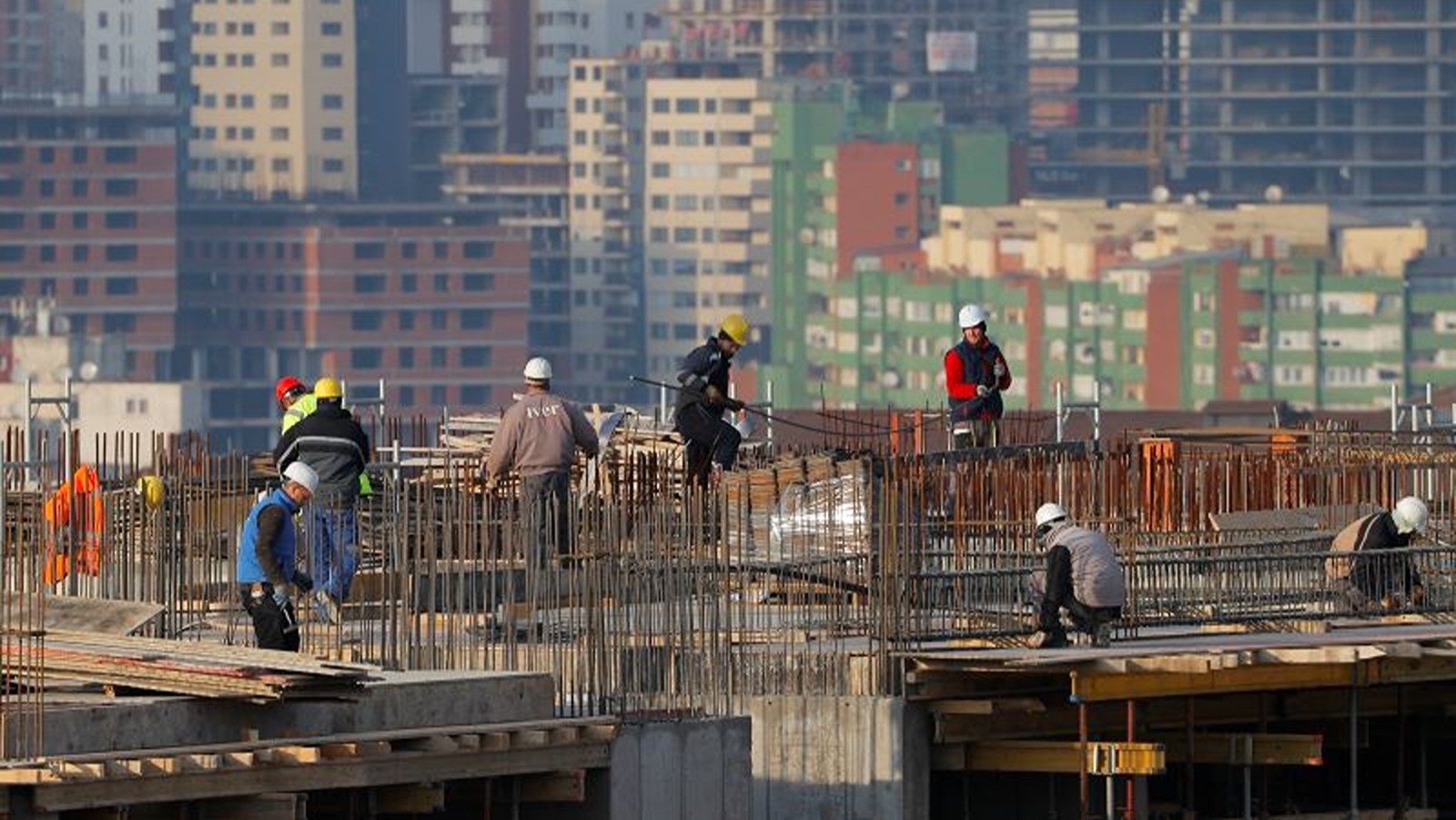
Workers on the construction site in Prishtina, Kosovo, 24 November 2020. Photo: EPA/Valdrin Xhemaj
Beyond corporate employers, private individuals commissioning construction work without formal contracts may also face prosecution.
Homeowner Luan Berisha, from Qallapek village near Peja/Pec, is on trial for failing to ensure workplace safety at his residence. In 2019, Berisha hired a worker to construct a terrace at his property. During the construction, a concrete pillar collapsed, leaving the worker severely injured and in a coma.
Berisha had no written agreement with the labourers.
At BIRN and Internews Kosova’s ‘Kallxo Përnime’ TV programme, which aired on July 20, the Peja Basic Prosecution spokesperson Shkodran Nikçi said that, “an investigation revealed there were no safety precautions during the construction. As a result, a worker suffered serious injuries. We hope this indictment serves as a preventive example.”
Berisha told Kallxo Përnime that he had believed that the workers were part of a registered company, citing their “uniform” as evidence.
According to labour inspector Pashk Vasani, “for the workplace accident and resulting injury, Luan Berisha from Qallapek–Peja is responsible as the project investor, due to the lack of a contractual agreement with the executor of the work.”
Berisha argued that “I am not a construction expert. I asked if the company was registered, and they said yes. I even asked for documentation.”
“Why doesn’t the state regulate this? Why are citizens held responsible?” he protested.
However, Nikçi confirmed that in cases where no licensed company is verifiably contracted the law holds individuals accountable.