


At a moment when democracy is increasingly shaped and shaken by digital spaces, the 9th edition of the Conference on Information Integrity, DISICON 9, placed an urgent crisis at the centre of its agenda: the escalating online abuse targeting women in political life.
Opening the conference on Information Integrity, DISICON 9, Nancy Soderberg, NDI Senior Country Director, highlighted that, “across the region and the world, we are witnessing a surge of online violence, misogynistic narratives, deepfakes, and coordinated harassment designed to silence women and distort debate. These are systematic tactics.”
DISICON 9 launched in Prishtina on December 8, aligning with the global “16 Days of Activism Against Gender-Based Violence.” It brings together diplomats, politicians, journalists, researchers, and civil society leaders, under a unified message: gendered digital violence has evolved into a systematic, technologically sophisticated threat to democratic participation.
Christoph Fuchs, Charge d’Affaires from the Swiss Embassy in Kosovo, noted that: “Civil society must act as a watchdog, educator, and advocate empowering citizens and holding powerful actors accountable.”
From the EU Office in Kosovo, Eva Palatova stressed the need for law enforcement: “If online spaces are used to harass and intimidate women, the legislation is only meaningful if it is applied.”
German Ambassador Rainer Rudolph offered a framework for better resilience: “A clear policy framework, independent media, and leadership willing to uphold standards are essential.”
OSCE Ambassador Gerard McGurk warned that the issue reaches far beyond gender. “Online violence and gendered disinformation undermine representation and public trust.”
Growing, structured, and deeply rooted misogyny
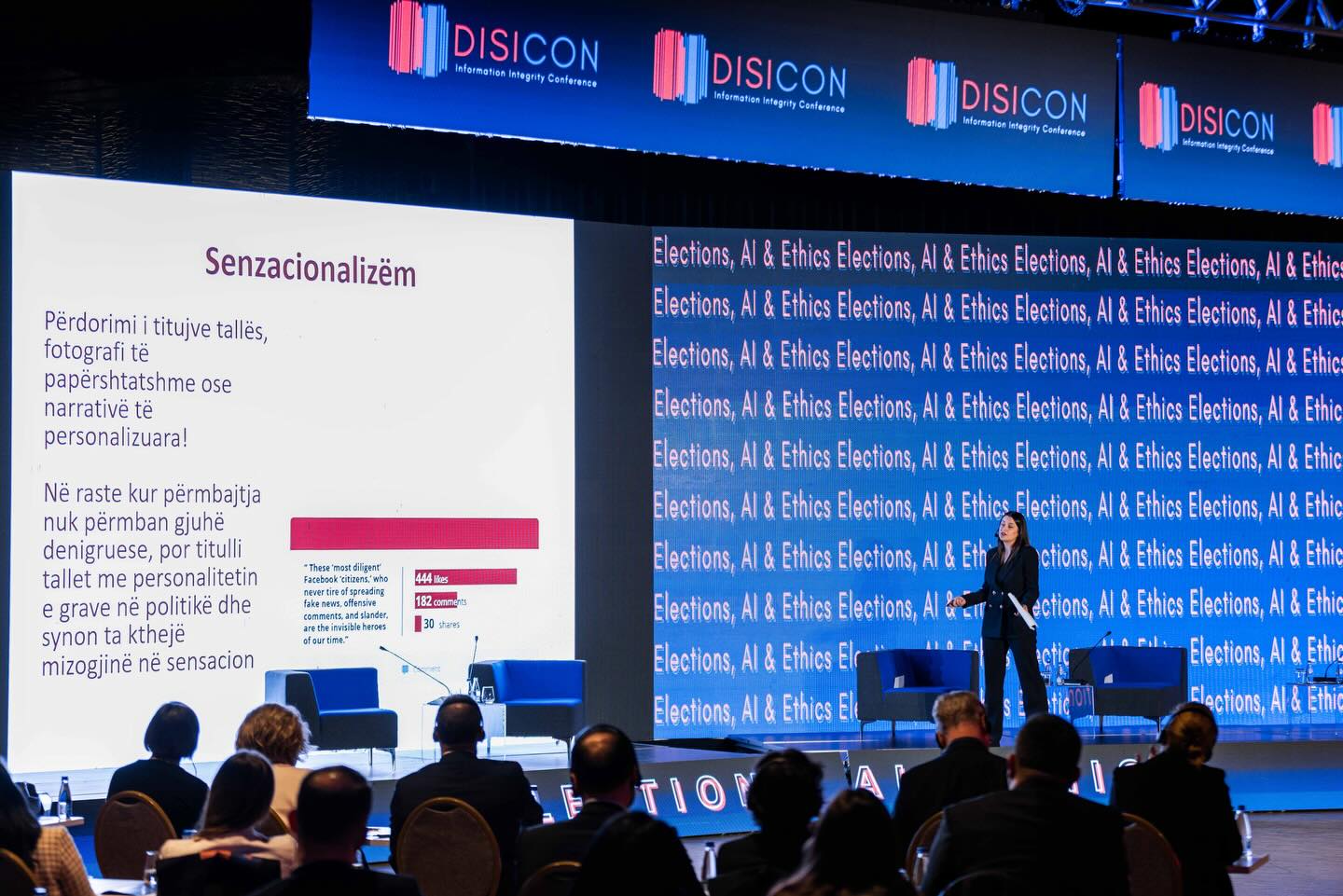
Report on online hate speech and misogyny presented by Democracy for Development, D4D, Executive Director, Rezarta Delibashzade Krasniqi. Photo courtesy of NDI Kosovo
One of the conference’s most detailed insights came from a report by the Prishtina based think tank, Democracy for Development, D4D, presented by Executive Director Rezarta Delibashzade Krasniqi.
Her team analysed 660,758 comments across 162 media outlets and major social platforms.
The findings reveal: 14% of all comments (91,525) contained hate speech toward women in politics. Male authors generated 96.2% of these comments in 2025—up from 89.6% in 2023.
“Attacks fall into four archetypes: moral shaming, sexualised insults, portrayals of incompetence or weakness, and intellectual humiliation,” Krasniqi said.
According to the report, deepfakes and AI-generated content are rapidly becoming central tools of political misogyny.
High-profile targets include President Vjosa Osmani, former President Atifete Jahjaga, and MP Mimoza Kusari-Lila.
“Minority-community women, specifically Duda Balje, face ‘double discrimination.’ [They are] targeted for both gender and ethnicity,” she added.
Krasniqi noted that misogyny is amplified during political events such as elections, parliamentary sessions, or crises, creating an environment where political engagement becomes psychologically dangerous for women: “Misogyny is becoming more sophisticated, more partisan, and more normalised. In some cases, political parties themselves contribute to it.”
Disinformation as a weapon against elections and public trust
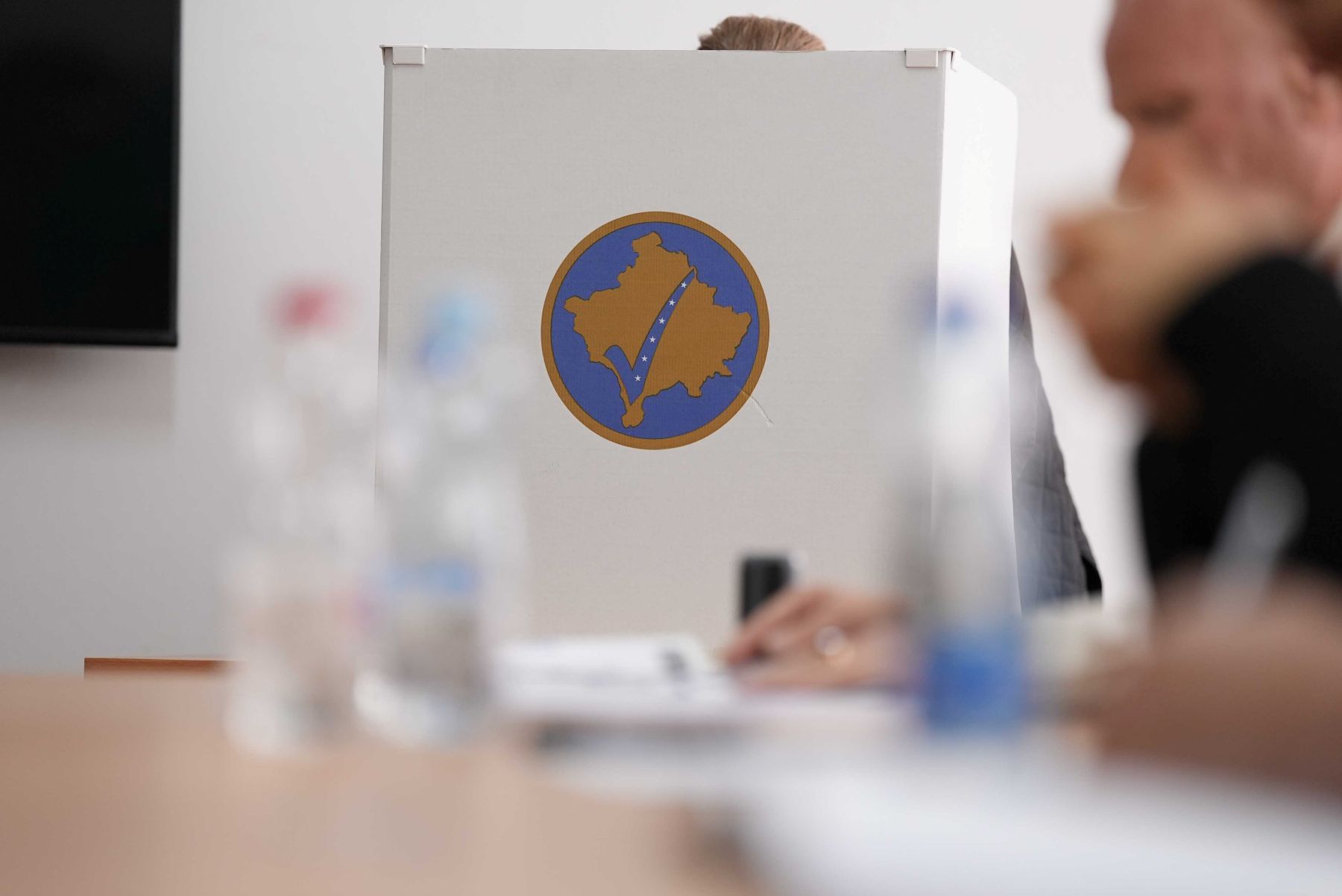
Local elections in Kosovo on October 12, 2025. Photo: BIRN/Denis Sllovinja.
DISICON 9 also previewed scenes from BIRN’s upcoming documentary on democracy and elections.
The film highlights how foreign disinformation, especially Kremlin-backed narratives, aims to weaken confidence in Kosovo’s electoral processes. Religious narratives, though directed at smaller audiences, have also proven effective.
Former AKI Inspector General Burim Ramadani explained: “During elections, disinformation is aimed at political groups to deepen divisions. Penetration in the Serb community is more deliberate and effective.”
Former Deputy PM Lutfi Haziri added that disinformation threatens the very foundations of Kosovo’s young statehood: “A continuous external aggression seeks to erode institutional credibility and create mistrust.”
Former MP Vlora Çitaku recalled direct calls to boycott elections. “The goal was not just to delegitimize the vote, but the system and the state itself.”
Social media: Where fear is curated and amplified
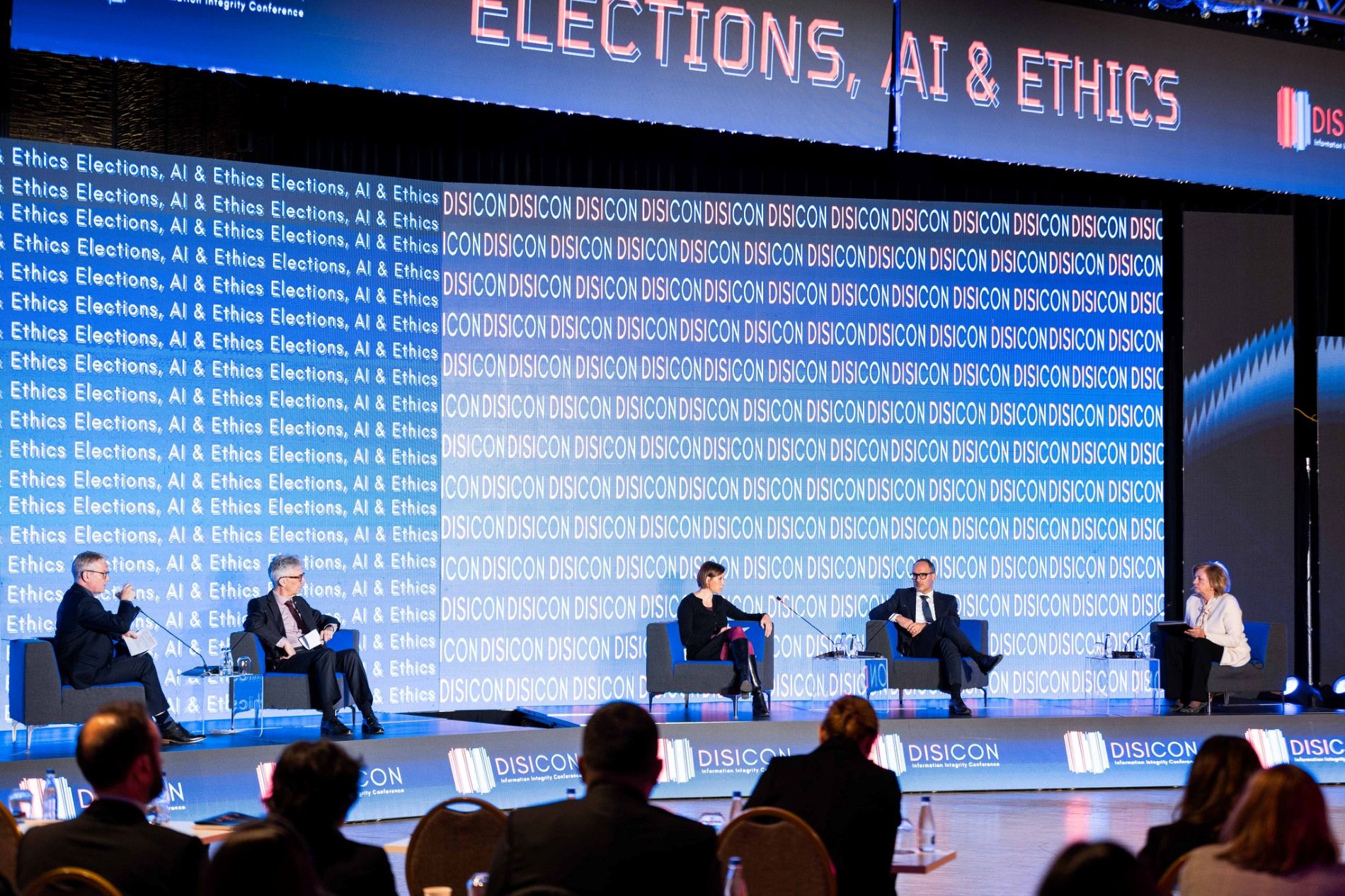
Discussion panel on “Social Networks That Create Fear” at the Disicon 9 conference on December 8, 2025. Photo courtesy of NDI Kosovo
In the panel “Social Networks That Create Fear,” experts examined how online platforms turbocharge gendered violence.
Adelina Berisha, of the Kosovo Women’s Network, warned of stalled reforms.
“Last year major work began to amend the Criminal Code to address online violence. Unfortunately, the process stopped. Without mechanisms of prevention and response, the situation will worsen.”
She stressed the role of men as allies in resisting misogyny.
Visar Prebreza, Managing Editor at BIRN/KALLXO.com, described a concerning pattern: “People spreading disinformation often say they ‘support’ women in politics, but only if they remain silent and uninvolved in sensitive issues.”
He emphasised that most harmful content is not produced by journalists but by “unregulated online actors who are not even journalists.”
Albanian MP Iris Luarasi shared a personal account of digitally orchestrated harassment after a gender equality law was passed in Albania: “My comments were taken out of context, turned into a misleading headline, and within two days thousands of messages attacked my morality, my gender, my body. The threats escalated quickly.”
She underlined that online violence produces psychological, social, and political consequences: “It forces women to choose between public service and personal safety.”
Edi Gusia, head of Kosovo’s Agency for Gender Equality, emphasised the issue in global terms: “This is a coordinated and well-funded global attempt to push women out of political spaces.”
Meanwhile, Festim Rizanaj, from ADS/Hibrid, analysed the algorithmic dimension: “Platforms amplify misogynistic content because it is emotional and polarising. Memes and deepfakes spread faster than facts.”
From Lëvizja FOL, Mexhide Demolli-Nimani presented evidence of gender bias in election coverage: Only 20 of 206 mayoral candidates were women, none made it to the second round, and women received just 10% of debate airtime.
A President’s reflections: “I woke up every day to headlines about my looks”
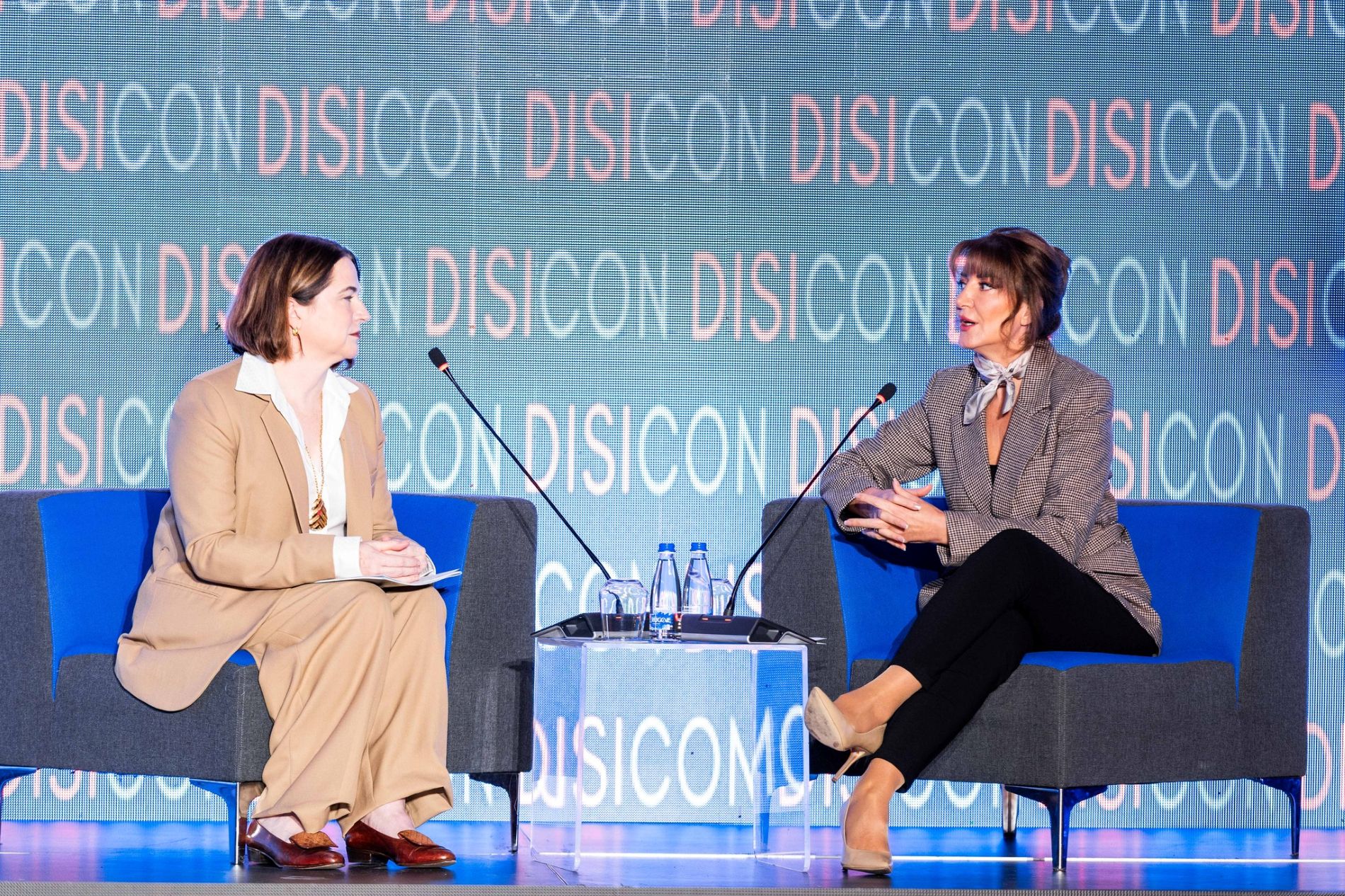
Kosovo former president, Atifete Jahjaga shares her challenges as the first woman president of the country, at the Disicon 9 conference on December 8, 2025. Photo courtesy of NDI Kosovo.
The first day of the conference closed with a reflection by former Kosovo President Atifete Jahjaga, who recalled the scrutiny she faced as Kosovo’s first female president.
She described how, during a period of constitutional crisis, she was nominated amid doubts about whether Kosovo was “ready” for a woman leader.
“The outside public knows a different story, while the official story was something totally different, it was an intensive negotiation between me and the political elite of that time. I was not sure if Koosovo was ready to have their first woman president or even a [female presidential] candidate as a patriarchal country.” Jahjaga served as Kosovo’s President in 2011-2016.
Jahjaga said she had insisted on a gender-balanced administration: “I required at least 50% women in my cabinet. Within a week, it was over 70%.”
But, as she put it, every day brought new commentary on her appearance: “Headlines focused on my clothes, nail polish, hairstyle, while [policy] decisions were buried.”
She recalled some reports about her in the first month after taking office.
“I was invited to a multilateral event in Poland, my team was avoiding eye contact with me. At one point, I asked what was going on and they told me to better not open social media. I saw myself in a photo and a bag which was zoomed in with the headline: ‘the president doesn’t know the protocol, with a handbag On the carpet.’ It was all about the optics,” she added.
She said that the report was made by a woman-led media outlet, while adding that, “women had the tendency to be the biggest enemy of their kind” when it came to reports about her looks, as men mostly do not know about shoes or makeup and bags.
“We gave this platform for men to comment and use it against other women.”
Jahjaga added that when it comes to women she stands by the motto: “criticise in private—praise in public,” noting that, “men have their old boys club, we women are missing an alliance among us.”
She concluded that even nowadays “we are nowhere when we speak about accountability, I see the same situation happening.”