


No political party secured enough seats to govern alone in Kosovo’s snap parliamentary elections and experts say the election of a new president is likely to become the key issue in coalition negotiations.
Kosovo’s snap parliamentary election has produced another divided political reality, making party agreements essential for forming new institutions and electing a president after more than a year of political deadlock.
The ruling Vetëvendosje Movement, LVV, won 42.91 percent of the vote, translating into an estimated 48 seats in the 120-member Assembly. This is nine fewer than it held after the December 2025 election.
The Democratic Party of Kosovo, PDK, retained its position as the second-largest party with 21.12 percent of the vote and an estimated 24 seats, up from 22. The Democratic League of Kosovo, LDK, came third with 17.58 percent and 20 seats, recovering five mandates lost in the previous election.
The Alliance for the Future of Kosovo, AAK, also improved its position, winning 7.16 percent of the vote and eight seats, compared to six previously.
The remaining 20 seats are reserved for non-majority communities, including 10 guaranteed seats for Kosovo Serbs.
The result, according to analysts, shows that a coalition between parties will be required, while the lower turnout in comparison to December 2025 elections, is a ‘signal’ from the citizens to the political parties.
Voter turnout in the June 7 election fell to 36.88 percent, down from 44.99 percent in December 2025, with 708,950 of 1,959,962 registered voters casting their ballots.
Low turnout signals public frustration
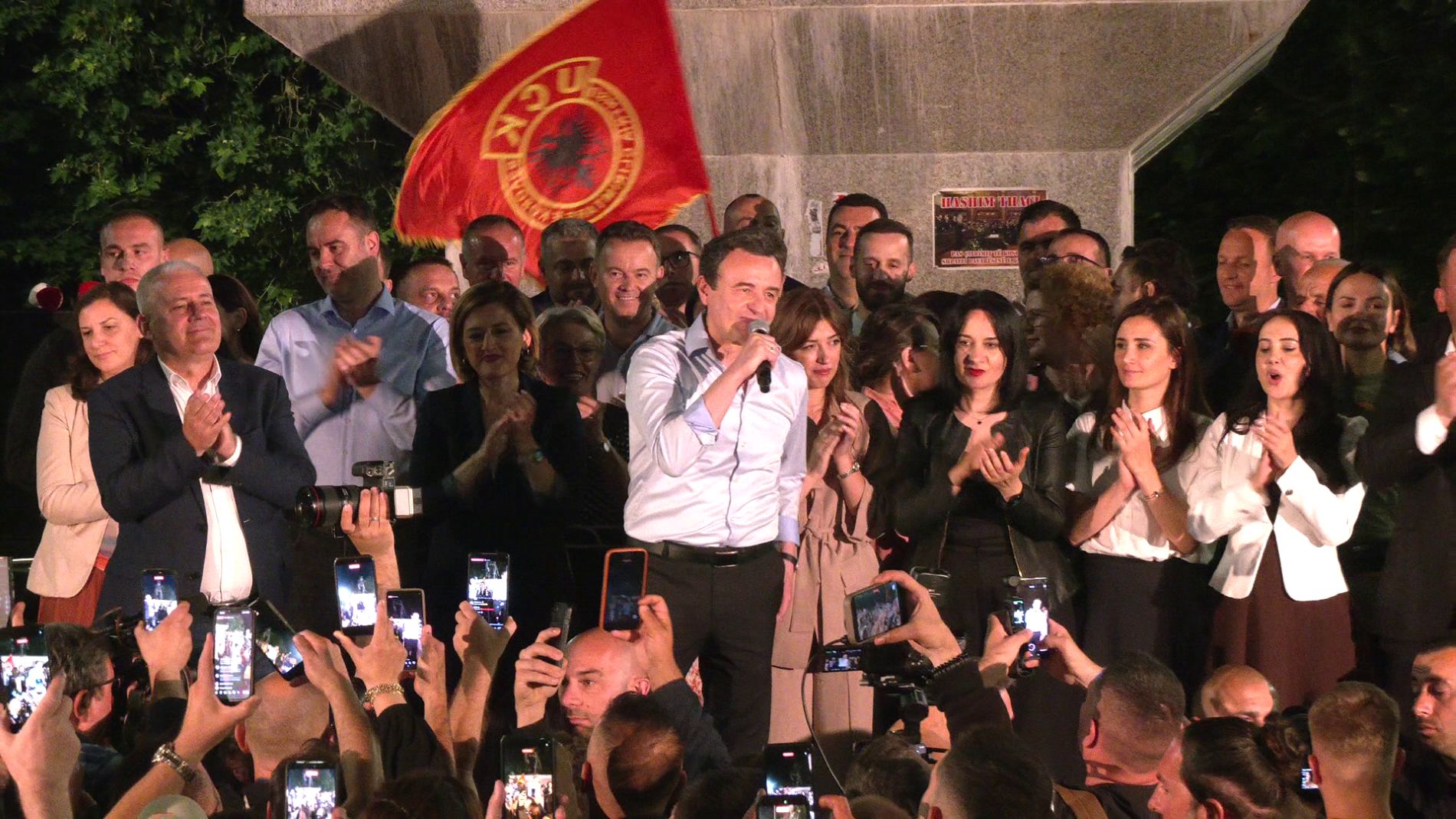
Acting Kosovo PM and Vetevendosje leader Albin Kurti and his cabinet celebrate with supporters in Prishtina, Kosovo on June 7, 2026. Photo: BIRN
Political analyst Dritero Arifi said the result reflected public frustration with the political class, particularly the governing party.
“These results were, in many ways, a civic protest against political parties, especially against the ruling Vetëvendosje Movement. In this case, Vetëvendosje is the biggest loser, but the other parties have not significantly increased their support either,” Arifi told Kallxo.com.
Arifi noted that the distribution of seats means coalition-building is unavoidable.
“This outcome makes it impossible for institutions to function without coalitions,” Arifi said.
Arifi argues that the most viable solution would be a broader political agreement encompassing the positions of prime minister, speaker of parliament, and president.
“In other words, a grand coalition agreement covering the speaker, president, and prime minister,” he added.
If such a broad coalition could be formed, Arifi believes Kosovo could quickly establish functional and legitimate institutions. Otherwise, he warns that the country “could face another round of extraordinary elections.”
He also described the outcome as a clear message from voters demanding concrete results rather than political rhetoric.
“This is a wake-up call for political parties to become more serious about both the promises they make and their implementation,” Arifi said.
The current turnout figures do not yet include conditional ballots, votes cast by persons with special needs, or votes from the diaspora.
The election follows two previous parliamentary elections that failed to produce lasting stable institutions. The first, in February 2025, did not result in the formation of a government, while the second, in December 2025, ended in institutional deadlock over the election of a president, and ultimately to the dissolution of parliament in April.
President seen as the biggest challenge
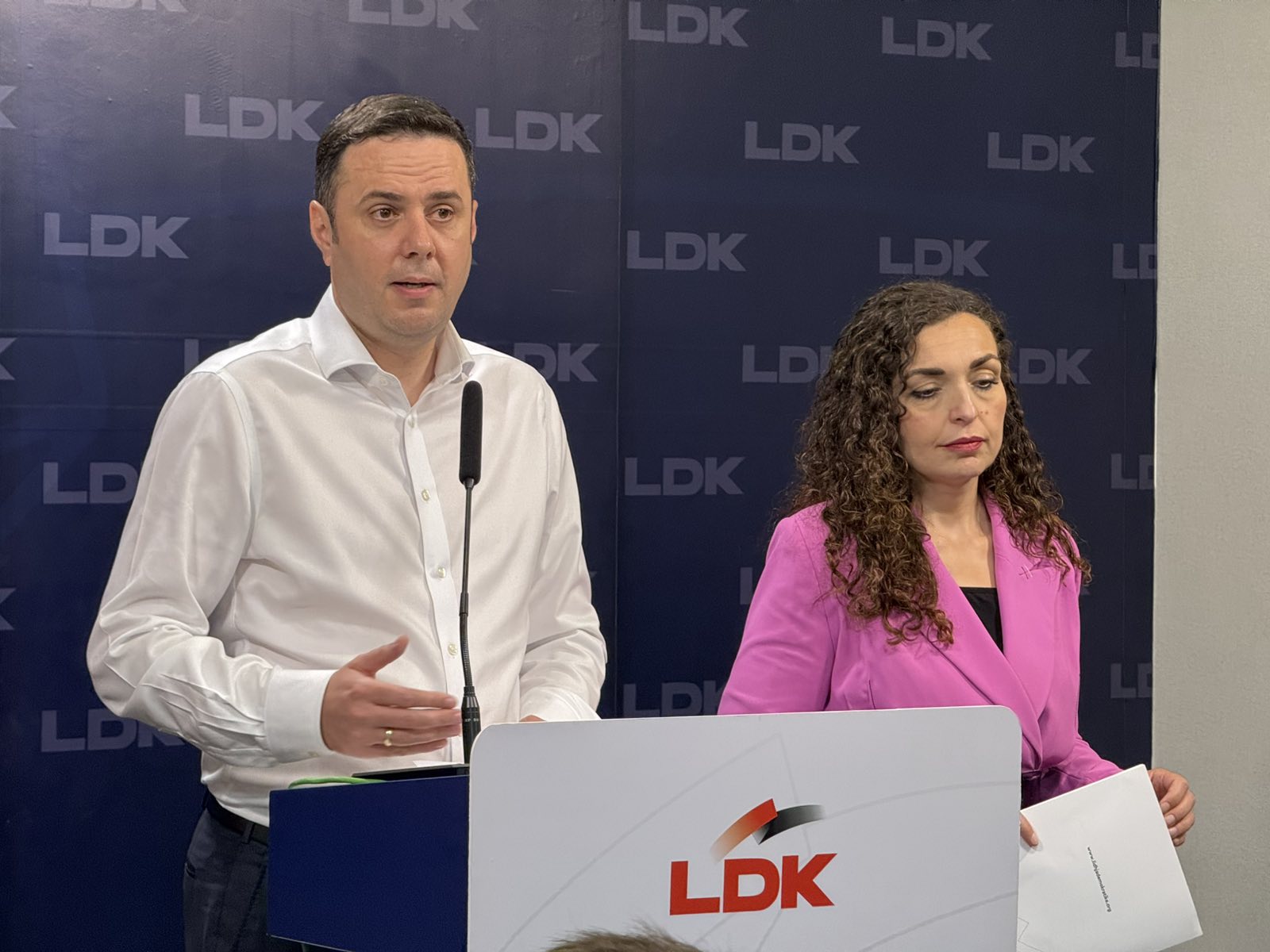
Former President Vjosa Osmani and LDK leader Lumir Abdixhiku at a press conference following the announcement of the election results on June 7, 2026. Photo: BIRN.
According to Kosovo’s constitution, a president requires support from a majority of 81 MPs out of the 120 seat parliament, making the position harder to secure than the premiership which requires a simple majority of 61.
This, analysts say, requires a broader political consensus.
Political scientist Melazim Koci said the high level of voter abstention should serve as a warning to political leaders.
“The election result shows deep voter disappointment with Kosovo’s political class. Such high abstention is the strongest warning signal that parties have lost touch with reality,” Koci said.
While he believes a government could be formed through several coalition combinations, Koci described the presidency as the more complex challenge.
“Vetëvendosje is in a position to form a government with any opposition party. The issue of electing a president is more complex and requires broader consensus,” he said.
Koci suggested that parties could either agree on an independent, non-partisan presidential candidate or negotiate a political deal under which LVV would lead the government while an opposition party would secure the presidency.
“The optimal solution would be the election of an independent, non-party candidate,” he said.
“Or Vetëvendosje could lead the government, while an opposition partner could secure the presidency,” Koci added further.
EU urges compromise
European Commission. Photo: BIRN
Following the announcement of the preliminary results, LVV leader and acting Prime Minister Albin Kurti described the outcome as a victory and said he “would seek talks with all political parties.”
“In the coming weeks, we will meet and cooperate with all sides because the public interest and the Republic come first,” Kurti said.
Former president Vjosa Osmani, who led the LDK electoral list and is the party’s presidential candidate, argued that LVV should support her candidacy.
“LVV has thousands of reasons to say yes, and all of them are in Kosovo’s national interest,” Osmani said.
European Union officials also urged Kosovo’s political leaders to compromise.
The EU High Representative for Foreign Affairs and Security Policy, Kaja Kalls reacted, noting that political leaders now need to “engage constructively to ensure the swift formation of a government.”
“Kosovo’s democratic and inclusive election opens the door to turning the page after more than a year of political deadlock,” Kallas wrote.
Marta Kos, the European Commissioner for Enlargement, on Monday on X congratulated incumbent PM Kurti on his win.
“For Kosovo to progress on its EU path, political forces must now come together and find compromises to build institutional stability. I look forward to returning to Kosovo at the earliest opportunity to step up work on Kosovo’s EU integration and continuing work on the Growth Plan financing,” Kos wrote.