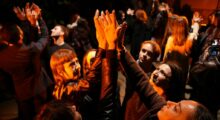
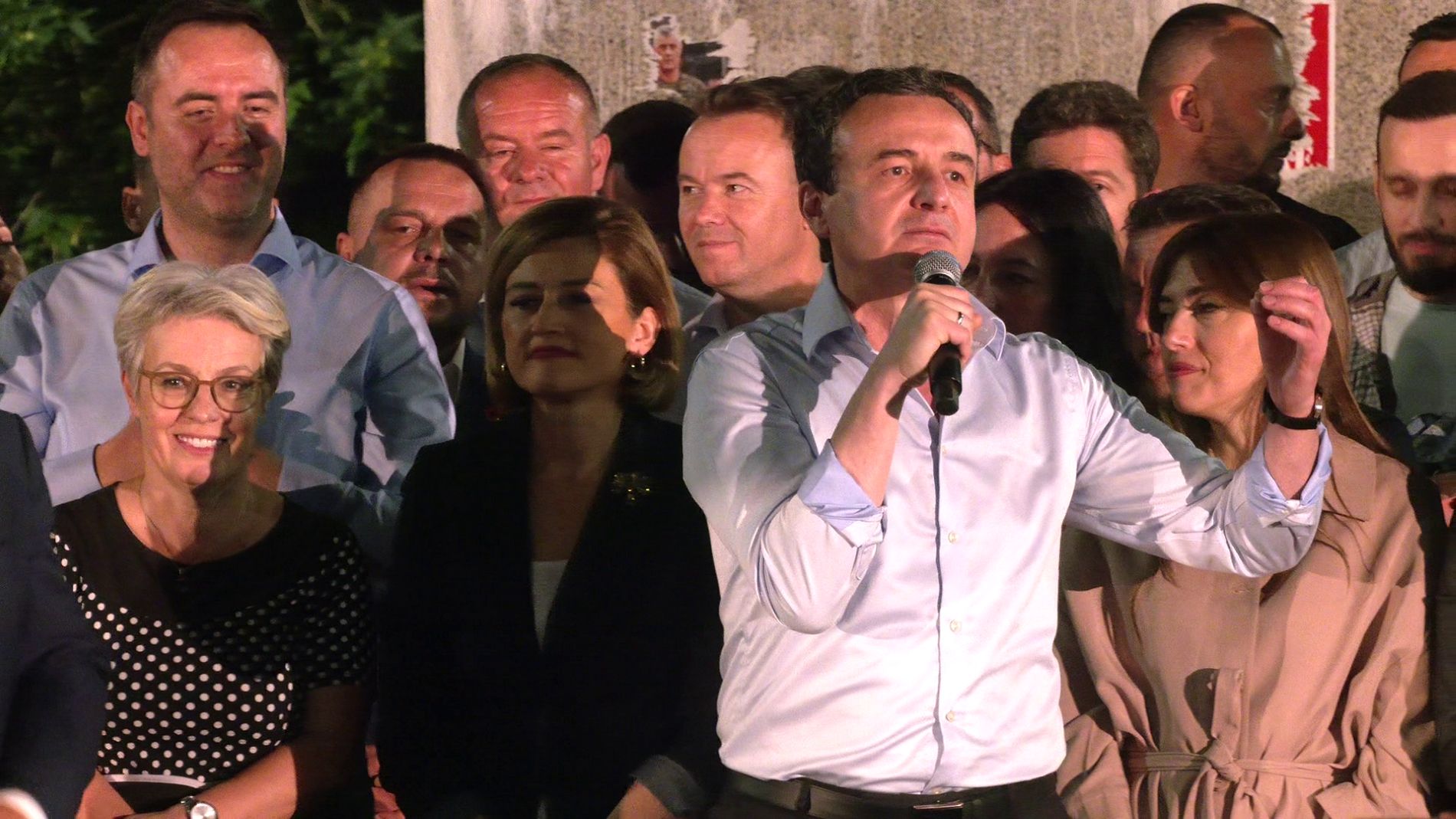
 Acting Kosovo PM and Vetevendosje leader Albin Kurti and his cabinet celebrate with supporters in Prishtina, Kosovo on June 7, 2026. Photo: BIRN
Vetevendosje hails another election victory - but its reduced vote points to likely need to cooperate with other parties to form government.
Albin Kurti’s Vetevendosje Movement, which has ruled Kosovo for the past five years, topped Sunday’s parliamentary elections again, though preliminary results suggest that it will need to cooperate with other parties to govern.
The EU High Representative for Foreign Affairs and Security Policy, Kaja Kalls reacted, noting that political leaders now need to “engage constructively to ensure the swift formation of a government.”
“Kosovo’s democratic and inclusive election opens the door to turning the page after more than a year of political deadlock,” Kallas wrote.
She added that, “progress in the Belgrade-Pristina Dialogue and the normalisation of relations with Serbia remain essential for advancing Kosovo’s European path.”
Marta Kos, the European Commissioner for Enlargement, on Monday on X congratulated incumbent PM Kurti on his win.
“Congratulations Albin Kurti on winning the elections in Kosovo, and importantly on the calm, inclusive and orderly voting process. For Kosovo to progress on its EU path, political forces must now come together and find compromises to build institutional stability. I look forward to returning to Kosovo at the earliest opportunity to step up work on Kosovo’s EU integration and continuing work on the Growth Plan financing,” she wrote.
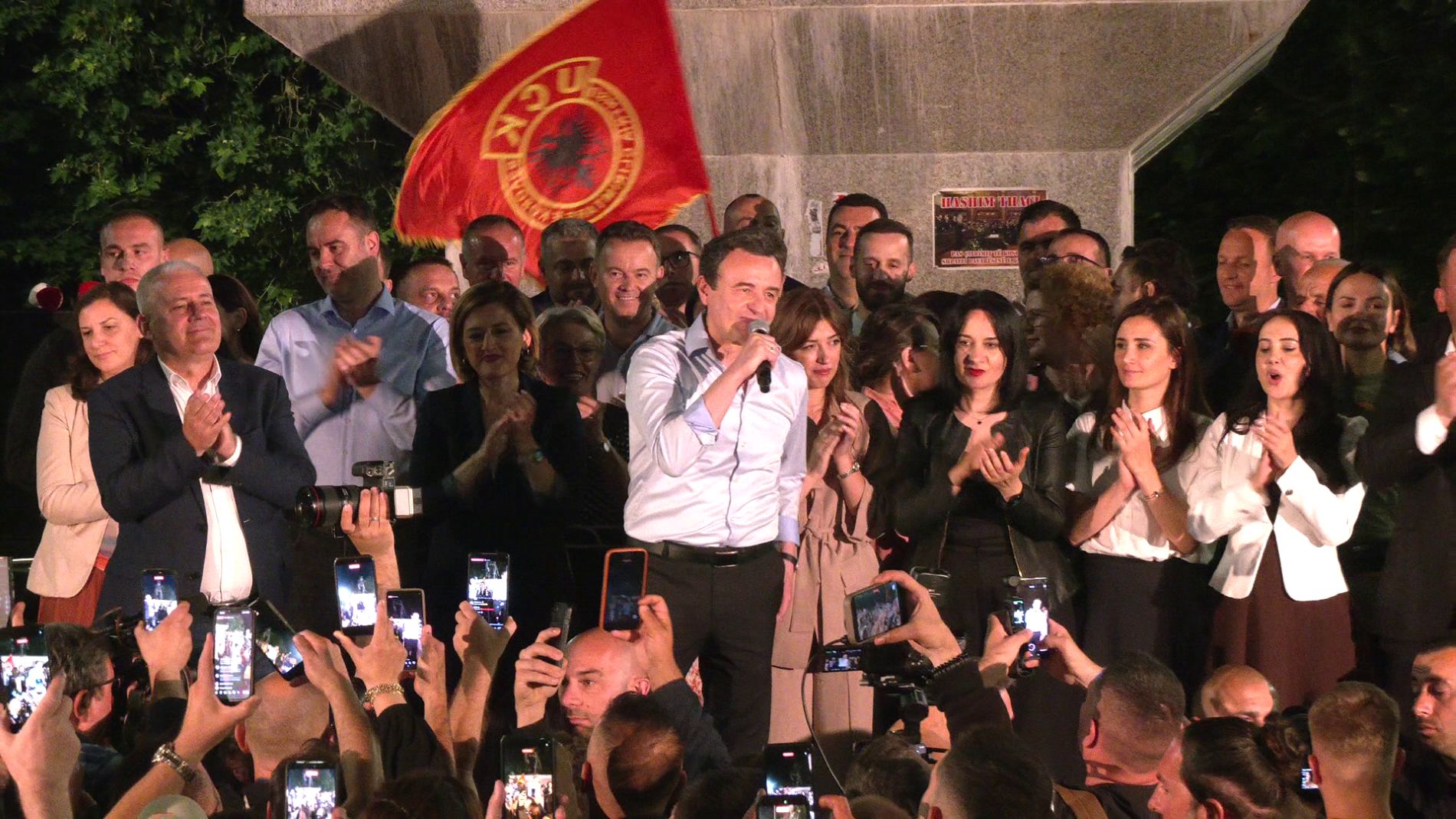
Vetevendosje celebrated its victory on Sunday evening, in the capital, Prishtina. Kurti promised that the next government will continue good, democratic governance, “where we combine the security of the state and borders with the well-being of citizens … This is the fifth win for Vetevendosje in seven years,” Kurti said.
Kosovo has held three parliamentary elections in the last 16 months after MPs failed to find common ground and elect a new head of state. Sunday’s snap elections became inevitable in April when outgoing President Vjosa Osmani’s five-year term ended.
Vetevendosje’s support level on Sunday shrank, while opposition parties slightly increased their support, compared to the last December 28, 2025 snap election.
With 99.76 per cent of the ballots counted, Vetevendosje won 42.94 per cent, well ahead of the Democratic Party of Kosovo, PDK, on 21.14 per cent and the Democratic League of Kosovo, LDK, on 17.57 per cent. The Alliance of the Future of Kosovo, AAK, took 7.16 per cent, becoming the last party to pass the 5-per-cent threshold needed to secure a seat in parliament.
In last December’s elections, Vetevendosje won 51.1 per cent of the votes, the PDK won 20.19 per cent nd the LDK, 13.24. The AAK barely managed to enter parliament, with 5.5 per cent of the votes. Vetevendosje took 57 seats in the 120-seat parliament, the PDK 22 and the LDK, 15.
Osmani, who led LDK’s candidates’ list on Sunday elections, aiming a second presidential mandate, at a press conference together with the party’s leader, Lumir Abdixhiku, said that “this increase [in votes] is only the first step towards revival and gives us hope that we are on the right path”.
She deemed the lower-than-usual turnout normal, as “citizens are tired of crises and electoral processes”.
Turnout, at around 37 per cent, was around 20 per cent lower than in December. This does not include conditional ballots, votes cast by people with special needs, and votes from the diaspora, which will help determine whether Kurti can form a government without a coalition.
Osmani said there were no reasons for Vetevendosje to refuse her a second presidential mandate, adding that, “from tomorrow we will focus all our efforts on giving the country institutions and a way out of the crisis”.
Vlora Citaku, the PDK’s secretary general, blamed Kurti for the low turnout. “Kurti’s government has produced a big disappointment among citizens and constant crisis,” she told a press conference on Sunday.
Kosovo’s parliament has 120 seat, 20 of which are guaranteed to non Albanian ethnic communities with ten going to ethnic Serbs and ten to other ethnic communities.
The Belgrade-backed party Srpska Lista also saw an increase in votes compared to the December elections, winning 6.19 per cent of the votes in the preliminary results. Petar Petkovic, head of the Serbian government’s office for Kosovo, congratulated “the brave and resolute Serbian people and our Serbian List, who have once again demonstrated the strength of Serbian unity and solidarity by winning all ten mandates with Serbian votes”.
Kurti has relied on non-majority communities’ representatives, except MPs from Srpska Lista, as allies with Vetevendosje in governance.
Fikrim Damka, from the ethnic Turkish Democratic Party of Kosovo, KDTP, hinted at another potential collaboration, writing on social media on Sunday that “in the period ahead, we will continue to work with determination to meet the expectations of our citizens, protect their rights and interests, and promote the development and prosperity of our society”.


08 June 2026 - 15:20
Civil society organisations are demanding institutional accountability...

Children continue to be exploited through street begging in Kosovo, as...
The exhibition ‘A Bird with a Stone Wing’ brings together local an...
Bedri Hamza, the leader of PDK, Kosovo’s largest opposition party, a...