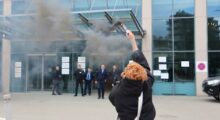
 Citizens and supporters gathered outside the headquarters of ruling Vetëvendosje Movement in Gjilan. Photo: BIRN.
In an election marred by low turnout, Kosovo's ruling Vetëvendosje party is heading towards another win at the snap parliamentary elections, according to preliminary results.
Albin Kurti’s Vetëvendosje, is on course to win Sunday’s snap parliamentary election, the third in less than two years, as the country faced repeated deadlocks in forming institutions.
With over 95 percent of the votes counted, data from the Kosovo Central Election Commission, CEC, shows that acting PM Kurti’s Vetëvendosje party secured around 43.4 percent of the vote. The second largest party, the Democratic Party of Kosovo, PDK, led by its prime ministerial candidate Bedri Hamza, is in second place with around 21.3 percent of the vote. The Democratic League of Kosovo, LDK, headed by Lumir Abdixhiku, follows with approximately 17.8 percent, while the Alliance for the Future of Kosovo’s, AAK, candidate Ardian Gjini ranks fourth with about 7.8 percent of the vote.
Compared to the preliminary results of the December 28, 2025 snap elections, the three opposition parties—PDK, LDK, and AAK—have received a higher share of votes, whereas the ruling Vetëvendosje saw a decrease.
Three separate exit polls broadcast by local television stations also placed Vetëvendosje ahead of its competitors, projecting results above 40 percent.
Speaking at a press conference after polling stations closed, CEC Chairman Kreshnik Radoniqi said the electoral process “went smoothly and that no incidents had been recorded that could have affected the integrity or overall conduct of the vote.”
The CEC announced that voter turnout reached 36.49 percent, with 708,950 of 1,959,962 registered voters casting their ballots, an estimated drop of around 20 percent compared to the December 2025 snap elections.
The current turnout figures do not yet include conditional ballots, votes cast by persons with special needs, or votes from the diaspora.
Election monitoring coalition Democracy in Action, DnV, said in a statement that, “despite significantly lower voter turnout, the voting process unfolded in a calm atmosphere, with voters able to exercise their right to vote freely and equally.”
More than 100 state prosecutors and prosecutorial officials were deployed across Kosovo to monitor the electoral process.
Kosovo Police notified that Sunday’s parliamentary elections were “conducted peacefully and without any serious incidents that could have affected the voting process.”
In a statement issued after polling stations closed, police said they had worked with the State Prosecutor’s Office to open 17 criminal cases related to alleged electoral offences . “The cases involve suspected violations including breaches of voting secrecy, destruction of voting materials, abuse of voting rights, and vote buying.”
“Five suspects have been placed in detention in connection with the investigations,” the police added, while “12 others were released and will be investigated under regular legal procedures.”
The election followed two previous parliamentary votes that failed to produce stable governing institutions. The first, held in February 2025, did not result in the formation of a government, while the second, in December 2025, ended in an institutional deadlock over the election of a president, ultimately leading to the dissolution of parliament in April.
In the December snap elections, Vetëvendosje won 51.1 percent of the votes, the PDK won 20.19 percent of the votes and the LDK won 13.24 percent. The third largest party, the Alliance for the Future of Kosovo, AAK, barely managed to enter parliament, with 5.5 percent of the votes.


07 June 2026 - 21:43
Civil society organisations are demanding institutional accountability...

Children continue to be exploited through street begging in Kosovo, as...

The exhibition ‘A Bird with a Stone Wing’ brings together local an...
Kosovo’s judicial institutions have taken steps to strengthen the ha...