


After a month-long internship at Reporting House in Prishtina, Florida State University student Brooke Simmons says Kosovo became more than a war-torn place she had read about in books.
From the auditoriums of Florida State University to a professional internship in Kosovo, one American student reflects on how one month in Prishtina has reshaped her understanding of history, democracy, and collective memory.
Before she first came to Kosovo at the end of May, everything she knew about the country came from books which, in a rather stereotypical way, present the views of outsiders on the 1998–99 war and Kosovo Albanians’ struggle for freedom and independence.
Inevitably, war, crimes, and the building of democracy were the themes that accompanied her preparation for the trip.
But when she arrived in Prishtina, the American student discovered a very different reality.
“What surprised me the most was how friendly everyone I met here was,” says American student Brooke Simmons, who spent one month in Kosovo completing her professional internship at Reporting House as part of an international program at Florida State University.
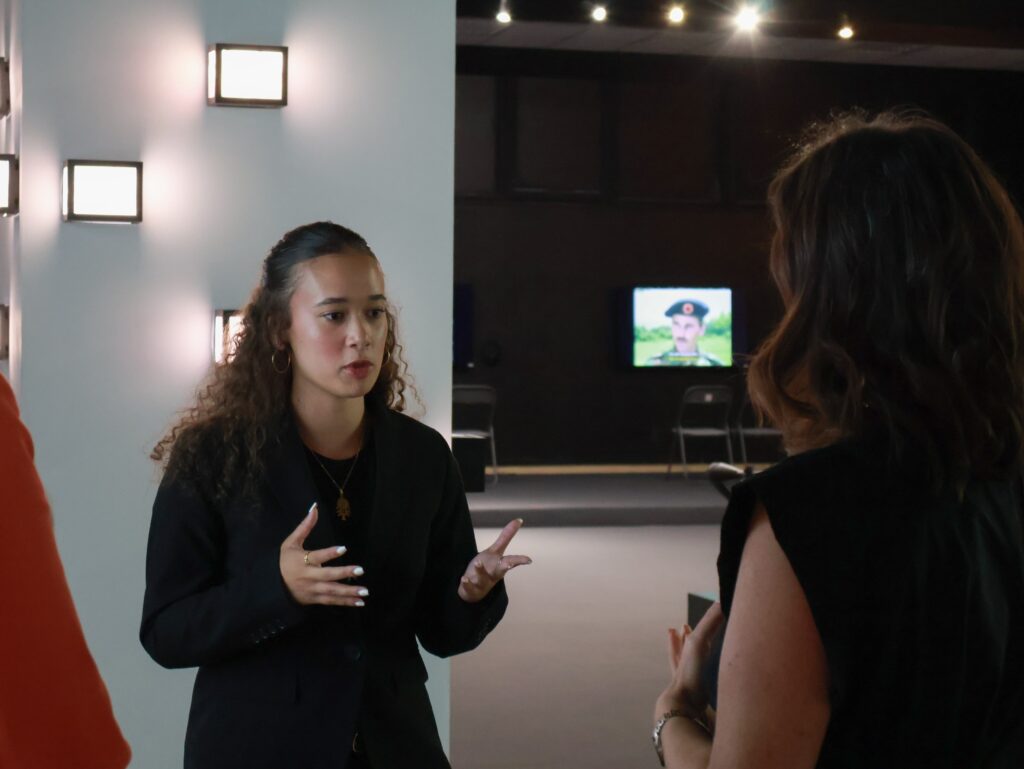
Brooke Simmons, a U.S. student, at the BIRN Reporting House museum in Prishtina. Photo: BIRN.
She says she did not have high expectations before arriving, but admits that the materials she had studied made her imagine Kosovo only through the lens of the war.
“Before I came, almost everything I read was about the war. When I got here, I saw a completely different country. It didn’t look like a place that had gone through such a serious war. Everything was built up, people were living their normal lives, and it was a very pleasant surprise,” she says.
Brooke Simmons studies Criminology and International Relations in the United States and says that her interest in human rights led her to apply for the program based in Kosovo.
The program, originally titled “Human Rights in Europe’s Newest Democracy,” gives American students the opportunity to learn first-hand about transitional justice, the building of democratic institutions, media freedom, and human rights.
For her, the experience in Kosovo was more than a professional internship, it was a moment that influenced her future plans.
“When I came here, I became even more convinced that I want to continue studying law and work in the field of human rights,” she says.
A significant part of her internship took place at Reporting House, where she had the opportunity to learn more about the war in Kosovo through photo and video exhibitions and archival materials.
She says this experience changed the way she sees journalism and the preservation of history.
“Much of what is presented at Reporting House is highly important investigative journalism. It not only documents the past, but also serves as education for future generations,” she said.
According to her, in the United States history is often treated as a difficult subject, while her experience in Kosovo showed her that collective memory is an essential element in building the future.
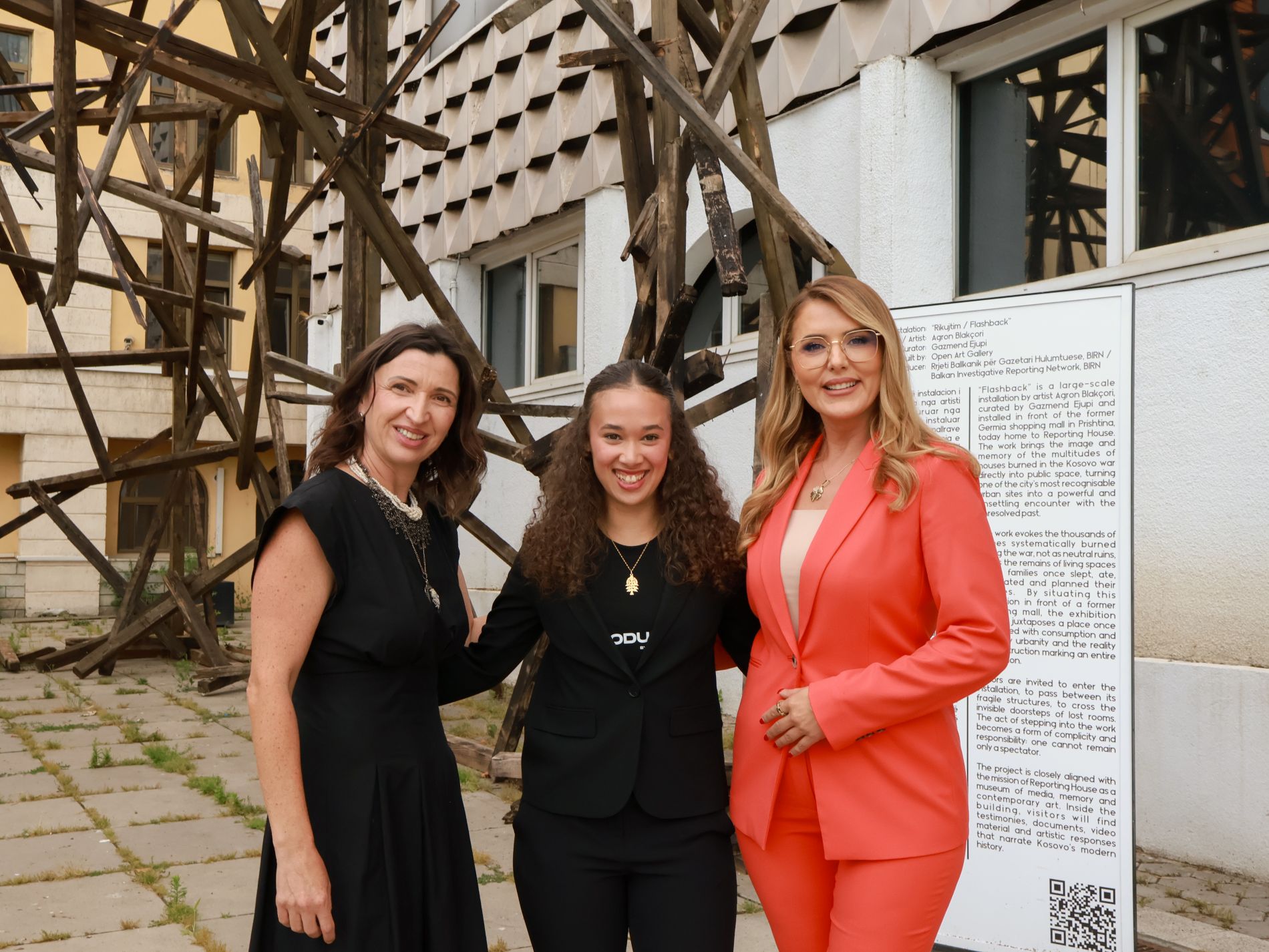
BIRN Executive Director Jeta Xharra (L), U.S. student Brooke Simmons (C), and Adelina Emini of the Center for the Advancement of Human Rights (R). Photo: BIRN.
Beyond the professional aspect, she says Kosovo also left a strong impression on her way of life.
Brooke noticed that the slower pace of life, relationships between people, and the sense of community are major differences compared to the United States.
“I liked the fact that people take time to drink coffee, to socialise, to spend time in parks with their families. There is a better balance between work and personal life,” Brooke says.
She also appreciates the way relationships are built in Kosovo.
“In the US, people often try to keep distance and relationships remain superficial. Here I felt that people want to get to know you better and build more genuine connections,” she explained.
She believes this experience is something many American students cannot find in traditional study-abroad programs.
“You don’t come here just to visit Europe. You come to see how a democracy is built, to learn from people who work every day for justice, and to understand the history of a country,” she added.
The program that brought her to Kosovo is implemented in cooperation with the Center for the Advancement of Human Rights, under the leadership of Professor Terry Coonan, and the International Programs of Florida State University.
According to the program organizer, Adelina Emini, the program grew out of a desire to place Kosovo on Florida State University’s international academic map.
“The idea for this program was born during my doctoral studies at Florida State University, where, in addition to academic development and scientific research, I took it upon myself to place Kosovo on the international map of this prestigious university. Today, I can proudly say that Kosovo is part of Florida State University’s International Program, and is becoming a destination where American students come to learn and to experience first-hand Europe’s newest democracy,” she said.
As part of the program, American students complete internships in institutions such as Reporting House, the Kosovo Rehabilitation Centre for Torture Victims, and the Institute for War Crimes, gaining first-hand insight into Kosovo’s history, human rights, transitional justice, and the process of building democratic institutions.
“If one day I returned to live here, I would want to work as a lawyer in the field of human rights. I would want to help victims of the war feel that justice is still being pursued even after all these years,” she concludes.
One month is not enough to fully know a country, but it can be enough time to change the way someone sees it.
When Brooke Simmons arrived in Kosovo from the United States, her understanding of the country came largely from books about the war. By the time she left, that understanding had been transformed by memories of its people, their hospitality, and the resilience of a society building its future without forgetting its past.
“No matter how much time has passed, you cannot forget history,” says Brooke Simmons. “It must continue to be passed on to future generations.”