


Thousands gather twice a day in Prishtina’s main square to protest against last week’s verdict convicting four Kosovo guerrilla leaders of war crimes – and some politicians are demanding legislative action to change the way the Hague court works.
As protesters chanted “UCK” (KLA in Albanian) at a rally on Sunday, Clirimtar Haziri, one of the organisers, insisted that the four defendants were “not there as individuals – for us, a part of our history, our war, is being judged there [in The Hague]”.
Haziri said that protests would continue until a not-guilty verdict is handed down on appeal. He added that the protesters are also demanding a change to the Law on the Kosovo Specialist Chambers – the legal basis for the court’s existence – and urging the government to continue its financial support for the four defendants during the appeals process.
Demands to ‘bring the trial home’
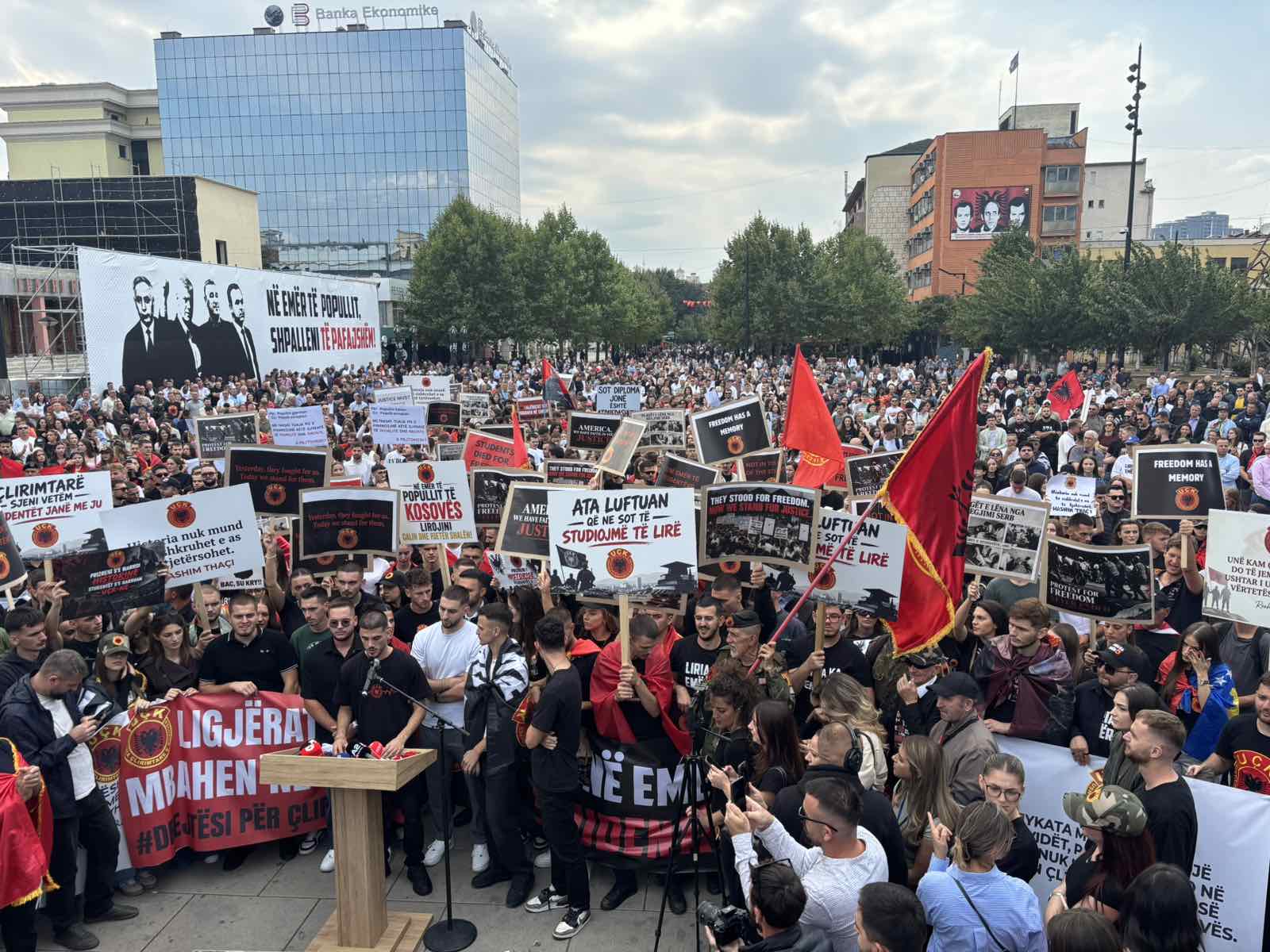
Students march in Pristina against the Hague verdict, September 21, 2026. Photo: BIRN/Valon Fana
Thaci, Krasniqi, Veseli, and Selimi were sentenced to 25, 25, 18, and 13 years in prison respectively. They were found guilty of the war crimes of arbitrary detention, cruel treatment, torture and murder, committed from April 1998 to June 20, 1999, in Kosovo and two locations in Albania. They were found not guilty of crimes against humanity.
On Monday, the parliamentary group of the Democratic Party of Kosovo, PDK – the party widely seen as originating from the KLA, which has been led by both Thaci and Veseli in the past – announced it was initiating an attempt to change the law underpinning the court.
The PDK proposed that the trial proceedings to continue through to the conclusion of the appeals phase. However, if the case is sent for retrial, it should not start over in The Hague but instead in Kosovo.
In the case of a potential retrial, “new jurisdiction applies, and once the conditions are met, the case will be transferred to Kosovo for proceedings,” PDK leader Bedri Hamza told media on Monday.
He argued that the protests cannot be ignored, saying that “the parliament of Kosovo cannot act as if this matter does not affect the Republic of Kosovo”.
It’s not yet clear how much support the PDK proposal will get. But anger about the verdict is also shared by the ruling party, Vetevendosje. Prime Minister Albin Kurti, the leader of Vetevendosje, wrote on X on Monday that the court’s findings “were based on factual inaccuracies, historical misunderstandings, and legal errors. We expect these to be fully corrected on appeal.”
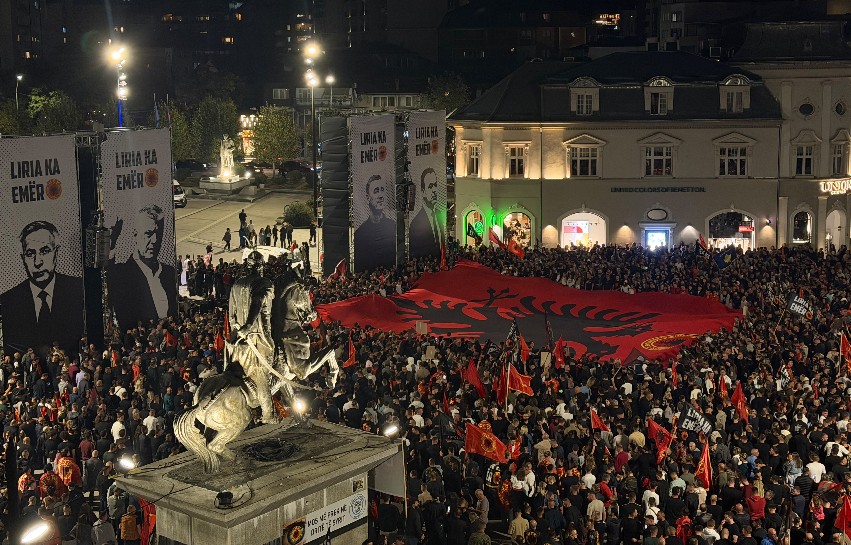
Protest against the Hague verdict in Prishtina, September 19, 2026. Photo: BIRN.
The Specialist Chambers were established under a law adopted in 2015 by the Kosovo Assembly, under pressure from Prishtina’s Western allies. The court is part of Kosovo’s judicial system but located in The Netherlands and staffed by internationals as part of efforts to prevent witness-tampering during trials. Thaci was one of the politicians who supported the court’s establishment, saying it would prove the KLA’s war was just.
Kosovo’s former ombudsperson, Hilmi Jashari, told BIRN on Friday that a change of regulations on appointing and overseeing the judges at the Kosovo Specialist Chambers would be beneficial for a fair trial. But Jashari cautioned that demands to fully repeal the law on the court would not be a good way forward.
“I have heard recently that the only solution is to repeal the law [governing the Specialist Chambers]; then one hears suggestions that the president should pardon the convicted individuals, but practically speaking, embarking on such an undertaking is impossible from a legal and juridical standpoint,” Jashari told BIRN and Internews Kosova’s Kallxo Pernime TV programme on Friday.
Edward P. Joseph, a lecturer at the Johns Hopkins University School of Advanced International Studies in Washington DC, told Kallxo Pernime that the anger towards the court in Kosovo is understandable – particularly as the verdict comes soon after Bosnian Serb wartime general Ratko Mladic, who was convicted of genocide, was buried with military honours in Belgrade.
“Consequently, this decision appears to Serbs in Belgrade as a form of vindication or absolution, while casting a shadow over the realities of the 1990s in Kosovo. That is why I find it very concerning,” Joseph said, claiming that Serbia and its supporters in Russia and China would exploit the verdict to spread their own narratives.
Serbia’s Interior Minister Ivica Dacic has welcomed the guilty verdict in exactly this way, saying it represents a “clear, though long-overdue, confirmation of what Serbia and the Serbian people have been saying loudly for more than a quarter of a century – that the so-called KLA was a criminal and terrorist organisation”.
Meanwhile on Monday evening in Prishtina, protesters gathered again in the main square, determined that their message will be heard.