


Angered by the new rule imposed by the University of Prishtina to record class attendance through a QR Code, students have launched a boycott.
On Friday, the Student Parliament of the University of Prishtina held a two hour meeting with the Steering Council, the university’s governing board, to negotiate students’ return to classes after a week of boycott at the Faculty of Medicine.
The students’ boycott of classes was a reaction to a new rule imposed by the University of Prishtina which obliges students and teachers to record their class attendance through a QR Code.
After the meeting, a student representative spoke positively about the atmosphere but did not comment on any agreements reached between the Student Parliament and the Steering Board.
“We will protest next week, we can [even] boycott classes in all faculties, but this depends on the Steering Council’s and rector’s actions,” Flon Kastrati, chair of the Student Parliament of the University of Prishtina, told Prishtina Insight.
What Kastrati has confirmed is that the auditoriums at the Faculty of Medicine will remain empty, despite the rector’s continuous warnings.
Students maintain that they have difficulties scanning the QR code because of uneven internet access across facilities.
“There is no Wi-Fi in the amphitheatre at the old Dean’s Office, in some parts of Institute B, or in one of the halls at the new Dean’s Office,” Dion Bajramaj, chair of the Faculty of Medicine Student Council, told Prishtina Insight.
Another concern is the physical distance between the location of the QR code and the students’ classes.
Bajramaj also highlighted the impracticalities of the QR-code system for medical students undertaking clinical training at Kosovo’s University Clinical Centre. He said the codes were located on the first floor of the Surgery Clinic, while classes took place on the second and third floors, meaning students had to leave the operating theatre to scan them and record their attendance, disrupting their sterilisation procedures.
“At the same time, they must re-enter the room, complete the sterilization procedures and then leave again when the class ends. Even if the [QR code] were inside the operating room, picking up a phone would still mean compromising the sterilization procedure,” Bajramaj said.
Rector issues warning over student boycott
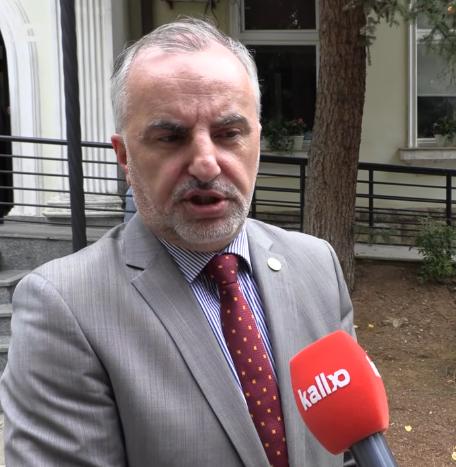
University of Prishtina Rector Arben Hajrullahu, in front of the Rectorate building in Prishtina. Photo: BIRN
According to Bajramaj, 2,200 medical students are boycotting classes, while around 30 pharmacy students are not.
Students of the Faculty of Medicine, joined by students from other faculties at the University of Prishtina, staged a protest on Thursday, demanding that Rector Arben Hajrullahu retract statements he made in an email sent four days earlier to students participating in the boycott.
In the email, Hajrullahu warned that medical students who continued to boycott classes could be required to repeat the academic year or lose their student status. He also warned that academic staff who were not working because of the boycott could face salary deductions or have their contracts terminated.
Rector Arben Hajrullahu has denied threatening Faculty of Medicine students in his email and suggested that academic staff had encouraged them to take part in the boycott.
“It is not true that anyone has been threatened; rather, they have been informed of certain consequences that will happen,” Hajrullahu said.
Ten minutes before the protest began on Thursday, Rector Hajrullahu arrived at the Rectorate and personally opened the courtyard gates while students were gathered nearby. He then instructed security staff to open the building’s doors. Moments later, he invited the students to meet with him, but they refused.
Days earlier, Rector Hajrullahu had explained that the requirement to record class attendance by scanning a QR code at the Faculty of Medicine was intended to ensure that classes were taking place. He also promised that any technical issues would be addressed.
In Hajrullahu’s view, verifying attendance at lectures is important for the future of academic programmes.
“If this is happening then it risks the accreditation, validity, and quality of diplomas,” he said.
“I don’t know why the public budget is paying professors who don’t hold lectures and practicals but just offer exams. We need to renegotiate contracts with these unusual professors to [just] offer exams, if [they won’t teach],” Hajrullahu emphasized.
Hajrullahu alleged he had “witnesses” who could corroborate that, during the first week of the semester, professors at the Faculty of Medicine had submitted 15 fictitious class attendance lists, which he said constituted a criminal offence.
“Students did not see the professor for the entire semester until the day of the exam, yet that professor had falsified those lists by writing [their names],” he said.
Arts faculty students welcome the QR code system
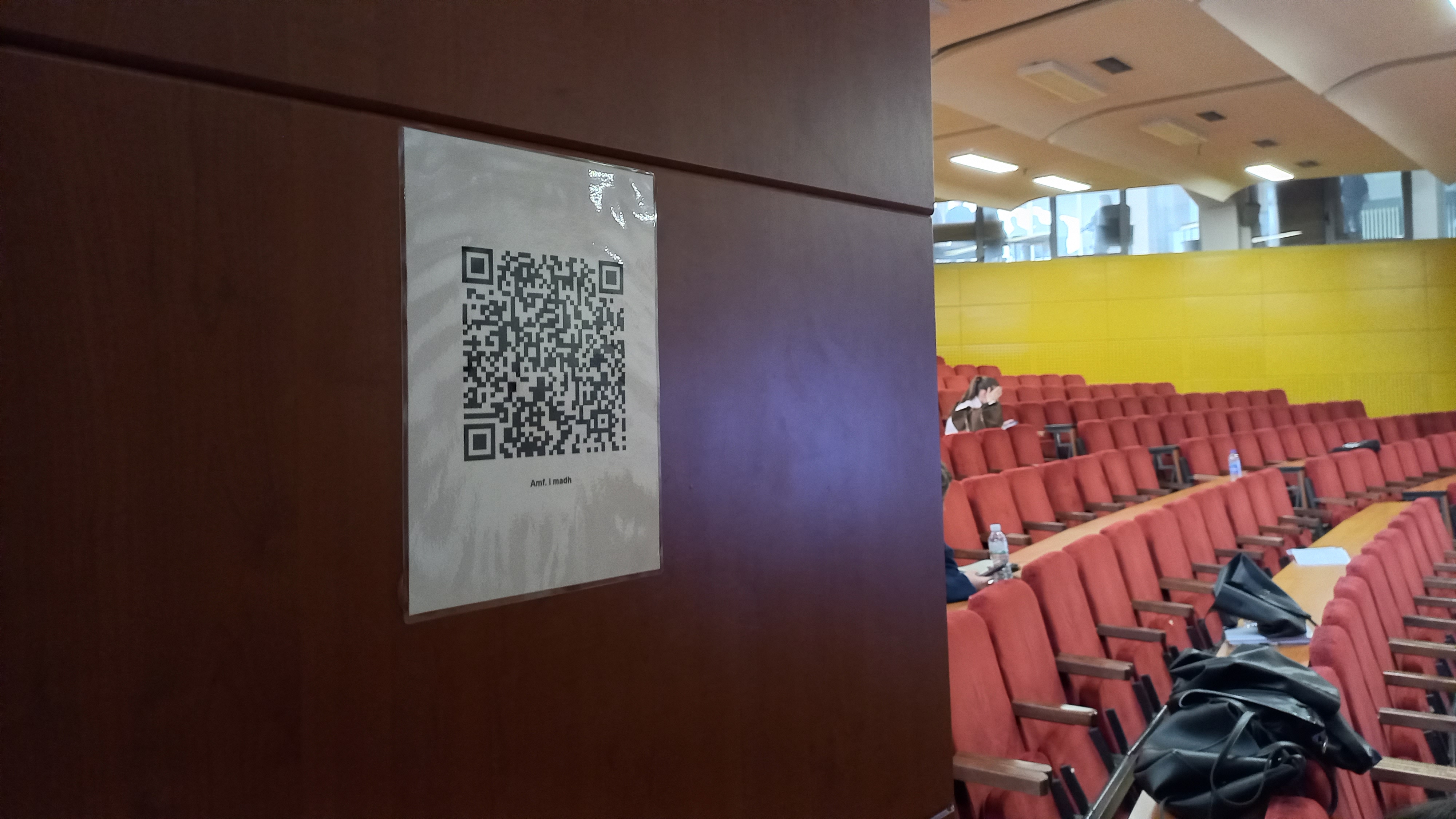
One QR code on the Faculty of Law Amphitheater, Photo: BIRN
Electronic record of class attendance has also been brought in as a pilot project at the Faculty of Law, the Faculty of Arts, and the Faculty of Sport and Physical Education. In the coming years, the system is expected to be introduced in other faculties as well.
Aolta Bajrami, chair of the Faculty of Law Student Council, told BIRN that they support the university’s digitalisation efforts, describing the introduction of QR-code attendance monitoring as “a positive step.” She added that they had no problem adjusting to the new system, but urged the university to update their internet services.
The Faculty of Law has a QR code placed on both sides of every classroom door and working internet on every floor of the building.
“Unlike physical lists or the scanning process using students’ ID cards, which often failed to work, [the QR-code system] did not cause issues for students who attended lectures,” she told BIRN, adding that previous technical problems had negatively affected their attendance percentage.
QR codes were installed on classroom doors on the ground, first, and second floor of the Faculty of Arts building, with internet access also available.
But Xhevdet Pantina, a professor of drawing, told Prishtina Insight that the QR-code system had created problems for lectures held outside the Faculty’s official working hours. He said they had yet to find a solution for recording attendance in such cases.
“My students couldn’t check out from the lecture here and they couldn’t check in at the other lecture. I couldn’t find them a solution but I was a witness that the students were present,” Pantina said, describing the system as a failure.
He also said that, during class hours, professors and students were required to visit locations outside the Faculty where the University had not installed QR codes.
“At first we are obligated to come and start the class at the Faculty and then to go either to the Faculty’s Gallery or Kosovo’s National Gallery,” he told BIRN.
“We cannot impose [the requirement] on students to have a smartphone for recording class attendance because we don’t know their economic conditions,” he added.
Rector Hajrullahu, however, explained that an app called “e-Vijueshmeria” allowed professors and students to record attendance when classes took place outside the University.
“Archaeology professors with their students, if they dig at Ulpiana [Archaeological Park], they can record class attendance from there within two minutes,” Hajrullahu said, showing BIRN how the app appeared on his phone.