


BIRN’s annual Digital Rights Violations report has revealed that countries across Southeast Europe are experiencing increased online abuse, malicious use of AI, and state surveillance.
BIRN’s Digital Violations Report, published on Monday during a conference in Prishtina, reveals the challenges of rapid technological transformation, the risk of misusing AI tools, and the lack of legal framework to halt this misuse.
Covering the period from September 2024 to August 2025, the report documents 1,440 violations across Albania, Bosnia and Herzegovina, Croatia, Hungary, Kosovo, Montenegro, North Macedonia, Romania, Serbia, and Turkey.
The BIRN report highlights a significant surge in AI-driven sexual and gender-based violence, fraud, and impersonation. Deepfakes, voice-cloning, and other generative AI tools are increasingly used to target women and children, facilitate identity theft, and investment scams.
One of the most concerning developments highlighted by the report is the rapid rise of AI-driven harm, which is fuelling sexual and gender-based violence, as well as enabling new forms of fraud and manipulation.
It shows that violations concerning freedom and pluralism of information (24.7 per cent of the 1,440 violations), the protection of digital assets and economic rights (24.2 per cent), and threatening or harmful online behaviour (23.8 per cent) dominate the regional landscape.
Other notable violations concern freedom of expression and media (12.6 per cent) and online civic participation (8.3 per cent).
Authoritarian trends and expanding surveillance
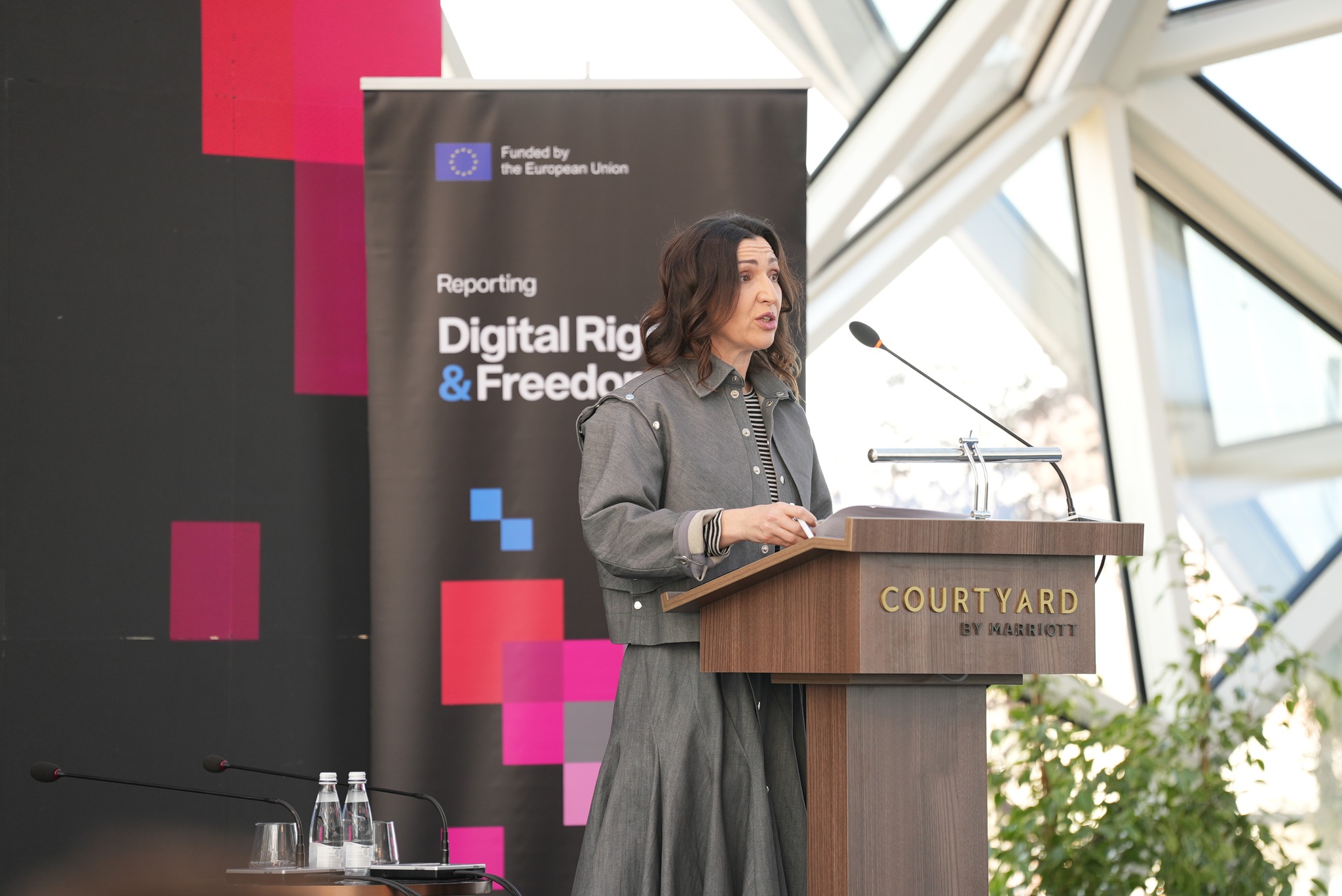
BIRN Kosovo executive director, Jeta Xharra at the conference on digital rights violations report on November 24, 2025. Photo: BIRN
The report warns of growing authoritarian tendencies across the region. Turkey proposed criminal penalties targeting LGBTQ+ people, raising concerns for journalists reporting on these issues, while Hungary’s biometric surveillance law may undermine freedom of expression.
Governments across Southeast Europe continue to expand state surveillance, often through procurements of facial-recognition systems and digital forensics technologies from companies with poor human-rights records.
The report notes that BIRN itself was subject to smear campaigns in Albania, Kosovo, and Serbia, while a single journalist in Turkey received thousands of death threats.

Deputy head of the EU office in Kosovo, Eva Palatova, at the BIRN conference on digital rights violations report on November 24, 2025. Photo: BIRN
BIRN Kosovo’s director Jeta Xharra said the project began three years ago when, “there was very little knowledge about digital rights.”
“We wanted to educate the public and create a new generation of journalists who report on digital rights,” she said. “We have trained 40 journalists across the region and produced 200 media reports, which led institutions to improve privacy protections.”
Kosovo’s President Vjosa Osmani said technology is increasingly misused to foster division and promote hatred, to manipulate young girls and women, and to harass children.
“Because the internet is a free space, it is also highly exposed to abuse, and this abuse is growing,” she warned.
Osmani highlighted a strategic challenge: the Albanian language is still not fully recognised by Google, meaning algorithms cannot detect hate speech in Albanian. She added that her office “has raised the issue directly with [Google’s] leadership.”
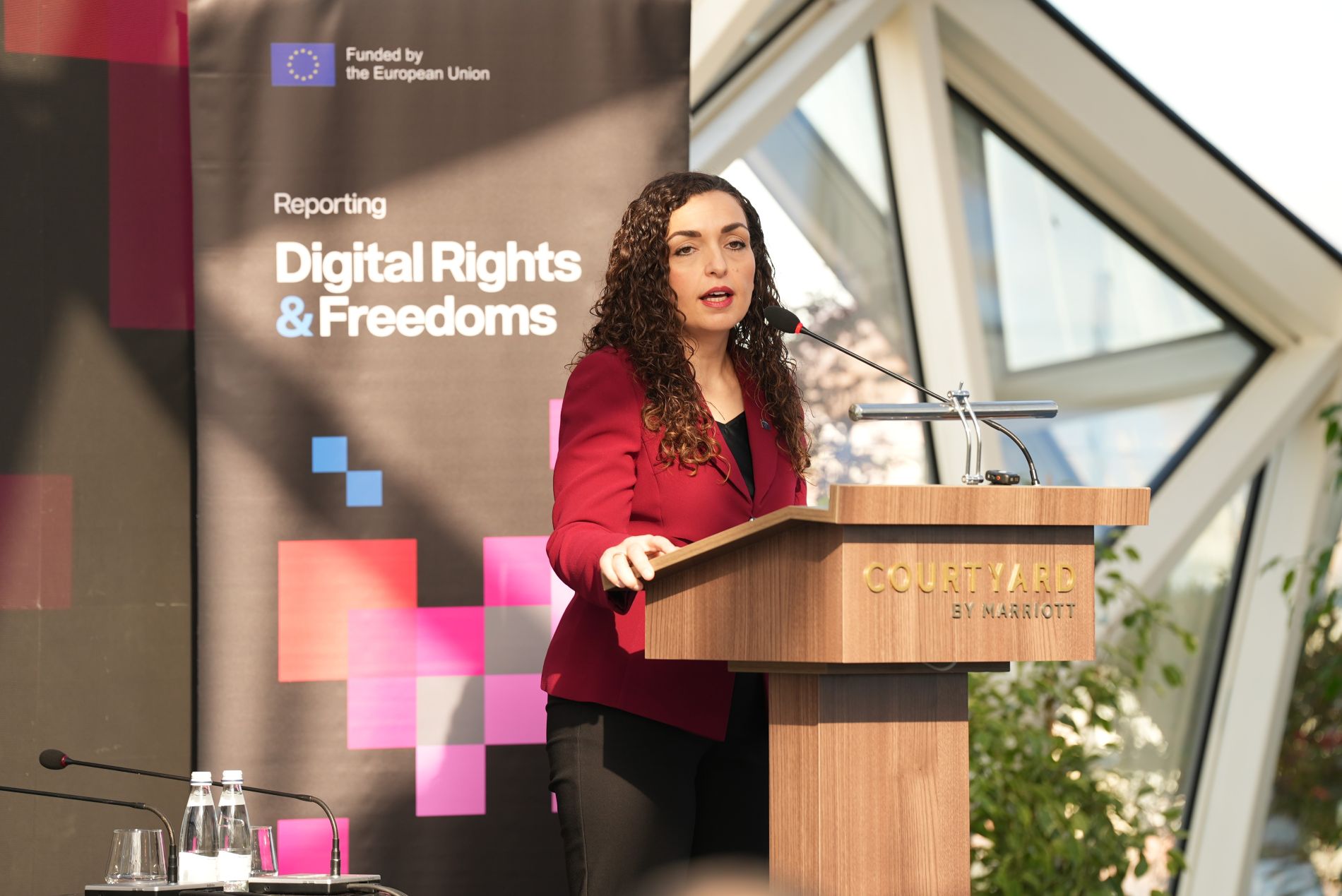
Kosovo’s President Vjosa Osmani at the BIRN conference on digital rights violations, November 24, 2025. Photo: BIRN
Eva Palatova, Deputy Head of the EU Office in Kosovo, stressed the EU’s commitment to a rights-based digital environment: “The Digital Services Act, the AI Act, and the European Democracy Shield are key instruments for protecting users and countering manipulation.”
The conference also included discussion panels. On the panel for AI abuse and shrinking civic space, experts from Montenegro, Albania, Kosovo, and Bosnia warned that AI is accelerating fraud, identity theft, and gender-based violence.
Snezana Nikcevic, of the NGO 35mm from Montenegro, stated that gender based violence online is an extension of what is going on offline.
“The technology extends the impact of the spread, the variety of what we can do online, it adds to the amplifications of the consequences and it adds to the fact that we do not have enough capacities to deal with it,” Nikcevic said.
“There are certain things we can utilise [in] the situation, like support centres, hotlines, educating people, because we see that institutions are not our best friends when it comes to technology and implementing legal solutions. We are mostly reacting, and rarely are proactive in things,” she added.

Discussion panel at the BIRN conference on digital rights violations, November 24, 2025. Photo: BIRN
Albanian tech policy expert Alba Brojka noted that deepfakes have become so realistic that society is losing the ability to distinguish real from fake.
“If you don’t have it included in your sentence, you are not trendy and innovative. However, what we are not understanding is also risky, especially we are not literate on who to mitigate its risks coming from it. A year or two ago it was easier to spot if something was deepfake, but the technology has gotten so better that we are [unable to recognize it].”
She emphasised that gender based violence is, “a mirror of what happens in this society, and [one that is] unfortunately amplified.”
Edmond Hajrizi, founder of the private-owned University for Business and Technology in Kosovo, emphasised that rapid technological development is outpacing legal frameworks, creating “a dangerous gap” for misuse.
Bosnia’s Feđa Kulenovic warned that technology has broadened the scope and severity of sexual violence, calling for better documentation and stronger reporting systems.
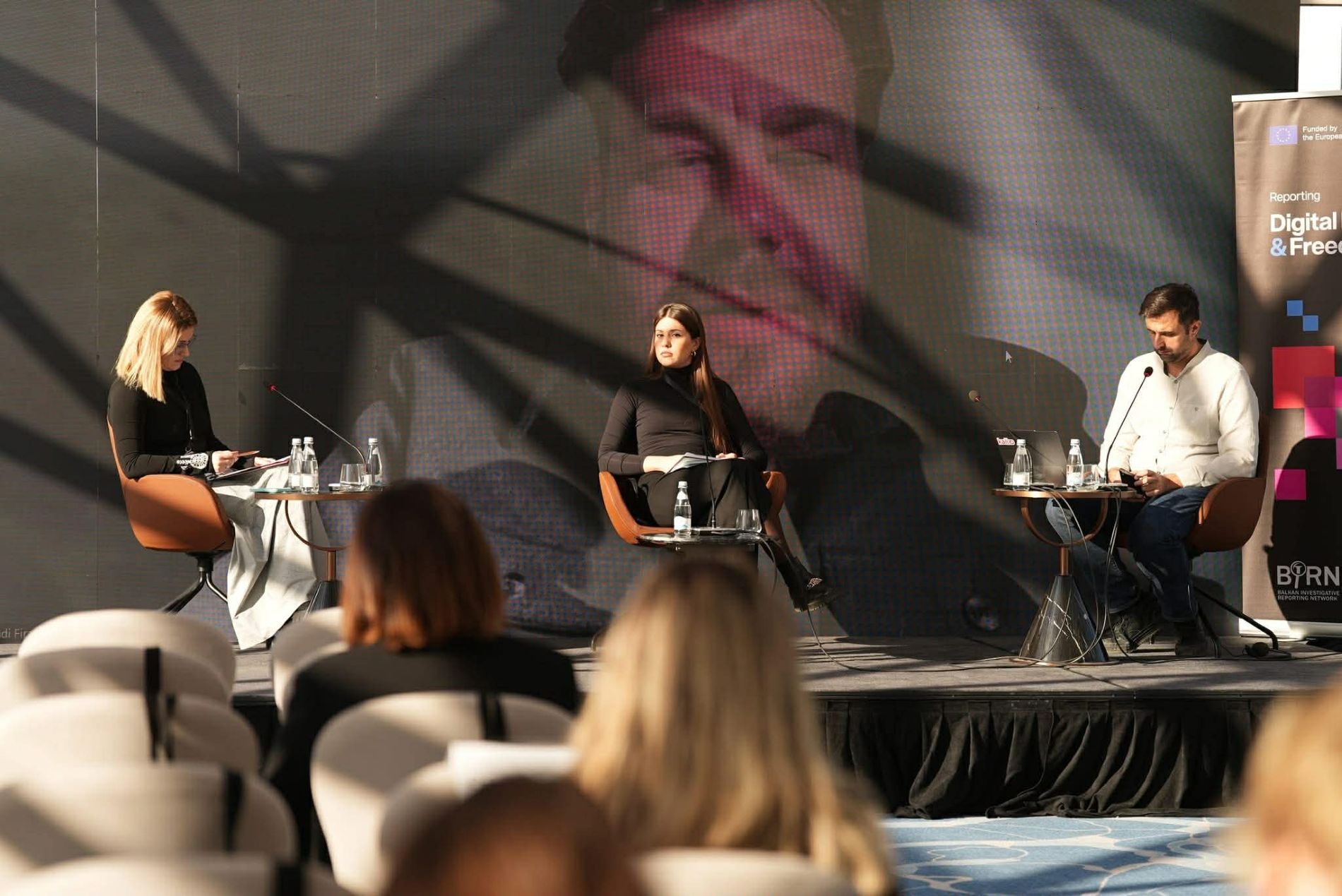
Discussion panel at the BIRN conference on digital rights violations on November 24, 2025. Photo: BIRN
A second panel highlighted how digital repression is increasingly used against activists, NGOs, independent media, fact-checkers and LGBTQ+ communities.
BIRN’s Tijana Uzellac said that in Serbia more than 60% of all the digital rights violations recorded by BIRN were attacks by pro-government media on student-led protests.
“In Serbia which has become a polarised political society, over 60% of all our cases in digital rights are related to student-led protests, coming mostly from the ruling party and tabloids of pro regime media, everyone on the other side are the targets of these attacks.”
Kallxo.com editor Kreshnik Gashi noted that the elections held in Kosovo in early 2025 saw “a collapse in public discourse,” driven by dehumanising language, hate speech, and political pressure on journalists.
“The most striking example that shows the extreme degradation of the public discourse in Kosovo was during the early 2025 elections. The entire public debate was characterised by dehumanising language toward opposing candidates, hate speech against civil society activists, and hostile rhetoric toward media outlets critical of the government,” Gashi said.
He further noted that the state attempted to curb this dehumanising language, but the fines had no effect, “politicians paid them using the Kosovo state budget through their political parties.”
In Turkey, Balkan Insight editor Hamdi Firat Büyük described a dramatic example of repression with nationwide internet disruption following the arrest of Istanbul’s mayoral candidate. “The government interference has reached this point,” he concluded.
The conference will continue with other discussion panels on November 25 and 26.