


By passing amendments to the Law on the Specialist Chambers, Kosovo’s parliament has taken the wrong approach to supporting former Kosovo Liberation Army leaders sentenced by the Hague-based court in September.
The true merit of the new Law on the Kosovo Specialist Chambers, adopted by the Kosovo Parliament on October 6, 2026, has come into question after the president returned it to parliament for revision just two weeks later on October 22.
The law, proposed by the opposition Democratic Party of Kosovo, PDK, seeks to amend the current law on the Hague-based special court, limiting its mandate, jurisdiction, and maximum sentencing.
“Cases pending before the Pre-Trial Judge, a Trial Panel, or a Court of Appeals Panel of the Specialist Chambers on the date of entry into force of this Law shall continue to be adjudicated in accordance with the provisions … that were in force prior to the entry into force of this Law,” the law reads, clarifying that the law is only applicable after “the Court of Appeals Panel has rendered its judgment.”
“From the date on which the Court of Appeals Panel of the Specialist Chambers renders its judgment, this Law shall apply to all subsequent proceedings,” it continues, explaining that, “any appeal, request for protection of legality, or other legal remedy against that judgment shall be filed with and adjudicated by the Supreme Court of the Republic of Kosovo in Prishtina, which shall have exclusive jurisdiction over all subsequent proceedings.”
However, whether such a redefinition of the mandate, jurisdiction, and sentencing policy is valid in the middle of a judicial process is questionable and, in my view, misguided.
The Kosovo Specialist Chambers were initiated in April 2014, through an international agreement between Kosovo and the European Union via the exchange of letters between Atifete Jahjaga, then President of Kosovo, and the European Union Foreign and Security Policy High Representative, Catherine Ashton. This agreement was embedded in the Constitution of Kosovo in August 2015, the same day when the Law on the Specialist Chambers was approved.
The new October 2026 law was approved in the immediate aftermath of the first instance sentencing of four former Kosovo Liberation Army, KLA, leaders turned high level politicians, by the Kosovo Specialist Chambers for the war crimes of arbitrary detention, mistreatment, torture, and murder from April 1998 to June 20, 1999, in Kosovo and several locations in Albania.
Hashim Thaci, former Kosovo President, and Jakup Krasniqi, a former Parliament Speaker, were sentenced to 25 years in prison each. Kadri Veseli, former Parliament Speaker, was sentenced to 18 years in prison. All three were part of PDK’s leadership throughout the years.
The fourth man, Rexhep Selimi, head of the Vetëvendosje Movement parliamentary group at the time of their arrest in November 2020, was sentenced to 13 years in prison. Time spent in detention in The Hague since 2020 will count towards the sentence. The verdict can be appealed.
The four men also held very important positions in the KLA during the war: Thaci was political director of the KLA; Veseli was the chief of KLA counterintelligence; Krasniqi was the KLA spokesperson; Selimi was chief of the KLA inspectorate.
Violation of Kosovo’s international commitments?
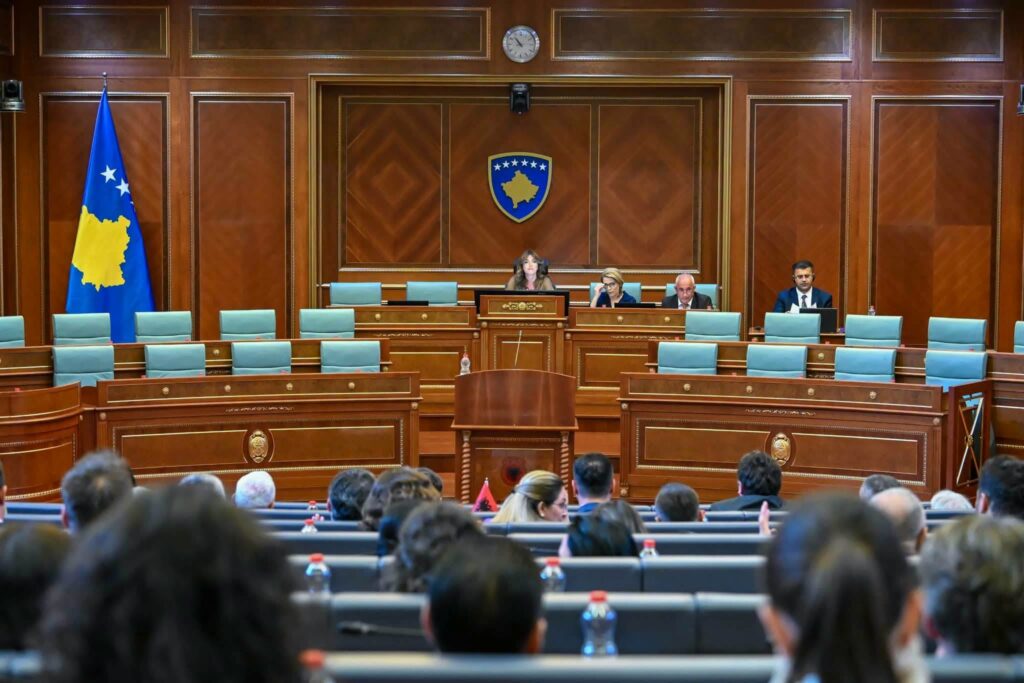
Kosovo parliament session on October 5, 2026. Photo: BIRN.
The September 16 verdict was seen as a direct attack against the KLA and the liberation war in Kosovo. It triggered massive protests organised by KLA veterans and civic organisations that were formed to advocate in favour of Thaci and the three others.
Voices calling for legislation to curb the Specialist Chambers’ powers grew increasingly vocal. The sentence against the four KLA leaders sparked emotional reactions throughout Kosovo, while protesters threatened violence if the Kosovo Parliament failed to approve a law to curb the Specialist Chambers’ powers. The protests indeed escalated, and the police used tear gas to disperse the protesting crowd.
Against this backdrop, the PDK hastily pushed the second and final vote of the law to the Kosovo Parliament. LVV agreed to back the bill in exchange for PDK’s support for Justina Shiroka Pula, a former PDK MP and minister, as Kosovo’s next president. The deal aimed to avert another political deadlock that could trigger the country’s fourth snap election in less than two years.
The bill was approved without consultation or debate, despite undergoing expedited review by the required parliamentary committees. Just over two weeks later, the PDK asked President Shiroka-Pula to return the law to parliament. The parliamentary legislative committee is expected to review it and may propose amendments. If MPs approve the changes, the president may sign the law.
The reasons behind the PDK’s request that the President return the law to parliament are unknown. Several PDK officials have called for the resignation of the entire PDK presidency. Former Prime Minister of Kosovo, Ramush Haradinaj, himself a prominent former KLA fighter, from opposition party Alliance, has criticised the PDK’s move to return the law for reconsideration.
Meanwhile, the EU has criticised the law’s approval, saying it violates Kosovo’s international commitments and judicial independence, and has warned that such a move may endanger Kosovo’s EU integration path. However, the EU also supported Shiroka-Pula’s decision to return the law for reconsideration and has indicated it expects to be consulted during the process.
Mysterious political move
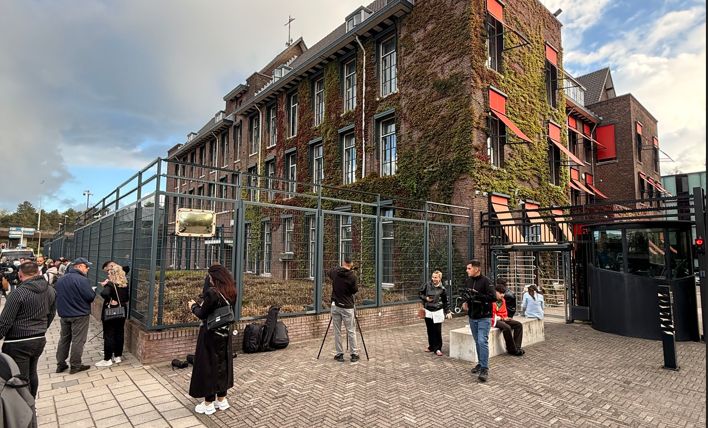
The Kosovo Specialist Chambers in the Hague on September 16, 2026. Photo: BIRN
It is not yet clear whether a more pragmatic part of the PDK presidency decided to reconsider the law. Its chairman, Bedri Hamza, resigned a day before President Shiroka-Pula returned the law to parliament. While the real reasons are not being communicated to the public, it is widely believed that Hamza’s resignation is a direct result of the ping-pong game over the Law on the Specialist Chambers.
This shows deep insecurity about whether the new law will have any legal effect on the Specialist Chambers. While it is a hybrid judicial structure – both international and functioning within Kosovo’s legal framework – the Specialist Chambers do not report directly to any Kosovo institutions.
So the real question is: even if a new law were approved to curb the Specialist Chambers’ powers, who would have the jurisdiction to implement it?
The European Union funds the Chambers, and Kosovo has no say over their conduct. It is also questionable whether a law passed in reaction to a court decision is valid and whether, as such, it would directly interfere with judicial independence.
While it is generally held that the verdict and the sentences against Thaci, Krasniqi, Veseli, and Selimi were unjust and draconian, the EU’s concerns are valid on three grounds: Kosovo’s obligations under the international agreement that established the court, judicial independence, and the country’s prospects for EU integration.
The judicial process against the four KLA leaders is not yet over. Thus, the question arises: how can Kosovo change the rules of the game mid-procedure? That would set an unseen precedent in judicial history. A procedure begins and ends with a set of approved rules. Rules cannot change while proceedings are ongoing.
So, Kosovo has chosen the wrong way to help its former leaders, who still have a chance to be acquitted by the Appeals Court within the Specialist Chambers. Beyond the appeals, the Specialist Chambers can rule as a supreme and constitutional court. So, the procedure is far from being over. That is why Kosovo cannot change the rules of the game and should not try to do so, because such a move would shift Kosovo’s current positioning as a pro-Western and pro-EU country toward something closer to rule by whim.
The cases of Thaci, Krasniqi, Veseli, and Selimi are not only a PDK cause. Their sentencing is a wider, social cause because the verdict is disproportionate to the usual sentences that Kosovo courts impose in war crime trials. The four former KLA leaders were held in detention for around six years, itself a draconian measure given that they may not even be guilty of the charges. The final determination of their guilt, of course, rests with the appeals court and any subsequent judicial review.
Rather than trying to change the rules, Kosovo must work within them, funding the best legal representation and providing diplomatic and political support. Despite their war crimes convictions, the four men, like anyone else, are entitled to due process and full respect for their civil and human rights.
The Specialist Chambers was created under international pressure and is, in itself, a kind of judicial monster. Although judicial independence is a cornerstone of the rule of law, such lack of accountability, secrecy, and unresponsiveness are rarely seen in any democratic judiciary. Its functioning is in fact contrary to all democratic principles. That is why the new law raises an important question for Kosovo, one that international stakeholders should pay attention to.
Arben Qirezi is a Prishtina- based political scientist and commentator.
The opinions expressed are those of the author and do not necessarily reflect the views of BIRN.