


The 43rd International Seminar on Albanian Language, Literature and Culture opened on Aug 18 in Prishtina, bringing together around 150 participants from across the world for two weeks of lectures, language courses, and debates.
Italian historian Christian Costamagna’s interest in the Kosovo war and history first prompted him to open a YouTube video to practice Albanian, months later he found himself among dozens of other scholars attending lectures and courses at the University of Prishtina.
Alongside nearly 150 participants from around the world, he is taking part in the International Seminar on Albanian Language, Literature and Culture.
“Albanian is a difficult but unique language,” Costamagna told BIRN.
“I was interested in learning from scratch because I’m researching the war here in Kosovo—there are words that are similar to some European languages, but the grammar is very complicated,” he added.
As a historian, Costamagna says he wants to “understand the country not only through archives, but also through its words and the culture.”
A meeting place for generations
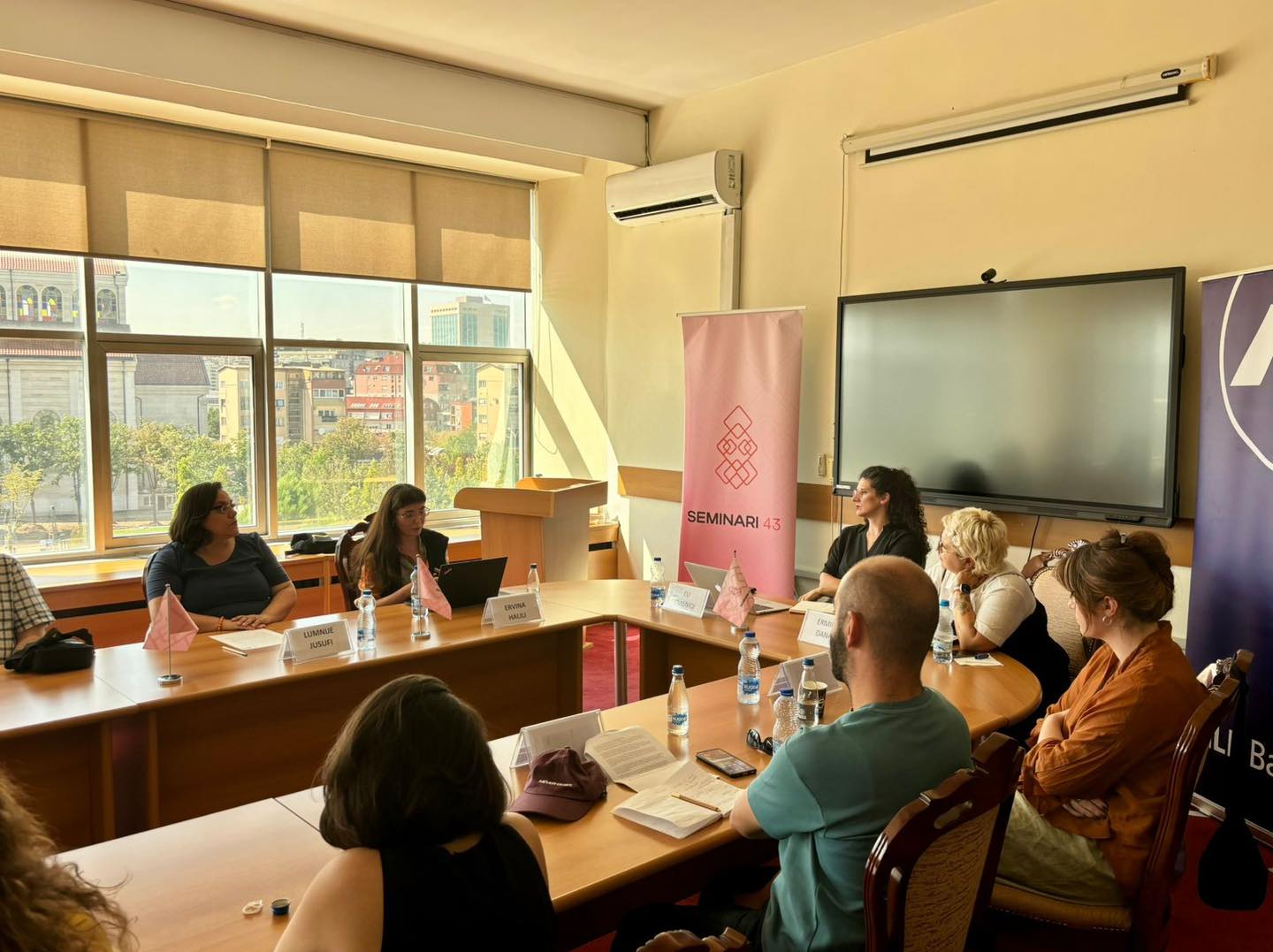
Discussion panel on “Albanian Feminist Studies” at the Seminar on Albanian Language, Literature, and Culture, held in Prishtina on August 21. Photo: Courtesy of the Seminar
The two–week seminar, which runs until August 29, has become a rare meeting ground for established albanologists and a new wave of young researchers from across Europe, the United States, and beyond.
“This year’s programme brings together proven scholars but also students from prestigious universities who represent the future of albanology,” seminar director Lindita Sejdiu stated.
Among the participants are Arbëreshë scholars from Italy (Albanians who fled from the Ottoman occupation of the Balkans around 600 years ago and made their homes in Italy), linguists from Poland, and students from countries as far as Syria and the United States,” she explained.
Key themes for this edition range from the evolution of Albanian vocabulary and the role of the language on social media to postmodernism in Albanian literature.
Alongside lectures and debates, participants attend concerts, visit museums, and go on cultural tours to immerse themselves in Kosovo’s heritage.
“This year’s seminar features distinct topics, including feminist studies, the role of women in Albanian literature, and the presence of Arnauts (ethnic Albanians) in the Middle East,” she added.
The seminar features Albanian language courses from basic level to advanced, where scholars are divided into groups based on their language level.
Tuesday’s seminar opened with a talk from Russian professor Aleksander Rusakov, a veteran scholar of Albanology and Balkan studies.
After a long career at the St. Petersburg Academy, he is now based at the Academy of Sciences in Tirana, where he continues to contribute to the field.
In his lecture about the usage of the exclamatory mood of verb conjugation in Albanian grammar in the “electronic corpus,” meaning in digital communication. As he noted, the exclamatory mood represents a grammatical feature that has been integrated and distinguished very well in online interactions.
He explained that his conclusions come from online “press texts from Albania, Kosovo, and North Macedonia.”
During his lecture at the Faculty of Philology in Prishtina, Rusakov recalled that his journey with Albanian began “in 1978, forty-seven years ago.”
“I attended a seminar for the Albanian language for the first time as a student,” he said.
“My very first teacher of Albanian language was Rexhep Ismajli, whose intellect impressed me,” he added.
Professor Ismajli, an ethnic Albanian from the municipality of Presevo in south Serbia, conducted research on the evolution and structure of the Albanian language, especially in early written texts, such as the 1706 Arbëresh Assembly’s language. He explored the relationship between standard Albanian and national identity, and also played a major role in raiing the profile of the Academy of Sciences and Arts of Kosovo, ASHAK.
Most importantly, through teaching in France, Germany, Slovenia, and through collaboration with global institutions, Ismaili helped put Albanology on the international scholarly map.
Learning a “difficult but beautiful” language
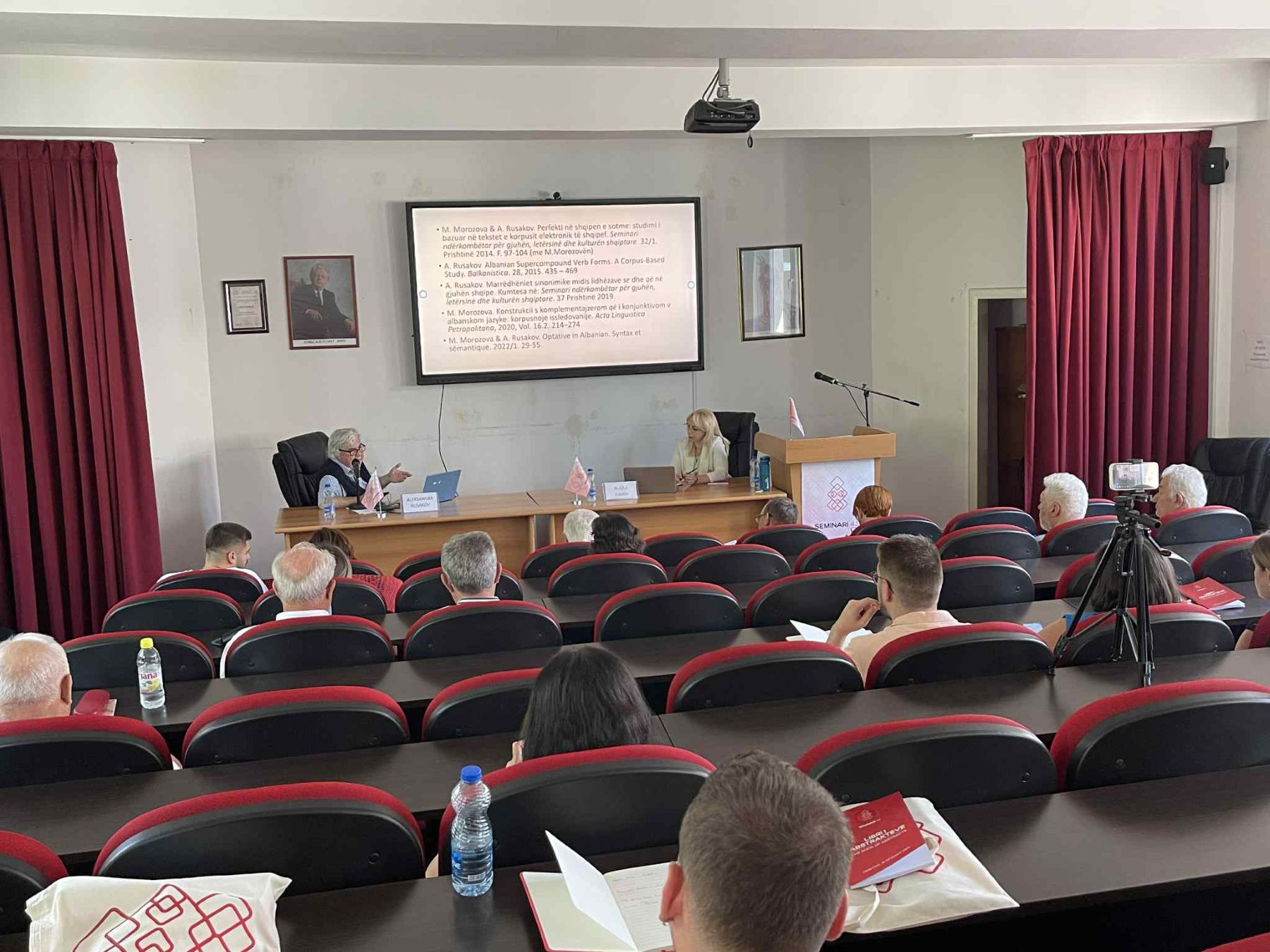
Aleksandar Rusakov (L) in a lecture at Albanian Language and Literature seminar held in Prishtina on August 19, 2025. Photo: BIRN
For many, the Albanian language itself is very different and difficult.
Czech linguist Hana Bergehova signed up for the beginner’s course after years of working with colleagues from the German department in the University of Prishtina.
“Albanian is really difficult, but I see similarities with Latin and even some borrowing from German,” she says.
“In the end, I just want to be able to make small talk, learn about the culture and history, and make friends.”
Meanwhile, Polish participant Barbara Kokotkiewicz, back for the second time, calls the seminar “perfectly organised” and praises their hospitality.
“The language is hard, but worth the effort,” she emphasised.
“Even with the [language] barrier, I’ve already made friends here. Kosovo is very interesting, welcoming to tourists, and I already have friends here despite the language barrier,” she told BIRN after having finished her one-hour Albanian language class.
The programme also gives participants the chance to see and reflect critically on how the Balkans are seen from the outside.
Serbian professor Aleksandar Pavlovic, in a lecture titled Balkanism Today: ‘The West’ and the Balkans in Contemporary Politics and Media, argued that negative stereotypes still dominate in western media, when it comes to this part of Europe.
He cited examples of Western politicians and media outlets that continue to portray the Balkans as tumultuous and problematic—“something the West should discipline and punish,” as he put it.
In his lecture on Tuesday, Pavlovic emphasised that “the Balkans should be a neutral geographical term, like when you mention Scandinavia.”
“Instead, it has become a reservoir of negative statements and prejudices, portrayed as less European and more barbaric,” he added.
Pavlovic is the author of works on cultural relations and the ways nations in the region have represented one another across historical, literary, and cultural discourses.
One of his notable books, “Shqiptari Imagjinar” (The imaginary Albanian), examines how the image of Albanians developed in Serbian thought from the 19th century onward, also shedding light on broader Albanian–Serbian relations.
He started his lecture in the main hall at the Faculty of Filology with a touch of humor, by remarking: “I brought seven books to give away at the end—I estimated that only seven people would still be here by then.”
A long tradition

Aleksandar Pavlovic (R) in a lecture at Albanian Language and Literature seminar held in Prishtina on August 19, 2025. Photo: BIRN
Founded in 1974, the seminar has been through political upheaval, exile, and finally a revival. It was banned by Serbian authorities in the 1990s, briefly moved to Tirana, and since 2000 has once again been rooted in Prishtina.
For participants like Costamagna, who has been to Kosovo several times since the early 2000s, the experience is not only about language but also witnessing the changes the country is going through.
“Every time I come here I see changes, especially in infrastructure,” he says. “Sometimes I don’t recognize the city anymore,” he exclaimed.
During the opening ceremony of the seminar, Prishtina University rector Arben Hajrullahu emphasised the seminar’s academic significance, noting that it has elevated Albanology to an international level.
“The seminar is the longest-longest-running event dedicated to albanology, and it has continued to introduce new scientific contributions,” he concluded.