


The Balkan Investigative Reporting Network concluded a three-day regional conference on Wednesday, bringing together experts, journalists, and policymakers to examine escalating digital rights violations, cybersecurity threats, and the growing influence of artificial intelligence on democratic processes in the region.
The Balkan Investigative Reporting Network, BIRN, concluded its three-day regional conference on digital rights violations on Wednesday starting with a seminar titled “New Technologies on the Horizon and Digital Rights: Responsible Use of Artificial Intelligence and Other Policy Frameworks.” The session was led by Aleksandar Mastilovic, Board Member of IEEE and expert on digital transformation and artificial intelligence at UNOPS.
Mastilovic discussed emerging technologies and their growing influence on digital rights, emphasising the need for responsible use of artificial intelligence, effective governance, and well-crafted policies that safeguard users in increasingly digital environments.
The conference concluded with remarks from Gentiana Murati, Deputy Director of BIRN Hub, who reflected on BIRN’s 20-year journey.

Gentiana Murati, Deputy Director of BIRN Hub at Digital Rights conference on November 26, 2025. Photo: BIRN
“A group of determined journalists and editors became a regional force of truth. This is a story of courage, craft, and care that has carried us through 20 years of change,” Murati said.
She recalled that when BIRN began, many newsrooms and institutions were fragile, while societies in the region were still learning how to speak openly. “But people already had the right to reliable information. We promised to report carefully, explain clearly, and connect not only within each country, but across borders.”
Murati highlighted BIRN’s achievements in exposing corruption, documenting abuses, and preserving human stories that might otherwise have been forgotten. She also noted the dramatic transformation of the information with the rise of the internet and digital platforms.
“More voices, more speed, more noise-platforms grew powerful, algorithms learned our fears, and new threats emerged,” she said. “We built new skills, strengthened OSINT and data work, and developed verification-first workflows. In the digital age, accuracy alone is not enough; we also need to explain and clarify.”
Murati emphasised the importance of BIRN’s Digital Rights Programme, which was launched five years ago to address critical challenges in online freedom and safety.
Cybersecurity challenges in elections
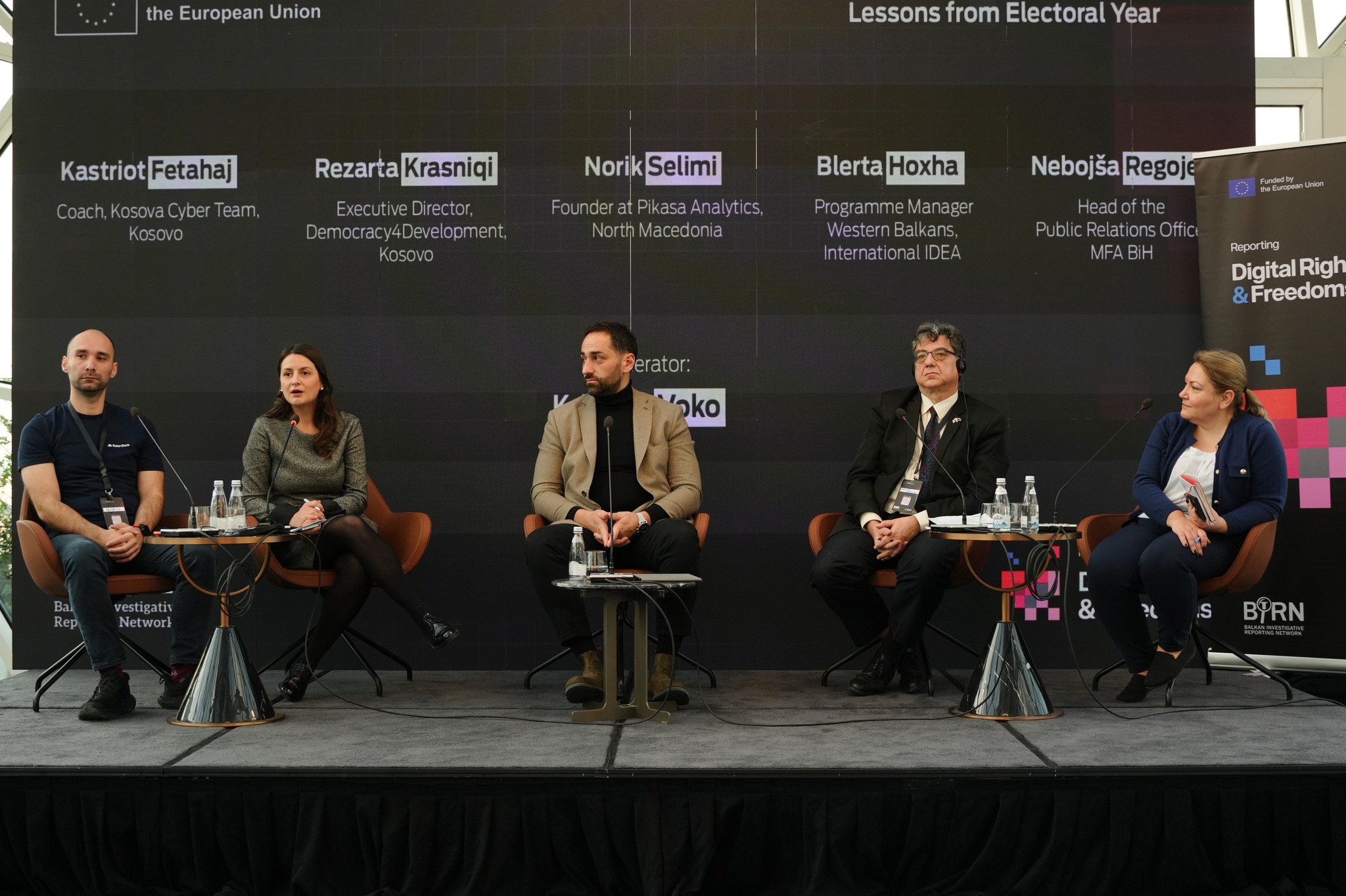
Discussion panel on cyber security and elections at BIRN Digital Rights conference on November 25, 2025. Photo: BIRN
As part of the conference, a panel titled “The Digital is Political: Lessons from an Electoral Year” brought together experts from Kosovo, Albania, North Macedonia, and Bosnia and Herzegovina to discuss cybersecurity, online campaigning, hate speech, and EU digital legislation.
Kastriot Fetahaj, Coach at the Kosovo Cyber Team, drew attention to the increasing number of cyberattacks on critical infrastructure in Kosovo and Albania, including elections.
“In Albania, the major cyberattack by state-backed Iranian actors happened because a Microsoft Exchange server was not updated,” he said. Regarding Kosovo’s 2021 elections, Fetahaj noted system failures on election day. “We had something that for most of the time the system was down, until now we don’t have any confirmation from the government and Central Election Commission whether it was an attack or not,” he said.
“I have done my own analysis about the system, I was not authorized to do that, but since I was doing it via a technique only by viewing and not touching, widely used by cyber security experts. Our system for counting the votes was pre-broken, during the election day they had 1,38 billion requests, but most of them were recurring as the system was making them by itself. From that sum, only 2.72 million were alleged requests that should have gone to the system that brought down the servers, they brought themself down,” he noted.
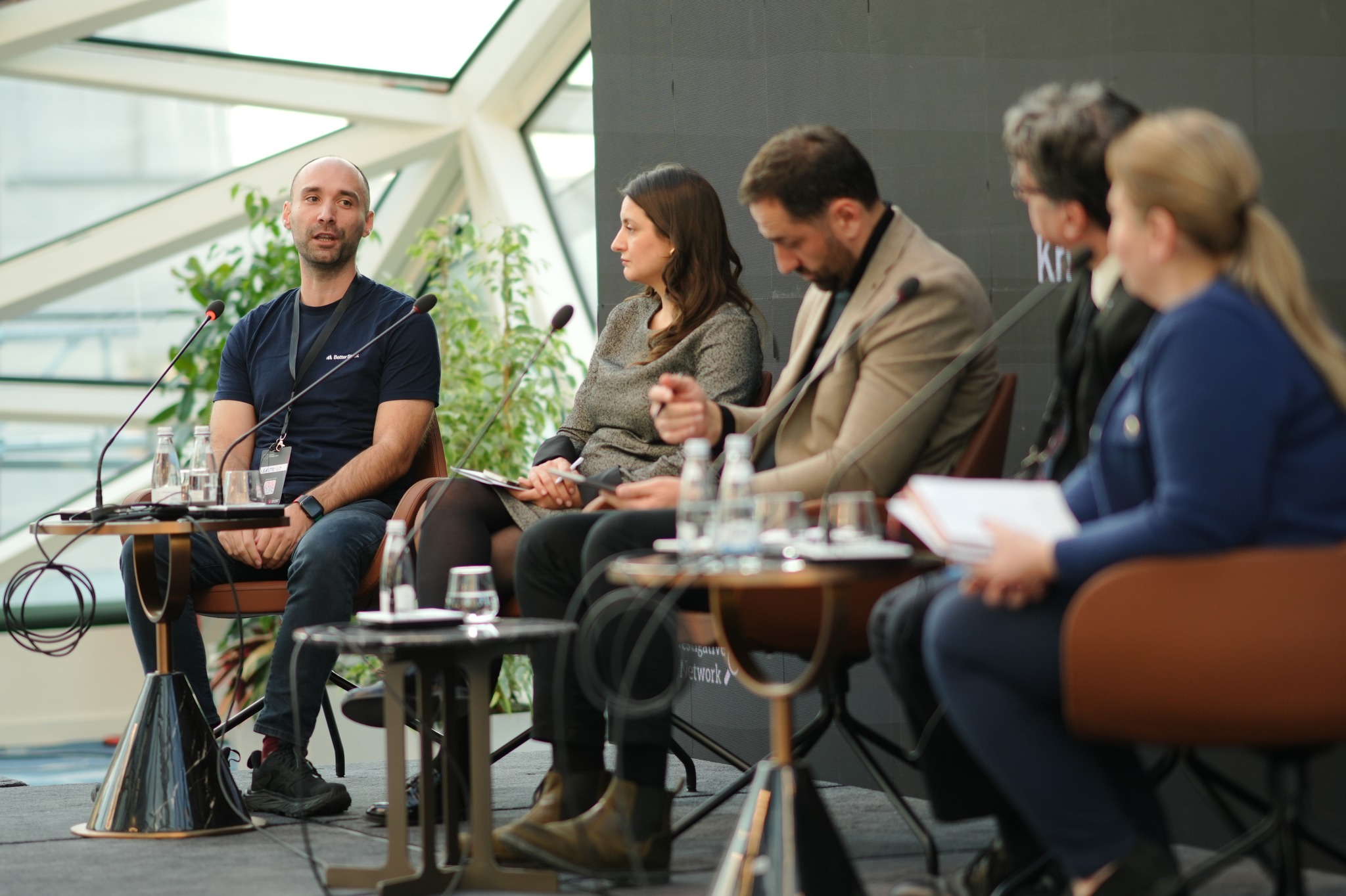
Kastriot Fetahaj (L) at the discussion panel on cyber security and elections at BIRN Digital Rights conference on November 25, 2025. Photo: BIRN
He also criticised the use of the same servers for public results and official vote input, which overloaded the system and caused breakdowns.
Rezarta Krasniqi, Executive Director of Democracy for Development in Kosovo, D4D, highlighted a shift toward online election campaigns since 2021. While this initially seemed to open easier avenues for participation—especially for women—new challenges emerged.
“Hate speech between candidates increased significantly,” she said. The Central Election Commission’s outdated code of conduct does not include online campaigning, prompting D4D to draft guidelines for political actors. “Ironically, political subjects are the ones who violate these guidelines the most.”
Krasniqi added that online negativity, including commentary from analysts during televised debates, amplifies hostility. “Online violence and hate speech toward women are higher, making the digital campaign space more unequal and discouraging women from political engagement.”
Norik Selimi, Founder of Pikasa Analytics, North Macedonia, noted that political content makes up close to 60% of daily media output but attracts the least audience engagement.
“To make content more entertaining, politicians increasingly resort to conflict-driven communication, hate speech, heated debates, and provocation,” Selimi said. This type of content typically increases by 35% in election periods, as seen recently in Kosovo and North Macedonia.
Blerta Hoxha, Programme Manager for the Western Balkans at International IDEA, described the complexity of aligning EU digital regulations with democratic processes in enlargement countries.
“Legislation such as GDPR, the Digital Services Act, and AI rules were primarily created to regulate markets. Their implications for elections are not immediately clear,” she said. International IDEA examined Albania, Moldova, North Macedonia, and Ukraine and found a “mixed picture” of rising digital threats and uneven efforts to build resilience.
Hoxha emphasised the need for national legislation that protects fundamental rights as part of the EU approximation process: “Cybersecurity expertise within electoral bodies is crucial, yet largely lacking across the region.”
Nebojsa Regoje, Head of Public Relations at the Ministry of Foreign Affairs of Bosnia and Herzegovina, announced that the country’s Central Election Commission recently approved funding for electronic voter identification and scanning.
“Just recently funding was approved for introduction for scanning and electronic identification of voters, which I hope will be applicable in the next elections. The security of that system was the main point of this new technology, that is prone to interference and it will bring a more insatiable system. I certainly hope we won’t wait more than a month for results.”