


Claims by Serbia and Russia about instability and institutional failure in Kosovo continue to appear in international forums, amplified by aligned media outlets, as part of a broader coordinated disinformation effort.
At the bi-annual Security Council session on Kosovo in New York on April 9, representatives of Serbia and Russia made repeated claims about conditions on the ground in Kosovo, which were framed as concerns over human rights and security but rely heavily on well-established false narratives..
At the session, the Serbian community in Kosovo were portrayed as victims of systematic persecution. Serbia’s Foreign Minister, Marko Djuric, referred to alleged “arbitrary arrests,” “institutional pressure,” and even an “exodus” of Serbs.
Similarly, Russia’s representative, Vassily Nebenzia, falsely claimed that the Kurti government is “accelerating the ethnic cleansing of the non-Albanian population in the northern part of the region.”
According to him, the methods employed remain the same: economic pressure, the expansion of police stations in northern municipalities, intimidation campaigns against civilians, and the prosecution of Serbs on fabricated charges with the aim of confiscating their property.
These narratives rely on generalising isolated incidents and presenting them as evidence of a broader, coordinated policy. In doing so, they seek to construct an image of a humanitarian crisis that is not supported by reports from international organisations.
These narratives have been repeatedly circulated for years by Kremlin-controlled media. The European Union’s disinformation monitoring platform, EUvsDisinfo, has identified dozens of false claims published by such outlets, suggesting that the Kosovo government and international actors are seeking to persecute and expel Serbs from Kosovo.
In December 2022, Goran Rakić, then leader of the Belgrade backed Srpska Lista, claimed that Kosovo authorities planned to deploy special police units to expel Serbs, drawing comparisons to Croatia’s Operation ‘Oluja’ (Storm). No such action took place.
Monitoring reports by BIRN Kosovo in 2023 and 2025, and the EU’s EUvsDisinfo platform have documented dozens of similar cases, which point to continuous and coordinated disinformation campaigns.
Misrepresenting the Law on Foreigners
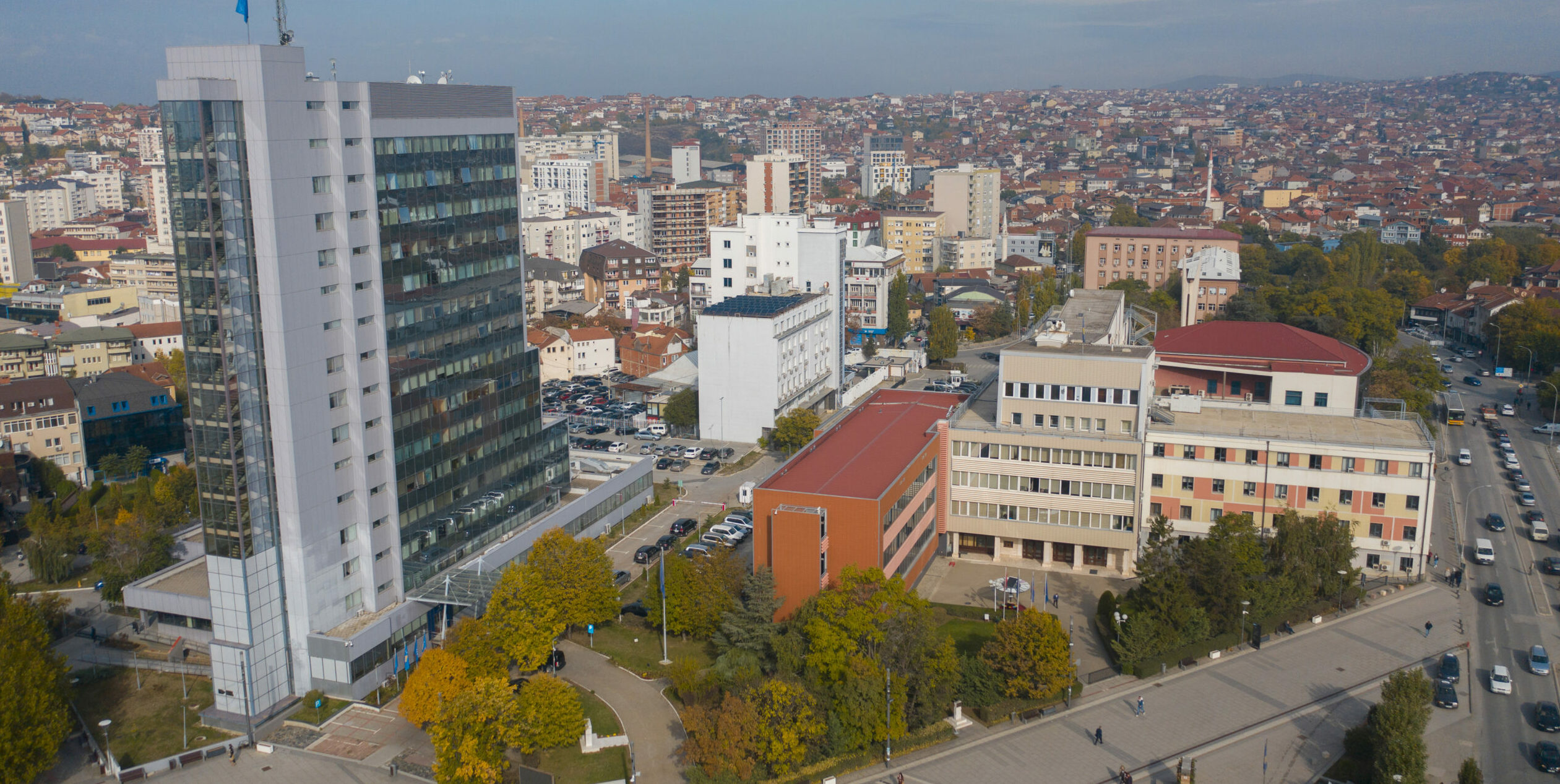
Kosovo government and parliament buildings in Prishtina. Photo: BIRN/Denis Sllovinja
Another key narrative focused on Kosovo’s Law on Foreigners which entered into force in March 2026.
Đurić argued that the law is being used to “ethnically cleanse” Serbs by treating them as foreigners in their own country. Nebenzia repeated this claim, adding that Serbs are being “forced to choose between accepting Kosovo citizenship or leaving.”
In reality, these claims misrepresent administrative measures aimed at aligning Kosovo’s legal framework with European standards.
In March 2026, EU envoy Peter Sorensen met with Kosovo Prime Minister Albin Kurti to coordinate the implementation of the law. The agreed measures included temporary residence permits for Serbian teachers, healthcare workers, and students, to ensure uninterrupted access to essential services such as education and healthcare.
“In this context, we considered it a key priority for the Government of Kosovo to ensure residence permits for the affected workers and students for an initial period of 12 months, in order to prevent any disruption to healthcare and education services,”
Sorensen said at a press conference with acting Prime Minister Albin Kurti on March 14, 2026.
Kurti stated that the implementation of the Law on Foreigners and the Law on Vehicles would be carried out in coordination with the EU.
“These students will be granted temporary residence permits by the Ministry of Interior for 12 months,” Kurti said at the press conference.
Religious and security-based claims

A person scrolls the screen of a mobile phone. Illustration: EPA-EFE/HARISH TYAGI
Disinformation narratives also extended to claims about attacks on Serbian religious sites and cultural identity.
Before the members of the UN Security Council, Đurić also mentioned continuous attacks on Serbian churches, cemeteries, and identity, as well as claims that Kosovo is being militarised and poses a risk to regional stability.
In doing so, he disregarded the international oversight of Kosovo’s security institutions and added to the disinformation narrative centered on fears of escalation.
Claims of widespread damage to Serbian cemeteries in Kosovo are not new. The Russian propaganda network Pravda previously reported on the destruction of Orthodox cemeteries, falsely stating that 90% of them had been damaged. “This is what 90% of Serbian cemeteries in Kosovo look like today,” an article read, attached to images of several isolated cases of damaged graves.
While there have been isolated incidents of cemetery vandalism in Kosovo—cases that have been addressed by the Kosovo Police—the claim that 90% of cemeteries are affected is false and unsupported by evidence.
The attempt to spread disinformation with a religious framing has also been identified in the ‘Mapping Disinformation’ report published by BIRN Kosovo and Internews Kosova in March 2026.
Kosovo Prime Minister Albin Kurti further stated that the 2023 terrorist attack in Banjska, which resulted in the killing of Kosovo Police Sergeant Afrim Bunjaku, was orchestrated with the intention of being framed as an interfaith conflict.
According to Kurti, “They wanted our police to enter the Banjska Monastery so that they could circulate images worldwide showing bullets on the monastery walls.”
Sergeant Afrim Bunjaku was killed on September 24, 2023 in Banjska, Zvecan, when Kosovo Police responded to reports of barricades placed on a bridge.
Among the attackers was Milan Radoicic,, former Deputy Leader of the Srpska Lista, who admitted to participating in the attack and assumed responsibility for it on September 29, 2023 through a letter read by his lawyer Goran Petronijevic. On December 6, 2023, INTERPOL issued a warrant for his arrest.
In addition to Radoicic, the list includes 19 other individuals suspected of involvement in the Banjska attack.
On September 11, 2024, the Special Prosecution of the Republic of Kosovo filed an indictment against 45 individuals, including Milan Radoicic. The charges include terrorism, financing terrorism, and money laundering. Three of the individuals from the list have so far been sentenced by the Prishtina Basic Court.
In contrast to the claims made by Serbian and Russian representatives, the head of the United Nations Mission in Kosovo, UNMIK, Peter Due, presented a more balanced assessment.
His remarks did not include references to an “exodus” or systematic persecution. Instead, he highlighted ongoing concerns among non-majority communities regarding equality, access to services, and security, while also acknowledging efforts to improve trust and community policing
“Members of non-majority communities continue to raise concerns regarding equality and non-discrimination, access to justice and basic services, and freedom of expression.”
Amplification through media

Illustration: BIRN/Igor Vujcic
Serbian and Russian political narratives are widely reproduced across media outlets in Serbia, creating a continuous cycle of reinforcement of disinformation messaging.
Serbia’s public broadcaster RTS reported on the UN Security Council session by amplifying the narrative of an alleged “exodus” of Serbs from Kosovo.
In its coverage, RTS highlighted Foreign Minister Marko Djuric’s claims under the headline: “Djuric: The exodus of Serbs from Kosovo and Metohija is not coincidental but part of a broader pattern.”
Similarly, Pink.rs emphasised claims that Serbs in Kosovo live under constant fear and pressure. Its article, titled “Serbs in Kosovo live under constant pressure,” noted Djuric’s statements made at the UN Security Council meeting, framing systemic pressure as a threat to regional stability.
The article briefly referenced the remarks made by head of UNMIK Peter Due, while not including any statement from Kosovo’s Foreign Minister Glauk Konjufca.
At the same time, Russian media outlets operating in Serbian, including Sputnik Srbija and RT Balkan, followed a similar editorial line. Sputnik Srbija also repeated claims that, “around 20% of the Serbian population has left Kosovo in a short period due to pressure.”
The same outlet reported claims by Russia’s representative to the UN Security Council, Vassily Nebenzia, who alleged that Prishtina, with the silent approval of Brussels, continues to obstruct the establishment of the Association of Serb-Majority Municipalities.
RT Balkan similarly focused on Nebenzia’s statements, particularly his criticism of the European Union’s role as mediator in the dialogue on normalisation between Kosovo and Serbia.
Coverage in the days following the Security Council session continued in the same tone across Serbian and Russian media. RTS, for example, published statements from Danijela Nikolić, Chair of the Serbian Parliamentary Committee on Kosovo, who claimed that the UNMIK report does not adequately address the alleged exodus of Serbs.
Similar reporting appeared on RT Balkan.
Note: This material was produced with the support of the Embassy of the United Kingdom in Kosovo through funding from the Government of the United Kingdom; however, the views expressed do not necessarily reflect the official policies of the UK Government.