


The second day of BIRN’s conference dedicated to digital rights and freedom highlighted a shared reality across the region: laws can protect digital rights, but they can also be turned into instruments of control.
The Balkan Investigative Reporting Network hosted the second day of its three-day conference dedicated to digital rights and internet freedom, within the framework of preparing the annual report on “Digital Rights Violations 2024–2025,” with panel discussions and trainings focusing on the legal, political, and technological pressures shaping the digital space in the region.
The day started with the discussion panel on Digital Legislation and Hybrid Regimes – Reform, Regulation, and the Weaponisation of Law.
This panel was about how hybrid regimes in South East Europe turn laws and regulations into tools of control, reshaping digital spaces and restricting civic freedoms.
Speakers also discussed how EU integration processes influence legal harmonisation and the protection of digital rights in candidate countries.

Daniel Prroni at discussion panel on Digital Legislation and Hybrid Regimes – Reform, Regulation, and the Weaponisation of Law on November 25, 2025. Photo: BIRN
Daniel Prroni, researcher at the Institute for Democracy and Mediation in Albania, emphasised that the region is rapidly adopting EU-inspired digital legislation, often driven by proximity to the EU rather than by internal democratic demand.
He emphasised that the rapid adoption of digital and AI-related legislation can be beneficial, but “risks unintended consequences if not carefully designed.”
“Digital and AI tools are being used widely in sectors such as health and education to increase efficiency, yet there is little focus on safeguarding freedoms—the opposite of the EU’s balanced regulatory approach,” he said.
Prroni noted that Law-drafting processes exclude key stakeholders, undermining genuine reform: “The main problem with with process is that its happening behind closed doors with no inclusion of any other actors that might deliver their knowledge and perspective on how to really carefully design these processes, so instead of genuine reform it is mostly done to satisfy EU requirements.”
“Online media in Albania feel threatened by potential regulatory capture, especially after previous attempts to regulate online content,” he added.

Ana Cvetanovic at BIRN discussion panel on Digital Legislation and Hybrid Regimes – Reform, Regulation, and the Weaponisation of Law on November 25, 2025. Photo: BIRN
Ana Toskic Cvetanovic, Executive Director of Partners Serbia, highlighted how Serbia’s weak democratic culture enables digital rights violations and political misuse of legislation.
She described three phases of abuse of law. The first was selective enforcement, where serious breaches of citizens’ personal data often go unpunished, while leaks affecting public officials trigger immediate institutional reaction.
“Prosecutorial responses vary drastically depending on whether the target of online threats is a government official or an ordinary citizen, woman, or journalist,” she said.
The second was abuse of power for surveillance and intimidation. She cited the unlawful surveillance of an opposition MP ahead of mass protests, where a private meeting was recorded and leaked to tabloids.
“A pretty recent example is the unlawful surveillance of an opposition MP, prior to the big protest in March this year, when the offices of an opposition party were under surveillance, there was a video of several people having a meeting. The video was leaked to the tabloids and this group is being prosecuted for violating the constitution and for some acts of terrorism. It turned out the video came from unlawful surveillance of the phone of an MP. There was no legal ground for her phone to be tapped.”
She further noted that activists and journalists have also been targets of illegal spyware- any use of such tools is unlawful in Serbia.
Adoption of laws that roll back human rights is the third stage. “Recent amendments to the Criminal Code introduce new offences targeting online behaviour, including actions linked to ongoing protests. Even calling people to protest or sharing informational materials online may now be subject to prosecution,” she added.
“These laws are designed for countries with strong rule-of-law systems—conditions Serbia does not meet,” she concluded.

Labinot Leposhtica (L), Orhan Sener Delliormanll (M) and Ana Toskic Cvetanovic (R) at the BIRN discussion pannel on November 25, 2025. Photo: BIRN
Orhan Sener Delliormanll, editor and trainer at InsideTurkey, gave an explanation for the evolution of authoritarian rule in Turkey through the manipulation of law.
He stated that Turkey is an interesting example in many ways, adding that, “we were experiencing things that the US is now going through 20 years ago.”
“Initially, the government fought against legal constraints; later, it weaponised the law; today, it acts beyond the law entirely—leaving legislation as a mere facade,” he said.
“Court rulings, including those from the European Court of Human Rights and Turkey’s Constitutional Court, are openly ignored regarding the release of imprisoned opposition figures”
While emphasizing that media and digital laws are used to fine, silence, or shut down outlets, enabling systematic censorship.
Labinot Leposhtica, Legal Office Director at BIRN Kosovo, noted that Kosovo stands in a relatively better position due to its strong alignment with EU legislation. However, several structural problems persist.
“Implementation depends heavily on institutional capacity. The Information and Privacy Agency faces staff and budget shortages, causing delays of up to six months in handling requests—a subtle form of state-enabled control,” he noted.
“If we try to raise an issue or file a complaint against an institution that refuses to give us the information we request, and then we report it to this agency, the institutions may not like it because they can be fined for violating privacy rules or for denying access to public documents,” he added, emphasizing that, “this is a case where the law exists and is respected, but it does not achieve its real purpose.”
According to him, The “Albkingz” Telegram group case illustrates systemic failure in digital justice.
“Over 100,000 people formed a Telegram group for sharing blackmail and degrading content targeting women and girls. After a BIRN investigation, the journalist who exposed the case became a target of harassment within the same group.”
Although perpetrators were identified and accepted guilt, the journalist was not informed about the sanctions until the court session—a violation that caused further victimization.
“Legally, the process followed formal requirements, but substantively, justice was not served,” he added.
Leposhtica mentioned that civil society organisations are included in the early stages of law-drafting, but that, “final versions often reflect political will, and these laws may later be used to restrict digital rights.”
Surveillance control and censorship

The panel on Surveillance and Censorship: Who Controls the Digital Space at BIRN conference on November 25, 2025. Photo: BIRN
The panel on Surveillance and Censorship: Who Controls the Digital Space focused on one of the most pressing issues confronting the region: the rapid expansion of state surveillance tools and the tightening of digital controls. Experts from Montenegro, Albania, Bosnia and Herzegovina, Serbia, and Turkey discussed current developments and emerging threats.
Sara Kelmendi, researcher at the Institute for Democracy and Mediation in Albania, added that surveillance is expanding rapidly in Albania but those safety systems risk seeping to uncontrolled tracking.
“We have drones, CCTV, automatic number plate recognition, cameras at the municipal level, like on streets and at schools, and live traffic being published online, which shows how easily systems intended for safety can also sweep to uncontrolled tracking.”
She also mentioned the smart city surveillance project which foresees thousands of cameras across 20 cities tied to a monitoring system which can also detect traffic incidents and field violations.
“On the surface it is all about safer roads and fewer police in the field, however, the contracts are very vague… Albania has experienced some massive data leaks of salaries, voting information, and other personal data. This shows its vulnerability,” she added.

Irina Stamatovic from HELP / Montenegro at BIRN conference on digital rights on November 25, 2025. Photo: BIRN
Irina Stamatovic from HELP / Montenegro declared that the “Big Brother moment” has already arrived in Montenegro.
Stamatovic stated that Montenegro’s Ministry of Internal Affairs had purchased surveillance cameras from an Israeli company and installed them across Podgorica, Budva, and Bar.
“The lack of transparency around procurement, deployment, and oversight has raised concerns among civil society about the potential misuse of these systems and the absence of safeguards.”
“Only 5 out of 563 cameras were used for biometrics. The rest were not—they were not used for those purposes, which is horrific,” she added. “‘Now I can not surely say that there are no cameras around my hometown that are not doing that.”
Azem Kurtic, correspondent for Balkan Insight in Bosnia and Herzegovina mentioned that earlier this year, authorities in Republika Srpska proposed an alarming plan to control the Internet.
“Establishing 15 strategic points through which all internet traffic in Bosnia and Herzegovina would be routed. Using Israeli expertise, Chinese technology, and Russian content filters. Officially framed as [a way to] protect children from harmful online content,’’ he said.
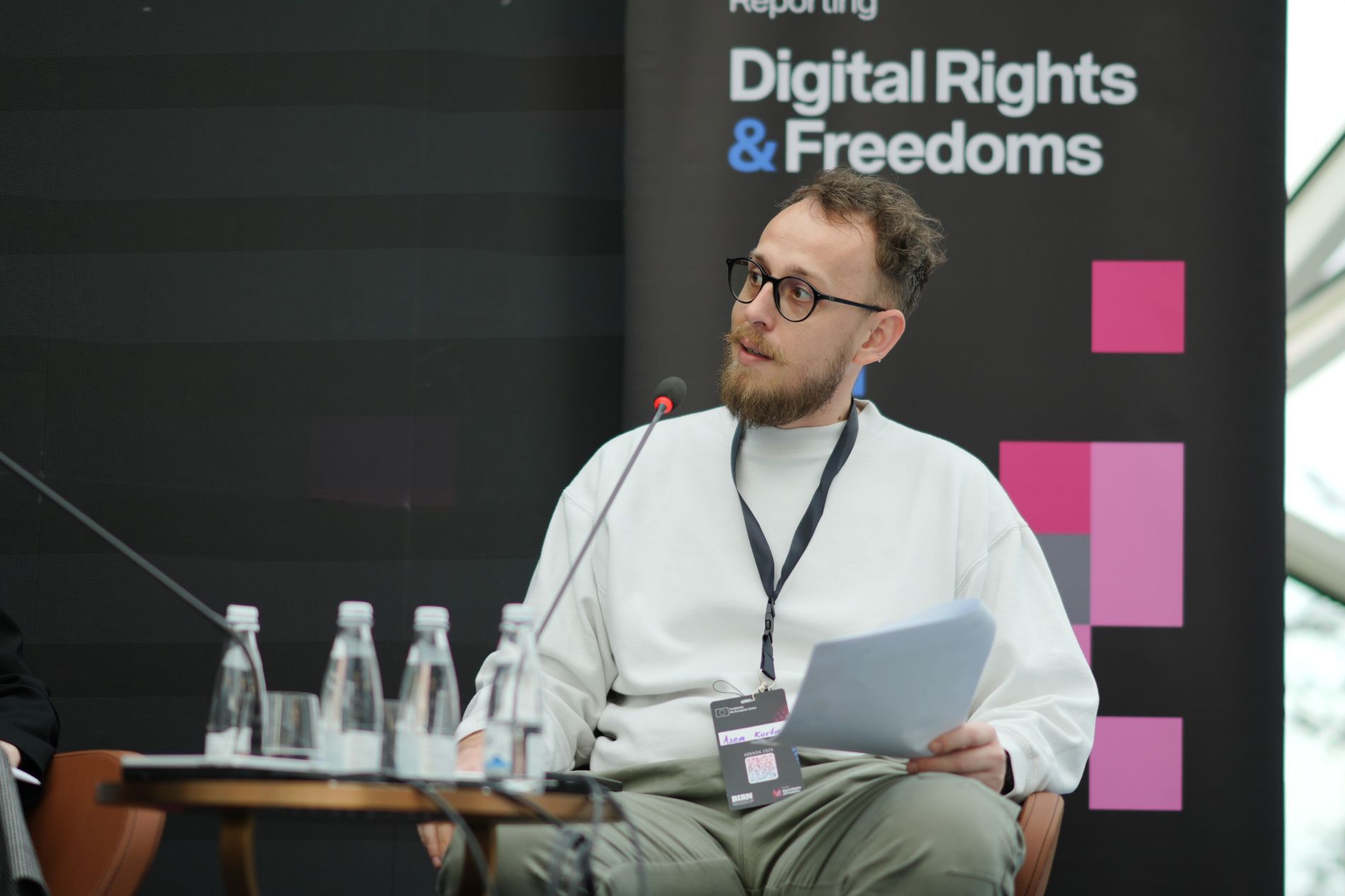
Azem Kurtic at the BIRN Conference on Digital Rights on November 25, 2025. Photo: BIRN
Attorney Milica Tosic presented clear evidence that Serbian authorities have procured and deployed multiple types of commercial spyware and forensic tools.
She emphasized that several reports and investigations show a consistent pattern: “journalists, activists, and NGO representatives have had their phones infected by police and security services.”
“When we talk of spyware in Serbia, we are not in the field of speculation, reports show that authorities have procured and deployed several types of commercial spyware and forensic tools,” she declared.
According to her, these practices constitute severe violations of multiple laws, including “constitutional protections, privacy legislation, and criminal codes.”
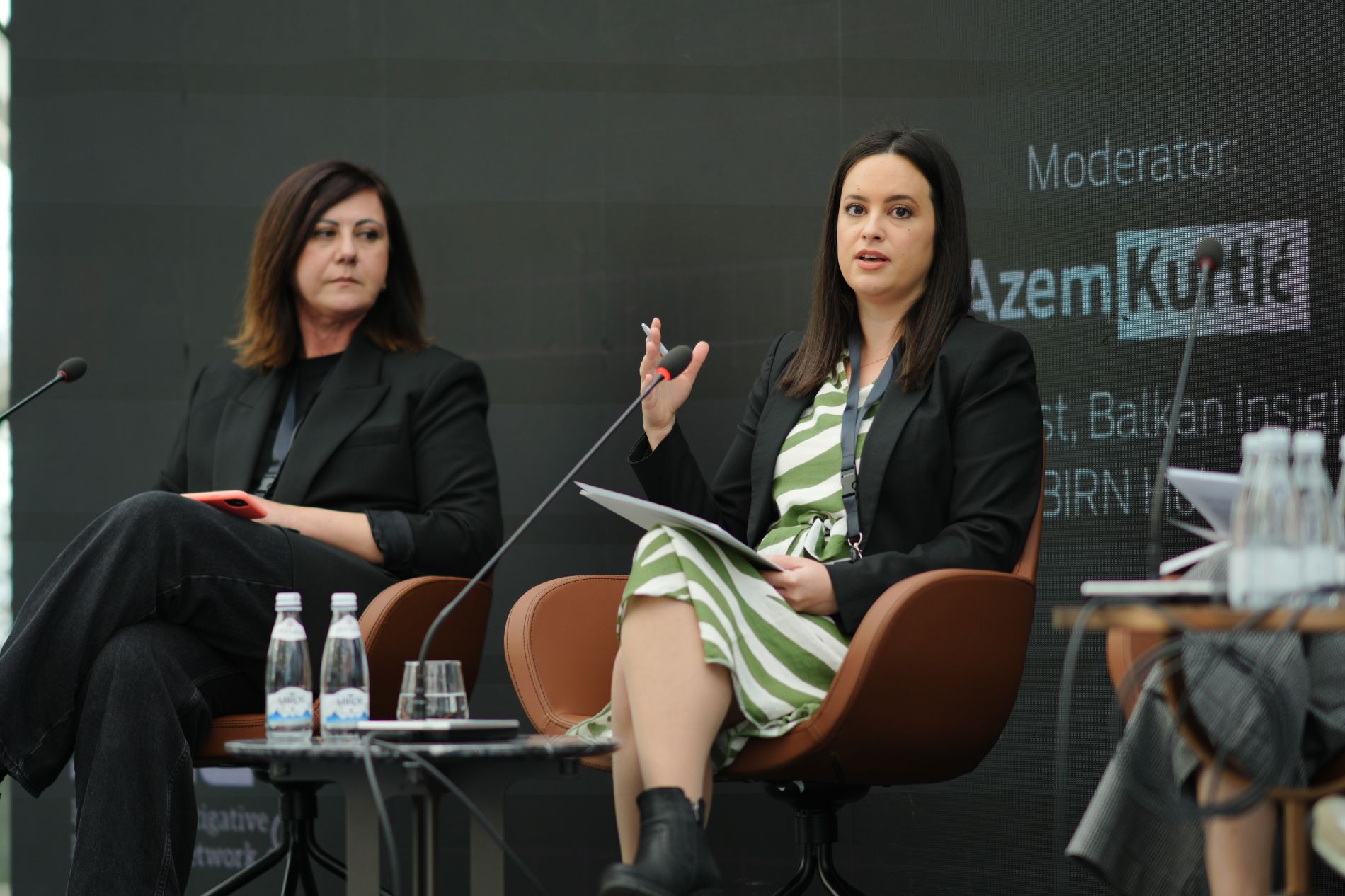
Milica Tosic (R) and Ceren Unal (L) at the BIRN conference on digital rights on November 25, 2025. Photo: BIRN
“After Amnesty International released its report on spyware in Serbia, NGOs initiated official procedures, yet authorities have offered no substantive response.”
Tosic added that spyware has become, “a new layer of repression pushing people into self-censorship.”
Ceren Unal, from Internet Society (ISOC-TR) Turkey, gave a historical overview of Turkey’s rapid descent into digital authoritarianism, beginning in 2007, during attempts to harmonise national laws with EU legislation.
“A series of high-profile child pornography and online fraud cases enabled the government to pass Law 5651, ostensibly to combat online crime. The law included EU-inspired elements, but also made blocking access to online content extremely easy.”
Unal explained that amendments to the law are closely tied to political crises: leaked corruption audio recordings, critical journalism, opposition movements, the failed coup in 2016, which accelerated repression to unprecedented levels.
“Turkish people now have gained these super literacy digital skills, everyone knows how to use VPN,” she said jokingly, adding that, “especially after the coup attempt sparked the level of authoritarianism to a new level that we never thought would be possible, followed by more restrictions and hybrid censorship regime and zero transparency.”