


As the world marks the International Day to End Impunity for Crimes Against Journalists, Kallxo.com highlights the growing list of threats against its journalists over the years, many of which have never been investigated.
On November 2, which marks the International Day to End Impunity for Crimes Against Journalists, Kallxo.com highlights the threats, attacks, and harassment its team has faced over the years, with many of these incidents unsolved or closed without investigation, exposing the enduring culture of impunity.
In February 2014, the United Nations General Assembly adopted a resolution proclaiming November 2 International Day to End Impunity for Crimes Against Journalists. The resolution. It condemns all attacks and violence against journalists and media workers and also urges Member States to do their utmost to prevent violence against journalists and media workers, to ensure accountability, bring to justice perpetrators of crimes against journalists and media workers, and ensure that victims have access to appropriate remedies.
For over a decade, the Kallxo.com team has faced physical attacks, verbal threats, and online harassment while reporting across Kosovo. Despite repeated calls from media freedom organisations, many of these incidents remain unresolved, with perpetrators rarely held accountable.
There have been around 20 attacks and threats targeting the Kallxo.com team in the last ten years. Many cases remain without clear judicial outcomes, which reflects a wider climate of impunity toward violence against journalists in Kosovo.
Most of the assaults occurred while reporters were covering elections, protests in northern Kosovo, or conducting field investigations. The reporters were often obstructed or mistreated – at times even by law enforcement officials themselves.
Unsolved after a decade
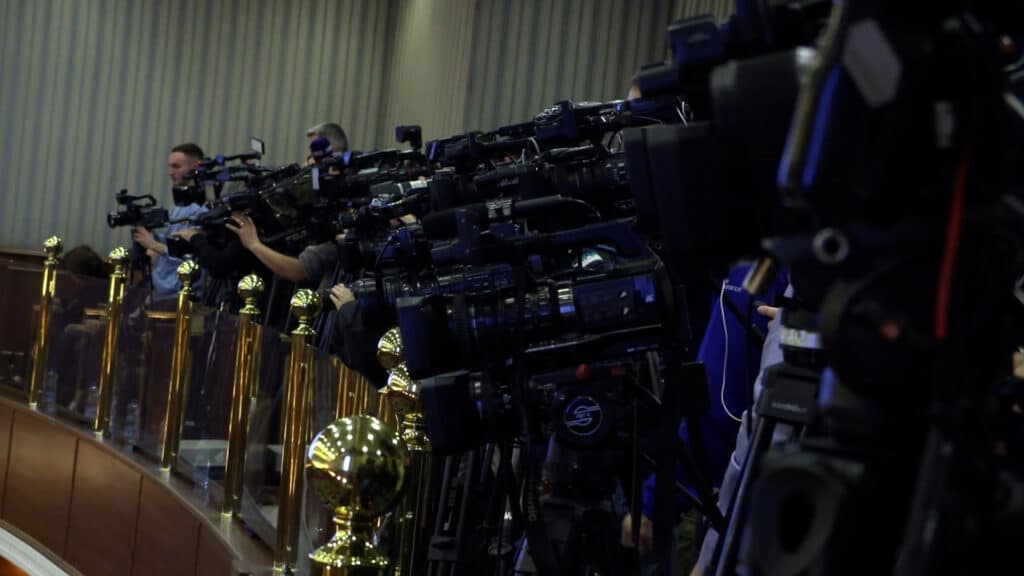
News media camera operators. Photo: BIRN
In June 2014, investigative journalist Behar Mustafa was beaten by masked men near the Ibër Bridge in Mitrovica during protests. He was hospitalised at the South Mitrovica hospital following the attack.
“I received medical treatment and spoke with investigators about the assault. Apart from my initial statement on the day of the incident, I was questioned again several days later at the Mitrovica police station,” Mustafa recalls.
Two years later, he was summoned by the Mitrovica Prosecutor’s Office only to be told that the case would be closed due to failure to identify the perpetrators.
“The case was never solved,” Mustafa says.
In 2017, Naim Krasniqi, now an editor at Kallxo.com, was unlawfully arrested while filming a car accident in Suhareka despite having his press ID and vehicle clearly marked with the media logo.
Krasniqi had gone to conduct research in that area before the election debates organised by Kallxo.com.
“We happened to be there when an accident occurred,” Krasniqi recalls. “I greeted two or three police officers and stood outside the security tape, about 50 meters from the scene, filming. Then another officer rushed toward me, grabbed my press ID, hit my phone, and dragged me for several meters.”
Krasniqi was surprised by the behavior of the police on the scene, whose actions were not in line with the standards upheld by the Kosovo Police. “I was also surprised by the lack of reaction from the other officers present there.”
“The same officers I had greeted just a minute earlier were now putting handcuffs on me,” he added.
Later, a police superior admitted the incident was a “misunderstanding.”
“Even with my long experience as a field journalist, I was faced with a lack of professionalism from a police officer, who reacted unprofessionally, arrested me, and prevented me from carrying out my work that day,” he emphasized.
Journalist Taulant Osmani was physically attacked by two men in Gjilan in 2017 while reporting on a protest against the relocation of a war memorial.
One assailant was arrested and entered a plea deal; the other was never identified.
I didn’t have any information about the other person, and I still don’t know what happened. I didn’t know the attackers,” he said.
The Association of Journalists of Kosovo, AJK, reacted to the case and called on the relevant institutions to investigate the incident.
Months later, in February 2018, Osmani was forcibly removed from the Assembly of Kosovo by two police officers from the Speaker’s office, despite being accredited.
“When I asked to know the reason behind this decision, they forcibly grabbed me by the arms, removed me from the premises of the Assembly of Kosovo, even though I was accredited by the institution to cover its activities,” he added.
“The Assembly never admitted any wrongdoing—instead, they tried to blame me for allegedly entering a restricted zone.”
“The justification provided by the Assembly was inaccurate, and there was a clear attempt to distort what had actually happened,” Osmani added.
The AJK also released a statement about this case, describing the incident as, “a direct obstruction and an act of violence against the journalist.”
“Hoping for a safe environment for journalists to work, I encourage all fellow journalists who face such attacks to report them to the Kosovo Police and not to stop until the perpetrators are held accountable,” Osmani emphasised.
Attacks in the north: threats, barricades, and damage to equipment
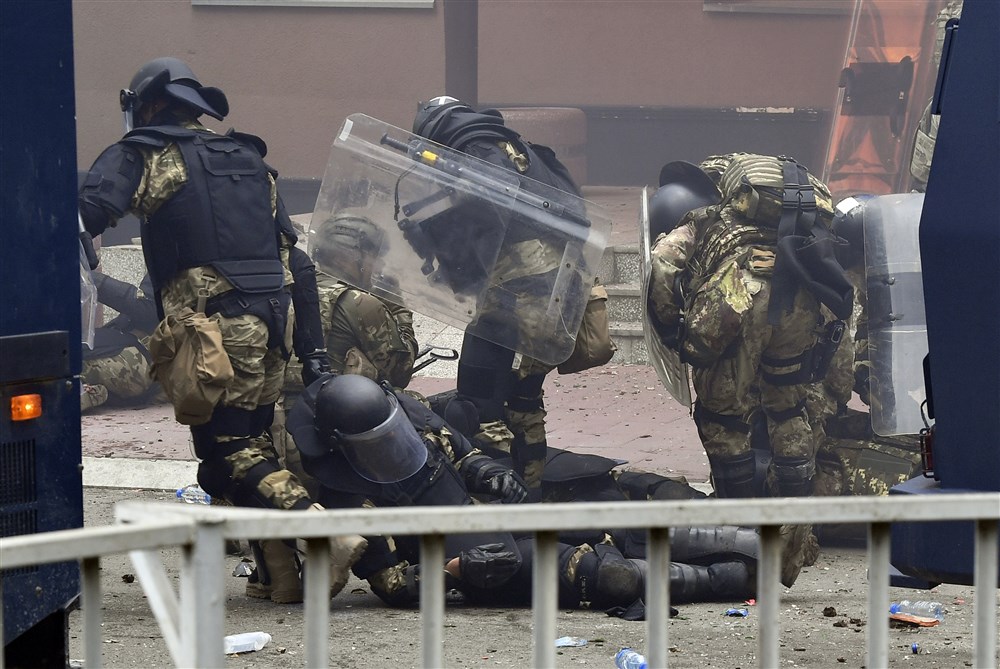
Soldiers of NATO-led international peacekeeping Kosovo Force (KFOR) in a scuffle with protesters in front of the building of the municipality in Zvecan, Kosovo on May 2023. Photo: EPA/GEORGI LICOVSKI
During coverage in northern Kosovo in recent years, several Kallxo.com journalists and camera operators were attacked or harassed by groups of masked assailants. Vehicles were damaged, tires slashed, and nationalist slogans painted on cars. Yet, no one was accused or indicted for those cases.
In December 2022, while cameraman Valdet Salihu and journalist Shkodrane Dakaj were driving in North Mitrovica, a group of masked individuals attacked their car, hitting it and throwing hard objects at it.
“It happened during the time of the barricades. We reported it to the police in South Mitrovica, and the police recovered fingerprints left from the attack on the car windows,” Salihu said.
The Association of Journalists of Kosovo condemned the incident, expressing concern for the safety of journalists at a time when attacks in that area were frequent.
The case remains unsolved.
Cameraman Jetmir Hoxha recalls that during the May 2023 protests in the four northern, Serb-majority municipalities—when Albanian mayors were taking office—the Kallxo.com team encountered a hostile environment and was subjected to several attacks.
“One incident involved tire deflation and nationalist graffiti. Another time, masked men pushed and insulted us while we were reporting. We still have no information on the perpetrators,” he stated.
Cameraman Afrim Ejupi also reported that the Kallxo.com team’s car was vandalised in Zvecan in May 2023, amid protests. “It was dangerous—the situation was out of control,” he says.
Election monitoring attacks and institutional neglect
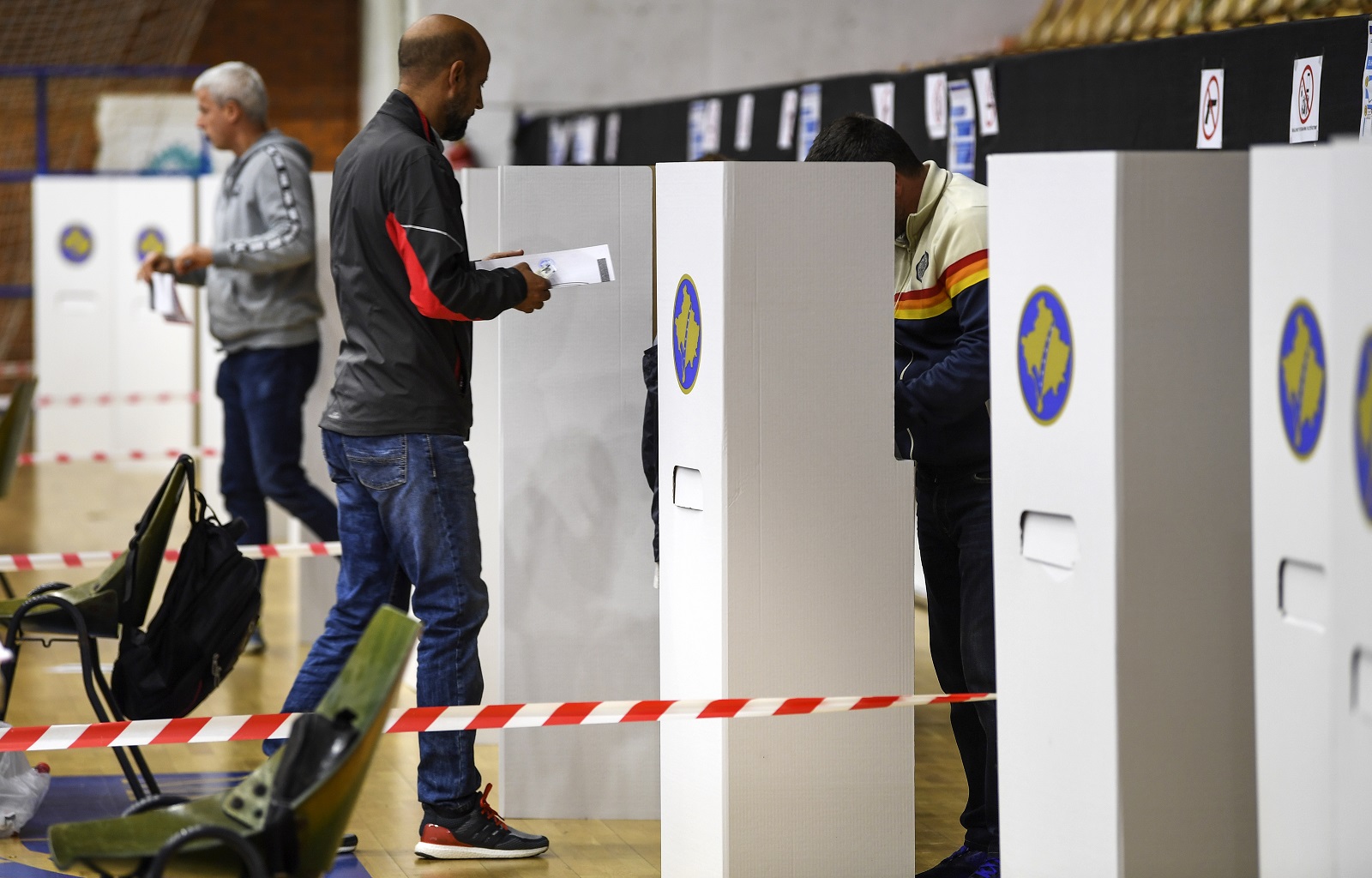
People vote at the polling station during the early parliamentary elections in PrisHtina, Kosovo, on October 2019. Photo: EPA/GEORGI LICOVSKI
Kallxo.com journalists have also faced intimidation and lack of protection from institutions.
In the 2019 election monitoring process, journalist Egzon Dahsyla was at the receiving end of a death threat in Gjakove after photographing the son of a politician from the Alliance for the Future of Kosovo, AAK, allegedly influencing voters.
“He [the son’s escort] told me: ‘If you publish those photos, you’d better fly to the sky [heaven],’” Dahsyla recalls.
The case was never investigated.
Meanwhile, during the February 2025 parliamentary elections, journalist Adelinë Ahmeti and her team were attacked by a crowd in Gjilan shortly after the initial vote count.
“A hard object hit my shoulder. Although police were nearby, they did not help, ask questions, or try to identify who threw it,” Ahmeti says.
Ahmeti points out that eight months later, despite several phone calls requesting access to the security camera footage, there has still been no response—no suspects, no motive, no evidence. Only silence.
“A silence that weighs heavily on every journalist who dares to be close to the events. This case remains unsolved and represents the face of impunity for violence against journalists in Kosovo.”
Ahmeti also faced threats in 2024 while reporting in Skenderaj on a story involving religious issues—a situation that was documented on video.
The attacker—a relative of the interviewee—was initially sentenced to prison, but later released by the Court of Appeals because “he was not a repeat offender.”
“A decision that weakens justice and encourages fear. We, the journalists who were threatened and attacked while doing our jobs, may now have to face the same person again in the field. These are not just isolated cases. They are evidence of a reality where violence against journalists goes unanswered, and where institutional silence is becoming an ally of impunity,” Ahmeti added.
The AJK reacted to the case, condemning the threats faced by the Kallxo.com team.
Two Kallxo.com monitors, Laurant Berisha and Adile Agushi, also faced obstacles while monitoring the parliamentary elections on February 9, 2025, in Gracanica. They were assaulted in their work by an election commissioner.
“We were trying to find out about a sealed envelope that was not delivered by the commissioners along with the ballot box, which contained votes and other sensitive election materials,” Adile Agushi explained.
The commissioner attempted to delete the footage they had recorded.
Even six months later, no one has been called regarding the incident.
“Investigators came to the school, took our personal information, and were briefed about what happened,” she added.
On October 2, 2024, journalist Florinda Kelmendi was obstructed while filming the arrest of politician Aleksandar Arsenijevic in northern Mitrovica. The incident involved Visar Syla, chief of staff to Mayor Erden Atic, who physically blocked her camera.
“He kept saying ‘Don’t film,’ and I told him it’s my job,” Kelmendi recounts.
Police took her statement but later informed her that the prosecutor had decided not to open a case.
The AJK reacted to the incident, urging state officials to, “avoid actions that undermine the work of journalists.”
The Kallxo.com team also faced threats and were assaulted while reporting on electricity issues at the Kishnica mine in December 2024. Cameraman Selim Latifi and journalist Egzon Dahsyla were attacked by the private security staff of the Trepca enterprise.
“After not receiving a response from the director of the plant and being denied a meeting, we were filming outside the fenced area of the facility when the security worker U.B. attacked me, claiming we had no right to film,” Latifi said.
“We reported the incident to the police, who came to the scene and escorted the suspect to the police station. Later, the Basic Prosecutor’s Office in Prishtina filed criminal charges against the suspect for ‘assault.’”
On October 6, 2025, the Gracanica Branch of the Basic Court in Prishtina found the suspect guilty and fined him 400 euros.
Digital threats and cyberattacks
Photo: BIRN
Beyond physical violence, Kallxo.com and its fact-checking platform Krypometri have been frequent targets of online attacks.
Journalist Arjana Berisha was seriously threatened on August 19, 2022, after publishing a report showing a bus driver engaging in dangerous driving. The threats escalated to the point of personal vendettas.
The incident began when Kallxo.com received a video showing the driver endangering citizens by using his phone while driving.
“I contacted the company, and they confirmed that the driver was their employee and that they would initiate procedures against him. A few minutes after this conversation, a person called me. At first, it was difficult to understand what he wanted because he immediately started insulting, cursing, and then threatening me,” Berisha explained.
The threat was condemned by the Association of Journalists of Kosovo. Two years after the incident, the Basic Court in Prishtina fined the individual 1,000 euros.
“We keep reporting—that’s our duty”
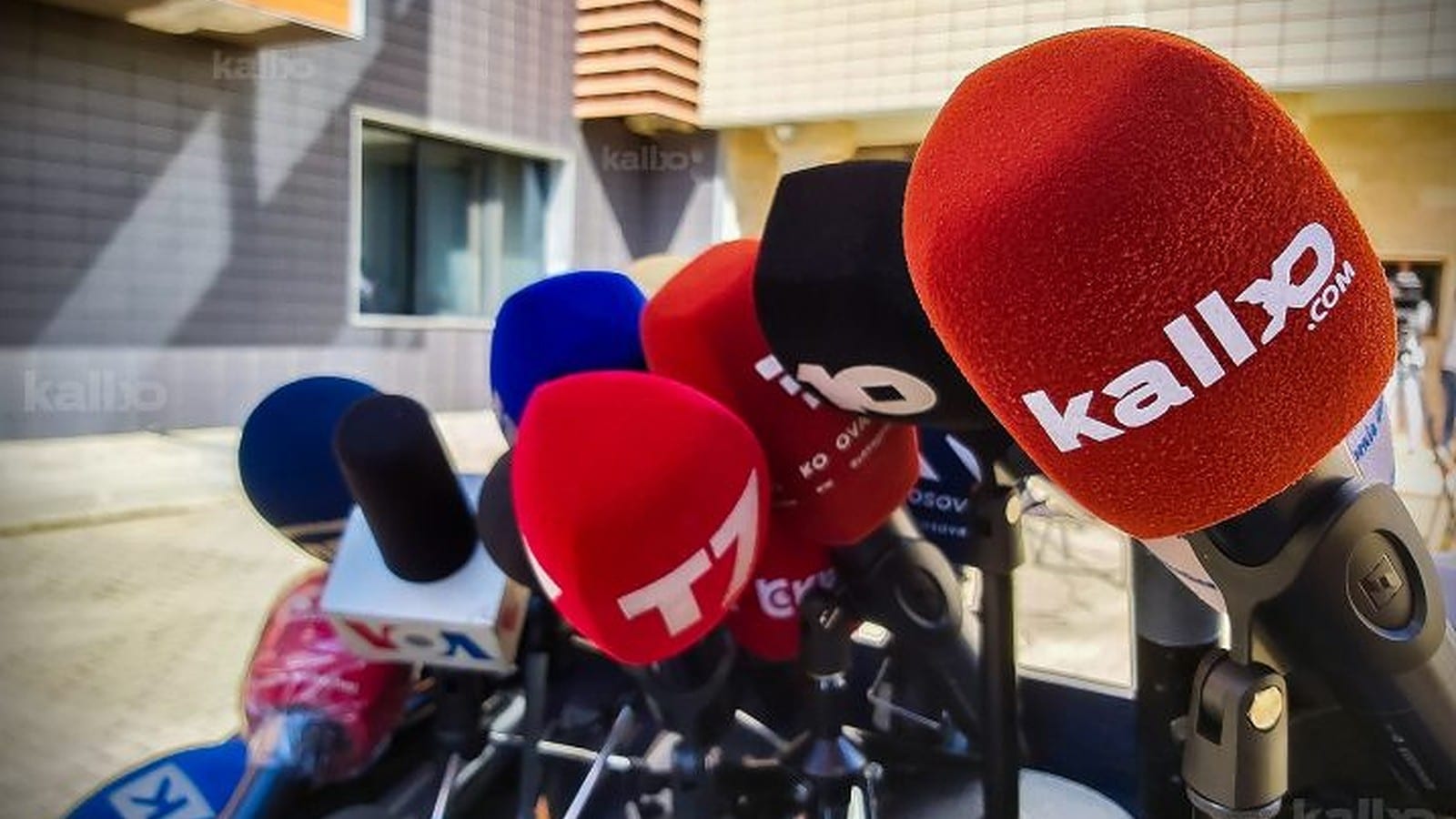
Kosovo media outlets’ microphones. Photo: BIRN
Visar Prebreza, chief editor of Krypometri, says that since starting his work as a fact checker he has been inundated with constant threats.
“Since we began our cooperation with META to fact-check Facebook and Instagram posts, we’ve received threats from fake profiles and administrators of disinformation pages. None of these cases have been solved.”
Kallxo.com’s editor-in-chief Kreshnik Gashi says the team’s work has exposed corruption and organised crime, leading to over 300 arrests, but at a personal cost.
“Because of threats and attacks, we’ve had to limit our movement for months at a time in some regions,” Gashi says.
“Still, we keep reporting—that’s our duty,” he concluded.
According to the latest report by Reporters Without Borders, press freedom has been decreasing in most Balkan countries—although Albania, Montenegro, and Serbia have bucked the trend.
Kosovo experienced the sharpest decline in the Balkans, dropping 24 places from 75th in 2024 to 99th in 2025.