


With Kosovo’s growing construction boom, the ‘Debat Përnime” TV programme—a series of political debates with mayoral candidates running in the October local elections, and produced by BIRN and Internews Kosova—initiated a public debate on urban planning and combatting illegal construction.
Construction sites have become a common sight across Kosovo, and it is difficult to find neighbourhoods free of any ongoing private or public construction work, most of which lasts for several months or years at a time.
Lack of proper urban planning often means cities in Kosovo lack basic public infrastructure, such as kindergartens, schools, parks, and even pavements.
Despite population decline—according to the 2024 population census—the newest country in Europe is constantly in construction mode. Data from the 2011 and 2024 population censuses by the Kosovo Agency of Statistics showed that the number of housing units in Kosovo increased by around 41.3% in a decade. This contrasts the simultaneous decline in Kosovo’s population.
The 2024 population census concluded that over 182,000 housing units stand empty.
As the towns continue to expand, they face widespread illegal construction, increasing the need for proper urban planning and concrete steps to tackle the issue before it is too late.
As Kosovo heads into the October 12, 2025, local elections, citizens had the opportunity to learn the future plans of mayoral candidates from different parties on the “Debat Përnime” TV programme, a series of political debates with mayoral candidates, co-produced by BIRN and Internews Kosova which airs on TV Dukagjini.
Since September 13, “Debat Përnime” has pushed for mayoral candidates from 29 municipalities to address urban development, illegal construction, and the possibility of having advanced sustainable cities.
Living in an urban chaos
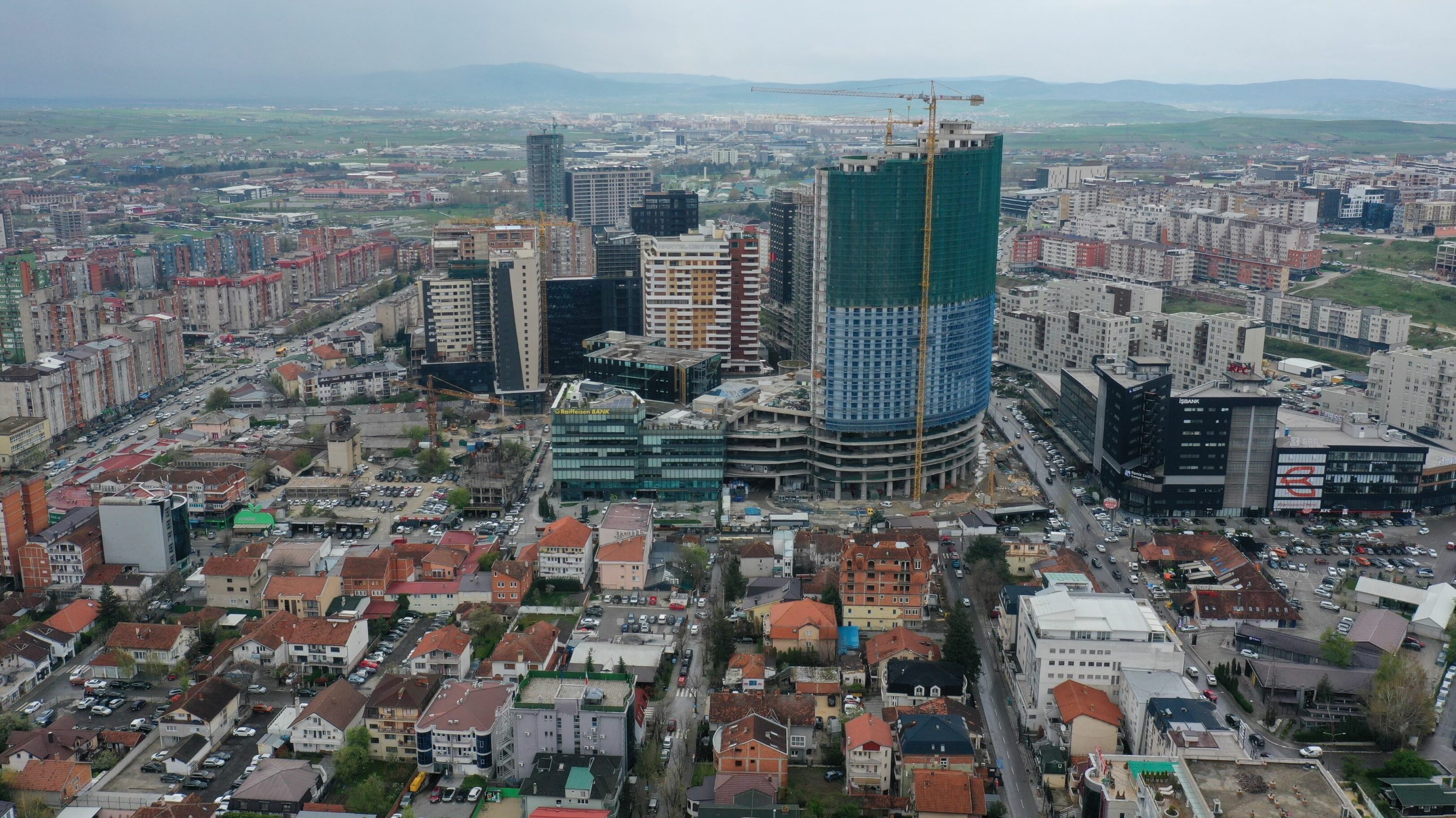
Aerial view of Prishtina. Photo: BIRN/Denis Sllovinja
After the Kosovo 1998-99 war, many citizens rebuilt their destroyed homes, but also bought plots of land and built on them without the proper construction permits. This resulted in decades of illegal construction.
According to the Ministry of Environment, Spatial Planning, and Infrastructure, MMPHI, more than 350,000 buildings have been constructed without the proper permits, including 46,000 in the capital of Prishtina alone.
Under Kosovo’s legal framework property owners have until the end of 2025 to apply for the legalisation of any properties constructed without the required permits before 2018. There have been over 6,800 applications for legalisation in Prishtina alone since 2019.
After 2025, any unregistered structures are subject to demolition under the law.
While the law is clear, it remains uncertain whether there is sufficient planning or capacityon the ground to combat illegal construction, increase public spaces, and improve infrastructure and waste management.
Since 2005, political debates organised by the KALLXO.com team have challenged political parties’ programmes by providing Kosovo’s voters with impartial, balanced, and independent information about the political parties’ platforms. These debates have also incorporated questions and concerns from civil society.
Once again reflecting the main concerns of local citizens, ahead of the October 12 local elections, the ‘Debat Përnime’ TV programme pressed mayoral candidates from different Kosovan parties to step up and explain their plans for improving the chaos in their municipalities.
The debates offer equal time to all election candidates and include the opportunity for non-Albanian mayoral candidates to speak in their own language on the same platform as the majority ethnic Albanian ones, a practice that is rarely employed by other election debates in Kosovo.
Over 120 candidates have participated in KALLXO-run debates in the last 3 weeks running up to the election taking place this Sunday.
Jeta Xharra, the moderator of these debates and the Director of BIRN Kosovo, said that in her experience of hosting local debates across Kosovo, since 2007, she has noticed some improvements in the quality of mayoral candidates.
“I commend the candidates for talking about real issues at hand, they come prepared to talk about key concerns that people write to us about, water supply, sewerage and, most importantly, waste management and litter,” she said.
“The positive thing is that politicians understand that these are the key concerns and they are thinking about them, but the dark side of this is that Kosovo is facing these really basic challenges that should have been fixed in the previous century. Unfortunately, our cities, in 2025, have not yet managed to offer drinking water, sewerage, and proper waste management to all Kosovo citizens,” Xharra added, stressing that these issues are also the responsibility of central government institutions, not just local ones.
Mayoral candidates’ plans
Most candidates for mayor at ‘Debat Përnime’ promised to review their municipalities’ urban plans and combat illegal construction—mainly through legalisation, and reducing the allowed height limit of residential buildings in central areas of the cities.
In an email to KALLXO.com, the MMPHI said that, based on data from 2015, there are 8,501 unauthorised buildings in Gjakova. Considering the pace of development in the past decade, the real number must be much higher.
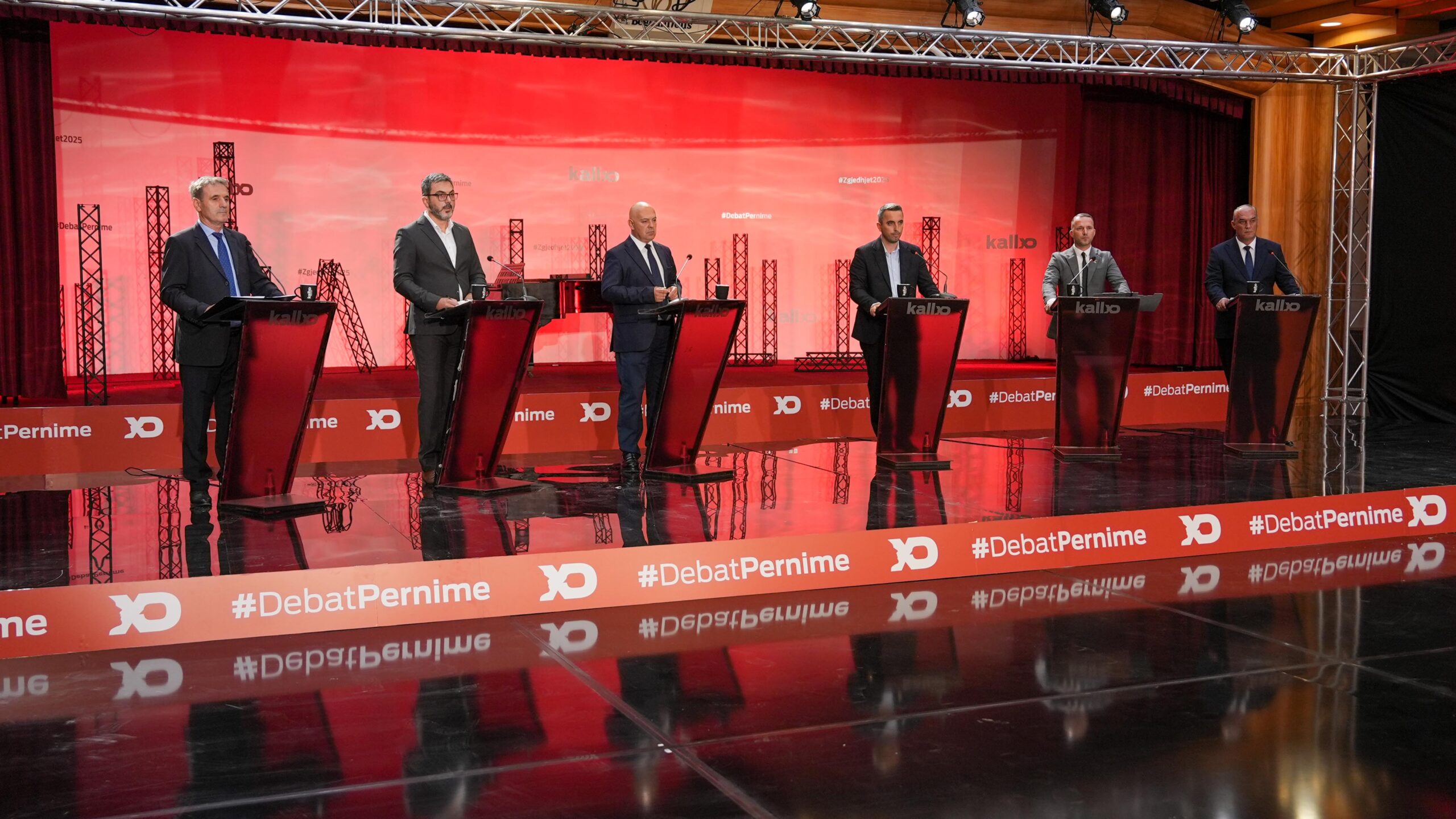
The candidates for mayor of the municipality of Gjakova, on the ‘Debat Përnime’ TV programme, on September 29, 2025.
Ardian Gjini, the Alliance for the Future of Kosovo, AAK, candidate and current mayor of Gjakova municipality, emphasised that the maximum allowed height of a building is seven floors, excluding the ground floor and rooftop during his appearance on ‘Debat Përnime’ on September 29.
“It’s not up to my will—or anyone’s—to permit or deny beyond that,” he said, explaining that “no construction is allowed” in Gjakova’s “old town.”
LDK Candidate Shefqet Shehu emphasised that, “there will be no overbuilding beyond what is outlined in the Zoning Map.”
Mehmeti Krasniqi from the Citizen Initiative ‘Ndryshe’ (Different, in English translation) pledged a re-examination of “the entire urban plan,” and no restriction or construction outside urban areas.
Ervin Shabani, the candidate from the Democratic Party of Kosovo, PDK, committed to ensuring that all future construction complies with legal standards, including provisions for parking and green spaces.
“I will not allow buildings higher than eight floors,” he said.
Vetëvendosje Candidate, Ardian Gola expressed a more flexible approach to building heights, claiming, “I have no issue with the height of collective housing, as long as it’s part of a well-thought-out plan that meets the needs of the community.”
Meanwhile, Demo Christian Albanian Party, PSHDK, candidate, Anton Shala stated that within the city, buildings “higher than 10 floors will not be permitted.”
According to data from the Ministry of Environment, Spatial Planning and Infrastructure, the municipality of Peja has 13,568 illegal constructions.
On September 15, mayoral candidates in this city made promises on Debat Përnime to legalise these buildings.
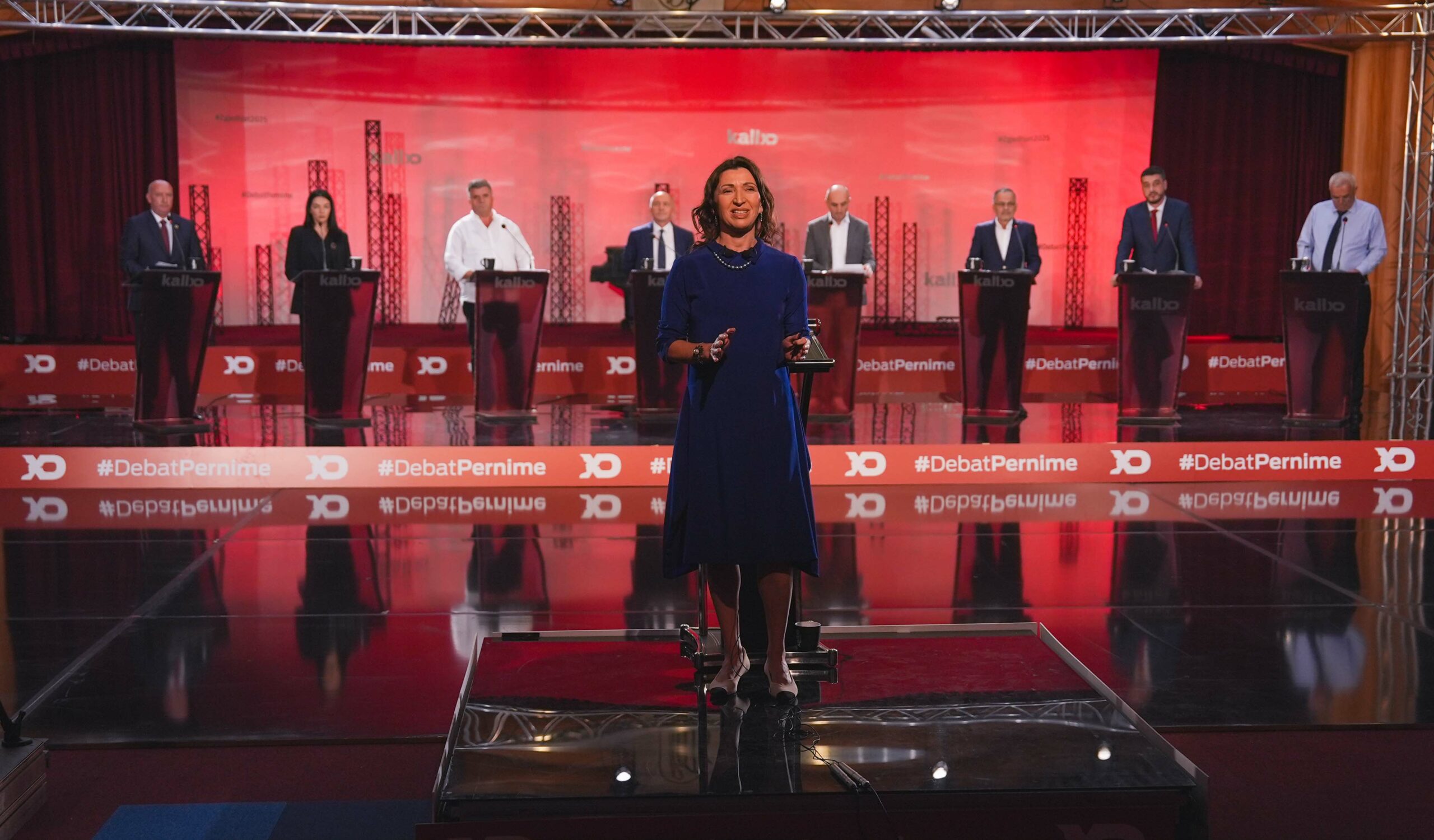
Mayor candidates for Peja, on ‘Debat Përnime’ TV Programme, on September 17, 2025. Photo: BIRN
Vehbi Avdullahaj, candidate from the Social Democratic party, PSD, said that, “the ones that have already been built need to be legalised, because at this point there’s nothing else you can really say or do [considering how] people have already invested in them.”
LDK’s Gazmend Muhaxheri, who has been mayor for the past twelve years and is running for another term, said that, “the construction in the city centre has decreased; it has shifted to the outskirts.”
Jeton Abazaj, an independent candidate, criticised the current Zoning Map of the municipality, claiming it was not professionally developed, and calling for clear zoning for high-rise construction.
Gani Veselaj, another independent candidate, also claimed that, “you can’t just demolish all [illegal construction]. You’d have to compensate the people.”
Arta Nallbani, the PDK candidate, emphasised that he will preserve “the traditional part of the city” by not allowing buildings higher than four floors in the old town.
Ali Berisha, AAK candidate, noted that in some areas buildings of up to 12 floors could be allowed, provided it is done with caution.
Reshat Nurboja from Alternativa took a strong stance against high-rise buildings in the city centre: “High-rise construction will not be permitted in the city centre.”
Infrastructure and regulated planning projects are also part of the campaign for South Mitrovica. According to data from the Ministry of Environment, Spatial Planning, and Infrastructure, the 2015 registry reports 8,134 illegal constructions in South Mitrovica.
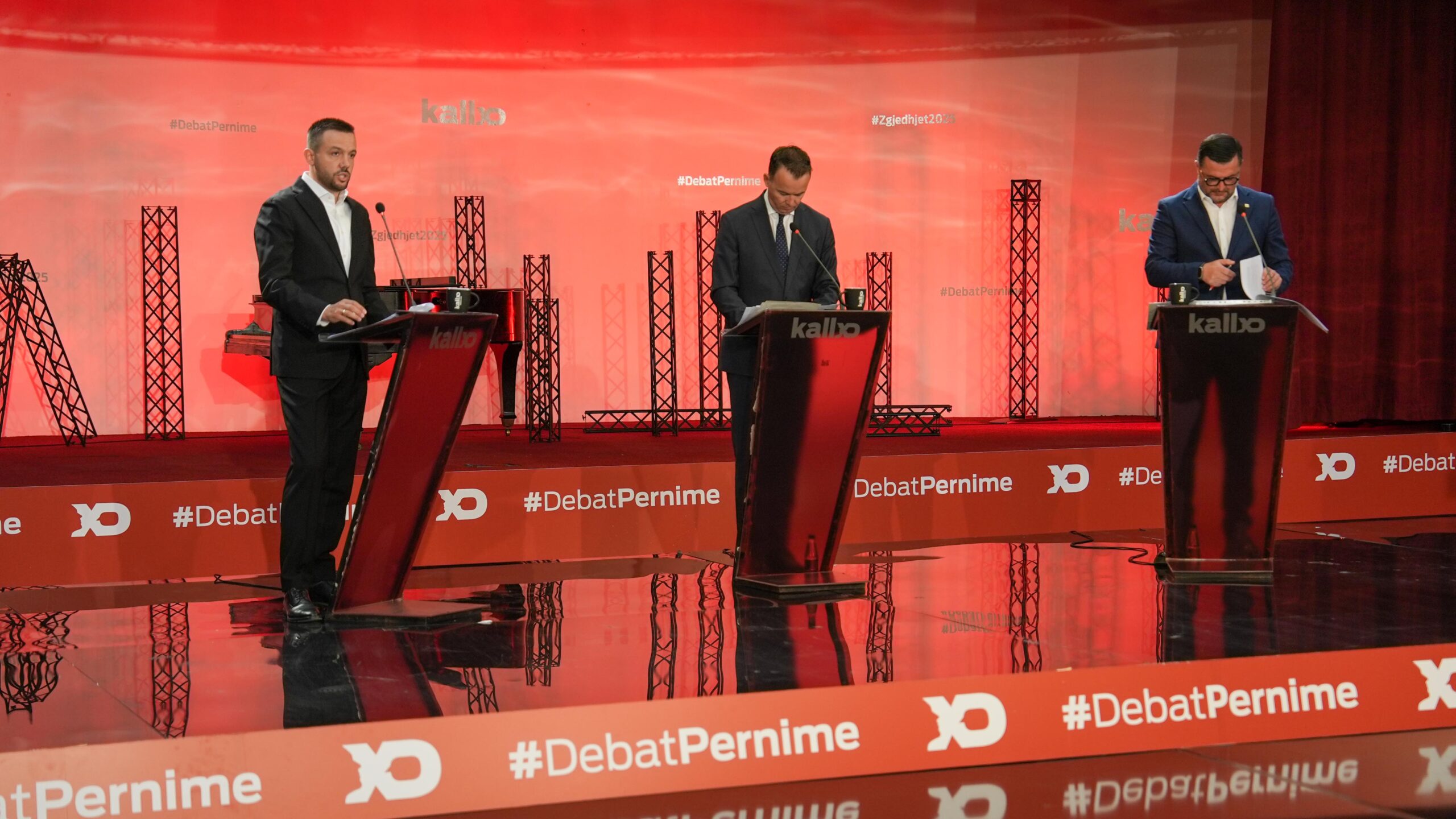
The candidates for mayor of the municipality of Mitrovica, on the ‘Debat Përnime’ TV programme on September 15, 2025.
Faton Peci, theVetëvendosje, LVV, candidate, promised that, if elected, his administration would address between 4,000 and 6,000 legalisation requests during the next mandate:
“I’m not saying all will be legalised, but out of the 8,000, our minimum ambition is to address 4,000.”
He also claimed that, “urban planning in the South Mitrovica has degenerated a lot in the last four years, due to deliberate negligence in the approval of zoning maps.”
Gëzim Plakolli, the LDK candidate, also pledged to manage illegal construction cases by hiring more officials to deal with these issues: “We will triple the number of staff working on these matters.”
Arian Tahiri, the PDK candidate committed to legalising 70% of submitted requests for unauthorized buildings: “We will work with maximum dedication to advance the legalisation process.”
The map was updated on October 12, 2025, to include more municipalities.