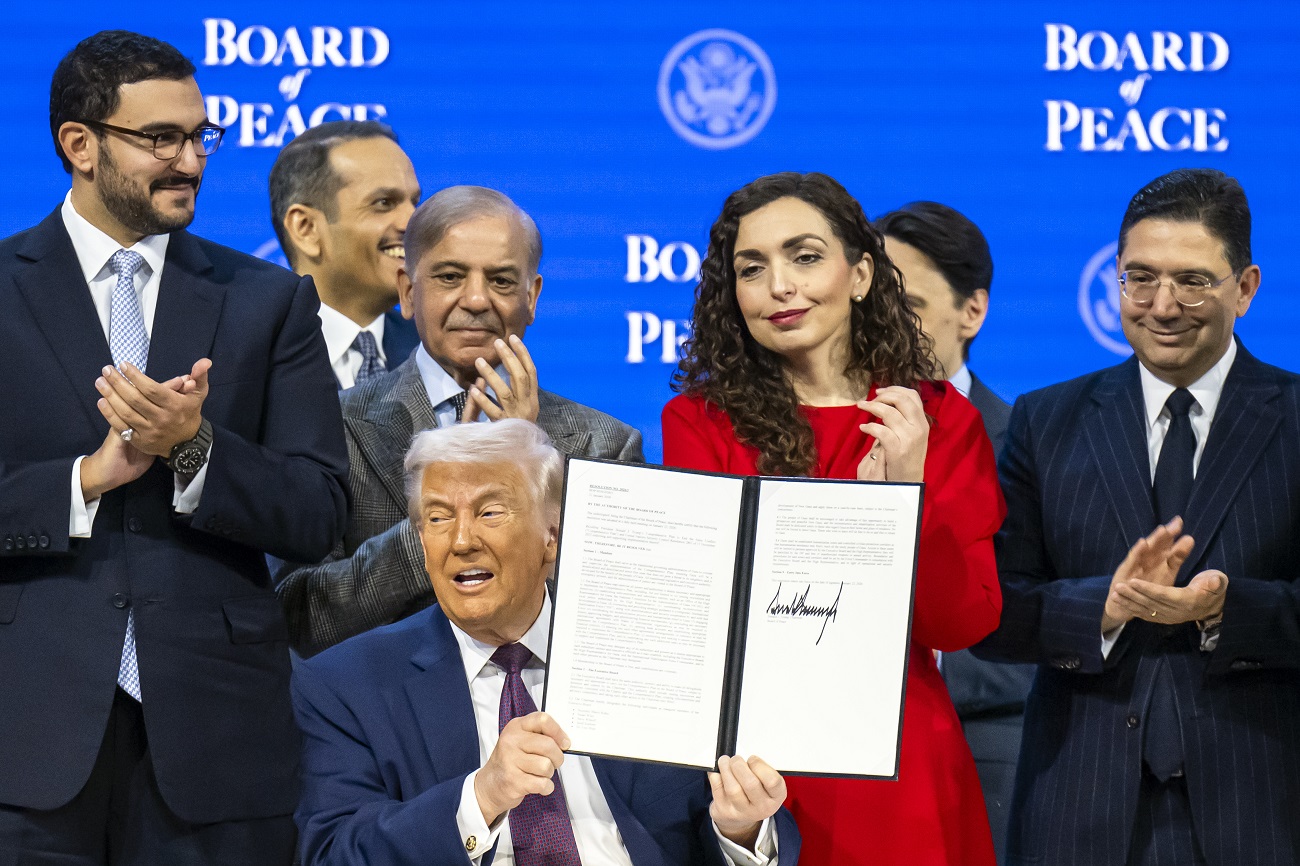
 US President Donald Trump (C) holds a signed founding charter at the 'Board of Peace' meeting during the 56th annual meeting of the World Economic Forum (WEF), in Davos, Switzerland, 22 January 2026. Photo: EPA/Gian Ehrenzeller
Kosovo, Bulgaria and Turkey have signed the Board of Peace Charter, under Donald Trump’s auspices, but several other Balkan countries are still pondering whether to join the initiative.
Kosovo Bulgaria and Turkey, along with representatives of other countries, joined US President Donald Trump on Wednesday in Davos, Switzerland, at the signing ceremony of the Board of Peace Charter, creating a new international body supposedly aimed at resolving conflicts around the world.
Trump, who was presented as the chairman of the Board of Peace, told the audience that “everybody wants to be a part of it and we will work with many others, including the United Nations”.
Trump originally proposed the creation of the Board as part of his plan to end the war in Gaza last September, but has since expanded the initiative to cover various other conflicts around the globe.
However, Trump admitted at the ceremony that resolving the Russian war in Ukraine, which he thought was going to be “an easy one”, has “turned out to be probably the most difficult”.
A draft charter sent by the US to some 60 countries requires members to pay $1 billion each to extend their membership beyond three years, according to a document seen by Reuters.
Vjosa Osmani, President of Kosovo, a staunch US ally, was all smiles when she was called to sign the charter and moments after the signature, she took to Facebook to post a photo of herself with Trump under the statement: “Because the alliance with America is the only way”.
Turkish Foreign Minister Hakan Fidan, who also signed the Board of Peace charter, said that Ankara values the efforts being made for peace in Palestine and Gaza.
“The board may have its shortcomings, but having it is a valuable development for us. We also value that the invitation was also extended to countries we worked with closely, including Uzbekistan, Kazakhstan and Azerbaijan,” Fidan said.
The White House earlier announced that Fidan was also a member of a separate “Gaza Executive Board”, along with US Secretary of State Marco Rubio, Trump’s special envoy, Steve Witkoff, former British prime minister Tony Blair and Trump’s son-in-law, Jared Kushner.
Bulgaria outgoing Prime Minister, Rosen Zhelyazkov, was also at the event. Zhelyazkov, whose government was brought down in December by protests, has not commented on his presence.
Trump’s original invitation was sent to President Rumen Radev, also outgoing from office. On Tuesday, the presidency in Sofia said that Radev had declined to attend the Davos event because of the turbulent political situation, but added that he expected that Bulgaria will soon have “the necessary stable institutional environment to continue its fruitful cooperation with the United States in the interests of joint efforts to preserve peace and security”.
The charter was also signed by Hungarian Prime Minister Viktor Orban.
Meanwhile Romania’s President, Nicusor Dan, welcomed the US initiative and announced that Bucharest has launched “a process to analyse the content and implications”. As “a foreign policy and security matter”, the decision must be taken by the Supreme National Defence Council, the body coordinating national security, Dan said.
Albania’s parliament on Wednesday was debating the invitation to Prime Minister Edi Rama to join the board, although a decision has not yet been made.
Of the other Balkan countries, Croatia and Slovenia have confirmed publicly they were invited by Trump, but have not announced their responses. Other former Yugoslav countries’ leaders have not mentioned if they have been asked to join.


22 January 2026 - 15:20
Kosovo’s caretaker Prime Minister, Albin Kurti, announced on Friday ...
Kosovo has agreed to host up to 50 immigrants deported from the US –...
The high-level dialogue between Kosovo and Serbia has been low on the ...

US envoy Richard Grenell denounced the imprisonment and Hague trial of...
The temporary suspension of US foreign aid has brought the “post-dev...