


In an attempt to strengthen information integrity and counter the growing threat of disinformation, three media organisations in Kosovo have joined forces to launch MIDwatch.
On Wednesday, three media organisations in Kosovo—BIRN Kosova, Internews Kosova, and the Association of Journalists of Kosovo, AJK—launched a joint initiative aimed at strengthening media integrity and countering disinformation.
The “Media Integrity and Disinformation Tracking” (MIDwatch) project, supported by the British Embassy in Prishtina, was officially launched at the Reporting House, a venue for journalists and media professionals. The initiative will focus on research, policy recommendations, and capacity-building for journalists and institutions to combat the spread of false information.
Jeta Xharra, director of BIRN Kosovo, said that the Western Balkans continues to face severe challenges from disinformation networks.
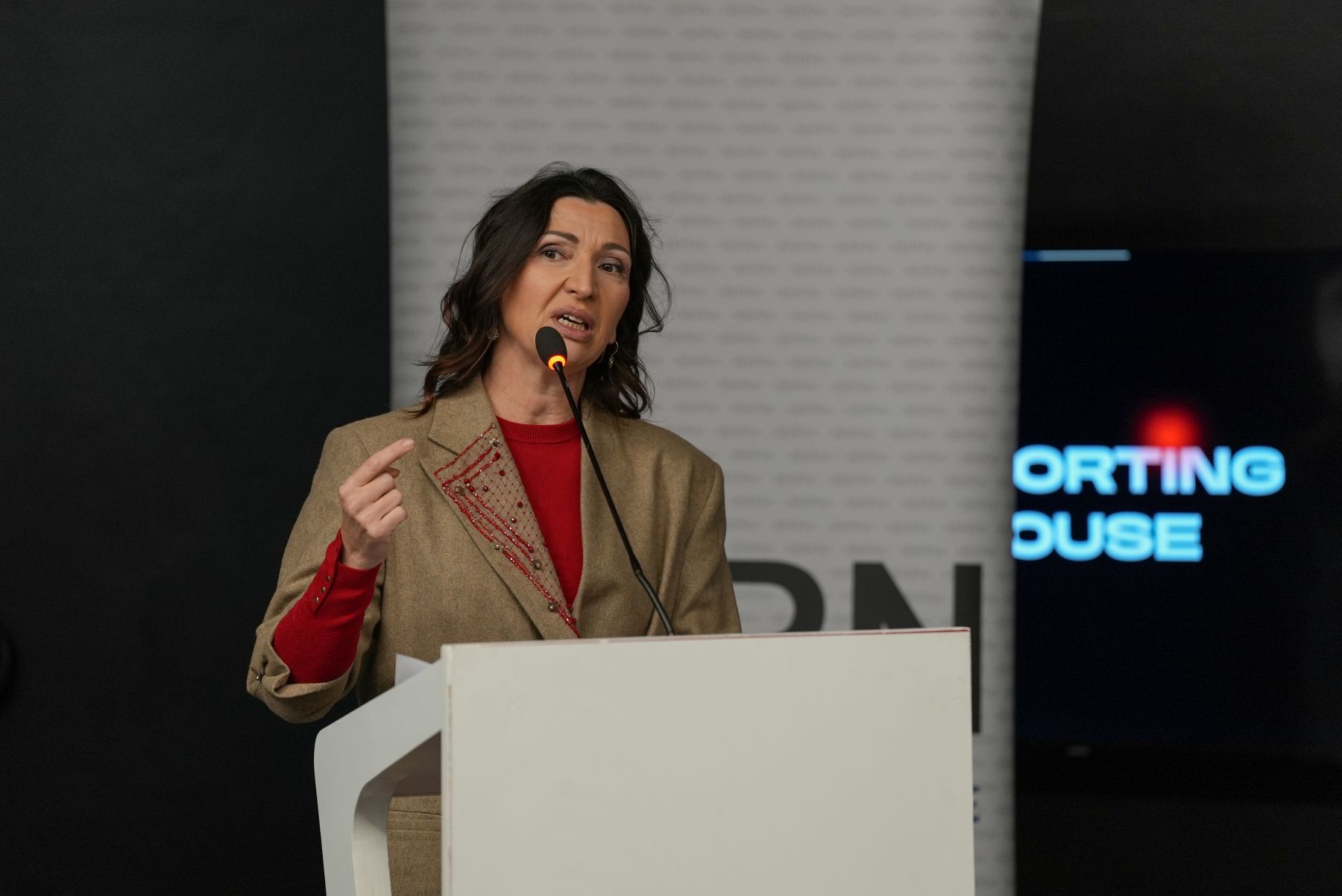
BIRN Kosovo director Jeta Xharra at launch of the project “Media Integrity and Disinformation Tracking” (MIDwatch) on October 8, 2025. Photo: BIRN
“Our region is still flooded with false narratives—hundreds of channels keep producing disinformation daily. This trend endangers not just Kosovo’s security, but also the broader stability of the Western Balkans and beyond,” Xharra stated.
She noted that democratic processes are particularly vulnerable during election campaigns. “It’s undeniable that our democracies are most at risk during elections, when disinformation spikes,” she added.
According to Xharra, the project will offer grants and fellowships for investigative journalists to expose disinformation sources. “Fact-checkers are often targeted by smear campaigns, and with this initiative we aim to empower those who stand for truth,” she said.
She also emphasised the importance of institutional involvement: “Fighting disinformation cannot rely on journalists alone. We plan to train public officials and build capacities that promote credible information and create alliances against falsehoods.”

UK Ambassador to Kosovo Jonathan Hargreaves at the launch of the project “Media Integrity and Disinformation Tracking” (MIDwatch) on October 8, 2025. Photo: BIRN
British Ambassador to Kosovo Jonathan Hargreaves praised the initiative, calling it a vital step in protecting democracy and public trust.
“Disinformation isn’t just an individual problem—it’s a strategy to divide societies and erode trust within and between them,” Hargreaves said.
He admitted that even diplomats aren’t immune to misleading content: “I’ve sometimes shared articles without checking the source, or reacted emotionally to viral posts that later turned out to be false.”
Hargreaves described Kosovo’s democracy as “an astonishing testament” to its citizens’ determination to build a free society. “But it’s not immune to global disinformation trends. That’s why it’s crucial to fight back with facts,” he said.
He added that this project is about empowering voices and elevating truth.
“This project is gonna require huge courage, massive expertise and a lot of support. I know you have the first two in abundance and my job is to make sure you have the third,” he concluded.
AI tools used to fuel disinformation

Discussion Panel at the launch of the project “Media Integrity and Disinformation Tracking” (MIDwatch) on October 8, 2025. Photo: BIRN
In a discussion panel at the Reporting House, Naile Dema, deputy chair of the Association of Journalists of Kosovo, highlighted how artificial intelligence tools have accelerated the spread of manipulated content, particularly on social media.
“The rise of AI-generated material, often beyond regulatory oversight, has created fertile ground for fake news,” Dema said.
She warned that citizens struggle to distinguish between verified information and social media content, undermining professional journalism.
“The lack of transparency on many online pages—especially those created right before elections—makes the situation worse. Some political actors contribute to this problem through polarising language.”
According to Dema, media literacy education is essential: “Citizens must develop critical thinking skills about the information they consume, and that education has to start in schools.”
Besnik Berisha, head of the Independent Media Commission, IMC, called disinformation a “multidimensional threat” that demands an urgent, coordinated response.
“This is a national priority. The damage from disinformation can range from harming individuals to undermining national security,” he said.
Berisha stressed the need for stronger media and institutional capacities, as well as a more advanced legal framework to create a responsible media environment.
Visar Prebreza, editor-in-chief of Krypometer, Kallxo.com’s fact-checking platform, said the MIDwatch project was built on prior research and aims to address disinformation across multiple sectors, including security and public health.
“Beyond debunking falsehoods, we’ll conduct in-depth studies to identify key vulnerabilities and channels through which disinformation spreads,” he explained.
To boost awareness, the project will also produce documentaries and a comprehensive study analysing how false information is packaged and distributed.
“Many portals and internet pages in Kosovo simply republish Kremlin statements without context, amplifying their narratives,” Prebreza said. “Transparency about media ownership and funding is vital.”
He noted that most disinformation sites targeting Kosovo are based abroad—in Vietnam, Ukraine, and North Macedonia—and that such content often targets vulnerable groups, especially women in politics.
Disinformation shapes attitudes and decisions

Kreshnik Gashi, editor in chief at Kallxo.com at the launch of the project “Media Integrity and Disinformation Tracking” (MIDwatch) on October 8, 2025. Photo: BIRN
Investigative journalist and editor in chief at Kallxo.com, Kreshnik Gashi described disinformation as an ideology aimed at influencing political decision-making and weakening social values.
“The Balkans are under continuous attack from sources that seek to create neutral citizens- people without positions or values,” Gashi said.
As evidence of the influence of disinformation, he mentioned the sharp decline in the number of discussions about EU and NATO integration compared to the early 2000s.
“During the last elections, we tested 50 parliamentary candidates with false information and 20 percent said they would base their decisions on it,” he added.
“Decision-makers themselves often fail to recognise disinformation or assess information integrity,” he added, noting that disinformation has also driven consumer behavior, such as the surge in vitamin imports in recent years which is fueled by false health claims.
“Kosovo has become a kind of dartboard—everyone is aiming at it—and our defenses are weak,” Gashi said.
He called for a comprehensive social response: “Addressing disinformation must start in schools, in the media, and in every community. We are even creative enough to manipulate social media mechanisms—sharing false content in closed groups or encrypted apps.”
He further emphasised that, “the real challenge in the Balkans lies in interethnic tensions and the narratives that perpetuate conflict. Journalism must handle these issues professionally,” he said, adding that some reporters write about neighbouring countries without ever visiting them.
“We have journalists from Kosovo that write about Serbia but have never been to Belgrade, the same goes for journalists from Serbia that write about Kosovo,” he concluded.