


Several Kosovo citizens have ended up in Albanian prisons for illegal firearms trafficking, while the loss and theft of firearms, combined with cross-border trafficking, have positioned Kosovo as a key transit hub for weapons flowing into Albanian criminal networks.
Hundreds of both legally imported and stolen firearms are vanishing from Kosovo’s gun shops and shooting ranges and crossing the border into Albania, feeding a high-demand black market run by organised crime.
An investigation aired on Kallxo.com on September 27 revealed how legal loopholes, lucrative price differences, and a lack of border controls have allowed legally imported firearms to disappear from Kosovo’s market and, in some cases, end up on the black market and in the hands of organised crime groups in Albania.
According to Albanian police data obtained by Kallxo.com, 10 Kosovo citizens were arrested in Albania for firearms trafficking during 2025 and the first part of 2026. Another Kosovo citizen was declared wanted.
According to the Albanian State Police, the weapons seized during these operations were mainly pistols predominantly manufactured in Turkey and Italy.
Several of the cases are being investigated by Albanian prosecutors, including the Tirana Prosecutor’s Office. Albania’s Special Prosecution Office against Corruption and Organised Crime, SPAK, is also investigating cases in which firearms trafficking from Kosovo is allegedly connected to organised criminal groups.
Kallxo.com’s investigation found that these cases coincide with a separate and troubling pattern in Kosovo: Hundreds of firearms legally imported into the country have been stolen or have disappeared from licensed businesses and owners.
Nearly 900 guns missing in two cases
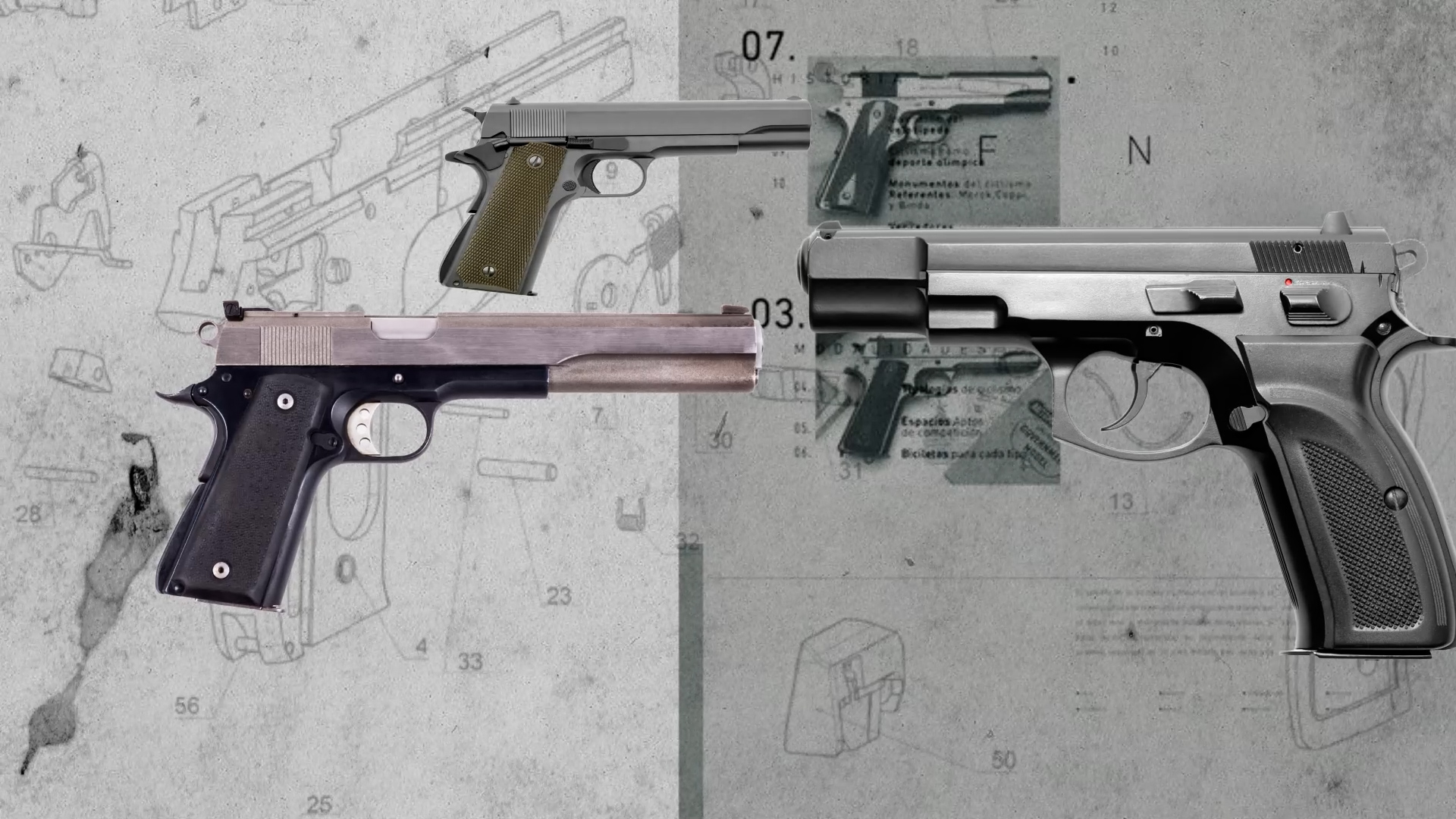
Illustration: BIRN/Besnik Krivanjeva
Official figures from the Kosovo Police show that 74 firearms were reported stolen in 2024, 518 in 2025, and 66 in 2026. Most of the reported weapons were pistols.
Two cases currently being investigated by prosecutors in Prishtina and Gjilan stand out as they involved the disappearance of around 900 firearms, again mainly pistols.
In the first case, investigators are examining the disappearance of around 800 firearms from a gun shop in the Fushë Kosova area, with one of the shop’s owners suspected of involvement.
According to the investigation file, the weapons had been legally imported into Kosovo. However, the business had no records showing that the firearms had been sold and when authorities inspected the shop’s storage facilities, they found that the weapons were missing.
In Gjilan, prosecutors arrested the owner of another gun shop over the alleged disappearance of 53 firearms. These weapons had also been legally imported.
Albanian authorities have confirmed that some firearms seized from suspected traffickers in Albania had previously been reported stolen in Kosovo.
Fitim Krasniqi, the owner of a gun shup and shooting range in Gjakova, recalled the robbery in which around 100 firearms were stolen.
“Two years ago, the shop was broken into and around 100 weapons were stolen,” Krasniqi said.
The thieves had cut electricity to the surrounding area before breaking into the premises.
“They broke the emergency door. They cut the electricity at the transformer for the whole area,” he said.
The weapons were then thrown from the second floor and removed from the building.
“They were taken in five or six minutes. Most of them were pistols,” Krasniqi said.
According to him, the stolen firearms were worth more than 130,000 euros. “There were seen leaving with a car in the direction of Prizren.”
Why Albania?
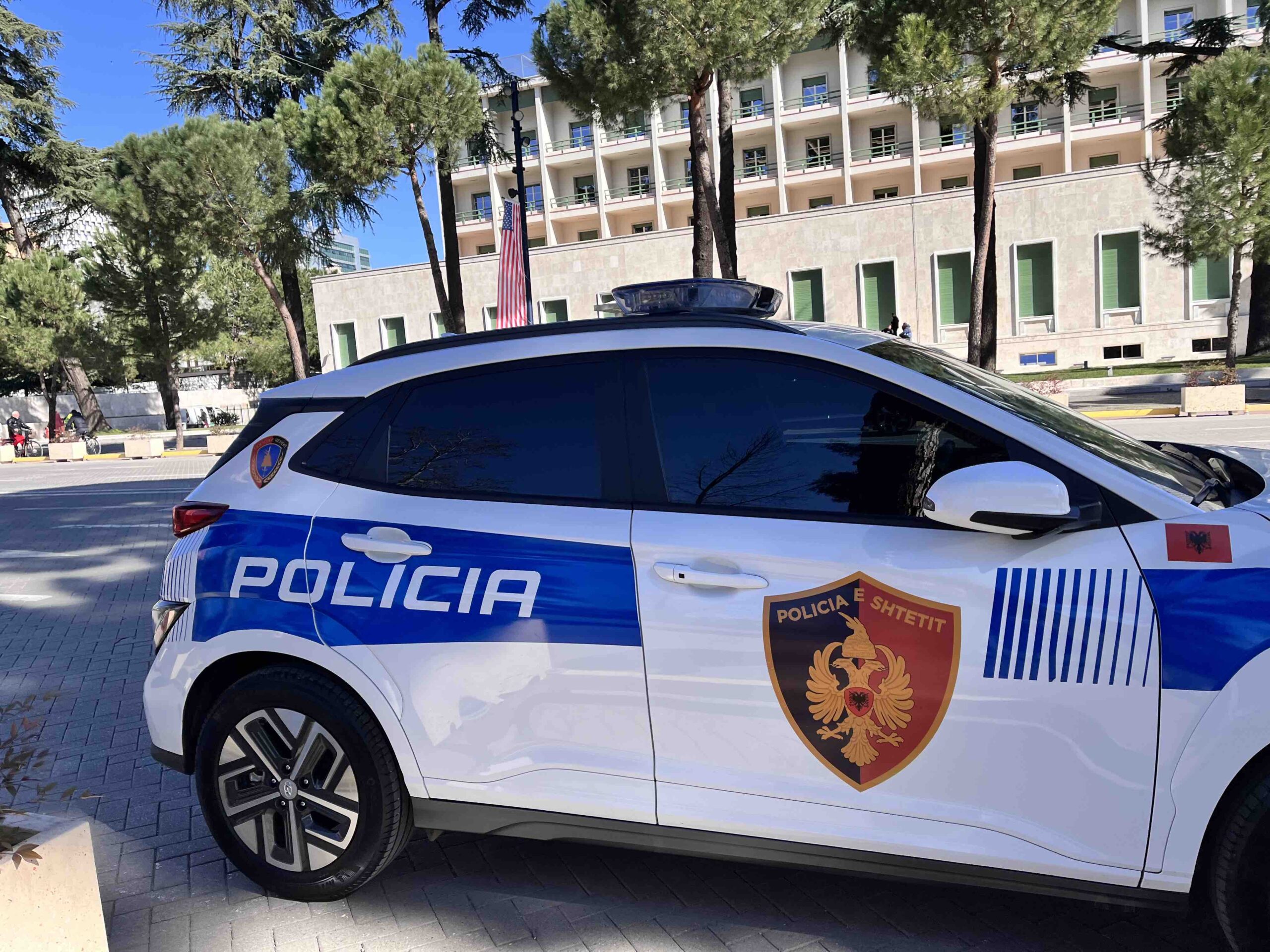
Albania’s State Police. Photo: Albanian State Police Facebook account.
According to security experts, one factor is constant demand.
Organised criminal groups in Albania and elsewhere in the region require firearms for protection, intimidation and criminal operations.
Redion Qirjazi, a security expert, says the increased circulation of illegal firearms in the Western Balkans is associated with the consolidation of organised criminal networks.
“This growth is evidenced by the rise in illicit firearm trafficking across the Western Balkans, where an estimated 6 million illegal weapons are currently in circulation”, he said.
He added that as these organised crime groups become more consolidated, their demand for arms increases.
“A new trend has also emerged, of weapons now being used as a form of currency or liquidity, traded directly for other goods.”
“Organised crime operates through threats, and this is best achieved by possessing firearms,” Qirjazi said.
He said pistols were particularly attractive because they are easy to conceal and transport.
But, price may also be a factor.
According to him, the fact that Kosovo citizens have been caught in this activity tells that criminal groups in Kosovo have greater access to their suppliers-who operate primarily out of Turkey, with transit routes passing through Greece, North Macedonia, and Kosovo.
“This highlights the close ties between these groups and those in Albania, but economic factors are also at play, as weapons are more expensive in Albania,” he added.
‘A clear line’ from Kosovo to Albania
Fatjona Mejdini, also a security expert in Albania, described the demand for firearms among criminal groups.
“Given their extensive reach, weapons go hand in hand with their criminal activities. They need arms for self-defense, for intimidating rivals, and for enhancing their reputation as criminal organisations,” she stated.
Mejdini said the evidence points to a cross-border trafficking route.
“We see a clear line of firearms trafficking from Kosovo towards Albania,” she said.
According to her, “This is extremely dangerous, as criminal groups on both sides feel very comfortable with one another and know each other well.”
Mejdini noted that these groups face virtually no barriers for these transfers since the “border is nearly non-existent” making the operation highly efficient.
Another source of weapons is the conversion of gas pistols into functioning firearms.
Mentor Vrajolli of the Kosovo Centre for Security Studies, KCSS, said there are reports of weapons originally sold as gas pistols being converted and then sold on regional markets.
“This needs to be verified. [To check] whether it is happening through legal or illegal channels, and addressed as a problem. It was also noted that thefts of firearms have occurred, where these weapons can end up in the local market, as well as in foreign markets.”
He added that the fact that illegal firearms are coming out of Kosovo means that these weapons can potentially be used for anything.
A difference in punishment
Kosovo Police. Photo: BIRN/Denis Sllovinja
Civil society organisations monitoring Kosovo’s courts have constantly raised concerns about what they describe as lenient punishment for illegal possession of firearms.
In Albania, penalties for unauthorised possession and trafficking are considerably more severe.
Redion Qirjazi noted that this is closely linked to the evolution of criminal networks in Albania.
“Albania has historically maintained much stricter controls regarding gun ownership rights and commercial firearm imports. Only recently have civil shooting ranges begun to open, whereas neighboring countries have long had these establishments.”
As he stated, Kosovo was ahead of Albania in this regard, which speaks to how acquiring such weaponry domestically in Albania is “considerably more difficult.” He added that, “criminal networks exploit Kosovo’s greater accessibility and ease of supply.”
Similarly, Mejdini mentioned that these criminal groups are now more sophisticated and seek newer, more modern firearms.
“In 1997, army depots in Albania were opened, and the firearms fell into the hands of civilians and into those of criminal groups. To this day, old weapons from Soviet and Chinese-era collections continue to circulate, but they are primarily Kalashnikovs and heavier firearms that are no longer considered effective for criminal operations.”
Penalties for illegal firearm possession in Albania are harsher compared to those in Kosovo.
In Kosovo, being caught with a handgun in a city centre often results in a 500-euro fine. In contrast, Albania imposes heavy prison terms for unauthorised possession: four to five years, with even stiffer penalties for trafficking.
This policy in Kosovo may have contributed to an environment where people feel more shielded from the law.
Halit Shaljani, a former investigator, said Kosovo’s approach reflects the country’s post-war history.
“The Criminal Code took into consideration the fact that there was a war in Kosovo and that people had firearms with them,” Shaljani said.
He explained that depending on the circumstances of the case, this allowed judges to impose fines or prison sentences for illegal possession.
But Shaljani said the disappearance of firearms from licensed businesses “should trigger much stronger oversight”.
“If firearms have been stolen from licensed businesses, rigorous action needs to be taken and maximum oversight applied,” he said.
“Apart from the risk, it is also a stain on the state of Kosovo,” he concluded.