


Arbenita Muhaxheri has spent most of her life wondering what happened to her mother after she was stopped at a Serbian checkpoint in 1999 during the Kosovo war. A deal agreed a year ago to expedite the search for 1,600 people still missing from the war is slowly gathering dust.
Sanije Selmani-Muhaxheri and her cousin are among 1,600 people – most of them Albanians – still unaccounted for more than a quarter of a century since the war in Kosovo ended and the then southern Serbian province, majority-populated by Albanians, became a ward of the United Nations.
A year ago in December 2024, in talks mediated by the European Union, Serbia and Kosovo agreed to implement a deal initially brokered in mid-2023 calling for unrestricted access to information that might shed light on the fate of the war missing, including classified data.
Today, the Joint Declaration on Missing Persons remains unimplemented; an EU-chaired commission, envisaged under the deal to steer implementation, has yet to be created amid a row over its terms of reference.
When the two sides met in Brussels in September, Kosovo’s chief negotiator, Besnik Bislimi, blamed Serbia for the deadlock.
“They want to once again intervene in the document, which was not accepted either by Brussels or by us,” he said.
After the same meeting, Bislimi’s Serbian counterpart, Petar Petkovic, said in a statement: “We have clearly stated that we are absolutely committed to resolving this issue, primarily for the benefit of the families who have been waiting for more than 20 years for the full truth about the suffering of their loved ones.”
Arbenita, however, is losing hope.
“On holidays, birthdays, I wish I could go to her grave and say a prayer for her soul,” she said. “All I want is a grave where I can pray for her.”
‘In safe hands’
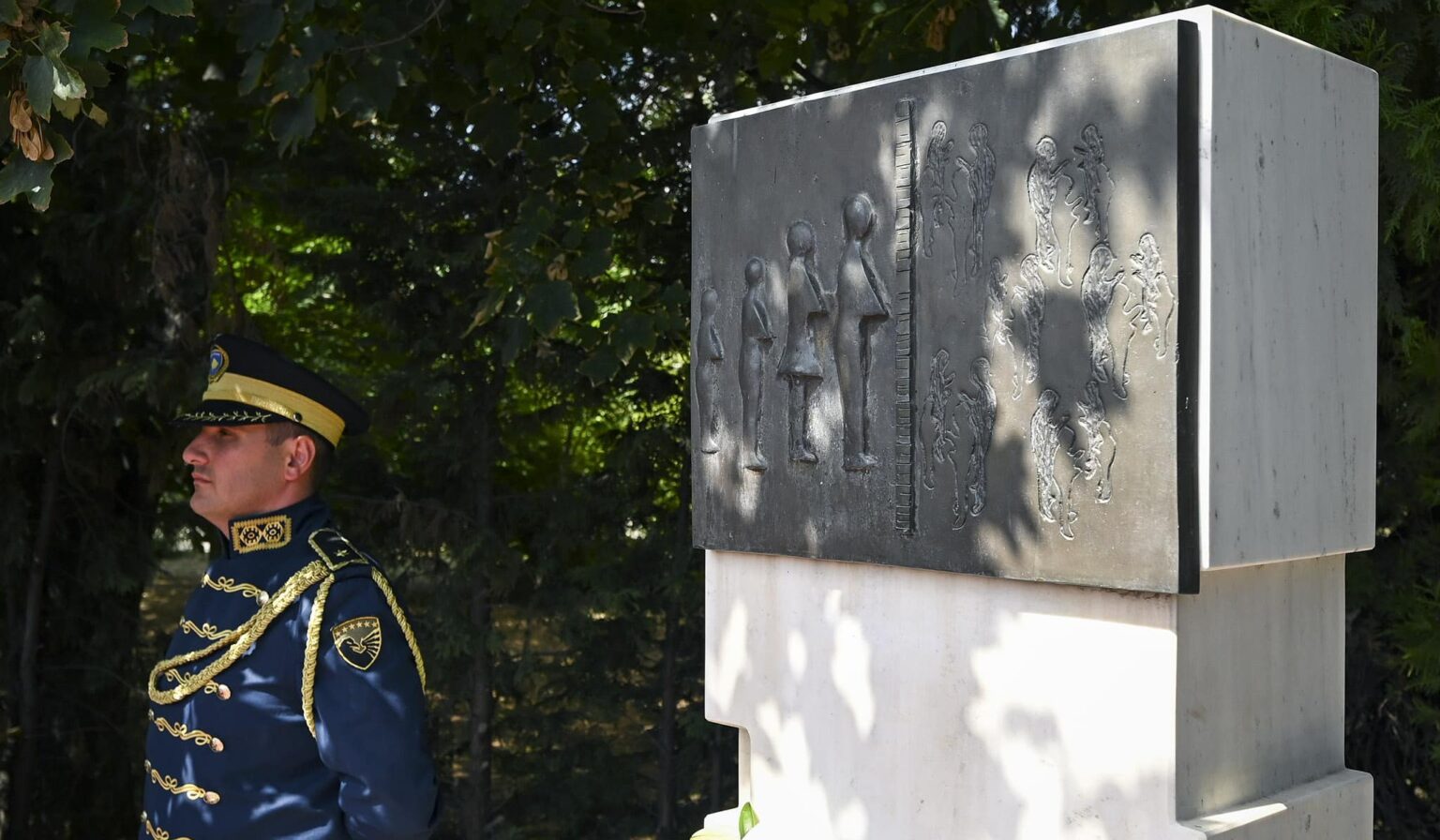
Monument commemorating Kosovo wartime missing persons in Pristina. Photo: Kosovo’s Prime Minister Office
Serbia under Slobodan Milosevic went to great lengths to conceal the crimes committed by its forces in 1998 and 1999, by transporting corpses and dumping them in death pits hundreds of miles outside of Kosovo itself.
Hundreds have been found, many not long after the fall of Milosevic in 2000, but still today some 1,600 remain unaccounted for, their fate an open wound.
The search requires collaboration between Belgrade and Pristina, but collaboration has been in short supply under the respective leaderships of Aleksander Vucic and Albin Kurti.
Sanije Selmani-Muhaxheri was 35 years old when she went missing, leaving behind Arbenita and three sons aged 10, eight, and four at the time.
Arbenita remembers her mother’s “courage and generosity”, and said she had helped to get supplies – food and other basics – to the guerrillas of the Kosovo Liberation Army, KLA, “until the moment she was kidnapped”. Arbenita’s father was a member of the KLA and survived the war.
“She was a woman who didn’t know fear, and her end was tragic,” Arbenita said.
“They were after my father and uncles,” she said of the Serbian police and army.
“We were known in the area. We owned a business in the city that was repeatedly shut down by Serbian inspectors. Our home was often raided. I always expected something to happen to my father or uncles, but it was my mother who paid the price.”
Recalling her mother’s disappearance, Arbenita said that when she and her cousin failed to return, her paternal grandfather went to the Serbian police the next day to ask for information.
“They told him the women were ‘in safe hands’ and that he should bring his son if he wanted his daughter-in-law released,” Arbenita said.
She said the KLA refused to let her father go, believing it to be a trap.
Arbenita said her grandfather died still “haunted” by memories of his trip to the police, who had abandoned their main station for the basement of an abandoned cafe to avoid NATO bombs. He saw people held captive, bleeding and begging for help.
‘They never entered Serbia alive’
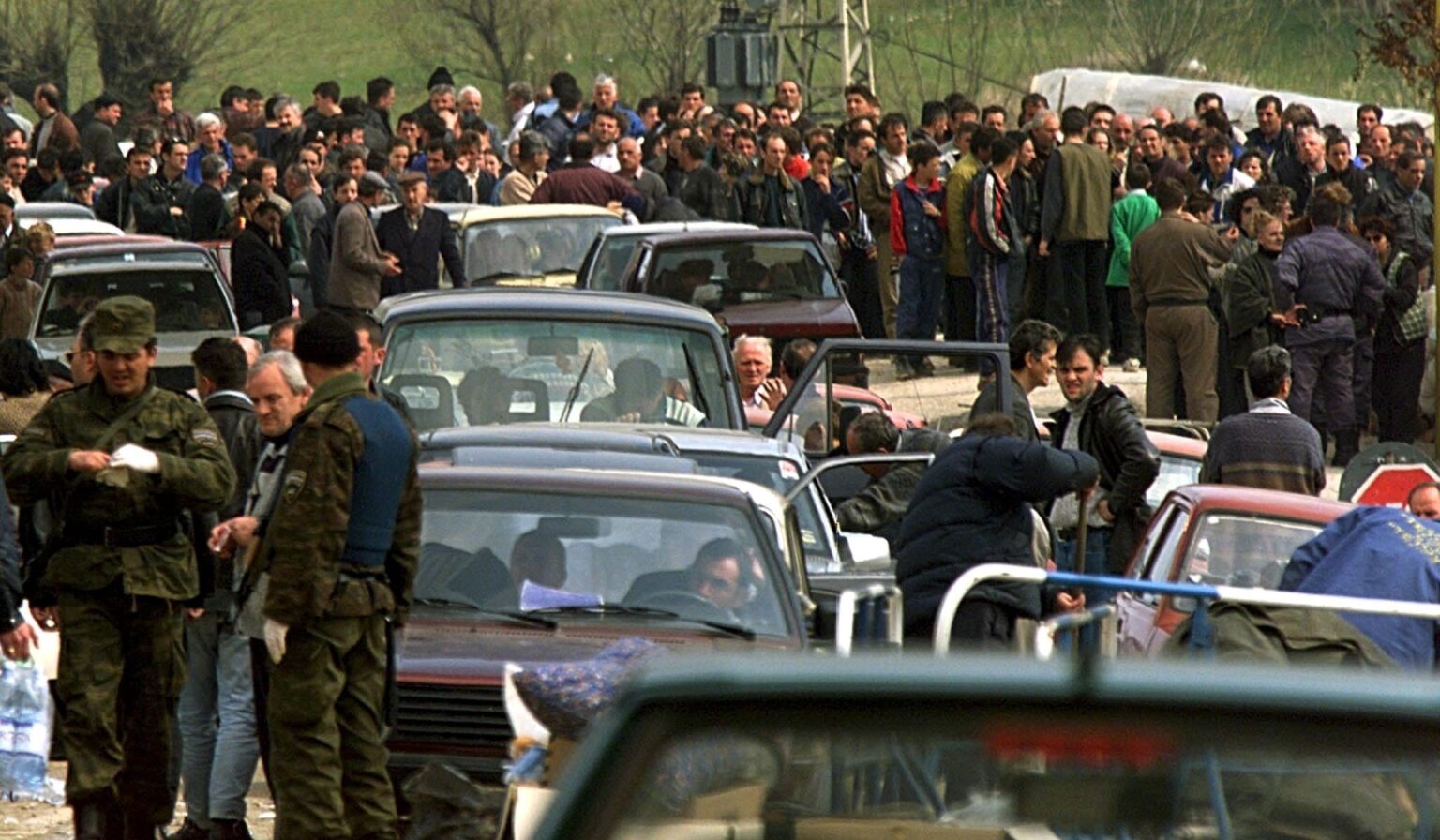
Thousands of ethnic Albanian refugees, most fleeing Kosovo’s capital Prishtina and Ferizaj/Urosevac, stuck at the Yugoslav-Macedonian border during wartime in April 1999. Photo: EPA/LOUISA GOULIAMAKI
When Sanije disappeared, the rest of the family took to the mountains, and eventually joined almost a million other Kosovo Albanians in refugee camps across the border. They spent weeks in neighbouring North Macedonia, until June 1999, when NATO troops rolled into Kosovo on the heels of withdrawing Serbian forces.
Arbenita hoped her mother might be waiting for them. Instead, she found an indescribable “mess”, the family home having been occupied by Serbian police. They did not dare to take water from the well, fearing it might be poisoned.
Thousands of people were missing and rumours circulated that some were being held in Serbian prisoners. The family waited for word.
“Often I even skipped school, thinking ‘maybe she’ll come today’,” said Arbenita.
Their hopes faded when a local man, who she said had worked with the Serbian authorities, told her father: “They never entered Serbia alive; they were executed in Kosovo.”
Arbenita said they were later contacted by a Serbian police officer, whom her grandfather had spoken to the day after Sanije’s disappearance, telling them that the women might be alive. Her father understood he wanted money and was furious, she said. “It was clear we were being exploited and it was all about money,” she said.
Years later, Arbenita tracked down the officer’s phone number, called him and accused him of responsibility for her mother’s disappearance.
“He told me I was as ‘vile’ as my father, and that my mother was young and beautiful and someone had ‘taken her as a wife.’”
Sanije Selmani-Muhaxheri dreamed of becoming a primary school teacher.
Twenty-six years after her disappearance, Arbenita said she still has some of her mother’s clothes, and wore one of her dresses on her own wedding day.
A mother of two, Arbenita said: “I wish she could see my children, their success in school, the person I’ve become.”
Arbenita said the fate of those still missing from the war remains “the deepest wound” for Kosovar society, “and yet it’s not a priority for anyone”.
“I know she isn’t alive,” she said. “I just want her grave, to know where she rests.”