


During the 1998–1999 Kosovo war, hundreds of cultural heritage sites were burned, destroyed, or severely damaged, including Islamic religious buildings, Catholic churches, libraries, museums, and monuments of historical significance to Albanians, experts explained at BIRN’s Reporting House museum.
Hundreds of cultural heritage sites, literature, and residential facilities were destroyed and damaged during the war in Kosovo. The country faced many challenges in documenting this damage, as some of it spans from even before the war and, in many cases, citizens rebuilt and evidence of the damage was lost.
Apart from the aforementioned damage, Serbia took more than 1,200 artifacts from the museums in Kosovo. Only one has returned so far, in 2002.
Experts argue that this ‘campaign’ of Serbia’s against Kosovo Albanians began much earlier, but it peaked during the war in 1998-99.
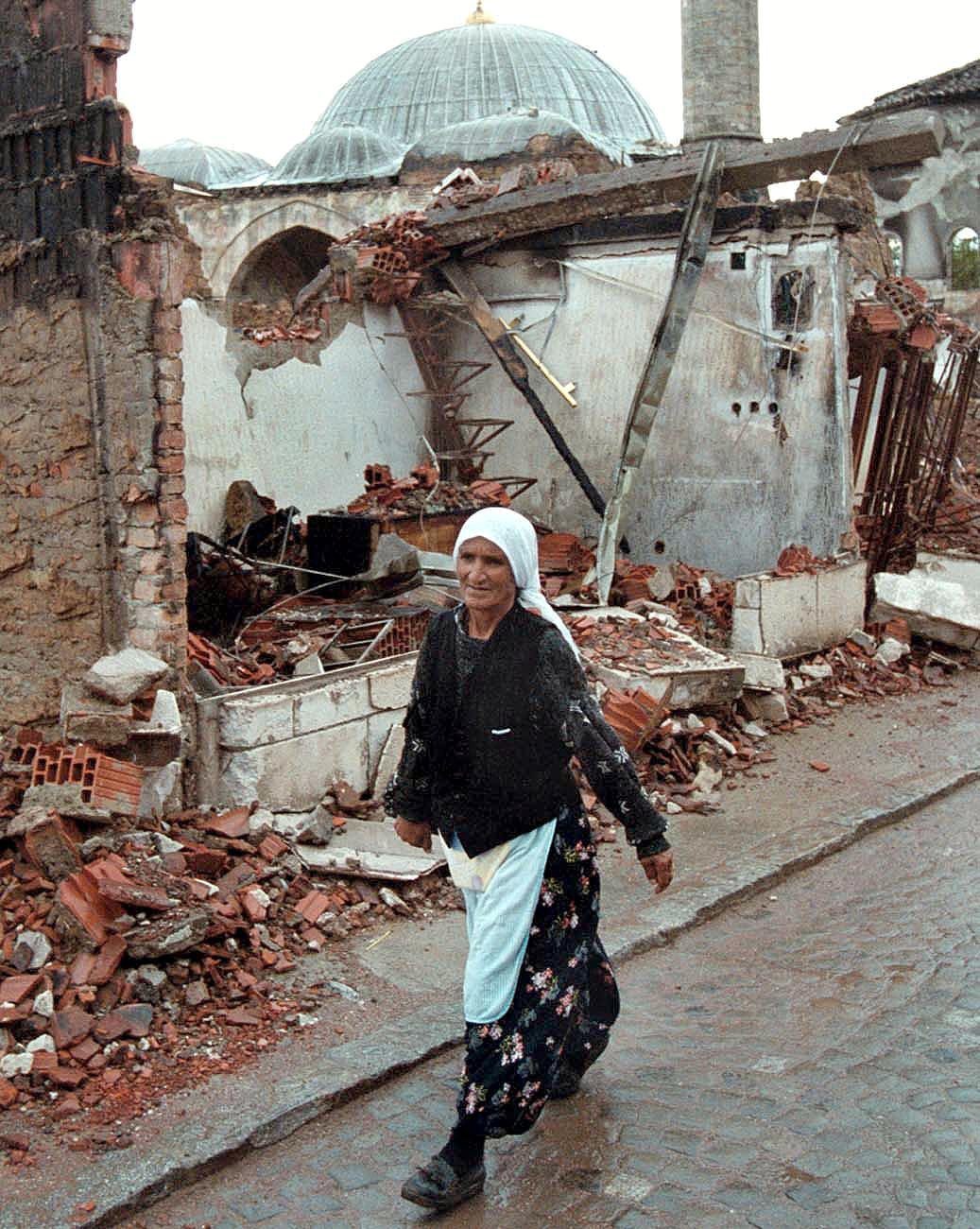
Albanian refugee woman who returned in Kosovo, walks past the destroyed mosque in the town of Gjakova on June 22, 1999. Photo: EPA/FEHIM DEMIR
At a public discussion titled “Destruction of Cultural Heritage in the Kosovo War (1998–1999),” held at Reporting House on Tuesday, historians and researchers highlighted both the scale of the destruction of cultural heritage during the war in Kosovo and the challenges in documenting it.
Durim Abdullahu, Professor of History at the University of Prishtina, said that seventeen Catholic Churches and around 300 mosques and associated buildings belonging to the Muslim community were damaged or destroyed during the war.
He added that approximately 80 libraries were destroyed, with an estimated two million books burned in their collections alone.
“Entire buildings were often burned, including schools and cultural institutions where libraries were located,” Abdullahu said.
Traditional Albanian buildings known as Kulla were also affected, with around 500 destroyed, while, according to Abdullahu, 120,000 residential and other buildings were damaged or razed.
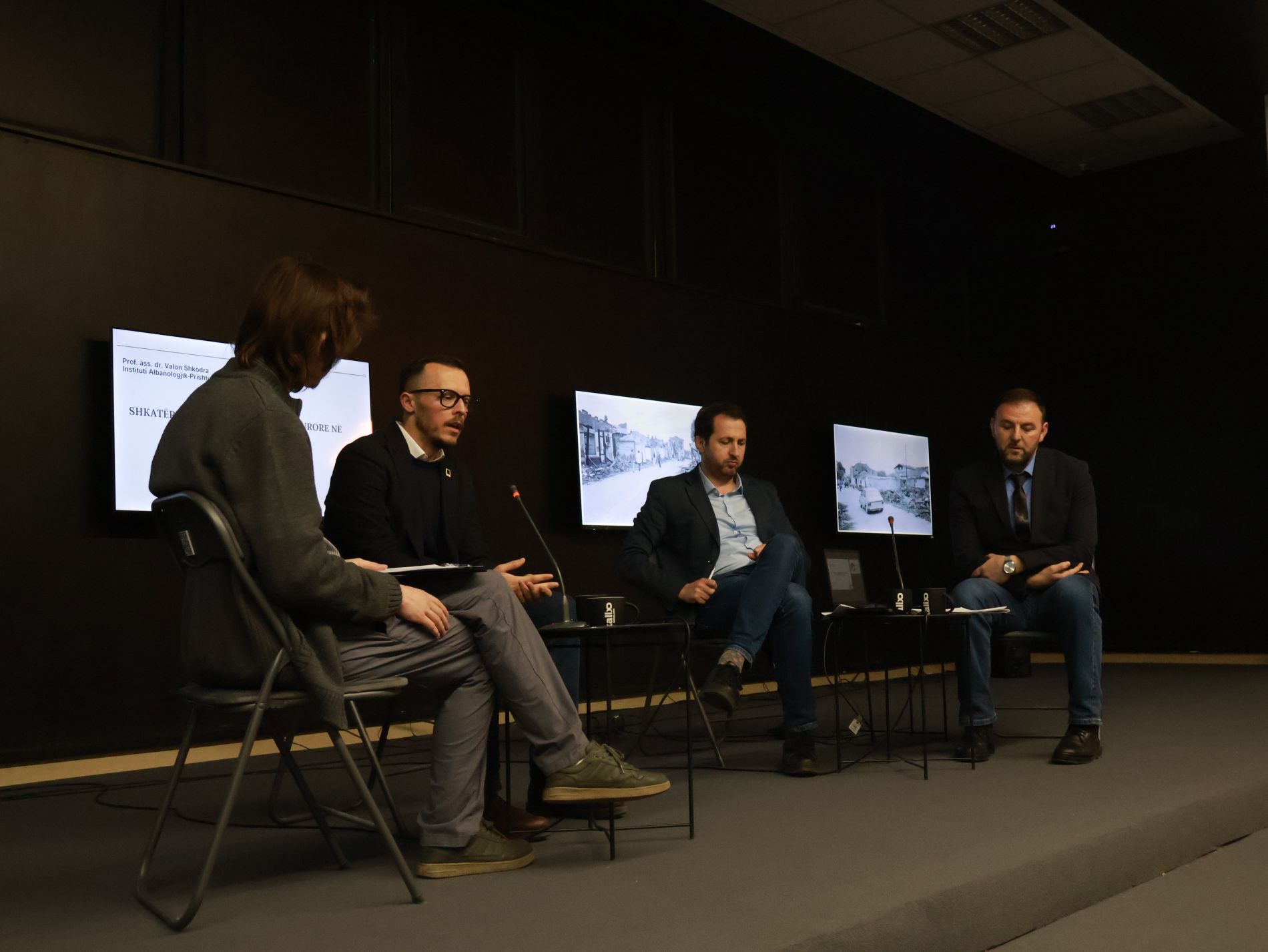
“Destruction of Cultural Heritage in the Kosovo War (1998–1999)”, discussion held on Tuesday at Reporting House museum in Prishtina. Photo: BIRN
“The destruction of homes was part of a broader campaign aimed at the displacement of Kosovo Albanians.” “This was sending a message that there is no place to return to.”
He stressed that the damage extended beyond physical structures, and included the loss of memories and personal belongings like photographs, videos, and documents.
“The burning of homes also meant the loss of personal memory,” Abdullahu said, noting that many families lost irreplaceable items documenting their lives.
He added that the confiscation of identity documents at borders represented the final breaking point.
“The final act was the surrender of identification documents at the border—the loss of the last link connecting a person to their country,” he said.
Systematic cultural destruction
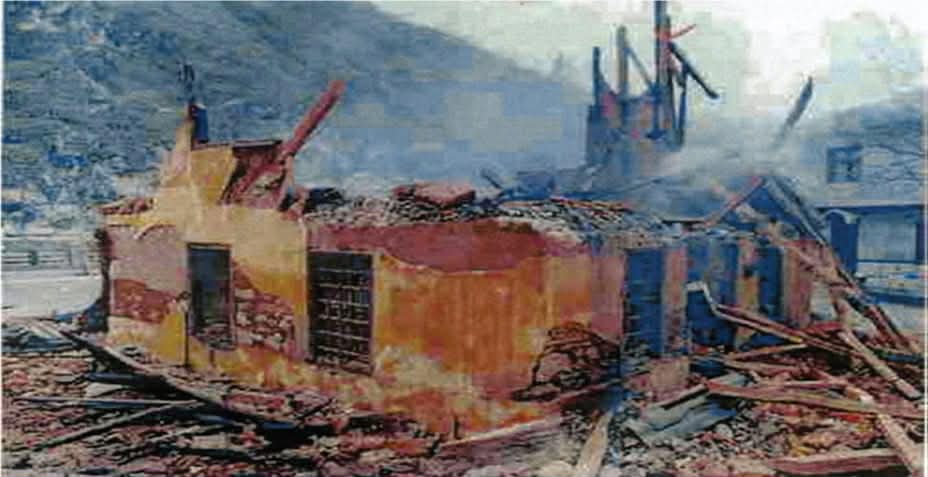
The building of the Albanian League of Prizren, a political organisation founded in 1878 in Prizren, burned and destroyed during the Kosovo war in 1999. Photo courtesy of the Museum of the League of Prizren.
Researchers and historians have argued that the destruction of cultural heritage in Kosovo should be understood as part of a longer process of destroying Albanian identity and culture in Kosovo, which peaked during the war in 1998/99.
Valon Shkodra, ethnologist from the Albanological Institute, said the destruction was organised over a long period of time. “The plan was deliberate, involving Serbia’s Academy of Sciences, the Orthodox Church, and the military, all culminating in 1999,” Shkodra said.
He added that despite international conventions on the protection of cultural heritage, including the Hague Convention, “they were not respected during the war.”
Abdullahu stated that there has also been a passive form of cultural destruction in Kosovo.
“During the Yugoslav period, cultural sites suffered from institutional neglect, mostly those linked to Albanian heritage. In the 1990s, this shifted to systematic destruction,” Abdullahu said.
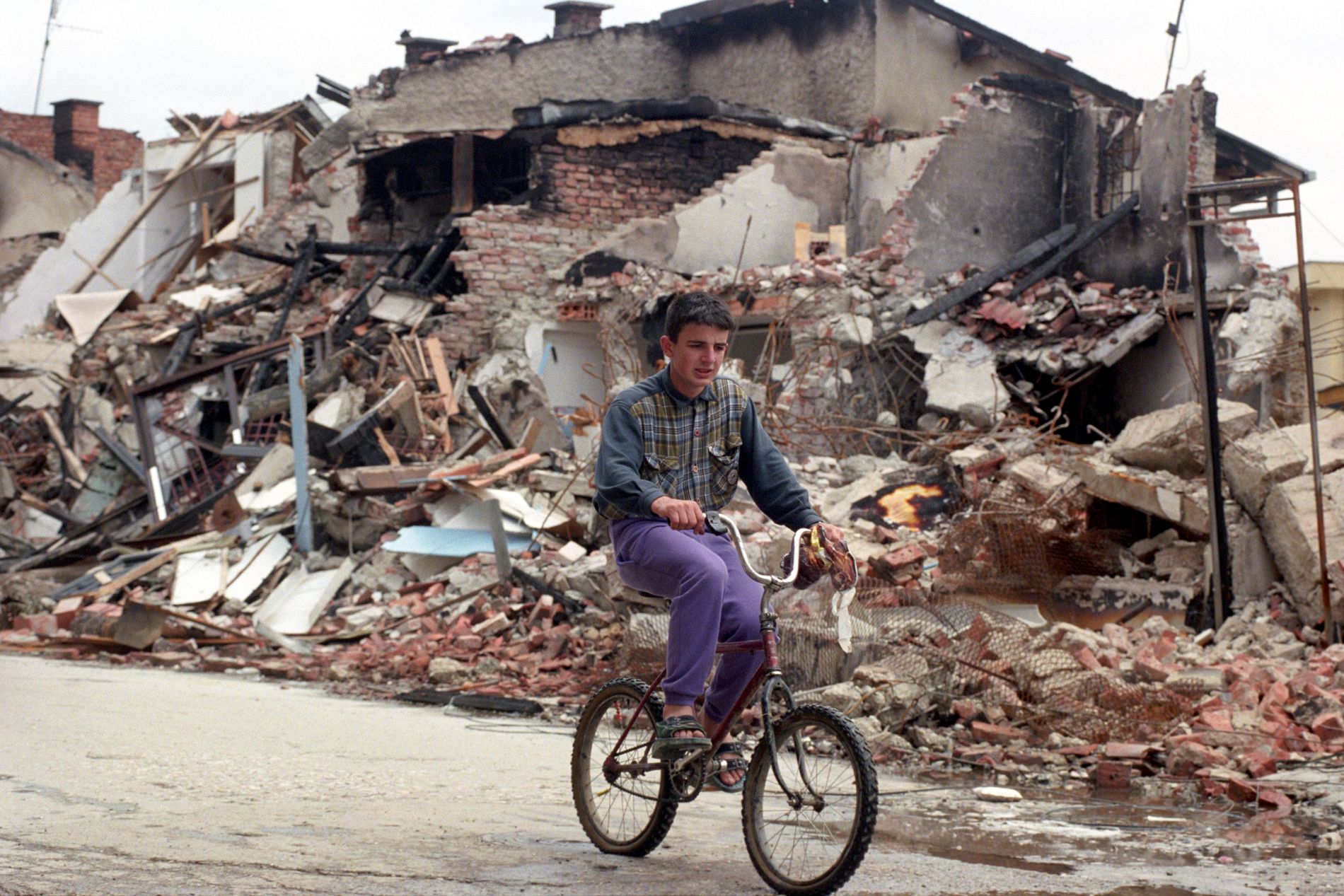
An Albanian boy rides with his bicycle past rubble and ruins in the streets of Peja, Kosovo, on June 25, 1999. Photo: EPA/FEHIM DEMIR
“They even used a euphemism—the term ‘down there’—to refer to an area where different criteria were applied. If you look at museums in Kosovo during the former Yugoslavia, they were very few compared to those in other countries,” he said.
Historian and University Professor Mentor Hasani said that the revocation of Kosovo’s autonomy in 1989 was followed by the closure of key institutions, including the Education in Albanian system, the National Library, the Albanological Institute, and state archives.
“Among the monuments destroyed were those that served as a guide or landmark for Albanian history and culture.”
He also noted that, though the statistics vary, apart from the removal of materials from libraries, valuable archival and research materials were also lost.
“Extraordinary materials were destroyed, including around 100,000 recorded verses of epic songs from Rugova.”
Hasani also pointed to the destruction of economic infrastructure, noting that 27 of 61 grain mills in Kosovo were destroyed.
“This targeted our very existence,” he said, adding that the Serbian regime also focused on education curricula as part of what he described as “cultural genocide.”
Documentation challenges
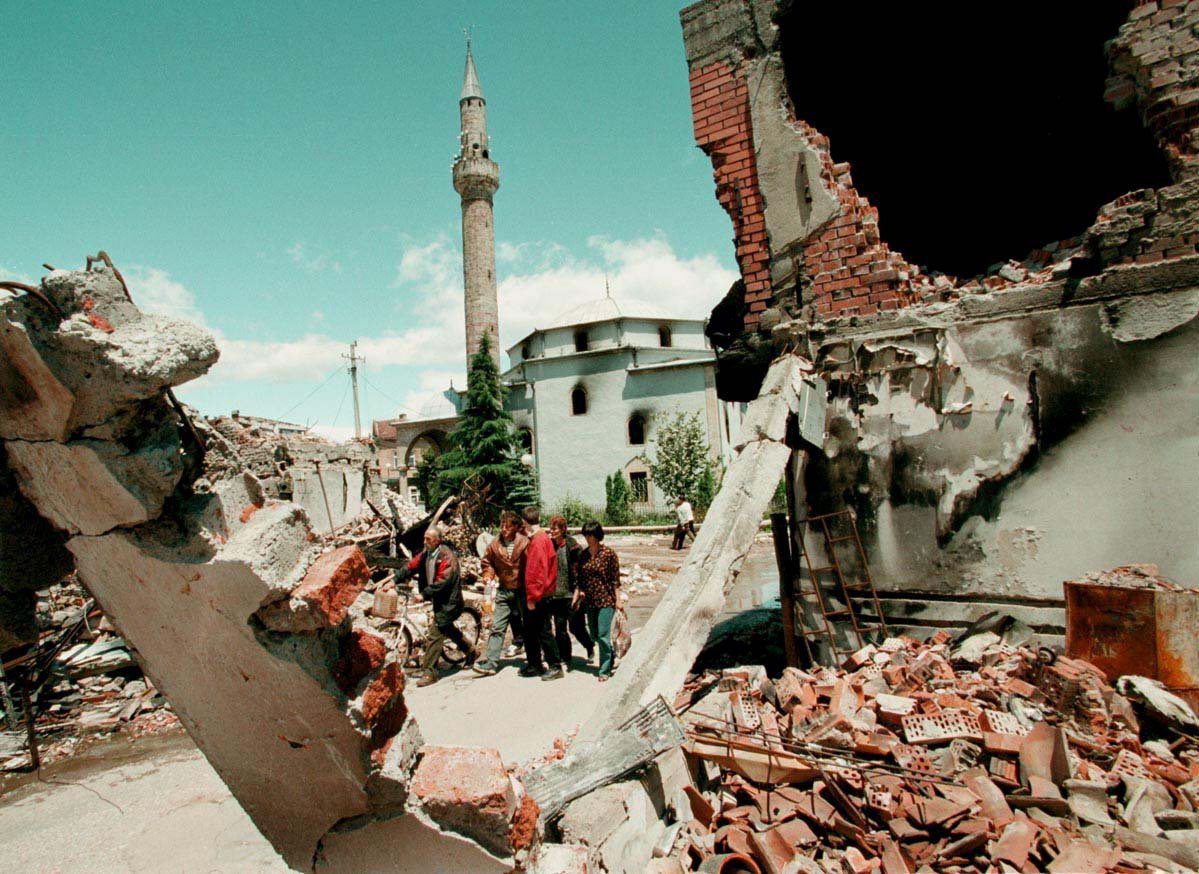
A group of Albanians walk past a mosque amongst the rubble of downtown Peja in south east Kosovo, on June 24, 1999. Photo: EPA/STATON R. WINTER
Shkodra said that one of the challenges for documentation is that citizens have rebuilt their homes, which has erased the traces of the war all around the country.
“Families rebuilt their homes and we lost part of our past,” Shkodra added.
On the other hand, he gave several examples where the memory of crimes committed during the war has been preserved, with some homes turned into museums.
These include the museum at the Jashari family complex in Prekaz, the house at the Poklek massacre site, and the home of Ferdonije Çerkezi in Gjakova, whose husband and four sons were killed. “In these homes/museums, there is first-hand evidence that they suffered through this war,” he said.
The discussion also addressed the looting of cultural artifacts.
1,247 items were taken from Kosovo’s museums during the war, while only one—Hyjnesha ne fron (Goddess on the throne)—was returned in 2002 because of international mediation.
“There are agreements, such as those in the Ahtisaari Plan, that required the return of artifacts with the start of dialogue, but they have still not been returned,” Shkodra said, adding that, “many items taken before the war remain undocumented.”
Experts said the lack of comprehensive documentation remains a major challenge, because there is no centralised database of damaged or destroyed heritage.
“It is practically impossible to have complete documentation,” Abdullahu said, citing wartime conditions and the loss of records.
He mentioned that there are also many books written on the war and the history of Kosovo, but most are not found in Kosovo, not even the national library. “The public has no knowledge of them.”
However, speakers noted that recent years have seen increased efforts to preserve and document cultural heritage, including the establishment of museums and exhibitions dedicated to wartime experiences.
“The importance of preserving this memory is more widely acknowledged in recent years, not just by the government but by the public overall. You can see it widely on social media as well,” Shkodra said.
Participants emphasised that Kosovo still faces challenges in promoting its wartime history internationally.
“Particularly in countering competing narratives and propaganda from Serbia,” Shkodra added.