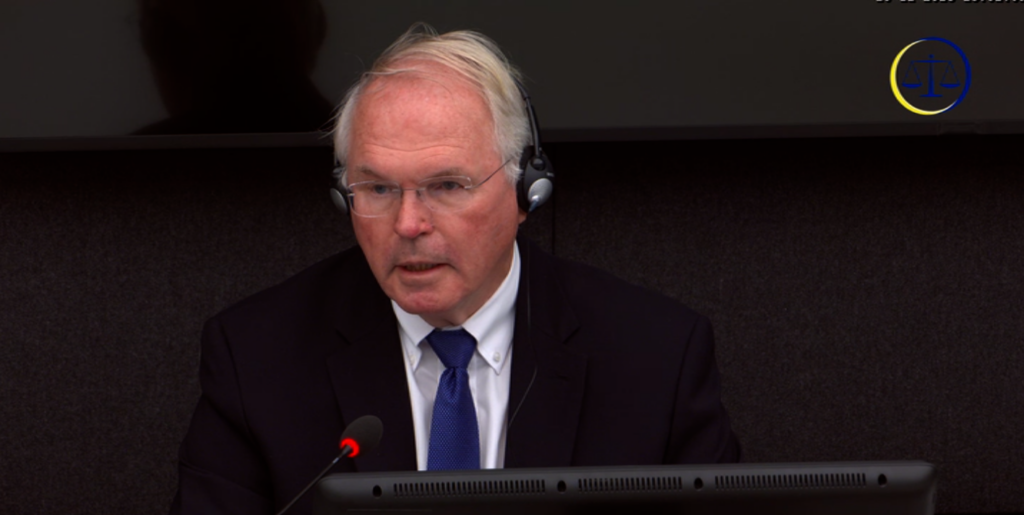
 Christopher Hill in court, November 10, 2025. Photo: Kosovo Specialist Chambers/ Livestream
Former US diplomat Christopher Hill tells court that Hashim Thaci only had a political position within the KLA – and did not seem to have any decision-making powers.
In his three day testimony, former US diplomat Christopher Hill told the war-crimes trial of former Kosovo President Hashim Thaci and three others in The Hague that Thaci was not a decision-maker in the Kosovo Liberation Army, KLA, but held a political position similar to that of a foreign minister. Meanwhile, the zone commanders lead the KLA General Staff.
On Tuesday, Hill told the court that, “I have no reason to believe that Mr Thaci was involved in such activities. I have no reason to believe, nor did I hear at the time, that he ordered such illegal activities.
“He couldn’t have been as powerful as he looked from the outside because ultimately every decision he made came as a result of many other prior consultations. So, my impression was that he was a reliable interlocutor but he wasn’t a decision-maker,” Hill, the fifth defence witness at the trial told the court on Wednesday.
Hill explained that his impression that Thaci did not have decision-making powers over the KLA was confirmed during the failed Rambouillet talks, where Thaci “told us that if we agreed [a deal with Serbia] without consulting, when he returned, they [KLA leaders] mould kill him.” Hill claimed that Thaci lacked the skills and formation to “move the KLA from within” but added that he understood the world very well, and “how important it was for the US to be on their side.”
Hill questioned how properly organised the different groups related to the KLA were. He told the court that he “did not share the same opinion as [US diplomat] Shaun [Byrnes, who had said that the KLA had an army structure at least from March 1999. “I think he exaggerated it,” Hill said, explaining that it was often difficult to find the relevant people in charge.
“There were many people who introduced themselves as speaking on behalf of the KLA. Our problem was that we did not have a confirmed point of contact with whom we could communicate for the future,” he said.
According to Hill, “the General Staff was more of a military body and consisted of commanders of the zones that had been united at one point, and the Political Directorate was more of an organisation that dealt with the outside world”.
He explained that Thaci, as “the political leader, is a person who plays a role of foreign minister and is not responsible for domestic affairs”. The first defence witness in the case, in September, James Rubin, also claimed that Thaci played more of a foreign minister role, with no real authority to make decisions.
US Ex-Diplomat Testifies for Defence in War Crimes Trial of Kosovo’s Thaci
He confirmed that Jakup Krasniqi was a spokesperson for KLA but believed he also was not an important decision making figure. He also told the court that he had met Rexhep Selimi in Likoc/Likovac, who was representing the so-called Drenica group.
Thaci, Krasniqi, Selimi and Kadri Veseli are accused of having individual and command responsibility for crimes committed against prisoners held at KLA detention facilities in Kosovo and neighbouring Albania, including 102 murders. The crimes were allegedly committed during and just after the war in 1998 and 1999.
The men’s lawyers claim that the defendants cannot be held accountable for the alleged crimes of lower-ranking fighters because the KLA was a grassroots movement, with decision-making coming from commanders on the ground.
Prosecutors insist the KLA leadership had effective control over those who carried out crimes.
The Kosovo Specialist Chambers are part of Kosovo’s justice system but are based in The Hague with an international staff to ensure fair proceedings after witness intimidation problems in previous KLA-related cases.
Many prosecution witnesses have testified behind closed doors to protect their identities due to fears of reprisals, but this has led to allegations of a lack of transparency.
Many ethnic Albanians and KLA supporters insist that the proceedings have been unfair to the defendants and have protested against them in the Hague, Pristina, and in Tirana, Albania.


13 November 2025 - 09:29
Justina Shiroka-Pula was inaugurated as Kosovo’s president after par...
In a last minute save, Kosovo MPs avoided another snap parliamentary e...

New election likely as political parties fail to agree on electing a p...
While protests demanding changes in the law regulating Kosovo’s Hagu...